
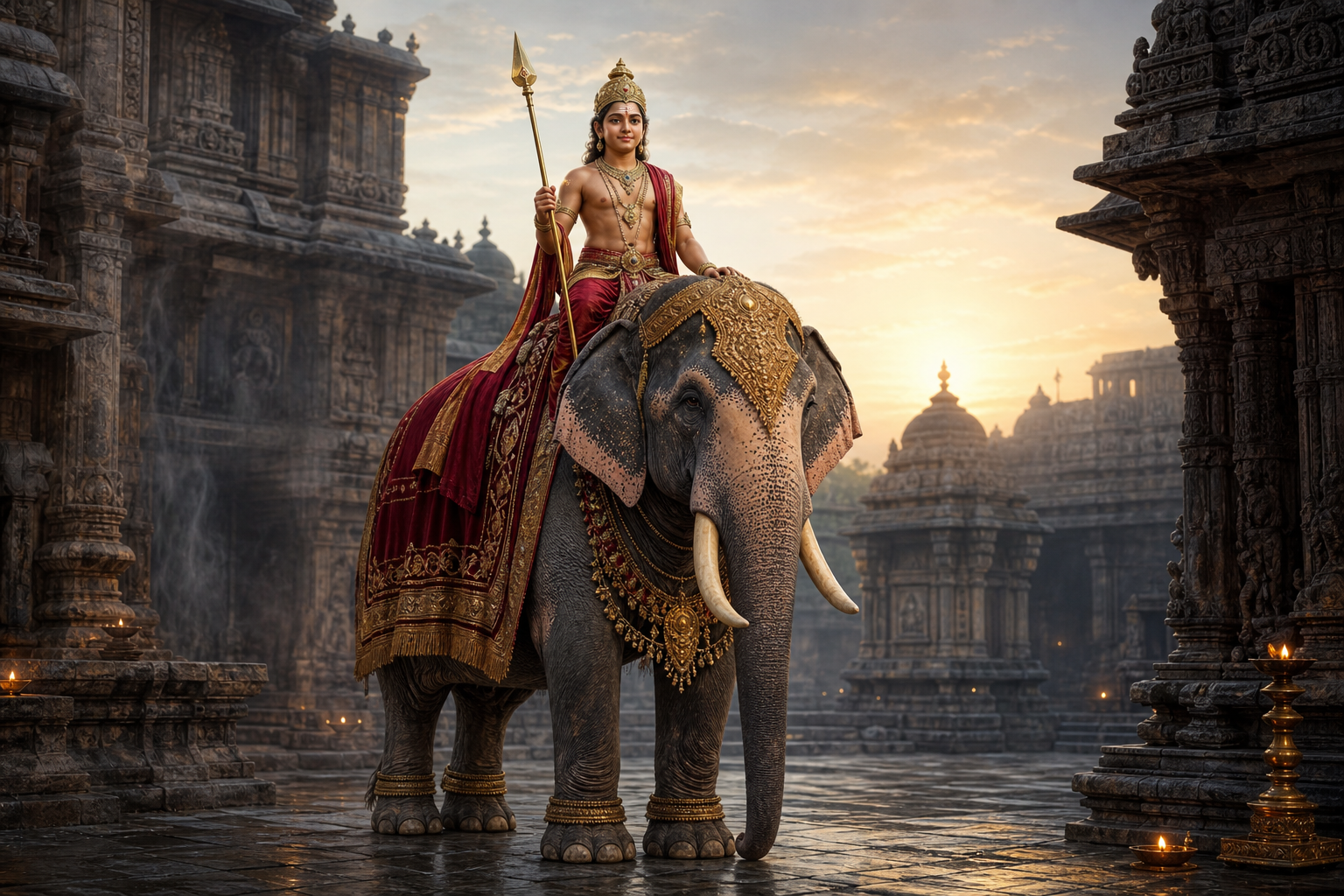
You recognize Murugan, but the animal beneath him is not the familiar peacock. It is an elephant. That difference is easy to dismiss as an artistic variation, yet it is the feature that tells you how this form should be approached.
This is Gajavahana Murugan: Murugan borne by an elephant. Once you distinguish identification from interpretation, you can recognize the form accurately, understand what the unusual mount brings into view, and respond without inventing a story that the image itself does not support.
Gajavahana names the mount, not a separate deity
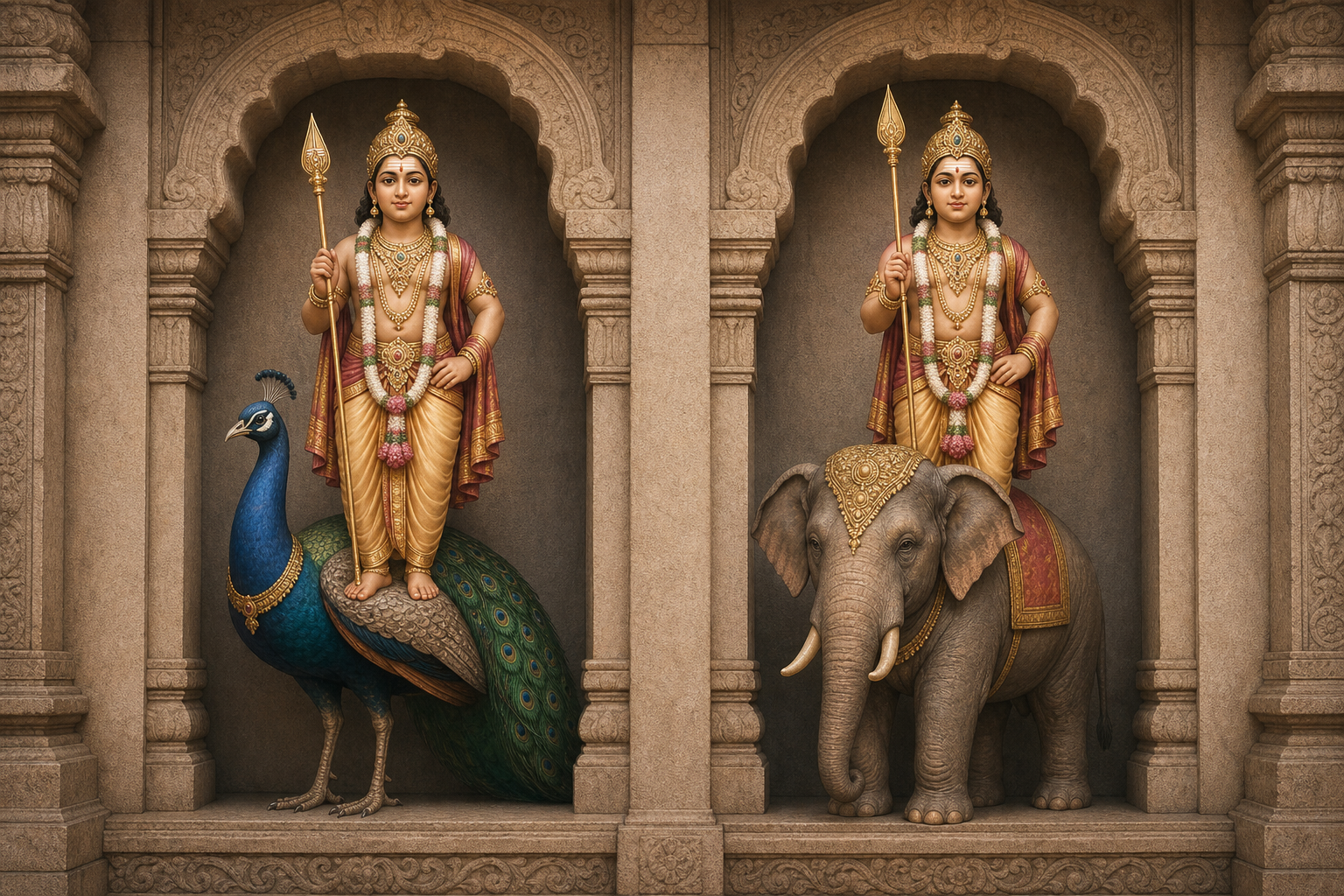
The Sanskrit components are direct: gaja means elephant, while vahana refers to a bearer, vehicle, or mount. Gajavahana Murugan is therefore the uncommon elephant-borne form of Murugan.
The name does not introduce another god beside Murugan. It identifies a particular manifestation of the deity known variously as Skanda, Kartikeya, Subrahmanya, Shanmukha, and Kumara. A tradition that addresses Murugan through 108 different names already gives you the right interpretive frame: one divine reality can be contemplated through many qualities, relationships, and forms.
A vahana participates in that disclosure. It is not merely the animal an artist happened to place under the deity. Changing the mount changes the visual emphasis, even when Murugan’s identity remains unchanged.
Rarity should not be confused with insignificance. It tells you that the form is encountered less often, not that it is an error, an inferior representation, or a different deity. When the elephant is clearly shown carrying Murugan, begin with the assumption that the choice is deliberate.
What the elephant brings into Murugan’s image
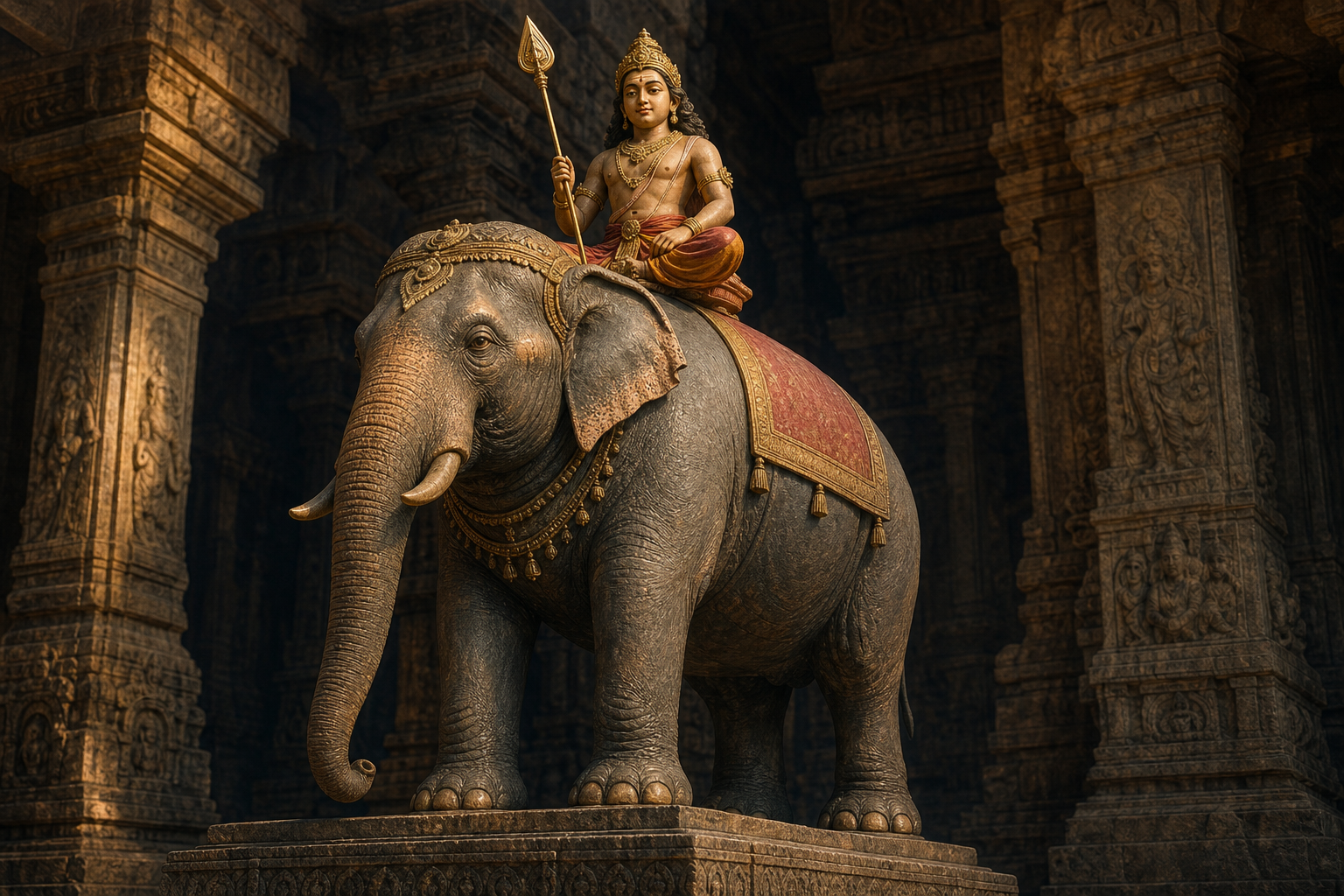
An elephant does not function as a one-word symbolic code. Its meaning has to be read through the whole composition and, where known, the tradition of the temple or community preserving it. Even so, the animal gives you several disciplined lines of contemplation.
- Strength brought under direction: The elephant possesses immense force, but in this image that force bears the divine commander. Power is not scattered or impulsive; it has purpose and command.
- Steadiness rather than haste: The animal’s mass and measured bearing can draw attention to resolve, endurance, and the ability to advance without agitation.
- Sovereign presence: Elephants carry associations of dignity and royal authority in the Bharatiya cultural imagination. As Murugan’s mount, the elephant can bring his commanding aspect to the foreground.
- Capacity disciplined by dharma: Great ability is not enough by itself. The image can be contemplated as a relationship between tremendous capacity and the consciousness that directs it rightly.
These are responsible readings, not a claim that every Gajavahana murti encodes an identical sentence. Iconography gives you a field of meaning; local tradition may make one part of that field more important than another.
The useful comparison with the peacock is therefore one of emphasis, not rank. The familiar peacock-mounted Murugan and the rarer elephant-mounted Murugan should not be set against each other as competing versions. Ask a narrower question: what becomes more visible when Murugan appears upon this particular animal? With the elephant, controlled strength, stability, dignity, and command become difficult to overlook.
How to identify Gajavahana Murugan without guessing
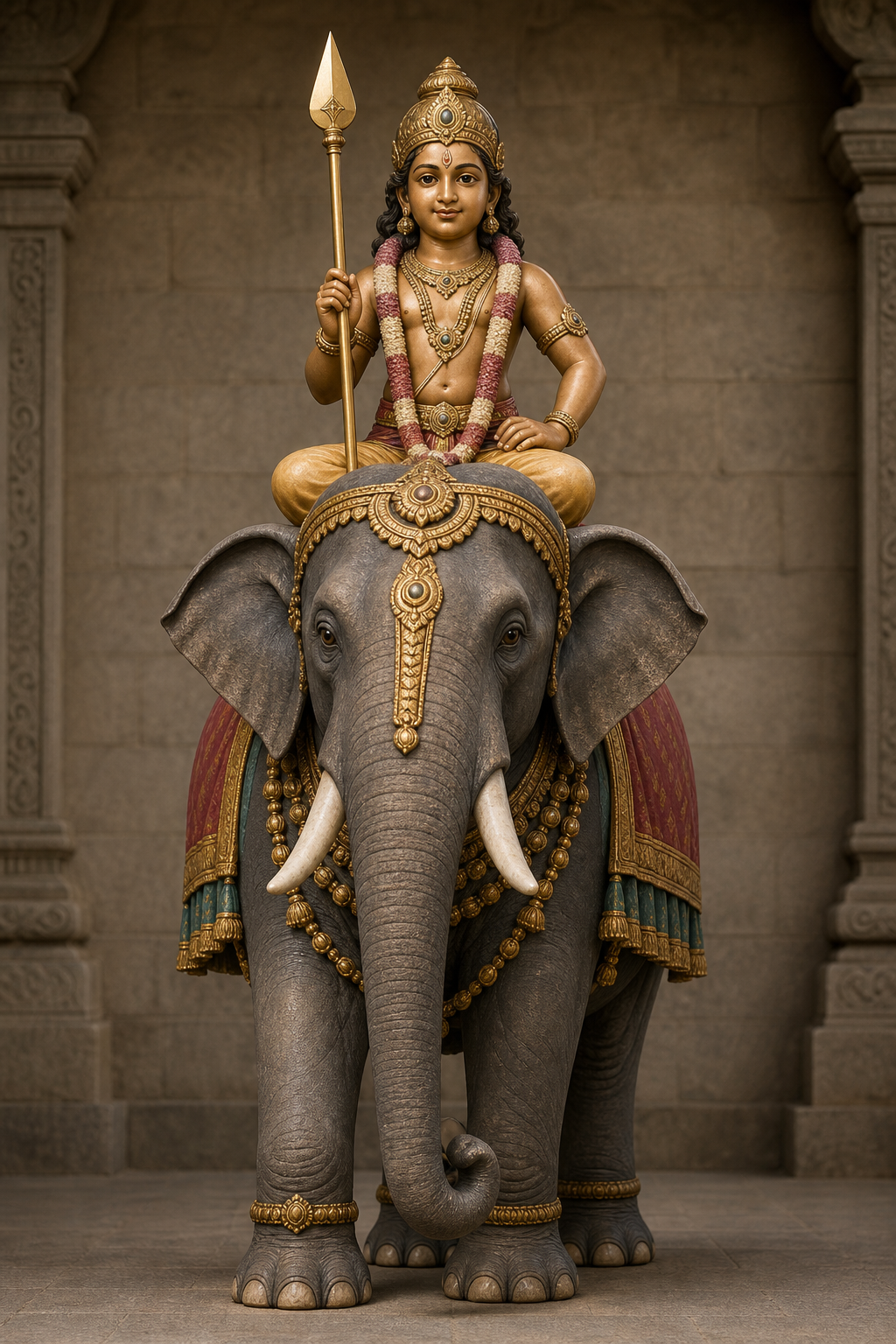
An elephant in sacred art does not automatically make an image Gajavahana Murugan. Identify the relationship between the deity and the animal before assigning the name.
- Find the principal deity first. Do not begin and end with the most conspicuous animal. Determine which figure occupies the central, worshipful position.
- Distinguish an elephant-headed deity from an elephant mount. Ganesha bears an elephant head. In Gajavahana Murugan, Murugan remains the principal anthropomorphic deity, while the elephant is a separate being beneath or beside him.
- Confirm that the elephant functions as the vahana. It should belong structurally to the deity’s presentation. A decorative elephant on a pillar, gateway, pedestal panel, or surrounding scene is not enough.
- Read the complete composition. A tightly cropped photograph may show the elephant while hiding the details that identify the deity. Seek a full view of the murti, panel, or procession image before reaching a conclusion.
- Look for corroborating names. A temple label, liturgical name, festival notice, or local explanation may identify the figure as Murugan, Skanda, Kartikeya, Subrahmanya, Shanmukha, Kumara, or Gajavahana.
- Give local tradition its proper weight. If the form belongs to a particular temple, ask the priest or knowledgeable custodian how that community names and understands it. A general symbolic reading should not erase a living local account.
This sequence prevents two common errors. The first is identifying a deity from one animal alone. The second is treating a personal symbolic association as though it were the temple’s established teaching.
If you are captioning a photograph, keep observation and interpretation separate. Write, for example, that the image shows Murugan upon an elephant and is identified as Gajavahana. Then describe controlled strength or sovereign bearing as meanings the form can evoke. That small distinction makes the caption both useful and honest.
A practical way to contemplate the form
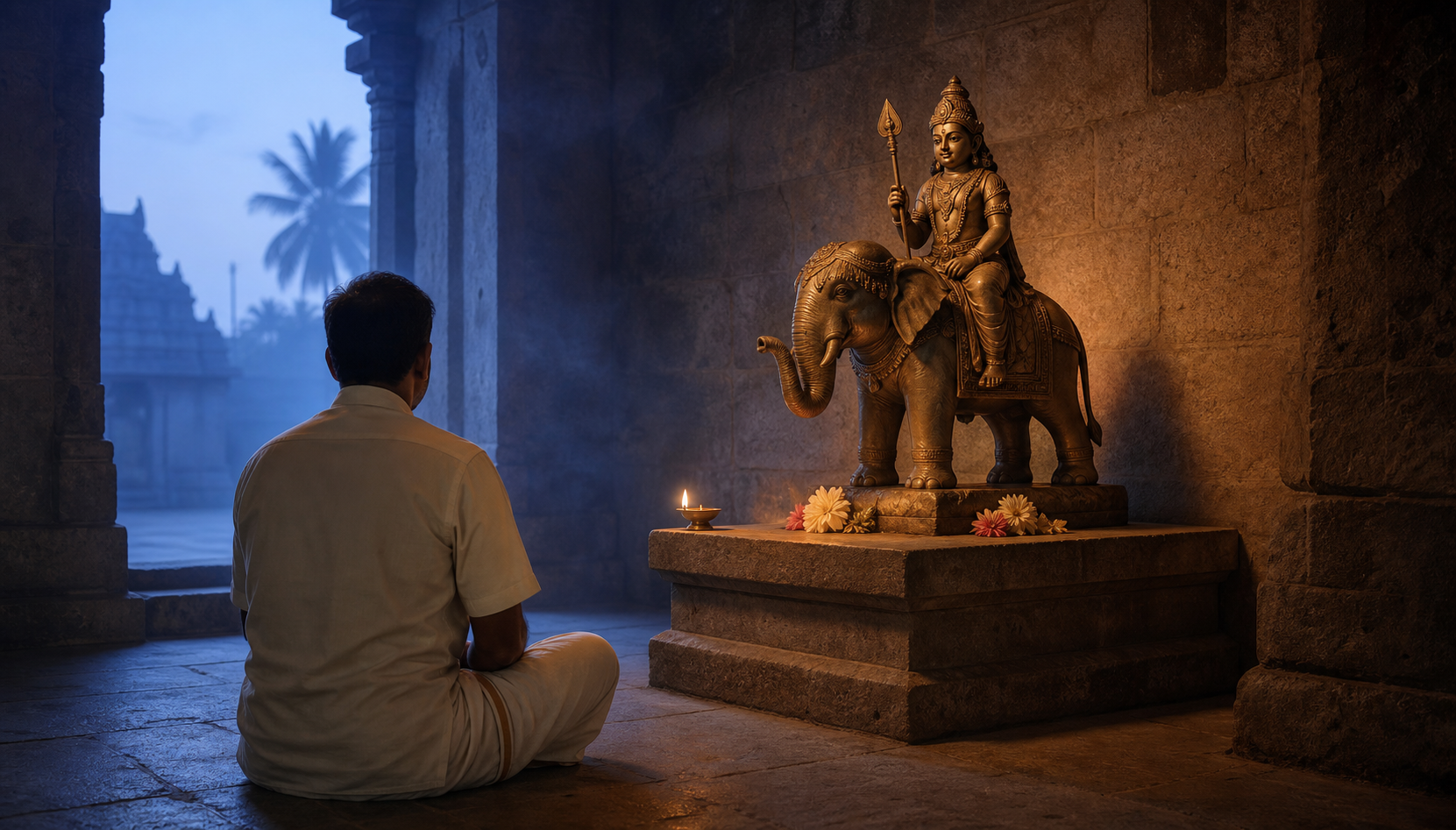
The change of vahana does not, by itself, supply a separate universal ritual. In a temple, follow the temple’s established procedure. If Gajavahana appears in a home image, book, or photograph, you do not need to invent a special mantra or abandon your customary way of approaching Murugan.
You can, however, let the form sharpen your attention. A simple contemplative practice is enough:
- Begin with Murugan. Address the deity by the name familiar to your tradition rather than making the unusual mount the sole object of attention.
- Notice the elephant deliberately. Observe its weight, composure, and relationship to the deity. Do not rush immediately to an abstract meaning.
- Select one quality that the form brings forward. Controlled strength, steady resolve, or dignified command is more useful than collecting a long list of symbolic claims.
- Connect the quality to one action. If you need strength, ask whether it is being directed well. If you need resolve, identify the duty that requires a steady next step rather than a dramatic gesture.
- Return to the living tradition when possible. If the image comes from a temple, learn its local name, worship context, and received explanation before presenting your own reading as authoritative.
This is a method of contemplation, not a newly prescribed rite. Its purpose is to move from visual recognition to ethical attention. The elephant matters because it can help you see a particular dimension of Murugan more clearly; it should not distract you from Murugan himself.
Key takeaways
- Gajavahana Murugan is Murugan borne by an elephant; the name identifies the vahana rather than a separate deity.
- The elephant distinguishes this form from Murugan’s more familiar peacock-mounted representation.
- The mount can emphasize directed strength, steadiness, dignity, and sovereign command, but these should be offered as interpretive possibilities rather than rigid definitions.
- Identify the principal deity and the animal’s structural role before naming an image Gajavahana.
- For a temple image, local names and inherited explanations take precedence over conclusions drawn from a cropped photograph or an isolated symbol.
- In devotion, let the unusual mount focus your attention on one quality you can put into practice; no invented ritual is required.
The next time you encounter Murugan on an elephant, pause before treating the mount as a curiosity. Confirm what you are seeing, ask what the elephant makes visible, and carry that insight into one act of steadier, better-directed strength.
References
