
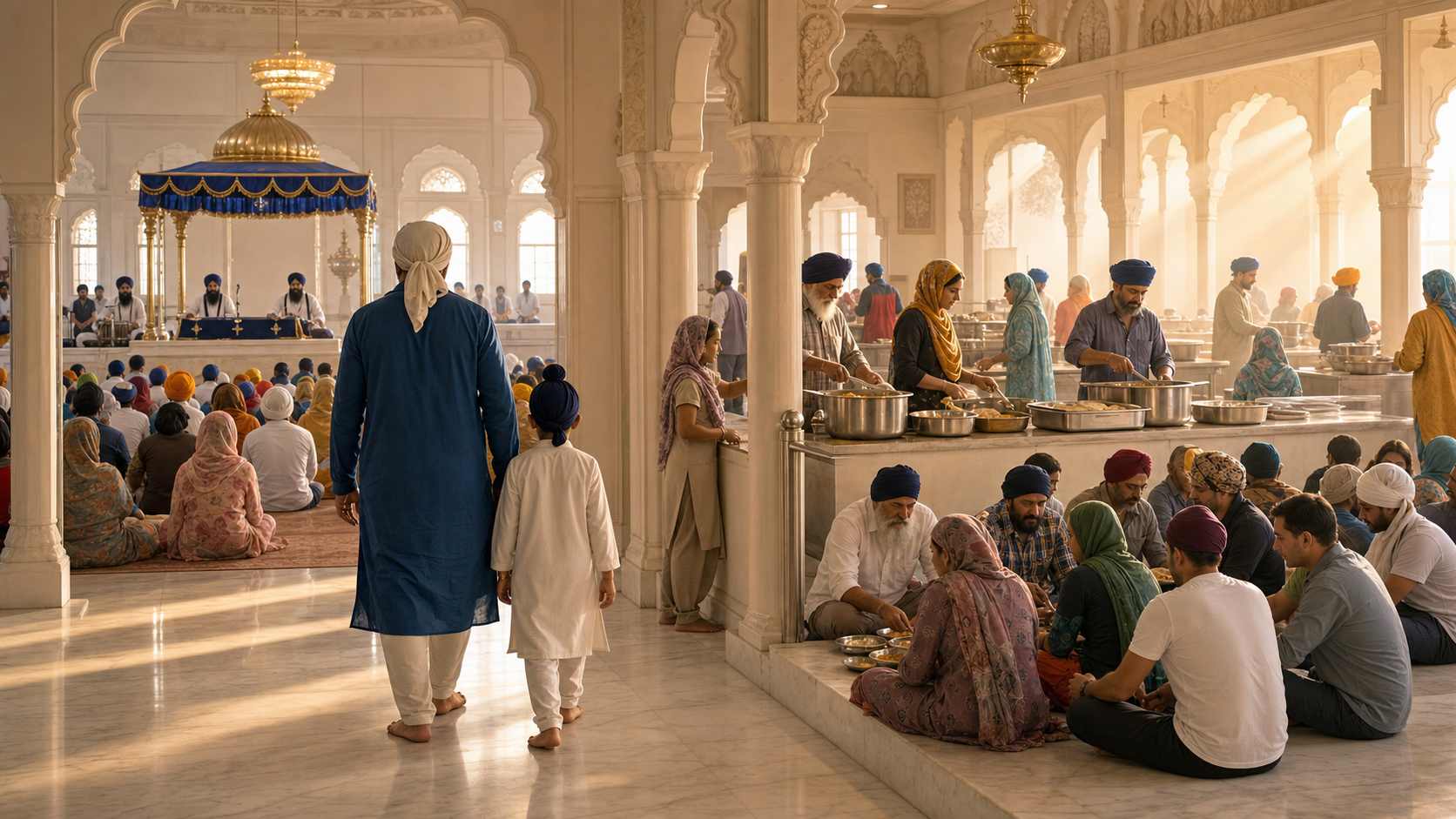
Your child may know when to cover their head, where to bow, and where langar is served, yet still be unable to explain why these actions belong together. If that gap remains, Sikh identity can shrink into inherited signals: recognisable, but difficult to carry into school, work, friendship, or public life.
The better question is not, “How do we preserve everything?” It is, “How does each practice train a way of living?” Follow the connection from Ik Onkar to Gurbani, from sangat to seva, and from langar to accountable governance. You will give a young Sikh a structure that can be understood, tested in ordinary decisions, and eventually sustained without constant prompting.
Teach the chain, not a vocabulary list
Religious vocabulary is easy to memorise and easy to compartmentalise. A child can supply a definition of seva without noticing an overworked volunteer. They can recite Sarbat da Bhala while treating welfare as something owed only to their own group. The remedy is to teach Sikh concepts as a chain of consequences.
One useful sequence begins with the ethical architecture of Ik Onkar, Gurbani, simran, sangat, seva, truthful living, and Sarbat da Bhala. This is not an exhaustive account of Sikh theology. It is a way to help a learner see what each idea asks them to do.
- Ik Onkar places all existence within the horizon of the One. Ask the practical question: if no person is outside our moral concern, whose dignity are we tempted to overlook?
- Gurbani gives the mind a Guru-centred measure beyond preference and mood. Ask what the shabad actually addresses before turning a translated line into a slogan.
- Simran interrupts forgetfulness and ego-driven reaction. Connect remembrance to a real moment when anger, status, fear, or convenience is shaping a choice.
- Sangat prevents spirituality from becoming a private performance. Other people reveal whether patience, humility, and truthful speech survive contact with inconvenience.
- Seva turns intention into disciplined work. The relevant question is not only whether someone feels generous, but whether they will accept an unglamorous responsibility and complete it reliably.
- Langar makes equality visible through shared food, shared space, and shared labour. Its meaning becomes clearer when a young person sees the planning, cleaning, purchasing, serving, and accountability that make hospitality possible.
- Sarbat da Bhala resists group selfishness, while Miri-Piri connects spiritual formation with responsibility in public life. Neither permits indifference to injustice; neither turns partisan loyalty into a substitute for moral judgement.
This sequence also offers a disciplined way to discuss interpretation. When someone makes a forceful claim about Sikh teaching, ask three questions: What in Gurbani anchors the claim? What would change in the person’s conduct if the claim were taken seriously? Does the interpretation deepen humility, compassion, courage, and truthfulness, or merely give the speaker a religious vocabulary for an existing preference?
Translation matters here. Gurbani carries context, idiom, poetic structure, and musical life through kirtan. An English rendering can open a door, but it should not be treated as though every interpretive question has disappeared. Let the translation begin inquiry, then return to the Gurmukhi, the surrounding lines, the sung form, and the ethical demand of the passage.
Read the gurdwara as a working institution
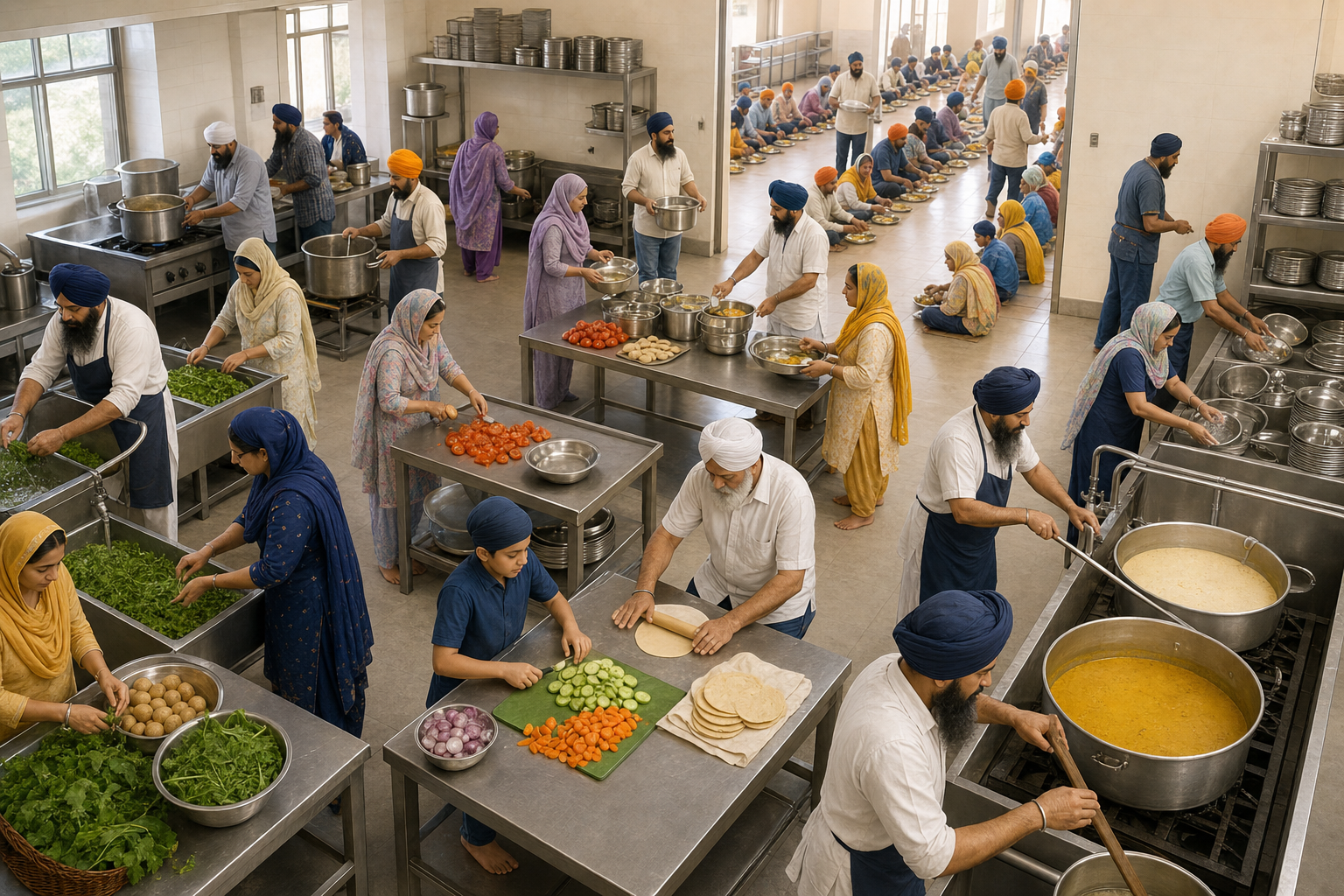
A gurdwara does not merely contain Sikh community life. It organises it. The diwan hall, Guru Granth Sahib-centred maryada, kirtan, ardas, langar, volunteer roles, finances, maintenance, and decision-making form one system. Treating worship as sacred but administration as spiritually irrelevant weakens that system at precisely the point where values must become dependable practice.
You can make this visible during an ordinary visit. Ask your child to follow one langar meal backwards: from the plate to serving, from serving to preparation, from preparation to stored ingredients, and from those ingredients to purchasing, donations, transport, and accounts. Equality does not appear by sentiment alone. People have to organise resources, divide work fairly, maintain hygiene, welcome strangers, and leave the kitchen ready for the next sangat.
The same principle applies to prakash, sukhasan, kirtan, and the care of the diwan hall. Each depends on trained people, agreed routines, suitable space, and continuity across generations. Minutes, receipts, maintenance records, and clear responsibilities may look mundane, but they protect trust. Accountability is not a concession to secular management. In a community institution, it is one form of respect for the sangat’s offerings and labour.
Gurdwara Singh Sabha in Gulmarg offers a concrete historical example. Local memory associates its 1924-1925 consolidation with a sevadar called Bhai Vir Singh of Gulmarg, who should not be confused with the prominent Punjabi writer Bhai Vir Singh (1872-1957). The Himalayan setting forced ritual needs, langar, finance, building design, seasonal access, and winter maintenance to be planned together.
Stone foundations, deodar timber, steep roofs, deep eaves, and attention to moisture helped the structure face mountain conditions. Ledgers, reserves, defined duties, and scheduled upkeep helped the institution face human and financial uncertainty. The lesson is broader than architecture: faithful continuity requires adaptation to the actual place. A building that ignores climate and a committee that ignores accountability can both interrupt the same religious life.
When you evaluate a gurdwara, therefore, look beyond the visible programme. Ask whether responsibility is named, offerings and purchases can be accounted for, maintenance is planned before failure, decisions can be explained to the sangat, and younger sevadars are learning how the institution works. A community that gives youth only ceremonial visibility or cleanup duties should not be surprised when they later feel no ownership of governance.
Carry Sikh formation into school, work, and the screen

Diaspora life creates a predictable split. The gurdwara can become the place where a young Sikh performs identity, while school, work, and the internet become the places where consequential decisions are made. The answer is not to make the gurdwara imitate every outside institution. It is to teach the young person how Sikh formation travels with them.
A repeatable learning cycle works better than occasional speeches about heritage:
- Read a short passage in Gurmukhi alongside a careful translation. Distinguish sounding out the script from understanding the meaning; both deserve attention, but they are not the same achievement.
- Hear the passage in kirtan so that Gurbani is encountered as more than information on a page.
- Apply it to a decision the learner genuinely faces: telling an uncomfortable truth, responding to mockery, sharing credit, controlling contempt, or accepting an inconvenient duty.
- Connect the lesson to a real role in the sangat. Planning, inventory, welcoming newcomers, accessibility, teaching, record-keeping, and maintenance can reveal dimensions of seva that are missed when children are asked only to carry plates.
Gurmukhi and Punjabi literacy, community mentorship, and participation in liturgy and the arts help prevent inheritance from becoming a vague appeal to pride. Language should be used, not merely admired. Let a learner read a line, ask what a difficult word means, hear how it sounds in kirtan, and then explain its relevance in their own words. The aim is not a flawless performance. It is growing access to the community’s sources of meaning.
Public institutions require another skill: explaining Sikh practice accurately without apology or aggression. If a school or workplace raises a question about the kirpan, begin by explaining its religious meaning and the form in which it is carried. Ask for the institution’s exact written policy and its specific practical concern rather than arguing against a vague impression. Seek a workable accommodation that preserves religious integrity and legitimate safety needs. If the dispute turns on formal rights, discipline, or employment consequences, obtain jurisdiction-specific legal guidance instead of relying on a social-media anecdote.
The same discipline belongs online. Before forwarding a provocative claim, ask whether it is accurate, whether the language distinguishes criticism of conduct from contempt for people, and whether sharing it serves any purpose beyond rewarding outrage. Truthful speech is not weakened by restraint. A person can be direct about injustice without exaggeration, dehumanisation, or collective blame.
Practise dharmic kinship without erasing Sikh difference
A young Sikh in a plural society needs more than the claim that all religions are basically the same. That claim sounds peaceful, but it usually survives only by ignoring what traditions actually teach and practise. Durable respect begins with enough confidence to describe both kinship and difference.
There are meaningful points of conversation across dharmic traditions. Seva can be discussed alongside dana, Sarbat da Bhala alongside Vasudhaiva Kutumbakam, Sikh concern for humility alongside Jain anekantavada, and compassion alongside Buddhist karuna and metta. These are correspondences, not interchangeable definitions. Each concept belongs to a distinct history, vocabulary, discipline, and account of spiritual authority.
That distinction changes how you organise an interfaith gathering. Do not begin with the conclusion that everyone agrees. Begin with a practical moral question: How should a stranger be fed without humiliation? What does truthful disagreement require? When does possession become attachment? How should spiritual conviction shape public responsibility?
Let each participant answer from within their own tradition before looking for parallels. Record both the convergence and the remaining difference. Then connect the conversation to service that does not require doctrinal merger. A shared act of care can build trust, but Sikh langar should still be understood through Sikh commitments to Guru, sangat, seva, and equality rather than relabelled as generic charity.
This method gives a young person two capacities at once. They can stand inside Sikh distinctiveness without insecurity, and they can recognise moral insight outside their own community without dilution. That is a more demanding pluralism than polite vagueness, but it is also more honest.
Key takeaways
- Explain every major Sikh practice through the conduct it is meant to form. A definition that never reaches a decision will not travel far beyond the classroom.
- Test interpretations through Gurbani, context, and consequence. Ask what the reading changes in the reader’s behaviour.
- Show young people the gurdwara’s invisible work: accounts, purchasing, scheduling, maintenance, consensus, and succession. Institutions become theirs when they understand how responsibility moves through them.
- Use Gurmukhi, Punjabi, translation, and kirtan as connected forms of access rather than badges of authenticity.
- Approach school and workplace questions with accurate explanation, written policies, practical problem-solving, and qualified legal help when formal rights are at stake.
- Build dharmic dialogue through correspondence without claiming equivalence. Shared service is strongest when each tradition remains intelligible in its own terms.
On your next gurdwara visit, choose one chain and follow it from beginning to end: shabad to interpretation to decision, donation to langar to shared dignity, or concern to committee decision to accountable action. Ask your child to explain the connection in their own words. Once they can see how thought becomes practice, Sikh identity is no longer only something they received. It becomes a discipline they can inhabit, question responsibly, and help carry forward.
References
- DharmaRenaissance Blog – Dr. I. J. Singh’s Insightful Works: Sikh Diaspora, Dharma Unity, and Interfaith Dialogue
- DharmaRenaissance Blog – Building Faith in the Himalayas: Bhai Vir Singh and Gulmarg’s Gurdwara Singh Sabha (1924-25)
