
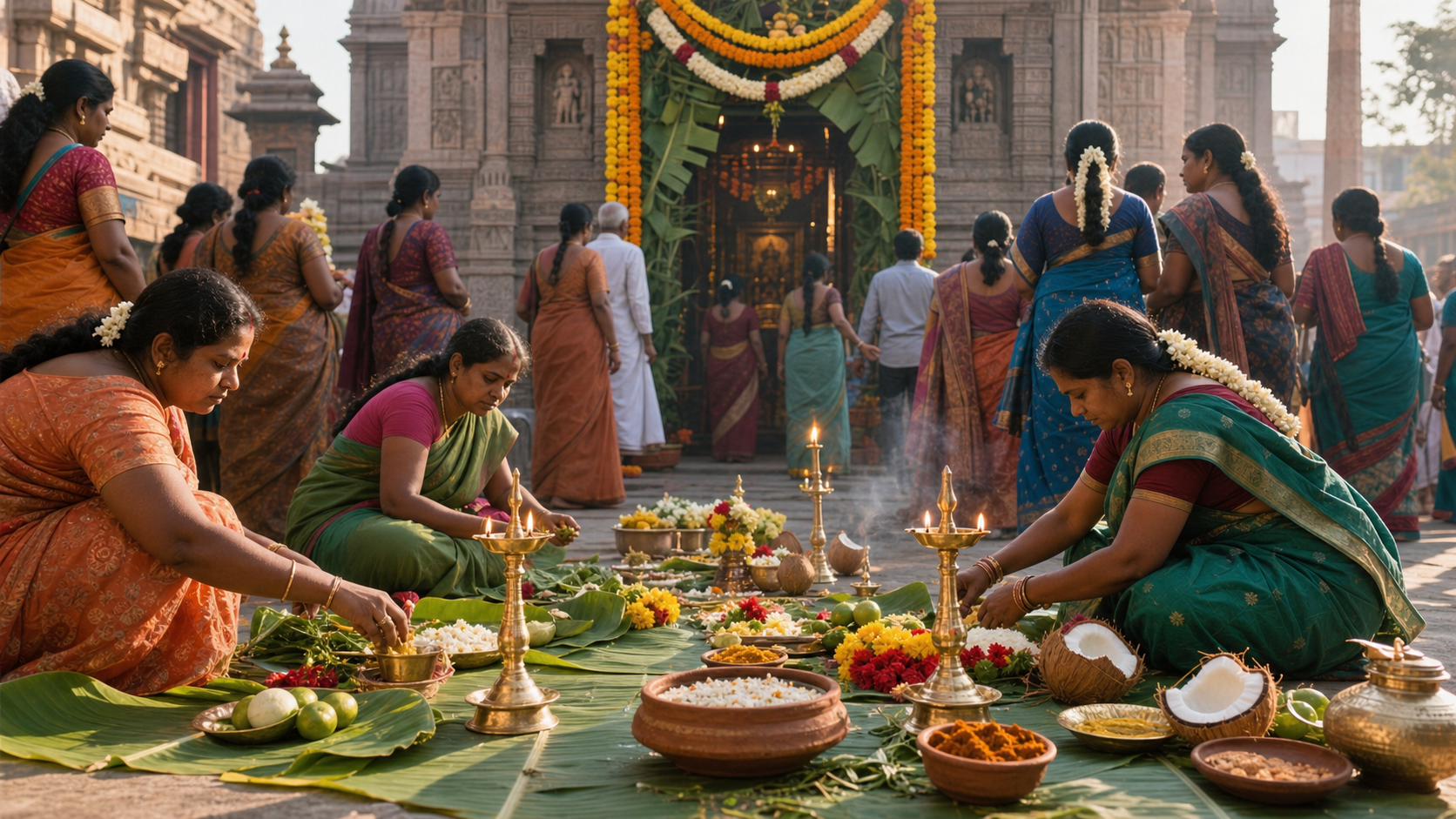
If you are deciding how to observe Aadi, do not treat the calendar, Shakti puja, temple visit, and festival meal as four unrelated choices. In Tamil practice, they form one devotional movement: sacred time leads to worship, worship leads to offering, and offering becomes shared nourishment.
You do not need to reproduce every rite to participate meaningfully. You need a rhythm you can sustain, a clear distinction between household and temple practice, and enough attention to local custom that devotion does not become a collection of disconnected rituals.
Read Aadi as a rhythm, not a single festival
Aadi is the fourth month of the Tamil solar calendar, generally extending from mid-July to mid-August and beginning when the Sun enters Kataka, or Cancer. Its place within the monsoon and agricultural cycle matters. The month directs attention toward protection, rainfall, fertility, health, household stability, and gratitude for the forces that sustain life.
Amman worship gives this seasonal concern a devotional form. Mariamman, Kaliamman, Kamakshi, Meenakshi, Visalakshi, Unnamulai Amman, and other manifestations of the Goddess are approached as Shakti: the active power that manifests, nurtures, protects, and restores. The word Amman, meaning Mother, is therefore more than an affectionate title. It identifies the relationship at the heart of the season.
Aadi Velli, the Fridays of Aadi, forms the best-known weekly cadence. Friday is associated with Shukra and with abundance, beauty, and harmony, while Aadi supplies the seasonal focus on the Goddess. Tuesdays, or Aadi Sevvai, also draw substantial Amman worship in many communities. Neither day should be treated as a universal rule overriding family or temple tradition.
For the five-Friday Aadi cycle in 2026, the dates are:
| Date | Place in the 2026 cycle | Planning note |
|---|---|---|
| 17 July 2026 | First Aadi Velli | Frequently given added importance in household custom |
| 24 July 2026 | Second Aadi Velli | Continue the same vrata or simple home routine |
| 31 July 2026 | Third Aadi Velli | Also regarded as especially auspicious in many traditions |
| 7 August 2026 | Fourth Aadi Velli | Confirm local temple programs before travelling |
| 14 August 2026 | Fifth Aadi Velli and Aadi Pooram | Expect distinct Pooram observances and larger gatherings at some temples |
The first and third Fridays receive extra emphasis in many families, but this is a living custom rather than a competition among dates. If work, health, caregiving, or distance prevents you from observing all five, follow the practice inherited in your household or choose the day supported by your local temple. A single attentive observance is more coherent than five hurried ones.
The other Aadi festivals should remain distinct in your mind. Aadi Perukku, observed on the eighteenth day of Aadi, venerates rivers, especially the Kaveri, and acknowledges agrarian abundance. Aadi Pooram is associated with Andal in Tamil Vaishnava temples and with Amman-centered rites in many Shaiva temples. Aadi Amavasai turns toward ancestral obligations through pitru tarpanam, while Aadi Krithigai honors Murugan. Together they create a month of concentrated sacred attention, but they do not all ask you to perform the same ritual.
Build a home observance you can actually sustain
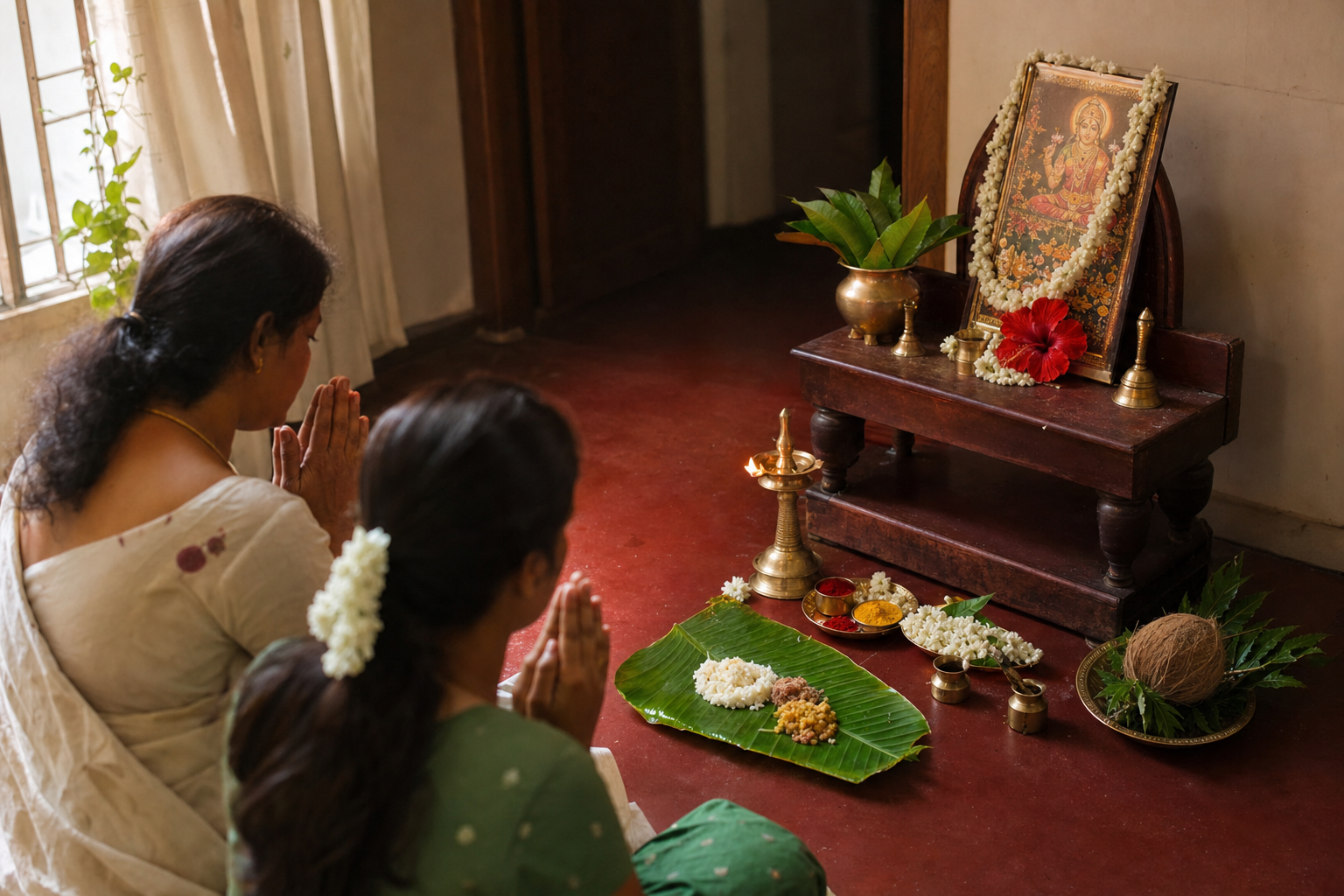
A household Aadi Velli puja does not need the scale or ritual complexity of a temple. Temple worship follows Agamic procedure, priestly responsibility, and an established institutional calendar. Home worship works best when it is reverent, intelligible, and proportionate to your time and knowledge.
A practical sequence is:
- Clean the prayer space and draw a kolam before beginning. The physical preparation marks a change from ordinary household activity to worship.
- If a kalasam belongs to your family practice, establish it with water, mango leaves, and a coconut. If you have never been taught this observance, it is reasonable to keep the altar simple rather than improvising a formal installation.
- Decorate the Goddess with red or yellow flowers. Offer turmeric and kumkum; bangles or a saree may be offered where that custom is established.
- Light a ghee lamp or the lamps normally used in your home. Many devotees favor evening sandhya, but local timing, household safety, and inherited practice should guide you. Place every flame on a stable, heat-safe surface and do not leave it unattended.
- Choose one recitation you can perform attentively. Possibilities include Lalita Sahasranama, passages from the Devi Mahatmyam, a familiar Devi mantra, or a 108-name kumkum archana. A short prayer understood and completed with care is preferable to a long recitation assembled without guidance.
- Offer fruit, sundal, payasam, sakkarai pongal, or another appropriate preparation as naivedyam. Let the offering remain untouched until the prayer is complete, then share it as prasadam.
- Conclude by seeking the blessings of elders where possible and by deciding how the observance will extend into service, whether through annadanam, assistance to a temple, or care for someone in your community.
Partial fasting, protective threads, Sumangali puja, Kanya puja, lemon lamps, and vow-based disciplines also appear in Aadi practice. They are not items on a mandatory checklist. Some depend on family lineage, local understanding, personal capacity, or temple sanction. If you are new to Aadi worship, begin with a lamp, flowers, one prayer, and food you can offer properly. Learn additional rites from elders or qualified temple practitioners rather than combining every visible custom into one ceremony.
The same principle applies in the diaspora. Locally available flowers, a reusable lamp, a modest homemade naivedyam, and coordinated family prayer can preserve continuity without pretending that every material must be imported from Tamil Nadu. Authenticity lies in the relationship between intention, discipline, and inherited form, not in the quantity of objects on the altar.
Understand what the food is doing in the ritual
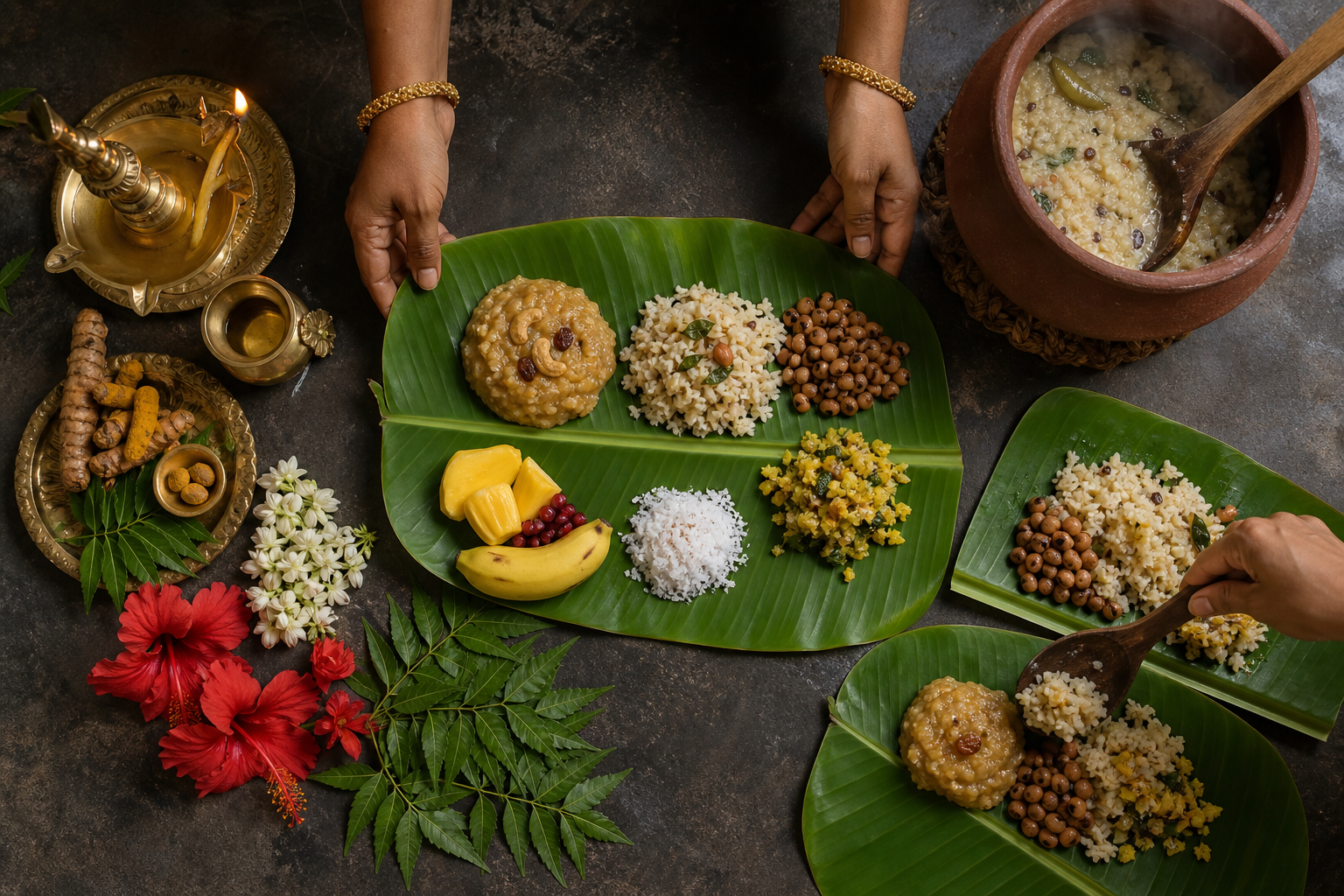
Temple foodways become easier to understand when you notice the sequence. Food is first prepared under the rules appropriate to the shrine or household. It is presented as naivedyam. Once offered, it is received as prasadam. When prepared and distributed to the wider community, it also becomes annadanam, the dharmic act of feeding. The same bowl of food can therefore carry culinary, ritual, and social meaning without those meanings being interchangeable.
Aadi offerings express that sequence in several forms:
- Maavilakku: Rice flour and jaggery are shaped into a lamp and lit for Amman. Food and flame meet in a single offering, making it inappropriate to describe maavilakku merely as a seasonal sweet.
- Sakkarai pongal and payasam: Their sweetness expresses abundance and auspiciousness, and they can be prepared in manageable household quantities.
- Sundal: A simple pulse preparation offers a practical choice when you want naivedyam that can be portioned and shared without an elaborate kitchen.
- Aadi koozh: A cooling millet porridge carries the strongest connection to seasonal nourishment, large-scale temple service, and the agrarian setting of the month.
Aadi koozh is commonly made with kambu, or pearl millet, although ragi and millet-rice combinations belong to some regional practices. The grain is soaked and cooked until smooth, cooled, and allowed to ferment gently, often overnight. On the day of service, it is thinned with water and mor, or buttermilk, and salted to produce a mildly sour porridge that may be drinkable or thick enough to ladle.
Oorugai and puli kuzhambu are customary accompaniments. Pickle supplies salt and spice; tamarind-based puli kuzhambu contributes an assertive sourness that works with the milder lactic tang of the porridge. These sides support the central food rather than turning prasadam into an elaborate restaurant meal.
There is no single pan-Tamil recipe to enforce. Some temples serve kambu koozh and others ragi koozh. Texture, salt, sourness, tempering, and accompaniments vary by district and shrine. Onions and garlic may be excluded from naivedyam, while certain communities add mustard seeds and curry leaves only after the offering. If you are cooking for a temple, ask what that temple requires before buying ingredients or seasoning the batch.
The seasonal logic is concrete. Millets provide fiber and nutrients that include iron, magnesium, and B vitamins. Gentle fermentation can improve the availability of some micronutrients, while buttermilk makes the porridge fluid and satisfying in humid weather. This helps explain why koozh endured as a monsoon-season food, but sacred food should not be turned into a medical claim. It is nourishment and prasadam, not a substitute for treatment or an individual dietary plan.
Fermented food also requires more care than a symbolic offering of fruit. At home or in a volunteer kitchen, use clean vessels and safe water, cook the grain fully, cool it properly, and distribute the finished porridge promptly. Do not assume that an overnight timetable produces the same result in every kitchen; warmth affects fermentation. If a batch appears or smells unsafe, reverence does not require serving it.
If you are receiving koozh, take only what you can finish. Use the right hand where that is the local etiquette, keep the service line moving, and avoid waste. If you cannot consume dairy, ask quietly whether a portion is available before buttermilk is mixed in; this may not be possible once a large temple batch has been completed. A smaller portion is better than accepting food you know you cannot eat.
The community kitchen is as important as the recipe. Volunteers soak grain, tend large vessels, stir, thin, season, portion, and manage queues. Women often carry much of this knowledge across generations through practice rather than written measurement. When you volunteer, arrive early enough to receive instructions and take the assigned role seriously. Bringing an unrequested variation to a mass preparation creates work for everyone and can compromise the shrine’s food rules.
Let each temple express Aadi in its own grammar
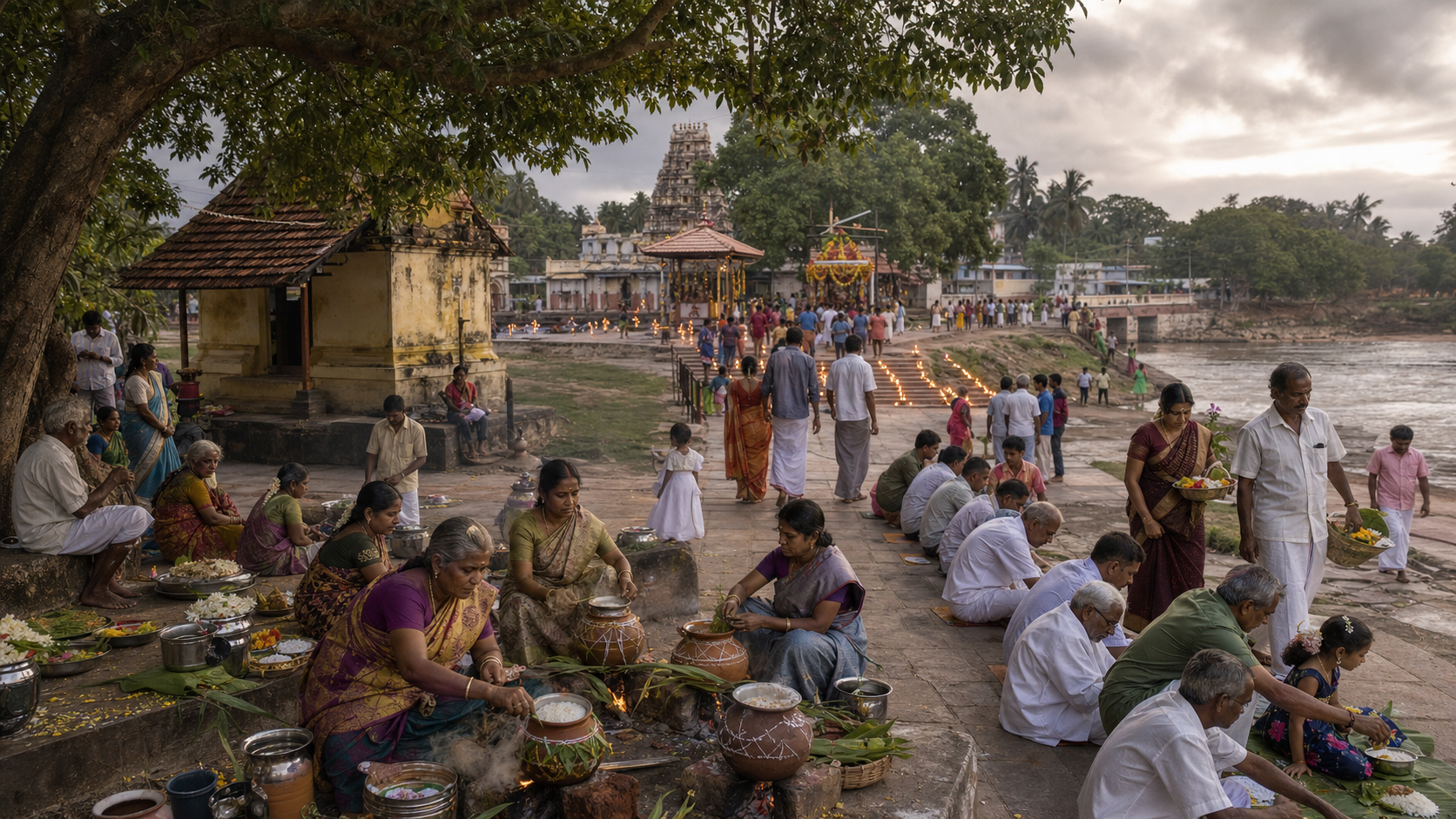
Aadi’s unity does not depend on making every temple identical. The month can foreground Mariamman at a village shrine, Andal at a Vishnu temple, and Unnamulai Amman within the great Shaiva complex at Thiruvannamalai. You understand Tamil dharma more accurately when you can recognize the shared reverence for divine feminine power without erasing each sampradaya’s theology and liturgy.
Thiruvannamalai makes the distinction especially visible. Arunachaleswarar Temple is revered as the Agni Sthala among the Pancha Bhoota temples, with Arunachala representing divine fire. During its ten-day Aadi Pooram Brahmotsavam, attention intensifies around Sri Unnamulai Amman and culminates on Aadi Pooram, which falls on 14 August in 2026.
The festival cycle may include Ankurarpanam, the ceremonial sowing of seeds; Dhwajarohanam, the raising of the festival flag; daily alankarams; homams and abhishekams; processions on selected vahanams; and Dhwajavarohanam after completion. The culminating worship of Unnamulai Amman can include special abhishekam, adornment, and deepa offerings under the temple’s Agamic discipline. Valaikappu, a bangle rite associated with auspiciousness and women’s welfare, appears in Aadi Pooram traditions, but its precise form must be confirmed from the temple’s annual program.
Elsewhere, the same Pooram nakshatra is celebrated as Andal’s Thirunakshatram in the Tamil Vaishnava tradition. You do not need to choose one expression as the only authentic meaning of Aadi Pooram. You do need to know which temple you are entering, which deity stands at the center of its celebration, and which ritual authority governs what happens there.
Use that knowledge when planning a visit:
- Confirm the temple’s own daily schedule, darshan arrangements, procession times, and ticketed sevas close to the festival. A general panchang date cannot tell you the full institutional program.
- Consult a regional panchang for local nakshatra and observance timing. Temple practice may account for sunrise, local latitude, and its established timekeeping convention.
- Arrive early if you want a quieter darshan. If the procession matters to you, consider returning in the evening rather than remaining in a crowded queue all day.
- Carry only essential items, follow customary dress and queue discipline, and observe restrictions on photography and sanctum access.
- Obtain ritual offerings through authorized counters where required. This helps preserve conformity with temple procedure and supports orderly administration.
- Do not assume that a popular practice is formally part of the festival. Girivalam around Arunachala, for example, can accompany a pilgrim’s visit as personal sadhana, but it is not a structural rite of the Aadi Pooram Brahmotsavam.
Food participation deserves the same respect. Receive the prasadam being served rather than demanding the version familiar from another district. If you sponsor or join annadanam, coordinate with the organizers before bringing vessels, ingredients, or disposable cups. Reusable steel tumblers and biodegradable leaf cups reduce waste, while locally used millets connect service to agricultural knowledge and regional biodiversity.
This feeding ethic also lets you notice a broader dharmic kinship. Hindu annadanam, Sikh langar, Buddhist dana, and Jain aahaar-daana are not identical institutions, but each gives moral weight to nourishing others with dignity. Aadi koozh expresses that civilizational value through a distinctly Tamil grain, climate, temple calendar, and form of Shakti worship.
Key takeaways
- Treat Aadi as a connected calendar of distinct observances, not as one generic Goddess festival.
- For 2026, Aadi Velli falls on 17, 24, and 31 July and 7 and 14 August; Aadi Pooram also falls on 14 August.
- At home, begin with a clean altar, lamp, flowers, one suitable recitation, and a manageable naivedyam. Add specialized rites only when you understand their lineage and requirements.
- Distinguish naivedyam, prasadam, and annadanam. The movement from offering to shared food is part of the ritual, not an afterthought.
- Expect koozh recipes and serving customs to differ by temple and district. Confirm the grain, seasoning, dairy use, and purity rules before cooking for others.
- Let temple authorities determine temple liturgy. A panchang gives the sacred date; the shrine’s own announcement gives the program you can actually attend.
- Receive only what you can consume, keep festival routes clean, and make ecological restraint part of your offering.
Before your next Aadi observance, make three decisions: which date you will keep, whether your center of practice will be home or temple, and what food you can prepare or help distribute responsibly. Then confirm the local custom and do that smaller plan well. In Aadi, continuity is built through repeated acts of attention: a lamp tended safely, a prayer completed without haste, and a portion of food offered and shared without waste.
References
- DharmaRenaissance Blog — Aadi Velli 2026: Auspicious Fridays in Tamil Nadu – Dates, Rituals, and Shakti Puja Guide
- DharmaRenaissance Blog — Thiruvannamalai Aadi Pooram 2026: Awe-Inspiring 10-Day Brahmotsavam Dates, Rituals, and Travel Insights
- DharmaRenaissance Blog — Aadi Month Koozh in Amman Temples: Sacred Millet Prasadam, Ritual Rhythm, and Community Care
