
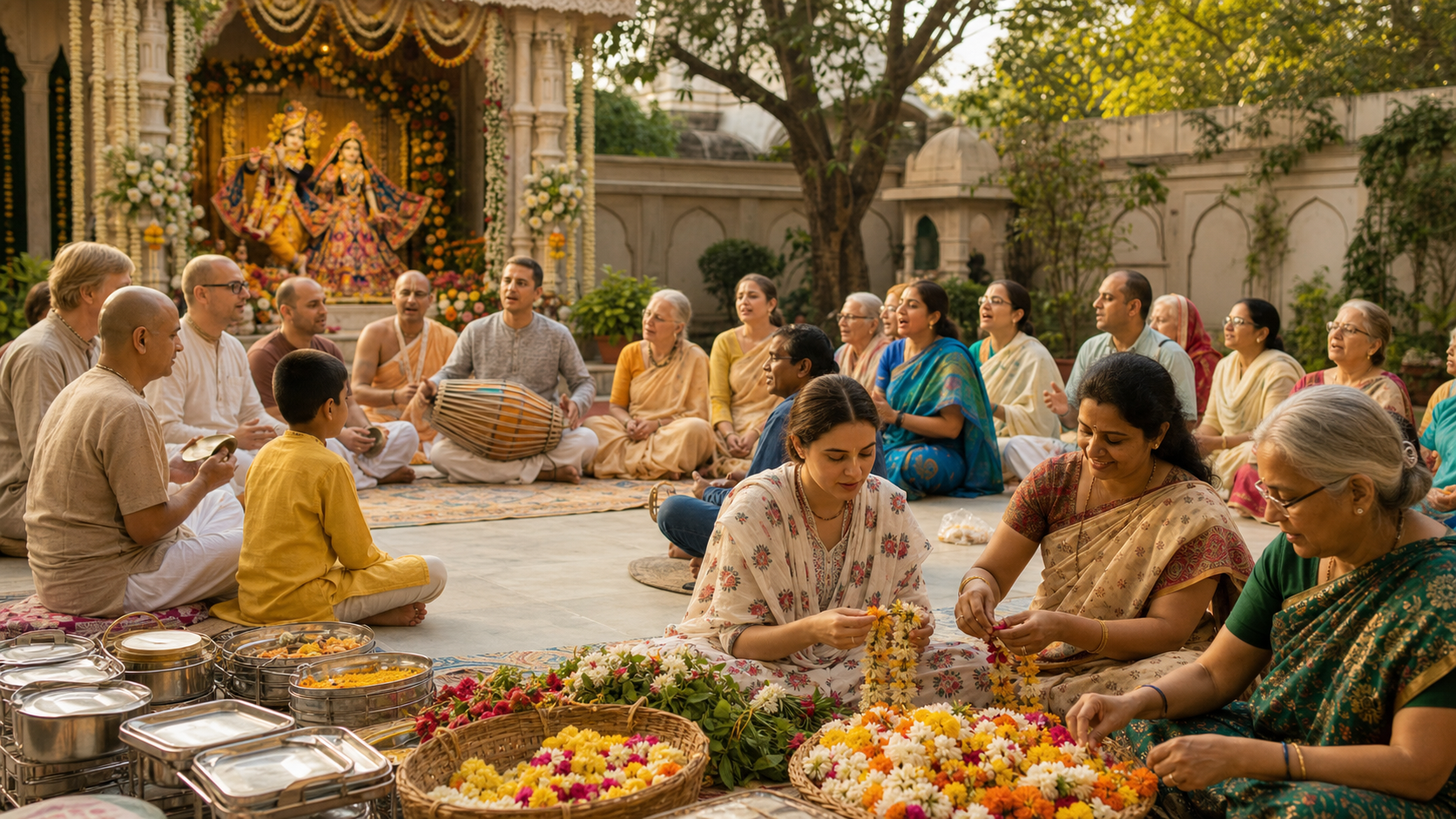
You may have met Gaudiya Vaishnavism through a crowded Ratha Yatra, a Hare Krishna kirtan, or a plate of prasadam. The harder question comes after the music stops: how do you take part without treating a living tradition as a spectacle?
Start by looking for the relationship between the practices. Festival, sacred song, and community are not separate offerings on a menu. They form one devotional movement: hear about Krishna, answer with the holy name, remember his form and lila, serve those gathered around him, and carry that service into ordinary life. Once you can see that movement, you know where to enter and how to continue.
Key takeaways
- Listen before trying to lead. Gaudiya kirtan begins with attentive hearing and becomes a shared response, not a display of musical skill.
- Choose one defined seva before a festival begins. Welcoming, serving prasadam, cleaning, guiding visitors, or supporting a kirtan gives you a place within the offering.
- Treat darshan and prasadam as forms of relationship. You are receiving sacred presence and grace, not merely viewing an image or collecting free food.
- Carry one name, image, or verse from the celebration into your regular japa, reading, or home worship. That is how a festival changes the days that follow it.
- In a community crisis, verify information, protect privacy, avoid medical or spiritual speculation, and turn concern into practical service.
Devotion becomes durable when hearing leads to service
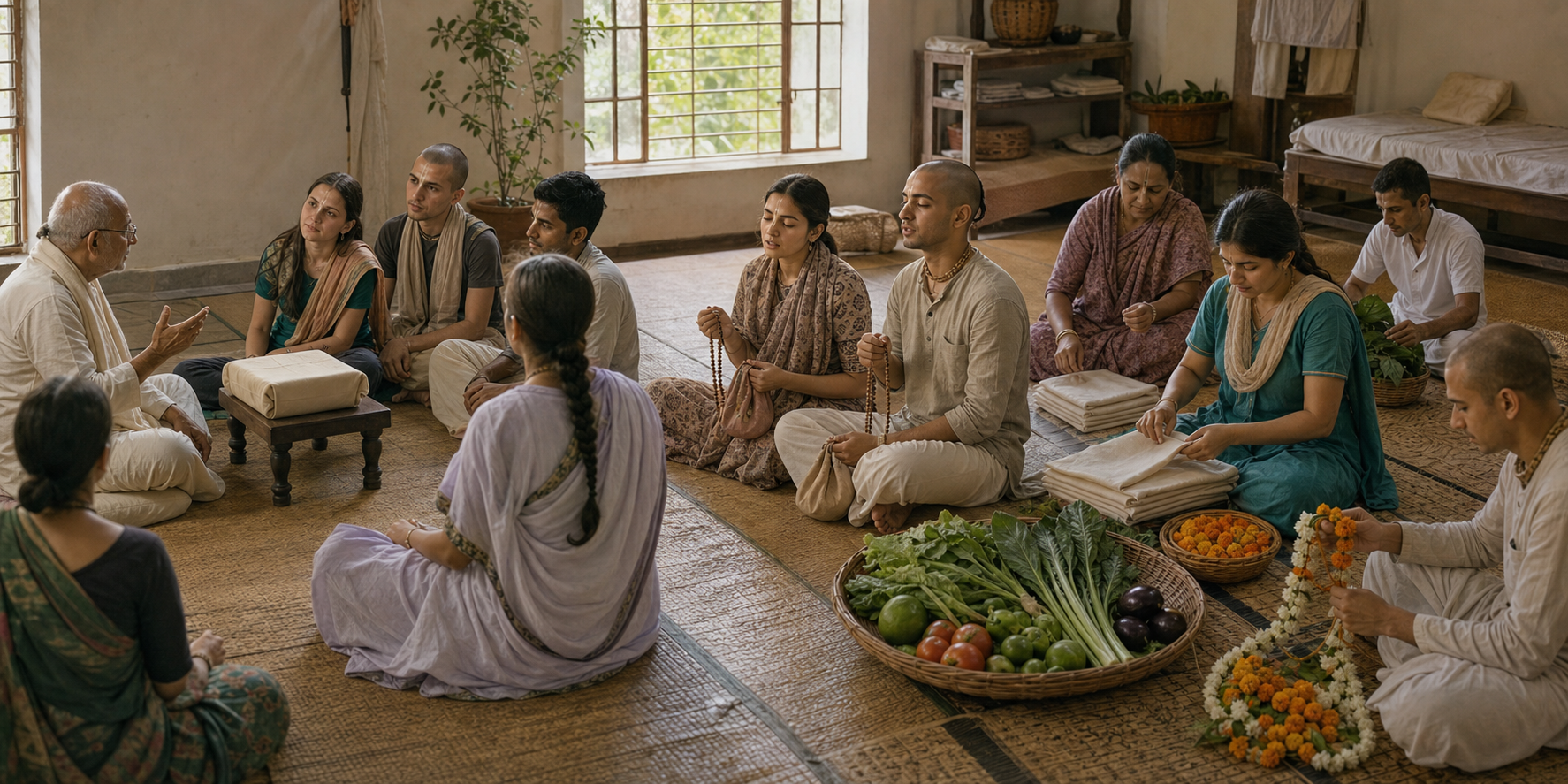
Gaudiya Vaishnava devotion is directed toward Bhagavan Sri Krishna as a person to be known, remembered, loved, and served. This is why names, narratives, sacred images, food offerings, music, and relationships all matter. They are not decorations around an abstract philosophy. They are ways of approaching and answering the Divine Person.
The tradition describes the relation between Krishna and his energies through acintya-bheda-abheda: inconceivable simultaneous difference and non-difference. The individual soul is neither an isolated rival to Krishna nor simply erased into an undifferentiated whole. The practical consequence is important. Bhakti joins you to Krishna without making love, personality, responsibility, or service meaningless.
A healthy devotional rhythm usually contains several mutually reinforcing movements:
- Sravana, or hearing: Listen to the holy name, teachings, and accounts of Krishna’s lila closely enough to understand what is being sung. If the language is unfamiliar, read a reliable meaning beforehand instead of treating incomprehension as a sign of reverence.
- Kirtana, or devotional utterance: Respond with the name or teaching you have heard. In congregational kirtan, follow the leader’s phrase and answer with the assembly. Volume is not the measure of participation; attention is.
- Smarana, or remembrance: Let a name, form, quality, or episode remain with you when the music ends. Without remembrance, a powerful gathering can become only a passing emotional experience.
- Seva, or service: Give devotion a practical consequence. Take responsibility for a task, keep your promise, care for the shared space, and make it easier for another person to approach Krishna.
- Prasada, or grace received: Accept sanctified food with gratitude and avoid waste. Sharing prasadam extends worship beyond the altar while making hospitality part of spiritual practice.
These are not rungs on a ladder that you leave behind one by one. They form a loop. Hearing gives meaning to chanting. Chanting feeds remembrance. Remembrance motivates service. Service makes you more capable of hearing without demanding that every gathering satisfy your preferences.
You can test your own balance with direct questions. Are you singing words whose meaning you never examine? Are you studying so much that you never join the congregation’s response? Does your spiritual emotion make you more dependable, or only more expressive? Do people encounter greater patience and honesty from you after the festival? The answers reveal where your practice needs attention.
Enter a festival as a participant, not a consumer
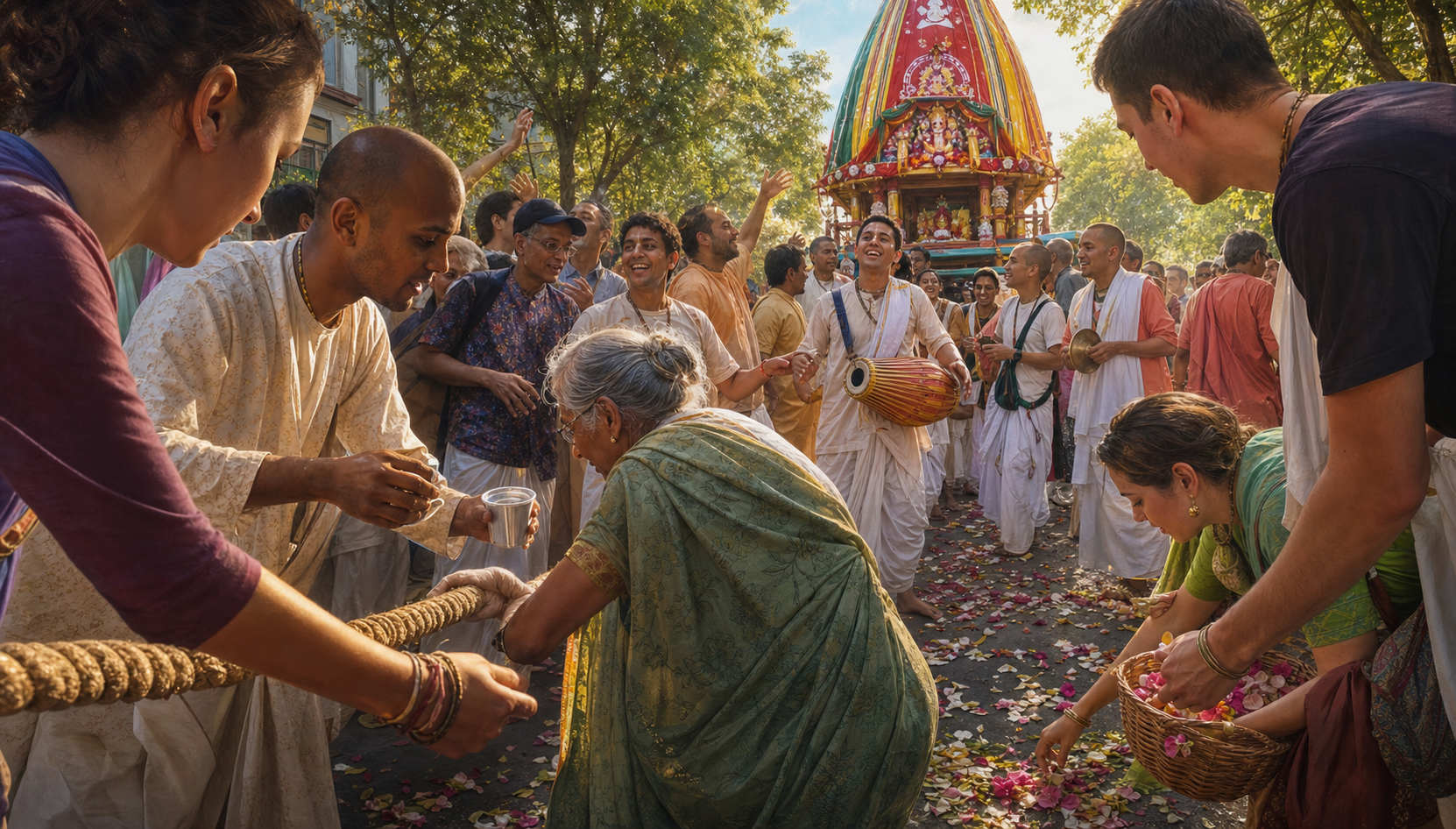
A public festival can overwhelm the eyes: decorated deities, chariots, drums, cymbals, dance, garlands, food, and crowds all arrive at once. You do not need to master every detail before participating. You do need to understand what the central actions mean.
Ratha Yatra comes from Jagannath Puri, where Jagannath, Baladeva, and Subhadra journey from the main temple toward the Gundicha Temple. Jagannath means the Lord of the Universe and is worshipped as a form of Sri Krishna. Bringing the deities into public space makes a theological claim in visible form: divine grace does not remain confined behind a temple threshold. The road becomes a sacred route, the chariot functions as a moving mandir, and congregational singing becomes an offering made in the presence of the wider community.
Srila A. C. Bhaktivedanta Swami Prabhupada helped carry this public celebration into cities around the world. The first public Ratha Yatra outside India took place in San Francisco in 1967, while New York’s procession began in 1976. That history matters for diaspora families: a practice rooted in Bharat can inhabit a modern city without surrendering its devotional center.
Before the procession or temple program
- Learn whom you are approaching. For Ratha Yatra, remember the names Jagannath, Baladeva, and Subhadra. Recognition turns a colorful chariot into an encounter with sacred personalities.
- Choose an intention that can survive distraction. You might listen carefully to one kirtan, offer one prayer, complete one seva, or help one newcomer understand what is happening.
- Ask for a specific service. A general offer to help is easy to lose in a busy program. Ask the coordinator whether assistance is needed with welcoming, prasadam, footwear, books, cleaning, accessibility, children, or crowd guidance, and then stay with the assignment you accept.
- Plan for the physical setting. At a large urban procession, use public transit where practical, wear shoes suitable for extended walking, carry water, and agree on a meeting point if you arrive with family. Sensible preparation lets you remain attentive instead of spending the day recovering from avoidable discomfort.
While the festival is moving
Begin with darshan. The word means more than looking at religious art. It is a respectful audience with the deity. Pause long enough to recognize whose presence the assembly is honoring. Folded palms, a bow, or quiet attention may express reverence; imitation without understanding is unnecessary.
In kirtan, listen for a complete phrase before answering it. Call-and-response protects the practice from becoming a competition between a leader and a crowd. Mridanga, kartals, harmonium, melody, and dance can support the offering, but intelligible chanting remains more important than virtuosity. If you do not know the melody, follow the response softly until it becomes familiar.
Pulling a chariot rope is seva, but it is also a safety responsibility. Join only where volunteers permit it, keep the spacing they establish, and follow marshal instructions immediately. Do not step near wheels or obstruct the people responsible for the chariot. Devotional enthusiasm does not cancel physical consequence.
Receive prasadam as sanctified vegetarian food, not as an entitlement. Take what you can finish, keep the serving area clean, and make room for elders, children, and visitors who need assistance. If you are photographing people at close range, especially near the deities or inside a kirtan circle, ask permission rather than assuming that a public event eliminates personal boundaries.
After the crowd disperses
Do not judge the day only by how elevated you felt. Ask what became clearer. Was it the sound of Krishna’s name, Jagannath’s form, another devotee’s service, or your own resistance to inconvenience? Carry that particular point into your next period of japa, reading, or worship. If you accepted a volunteer role, finish the clean-up or handoff before moving into social conversation.
This is the difference between consuming an event and entering a tradition. A consumer asks whether the program delivered the desired experience. A practitioner asks how the encounter should reshape attention, conduct, and service.
Let sacred poetry educate your devotional emotions
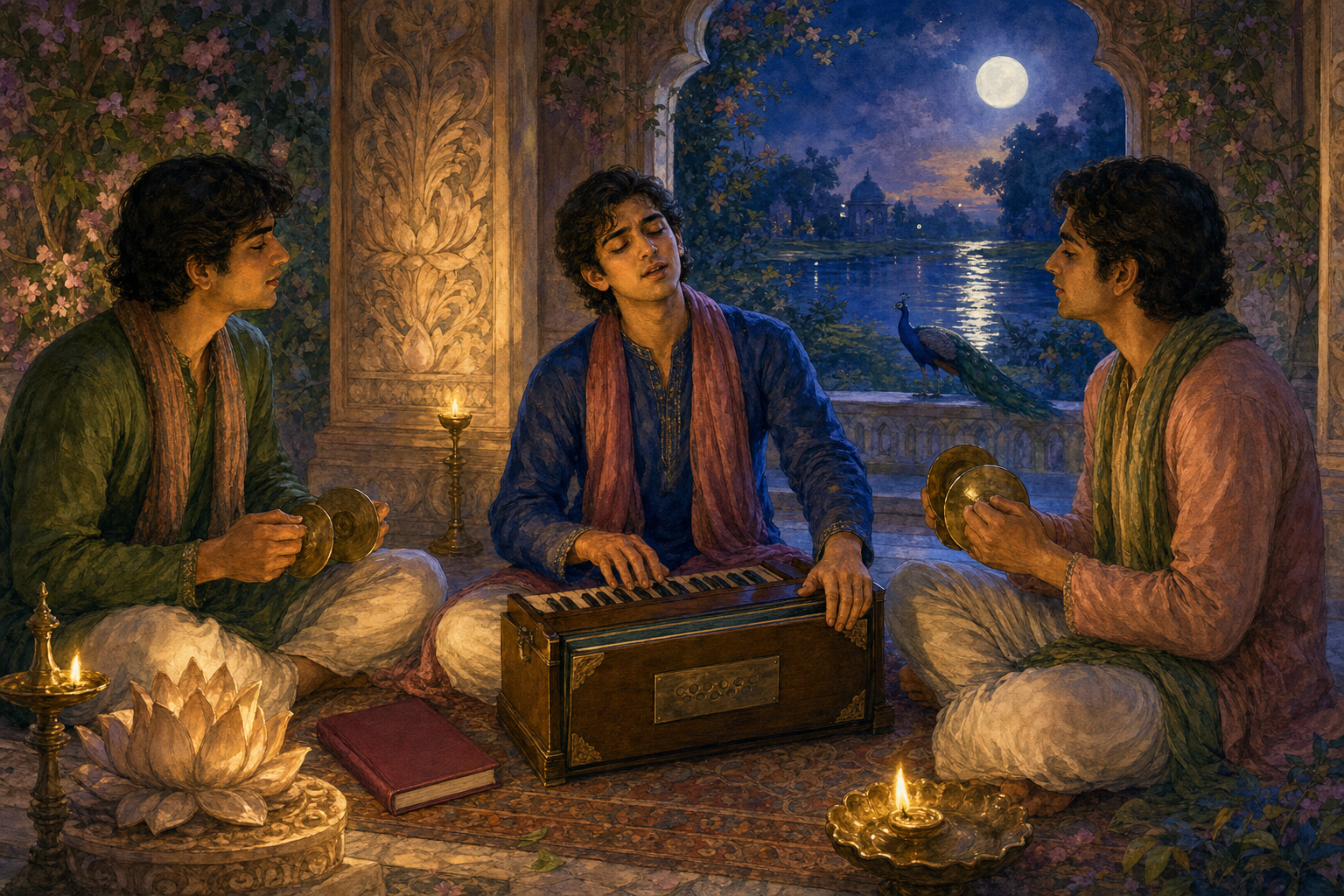
Kirtan can awaken feeling quickly. Sacred poetry helps that feeling acquire theological shape. Without such formation, you may mistake musical intensity for spiritual depth or reduce Krishna’s lila to a collection of charming stories.
Sri Caurastakam, an eight-verse hymn attributed to Bilvamangala Thakura, offers a compact example. It addresses Krishna as the thief of Vraja. He steals butter, captivates minds, and ultimately takes possession of the heart that tries to remain self-owned. The paradox is deliberate: what appears to be loss becomes freedom from pride, fear, and the exhausting demand to control everything.
This should not be flattened into the claim that ordinary theft is virtuous. Krishna’s butter stealing belongs to Vraja-lila, where divine majesty appears through intimate household and pastoral relationships. The imagery gives devotees a way to contemplate grace that defeats possessiveness. Its meaning depends on who Krishna is, not merely on the external shape of the action.
Use a hymn such as Sri Caurastakam through a deliberate cycle:
- Read first. Use a reliable transliteration and meaning so that you know whom the hymn addresses and what its repeated image is doing.
- Listen for the words. An English musical rendering can disclose the movement of the prayer to someone who does not read Sanskrit. Let meaning lead the melody.
- Return to the Sanskrit. Hear how repetition, sound, and the recurring epithet cora, or thief, concentrate attention. Translation opens the door; it need not replace the original.
- Bring the image into remembrance. Notice what you defend as exclusively yours: status, certainty, praise, control, or even a preferred spiritual identity. Ask what it would mean to offer that possessiveness to Krishna.
- Watch the result in conduct. If contemplation only makes you attached to a particular recording or mood, the image has remained aesthetic. If it exposes pride and makes service less self-protective, it has begun to do devotional work.
This pattern is especially useful in a multilingual household. Younger family members can begin with intelligible English, elders can preserve pronunciation and traditional melodies, and everyone can return to the Sanskrit text together. The goal is neither linguistic gatekeeping nor casual replacement. It is shared access joined to respect for the inherited form.
It also corrects a common mistake in festival programming. Sacred music does not become more authentic merely by becoming harder for newcomers to understand, and it does not become more accessible merely by sounding contemporary. The better question is whether text, melody, explanation, and performance direct attention toward Krishna rather than toward the performer.
Community is measured on ordinary days and difficult ones
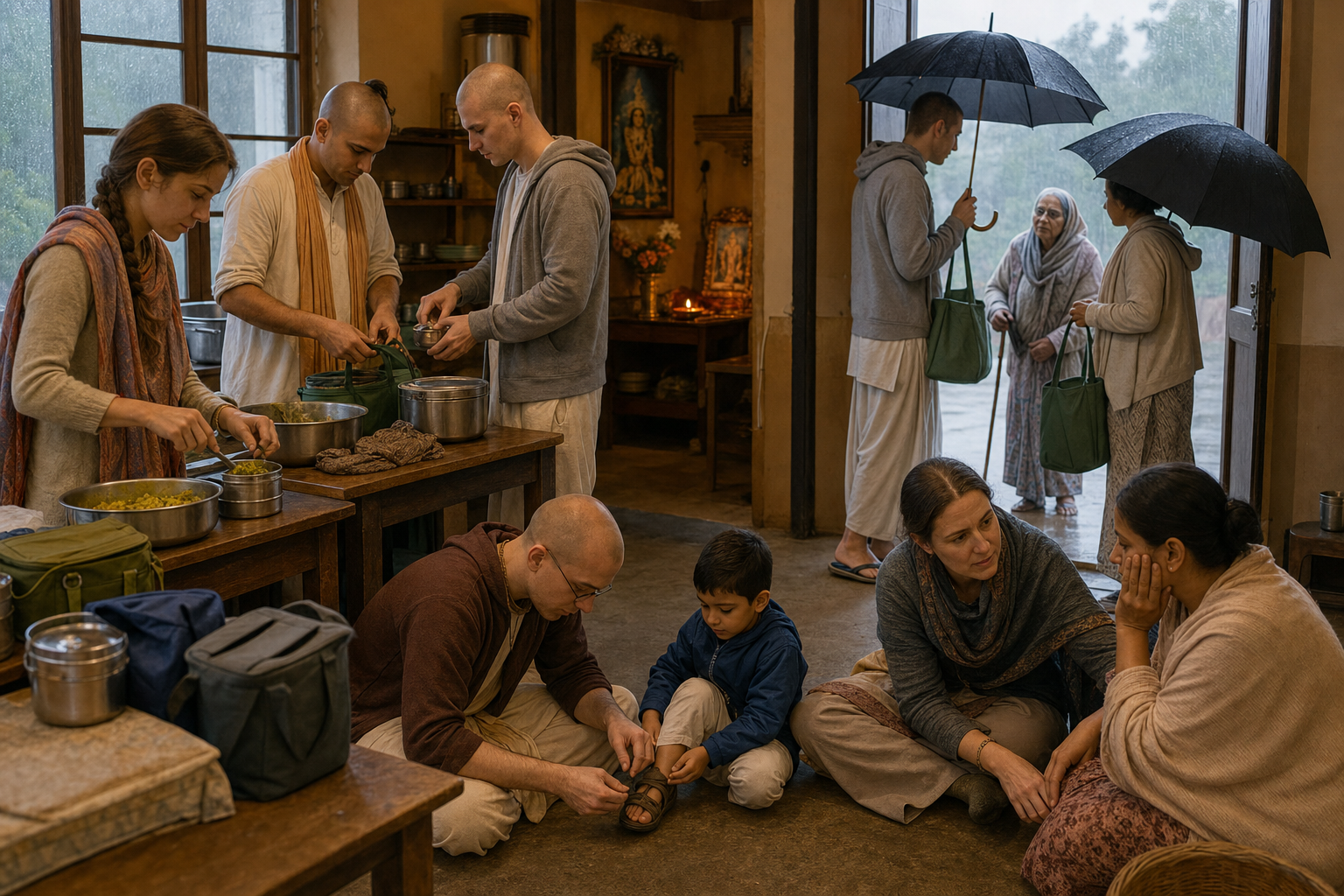
A community may produce a beautiful procession and still leave newcomers unseen, volunteers exhausted, or vulnerable people exposed to gossip. Gaudiya community life becomes credible when the reverence displayed before the deity shapes speech, responsibility, hospitality, and care after the public celebration.
Vaishnava etiquette is not a demand to pretend that disagreements do not exist. It asks you to resist humiliation, rumor, factional excitement, and the use of devotional language as a weapon. Raise a real concern through an appropriate forum, distinguish witnessed fact from interpretation, and do not turn private information into social currency.
When a teacher or community member is seriously ill
A health crisis reveals whether a congregation can combine devotion with disciplined communication. If a public update says only that a teacher is in intensive care and receiving respiratory or renal support, you know that the situation is serious. You do not know the complete diagnosis, likely outcome, or private decisions of the patient and care team. Clinical terms describing high-acuity support should not be reverse-engineered into an unofficial prognosis.
- Use recognized channels. Before forwarding an update, confirm that it came from the family, care team, or an authorized institutional communicator. Preserve the date and wording so an old notice does not circulate as a new development.
- Separate prayer from prediction. You can chant, offer japa, organize kirtan, and pray for well-being without claiming that you know what Krishna must do or what medical treatment will achieve.
- Protect dignity. Do not demand photographs, private medical details, or constant access as proof of transparency. Concern does not create ownership over another person’s body or suffering.
- Convert emotion into useful seva. Ask what concrete responsibility needs coverage. Continuing temple duties, congregational care, communication, transport, meals, or educational work may help more than adding another speculative message to a group chat.
- Preserve continuity without denying grief. Distributed responsibilities and documented procedures allow essential service to continue when a respected leader cannot personally direct it. This honors the mission the teacher served rather than making the mission dependent on uninterrupted personal availability.
Prayer and medicine should not be placed in competition. Devotional practice can steady attention, support compassion, and gather a community around service. It is not a substitute for clinical care, and a medical outcome should never be used as a crude measurement of someone’s faith.
When other Dharmic communities join the gathering
Public kirtans and festivals often welcome Hindus from other sampradayas as well as Buddhists, Jains, Sikhs, and visitors without a formal religious affiliation. Hospitality does not require pretending that every tradition teaches the same metaphysics. It requires enough confidence in your own path to explain it clearly without belittling another.
There is genuine ethical ground for cooperation. Buddhist cultivation of non-grasping and compassion, Jain commitments to self-restraint, friendship, and ahimsa, Sikh emphasis on naam-simran and seva, and Gaudiya practices of japa, kirtan, remembrance, and service all challenge egoic self-enclosure in distinctive ways. The resemblance is useful when it leads to shared care, truthful dialogue, vegetarian hospitality, and service. It becomes misleading when it erases doctrinal differences or treats every sacred vocabulary as interchangeable.
Make participation invitational. Explain what the maha-mantra is before asking guests to sing. Tell them that quiet observation is welcome. Identify prasadam as food first offered to Krishna. Explain whom the deities represent and why the chariot is being pulled. These small acts remove avoidable confusion without diluting the practice.
The same standard applies to children and diaspora youth. Do not give them only tasks with no meaning, or explanations with no place to serve. Tell them why the action matters, give them a responsibility suited to them, and let their questions remain real questions. Inherited identity becomes durable when understanding and contribution grow together.
At your next kirtan or Ratha Yatra, do not try to consume the whole tradition in a day. Listen until you can answer the refrain, accept one concrete seva, receive prasadam with attention, and carry one name of Krishna home. Repeat that movement after the crowd disperses. Festival then becomes what it is meant to be: daily bhakti made visible, strengthened by community, and returned to daily life.
References
- Dandavats — Sri Caurastakam in English: Bilvamangala Thakura’s ‘Thief of Vraja’ in a Soul-Stirring Musical
- Dandavats — HH Jayapataka Swami’s ICU Hospitalization: Clinical Context, Community Solidarity, and Dharmic Unity
- Dandavats — Hare Krishna Ratha Yatra NYC 2026: Experience the Vibrant 51st Festival of Chariots on Fifth Avenue
