
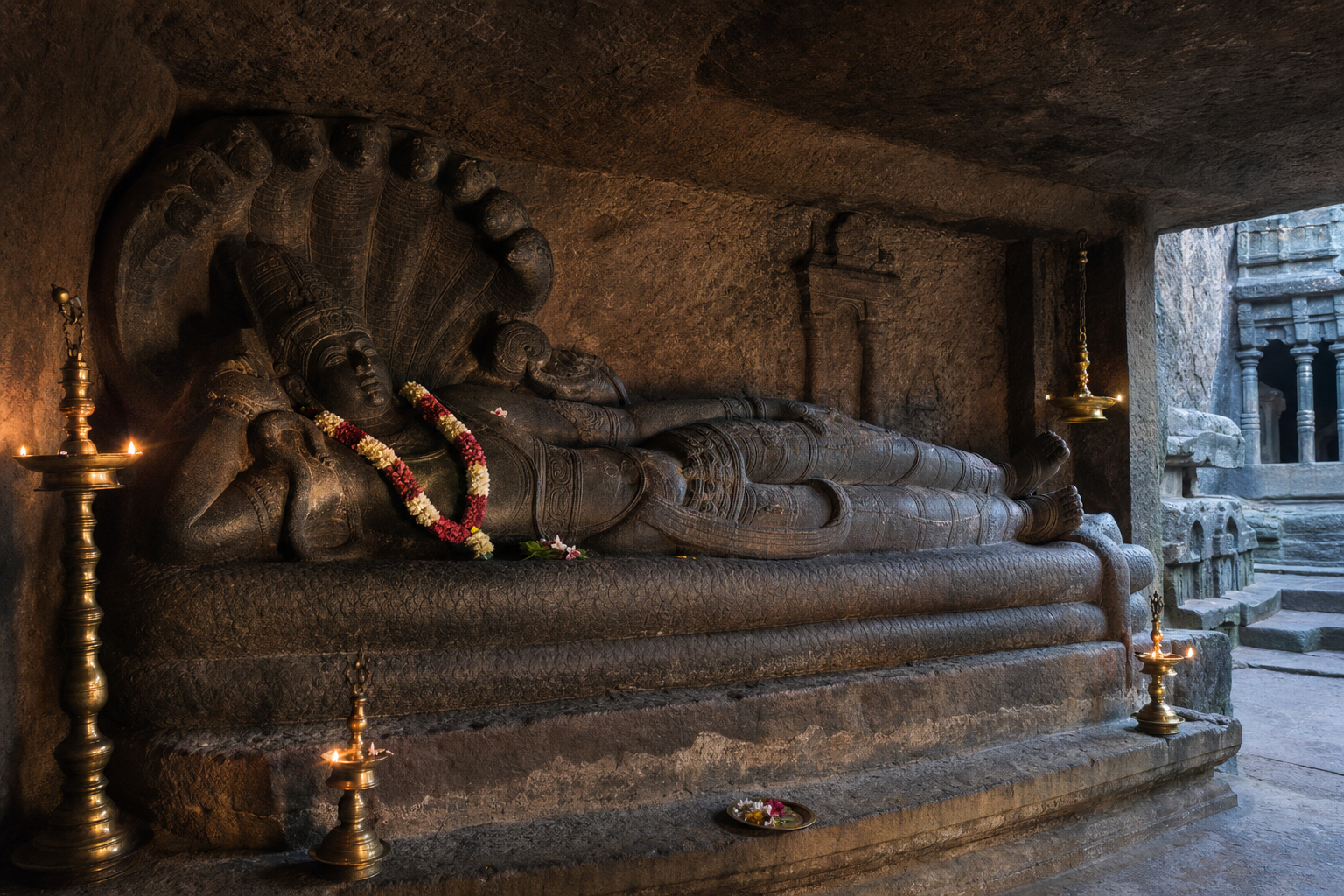
If you are visiting Namakkal for Ranganatha darshan, the essential question is not merely where the deity is located. It is what you are seeing: why the reclining Lord rests upon Karkotaka, what the serpent contributes to the image, and how this sanctuary belongs with the nearby Narasimha and Anjaneyar shrines.
Approach the three temples as one pilgrimage and the arrangement becomes intelligible. Narasimha embodies protection, Anjaneya demonstrates devoted service, and Ranganatha reveals the stillness that follows when duty rests in the Divine. The rare Karkotaka Sayanam at the heart of that sequence is not an ornamental variation. It is the theological culmination of the Namakkal sacred landscape.
Why Karkotaka Sayanam is a distinct form
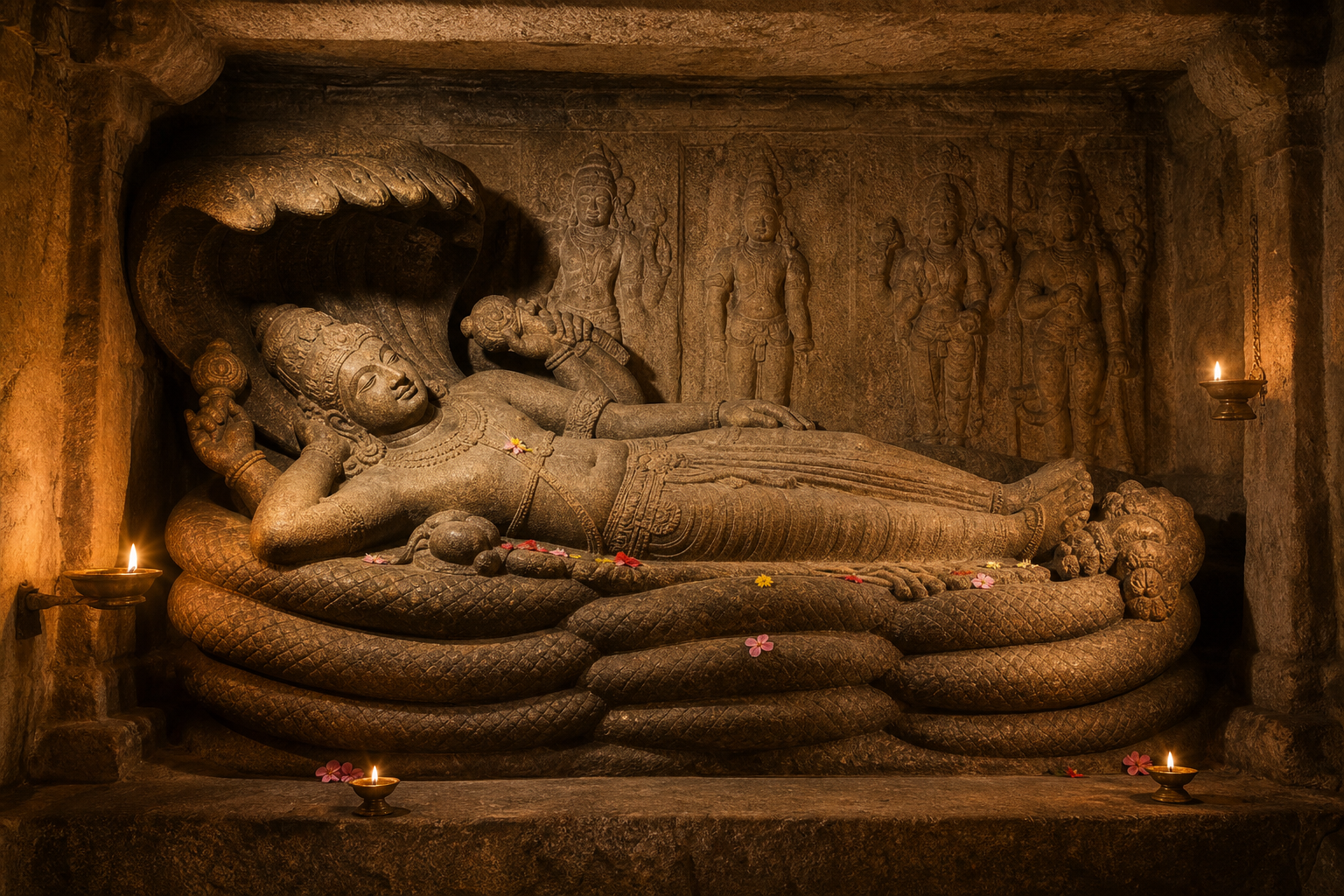
The first distinction to keep clear is between posture and identity. Bhujanga sayana describes Vishnu reclining upon a serpent couch. Karkotaka Sayanam identifies the particular serpent who serves as that couch at Namakkal. In many familiar Ranganatha images, the serpent is named Adishesha. Here, local sacred tradition explicitly identifies him as Karkotaka.
Karkotaka is a serpent-king associated in Sanskrit narrative with moral testing and transformation. Namakkal’s sthala tradition carries that transformative movement into worship: Karkotaka ultimately becomes the support for Vishnu’s repose. A being linked with trial does not remain defined by trial. He becomes capable of surrender and service.
This is why you should not treat the serpent as a platform that can be visually skipped on the way to the Lord. Karkotaka’s service is part of the darshan. His coils bear the divine form; his hoods shelter it. What might otherwise suggest latent danger has been gathered into divine order.
Nor does the name Karkotaka place Namakkal outside the wider Ranganatha tradition. The form retains the established grammar of reclining Vishnu while giving a local Naga tradition greater emphasis. It is a good example of how Hindu sacred geography works: canonical form and regional memory can reinforce one another without becoming identical everywhere.
If you remember only one interpretive sentence during darshan, use this one: Karkotaka is not beneath the meaning of the image; his transformed service helps disclose it.
How to read the murti without reducing darshan to a checklist
The rock-cut sanctuary rewards slow looking, but its dim, enclosed character can make hurried observation difficult. Let your eyes settle before trying to identify individual features. Then move through the image in a deliberate sequence.
- Begin with the coils. The layered serpent body establishes the base of the composition. Its rhythm gives physical support to the reclining Lord while suggesting continuity, contained energy, and an order that does not collapse.
- Follow the coils to the hoods. The many hoods rise as a protective canopy. They are not merely a background ornament; together they work like a living prabhavali, enclosing the sacred presence while remaining alert.
- Notice the Lord’s repose. The body is at rest without appearing inert. The carefully proportioned form and subtle movement through the torso create stillness without stiffness, consistent with the Shilpa Shastra-informed treatment of reclining Vishnu.
- Recognize the Vaishnava emblems. The four-armed form is understood through shankha, chakra, gada, and padma: conch, discus, mace, and lotus. Together they hold sovereignty, protection, strength, and auspiciousness within the serenity of the reclining image.
- Rest your attention on the countenance. The serene, half-lidded expression communicates yogic inwardness. Ranganatha’s rest is not sleep born of exhaustion. It is composure that remains capable of sustaining and protecting.
- Do not omit Ranganayaki Thayar. Her separate shrine belongs to the Sri Vaishnava grammar of the temple. Lakshmi’s presence makes grace integral to the encounter rather than an afterthought to divine majesty.
This sequence helps resolve an apparent tension in the image. Karkotaka is vigilant while Vishnu reposes; the hoods shelter while the Lord remains inwardly composed. Protection and peace are not opposites here. The image presents peace as the condition from which true protection can operate.
Naga imagery also offers a point of recognition across Dharmic art. Serpents appear as protectors and threshold figures in Buddhist and Jain traditions as well as Hindu traditions. That shared vocabulary should not erase the specifically Sri Vaishnava identity of Namakkal’s murti. It can, however, help you notice a wider Indic intuition: disciplined power becomes sacred when it protects rather than consumes.
Make the three Namakkal shrines one pilgrimage
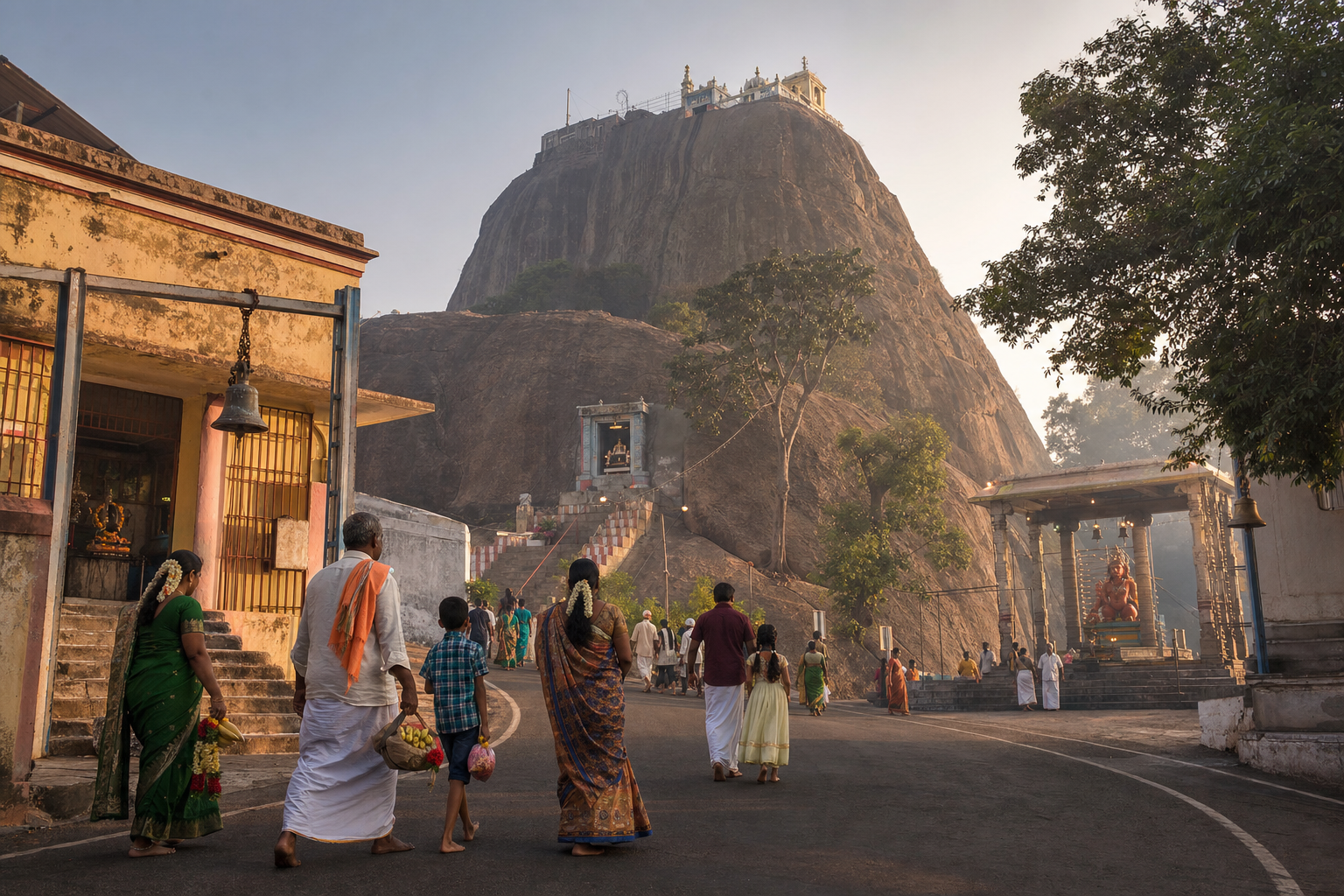
The Ranganatha sanctuary belongs to a closely connected sacred cluster around the granite monolith commonly known as the Namakkal Rock Fort. The cluster comprises the rock-cut Narasimha temple associated with the hill, the cave sanctuary of Ranganatha at the foothill, and the freestanding Anjaneyar temple known for its monumental Hanuman.
If local access and temple practice permit, a meaningful contemplative order is Narasimha, Anjaneya, and then Ranganatha. This is an interpretive itinerary, not a claim that every pilgrim must follow a compulsory ritual sequence. Directions from archakas and temple authorities take precedence.
- At Narasimha, face the need for courage. Protection is fierce because adharma sometimes has to be confronted. Bring to mind one duty you have been avoiding through fear, confusion, or convenience.
- At Anjaneya, turn courage into service. Hanuman prevents strength from becoming self-display. Translate the duty you identified into one concrete act of seva, loyalty, or disciplined effort.
- At Ranganatha, release the demand to control every outcome. Having acknowledged duty and service, stand quietly before the reclining Lord. The point is not passivity; it is action freed from restless possession of the result.
This progression gives the pilgrimage an ethical structure: protection, service, and repose. The three modes correct one another. Protection without service can harden into aggression. Service without inner steadiness can become exhaustion. Repose without duty can become avoidance. Experienced together, the shrines present strength disciplined by bhakti and brought to rest in trust.
Do not plan the visit as though Ranganatha were simply an optional stop after the more visually prominent Hanuman. Leave enough room in your itinerary for all three sanctuaries. Before travelling, verify current opening times, puja arrangements, festival access, and photography rules directly with the temple, because these practical conditions can change and the fixed ritual calendar does not supply reliable daily visitor hours.
Vaikunta Ekadashi, Panguni Uthiram, and the annual Brahmotsavam are among the major observances associated with the temple. A festival visit places you inside a larger liturgical community, but it may not offer the same pace for close visual attention. Decide what you need from the journey: the collective energy of an observance, a quieter study of the murti, or separate visits for both purposes.
Notice a living temple, not a monument frozen in one century
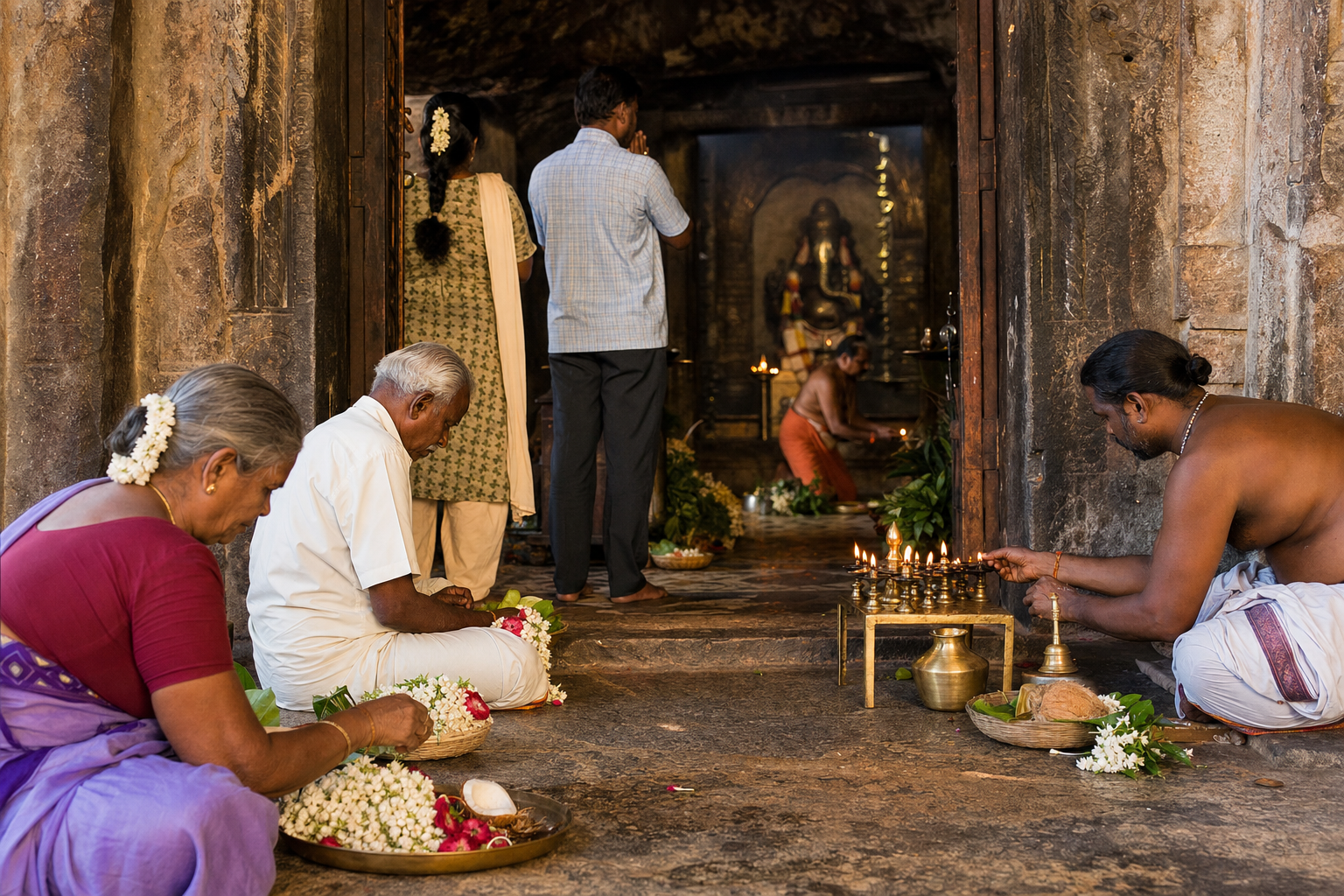
Namakkal’s architectural layers matter because they reveal continuity. The complex belongs to the early-medieval tradition of Tamil rock-cut temple building, while later additions are associated with Pandya, Vijayanagara, and Nayak phases. The cave garbhagriha, structural mandapa, circumambulatory elements, and later thresholds therefore should not be mentally compressed into a single construction event.
As you move inward, notice the change from built space to excavated rock. The pillared hall organizes approach and congregation; the cave sanctum concentrates attention through enclosure, shadow, and the physical mass of the hill. The architecture does not merely contain worship. It changes your pace before you reach the deity.
The temple’s continuity is also social. Epigraphic notices and stylistic evidence point to continuing support for lamps, offerings, maintenance, and ritual life. Agrarian and mercantile communities helped sustain the institution across generations. What survives at Namakkal is therefore not only old stone but an ecosystem of worship, patronage, memory, and responsibility.
Listen as well as look. Vedic recitation and the Tamil Divya Prabandham participate in the temple’s Sri Vaishnava soundscape. Hearing Sanskrit and Tamil together is not a collision between two religious worlds. It expresses a tradition in which revealed authority, Tamil devotional poetry, temple ritual, and communal participation meet in the same sacred space.
A living temple also requires restraint from visitors. Rock surfaces, inscriptions, and sculpted details are vulnerable to moisture, soot, repeated touching, and aggressive cleaning. Do not touch or trace inscriptions, apply oil to unapproved surfaces, or use flash photography where it is restricted. Follow the temple’s rules around lamps and offerings. These small acts protect both the cave’s microclimate and the physical record carried by the stone.
The nearby water body likewise belongs to ritual life rather than functioning merely as a scenic feature. Treat barriers and local instructions seriously, and do not assume that entry into the water is permitted. Reverence for a tirtha includes respecting the practices that preserve it.
Key takeaways for your Namakkal darshan
- Karkotaka Sayanam names the serpent serving as Vishnu’s couch; bhujanga sayana names the reclining-on-a-serpent posture more generally.
- Namakkal’s identification of Karkotaka is a local intensification of Naga devotion within the wider Ranganatha and Sri Vaishnava tradition, not a rejection of that tradition.
- Read the image from serpent coils to hooded canopy, from canopy to reclining Lord, and from the Lord’s yogic countenance to the complementary grace of Ranganayaki Thayar.
- Approach Narasimha, Anjaneya, and Ranganatha as an interconnected teaching about protection, service, and inward rest.
- Distinguish the rock-cut sanctum from later structural additions; the architectural layers record a temple sustained over time rather than built in a single moment.
- Confirm current darshan arrangements before travelling and protect the heritage in front of you by following rules on touching, offerings, lamps, water access, and photography.
Before you leave for Namakkal, confirm the current arrangements and give the full sacred cluster enough time. When you reach Ranganatha, begin with Karkotaka instead of looking past him. Follow the coils to the canopy, the canopy to the Lord, and the Lord’s quiet gaze back to your own restless mind. That is where this distinctive darshan begins to do its work.
References
