

If you admire Narendra Modi, his milestone at 75 after a decade of national transformation invites a tribute. If you distrust him, it invites an indictment. Neither response is enough. The useful question is harder: which changes have entered India’s ordinary life, which remain dependent on one leader, and which will endure after the political moment passes?
A Dharmic assessment must be more demanding than applause or hostility. It asks whether power has moved the state toward kartavya, whether Bharat has gained the capacity to defend its interests, and whether citizens now expect better conduct from public institutions. You can make that assessment without pretending that every policy belongs in the same column.
Measure the changed baseline, not the loudest headline
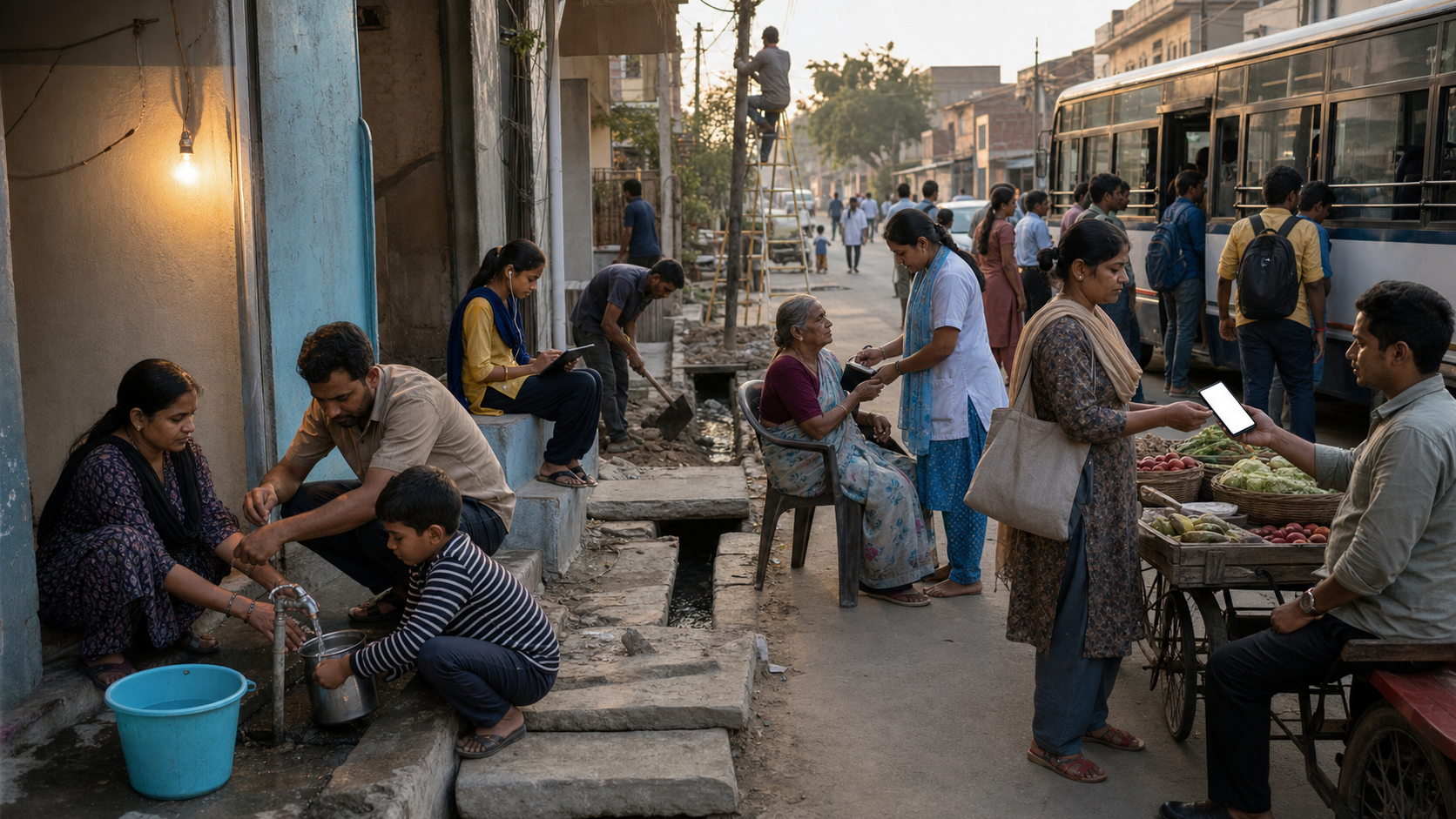
The deepest political changes are often the least theatrical. Once a difficult process becomes routine, you stop thinking of it as reform. It becomes the minimum you expect. That is why a decade can alter a country while its citizens remain preoccupied with the controversy of the week.
Consider how quickly UPI payments entered everyday life. Consider the change represented by direct transfers reaching bank accounts instead of passing through a chain of intermediaries. Neither should be judged merely as a government announcement. Their significance lies in the new baseline they create: a citizen begins to regard speed, traceability and direct access as normal rather than exceptional.
You can test this in your own life. Do not begin with the question, “Was the Modi decade successful?” That is too broad to produce an honest answer. Run a baseline audit instead:
- Choose three ordinary interactions with the state or formal economy. A payment, a benefit, a tax process, a journey or a document request will tell you more than a slogan.
- Reconstruct the old chain. Write down how many offices, intermediaries, uncertain steps or discretionary approvals the same task once involved.
- Identify the mechanism that changed it. Separate digital infrastructure, administrative reform, legal change and private-sector expansion. Government receives too much credit when these are blurred together, but it can also receive too little.
- Record the failure cases. Ask what happens when the network fails, a record is wrong, an official refuses to act or a citizen cannot navigate the system. A reform is not mature until it has a usable remedy.
- Check beyond your own social circle. An urban professional’s smooth experience does not prove universal delivery. Look for the last-mile experience in the district, town or village you actually know.
This method prevents two common errors. A single broken office should not erase a large structural improvement, and one successful app should not be treated as proof that the entire state has been repaired. The proper unit of judgment is the changed expectation: what can an Indian reasonably demand now that seemed implausible before?
Sort the record into four kinds of change

UPI, demonetisation, GST, Article 370 and the response to China at Galwan are often placed in one list. That creates confusion because they are different kinds of action. A payment system, a disruptive monetary intervention, a national tax framework, a constitutional decision and a security confrontation cannot be evaluated with one test.
| Kind of change | Examples from the decade | The question you should ask |
|---|---|---|
| Service delivery | UPI and direct bank transfers | Does the system reliably reduce time, leakage, discretion and dependence on intermediaries? |
| Disruptive intervention | Demonetisation | Was the burden proportionate to the durable capability or outcome created? |
| Legal or institutional restructuring | GST and the removal of Article 370 | Has the new arrangement become stable, correctable and enforceable beyond one government? |
| Strategic and security action | Galwan, policy toward Pakistan and the campaign against Maoist violence | Did the action improve deterrence, territorial security, civilian normality and India’s freedom of choice? |
Service delivery should be judged from the citizen outward. With UPI or a direct transfer, the relevant questions concern reliability, access, correction and grievance handling. A visionary launch is not enough. If a wrong record traps a citizen without an appeal route, the digital front end has modernised the appearance of the problem rather than solved it.
Disruption needs a stricter test. Demonetisation was an audacious and irreversible intervention, but irreversibility is not itself evidence of success. A fair assessment must distinguish the boldness of the decision from its costs, its stated aims and the durable capacity it produced. Supporters should not evade that distinction, and critics should not substitute the memory of disruption for an examination of what remained afterward.
Institutional change is tested by political adoption. Direct transfers have become difficult for any major political formation to oppose in principle, while disagreement over GST increasingly concerns its design and details rather than a simple return to the previous order. That is an important threshold. A reform begins to outgrow its founder when rivals promise to improve it instead of abolishing it.
The parliamentary removal of Article 370 should likewise be separated into decision and outcome. The decision is identifiable. Its long-term effects on integration, security, administration and public life require continuing observation. Treating the act itself as the whole achievement ends the assessment at precisely the point where governance begins.
Security claims require the most discipline. The favorable case for the decade includes a sharp reduction in jihadist attacks, the near defeat of Maoist terror, functioning schools in Gadchiroli, diplomatic isolation of Pakistan and a firm response to China at Galwan. These are consequential assertions, not decorative talking points. Each should be independently tested with consistent definitions and evidence over time before being treated as settled.
Ask whether violence declined or merely moved, whether schools remained open, whether the state retained control after security forces departed, whether deterrence survived the next confrontation, and whether diplomacy expanded India’s choices. This approach does not diminish a national achievement. It protects the achievement from being reduced to propaganda.
The Dharmic test is kartavya, not leader worship

One of the decade’s most revealing changes is linguistic. Rajpath became Kartavya Path, and the Central Secretariat acquired the name Kartavya Bhavan. The movement is from the imagery of imperial authority toward the language of duty.
That symbolism matters because political language teaches the state how to imagine itself. A colonial apparatus is designed to command subjects, preserve distance and protect official privilege. A Dharmic state should understand public office as an obligation. Yet a new name is a covenant, not proof that the covenant has been fulfilled.
Pair every civilisational symbol with an operating test:
- Kartavya toward the citizen: Does an office provide a clear process, a reason for refusal and a path of appeal, or does the citizen still depend on personal access?
- Kartavya toward public wealth: Does the system reduce opportunities for brokers and private profiteering, and can wrongdoing be investigated without regard to political loyalty?
- Kartavya toward national security: Are decisions made around Bharat’s interests, with the capacity to sustain them after the headline passes?
- Kartavya toward institutions: Can officials be held responsible while still receiving the authority and clarity needed to perform their duties?
- Kartavya toward civilisation: Does cultural confidence lead to conservation, teaching and living continuity, or stop at renamed avenues and ceremonial display?
This is also why support for Modi should not become personal sanctification. Dharma does not free a powerful ruler from scrutiny; it makes scrutiny more exacting. The greater the authority, the greater the duty attached to it. A government that invokes civilisational language should be judged against a higher standard of conduct, not granted a lower one.
The useful question after any symbolic act is therefore: what duty follows from it? Kartavya Bhavan should imply a different administrative ethic. An India-first foreign policy should imply the material capacity to withstand pressure. Civilisational confidence should imply sustained care for the institutions that transmit civilisation. Without the second half of each pair, symbolism remains unfinished work.
The decisive legacy test is whether the system can outlast Modi

No decade begins from zero. Atal Bihari Vajpayee had already advanced telecom reform, the Golden Quadrilateral, changes in banking and investment, and a more innovative foreign policy. Modi’s achievement must be read partly as acceleration: taking foundations laid under severe coalition constraints and pursuing change with the authority of a parliamentary majority.
That continuity is important because it corrects great-man history. Leaders matter enormously, but durable national renewal depends on inheritance, expansion and institutional memory. Modi’s own place in history will eventually depend on whether the next generation can inherit functioning systems rather than a collection of achievements that require his personal supervision.
The third term began with a reduced Lok Sabha majority. That makes the durability test immediate rather than theoretical. Authority must now coexist with greater negotiation, and reforms must survive a political environment less dependent on the conditions of the first two terms.
Use five checks to decide whether a Modi-era change has become an institution:
- Legal anchoring: Is the change secured by a clear law, rule or constitutional arrangement, or does it rest mainly on executive attention?
- Administrative routine: Can an ordinary official implement it correctly without a special instruction from the highest office?
- Correction: Can the system detect errors, hear grievances and revise a poor design without treating criticism as sabotage?
- Political adoption: Do rival parties compete over how to improve the policy, or is its survival tied to one party’s control?
- Civic expectation: Have citizens internalised the new standard strongly enough to punish any government that takes it away?
You can then classify a reform as leader-dependent, party-dependent or system-dependent. The distinction is more revealing than the usual choice between “historic” and “failed.” A leader-dependent initiative may be impressive but fragile. A party-dependent programme has a wider base but remains politically exposed. A system-dependent reform has become part of the country’s operating grammar.
This test also exposes unfinished work. If the bureaucracy remains resistant and the judiciary remains insufficiently accountable, as many supporters of the government contend, then exposing the inherited structure was only the first stage. Replacing informal privilege with transparent responsibility is slower and more difficult than identifying the old elite.
A strong state is not one in which every problem waits for the prime minister. It is one in which lawful authority travels downward, responsibility is visible, failure can be corrected and citizens do not need political patronage to receive routine service. At 75, this is the most serious measure of Modi’s success: whether the energy of one leader has become the dependable capacity of Bharat.
Key takeaways
- Judge the decade by changed public expectations, not by the number of announcements or controversies.
- Evaluate service delivery, disruptive interventions, institutional restructuring and security policy with different tests.
- Treat civilisational symbolism as a promise of conduct: every invocation of kartavya must produce a corresponding duty.
- Separate identifiable decisions from long-term outcomes, especially in constitutional, diplomatic and security matters.
- Count a reform as durable when officials can execute it, citizens can correct it and political rivals prefer improvement to repeal.
- Ask whether Modi’s governing energy has become institutional capacity that a successor can preserve and refine.
To make the milestone useful, build a one-page audit with four columns: the change, the evidence visible to you, the cost or unresolved weakness, and the reason it is likely to endure. Choose one example from daily service, one from institutional reform, one from national security and one from civilisational policy. If you cannot fill a column, you have found the question that deserves your attention.
That is a more fitting response than unqualified celebration or reflexive dismissal. Give credit where a new national baseline has genuinely been created. Demand correction where boldness outran accountability. Above all, insist that the language of Dharma become the habit of government. A birthday marks the leader’s years; the next phase must show whether his decade has matured into India’s lasting strength.
References
