
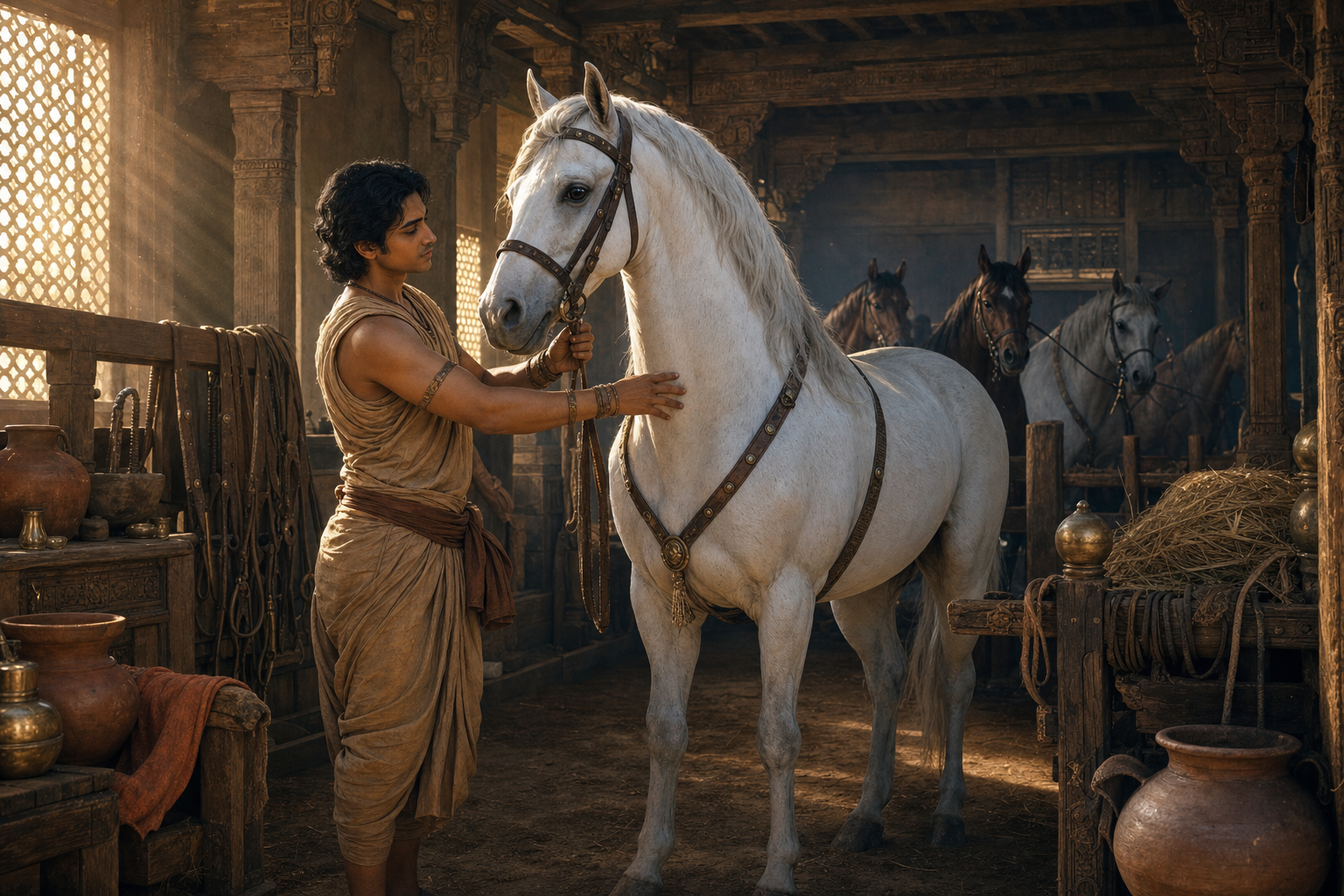
If Nakula’s work with horses has seemed like a minor detail in the Pandavas’ exile, look again. His choice of occupation answers a difficult question: how do you conceal a public identity without losing the qualities that make it meaningful?
Nakula’s disguise does not require him to become an entirely different person. It places his real competence inside an ordinary role. The horse then becomes the episode’s central image: strength kept under discipline, movement held in reserve, and health preserved through patient care.
Granthika hides Nakula’s name, not his character
During the thirteenth year of exile, the Pandavas had to remain unrecognised in King Virata’s kingdom. Nakula adopted the name Granthika and became a keeper of horses. Like the roles chosen by his brothers, his work suited his established skill and temperament.
That fit is the first interpretive key. A disguise can change the signs by which society identifies a person: name, rank, clothing, place and occupation. It cannot safely manufacture an entire character from nothing. Granthika is convincing because Nakula can perform the work with genuine ability. The outward identity is constructed, but the competence beneath it is real.
This creates an important distinction between concealment and self-erasure. Nakula temporarily gives up recognition, not discipline. He does not need his familiar name to make his qualities operative. He can remain dependable even when no one around him knows why he is dependable.
If you are reading this episode during a period when your own role feels smaller than your ability, do not measure continuity only by title or visibility. Ask a more exact question: which of your enduring capacities can still be practised honestly here? A reduced public role need not become a reduced inner life.
The horse represents power that must remain governable
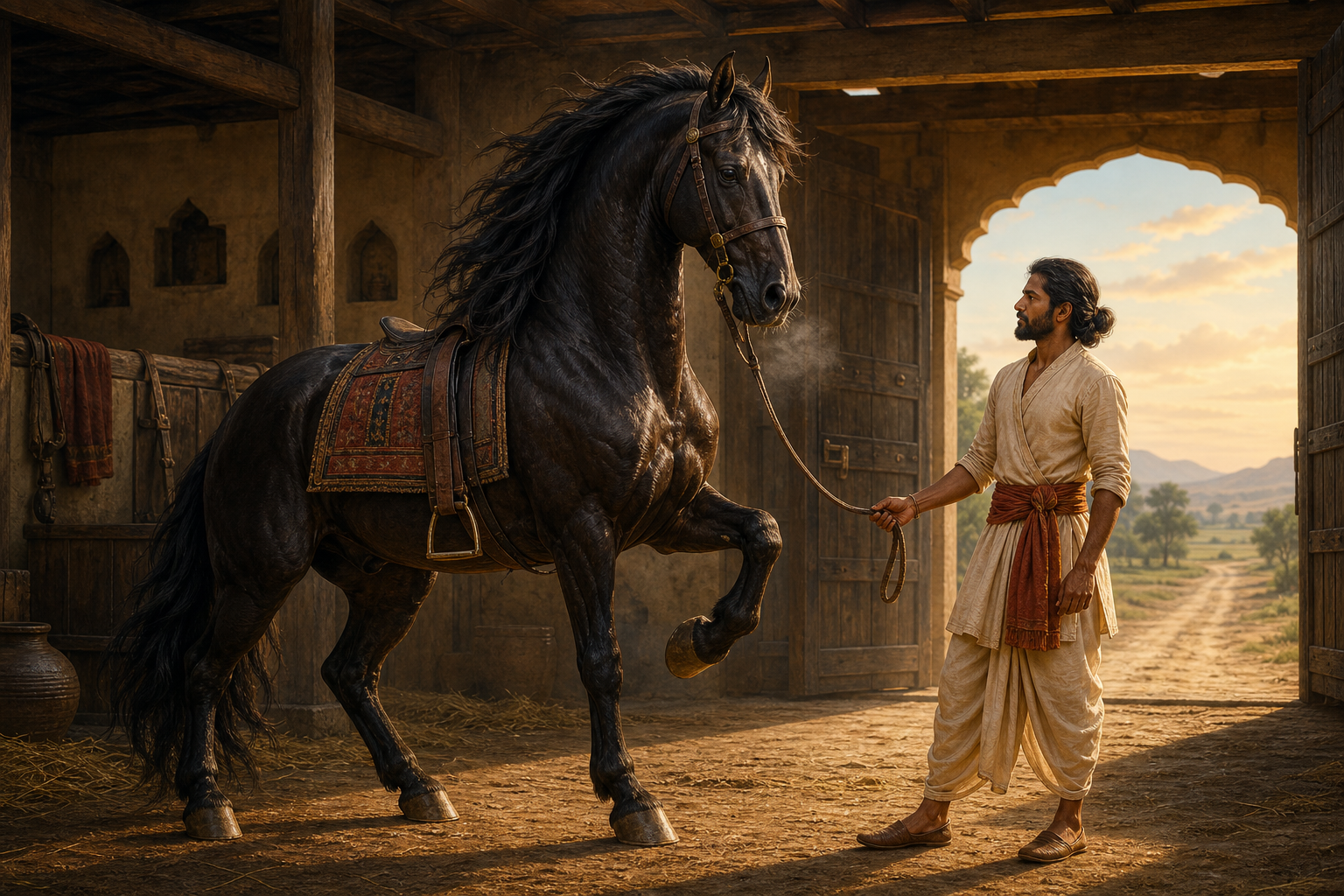
A horse joins energy with responsiveness. Its strength matters, but strength by itself is not enough. A neglected animal loses condition; a frightened one can become difficult to direct; an untrained one cannot reliably turn speed into useful movement. Feeding, grooming, observation and steady handling preserve the animal’s power without suppressing it.
That relationship makes the horse an apt companion to Nakula’s incognito life. He must retain his capabilities while restraining the impulse to display them openly. His power has not disappeared. Like a well-kept horse awaiting the proper moment to move, it is being maintained under control.
This is more precise than saying that the horse simply means strength. Uncontrolled strength would contradict the demands of the episode. The relevant quality is disciplined vitality: energy that remains available because it has not been wasted on premature display.
You can test any symbolic interpretation with three questions. What does the image actually do in the narrative? What qualities does that activity require? How do those qualities echo the character’s predicament? Here the horse is not merely seen or ridden; it is kept. Keeping requires sustained attention, while the incognito condition requires sustained self-command. The connection comes from the action, not from a free-floating symbolic dictionary.
Incognito identity becomes a form of adaptability
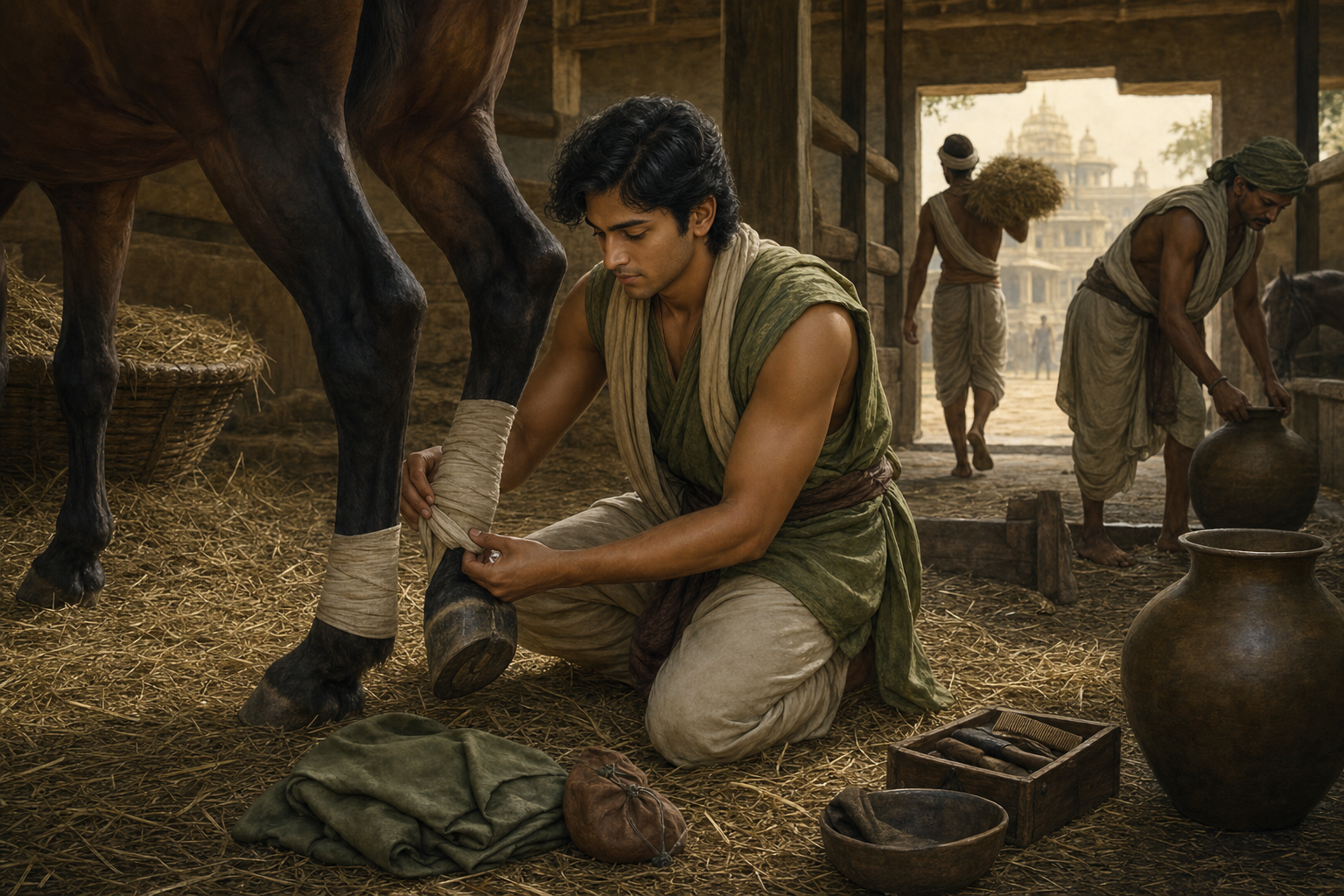
Nakula’s new name is meaningful first at the functional level. Granthika is the identity under which he can fulfil the conditions of exile and perform useful work. It marks a temporary social form suited to a specific duty.
It is wise not to force an unsupported etymology onto that name. The secure narrative claim is that Granthika is Nakula’s adopted identity and horse keeping is his occupation. Any further linguistic conclusion would require textual and philological evidence. The symbolism is already substantial without invented wordplay.
The deeper point is that adaptability need not mean shapelessness. Nakula changes how others encounter him, yet he does not abandon careful action. His circumstances determine which part of him may be visible, but they do not determine whether he will act competently.
Read in a Dharmic frame, this is situational intelligence rather than attachment to a single social label. The obligation of the incognito year cannot be met by insisting on public recognition. It must be met through restraint, credible service and fidelity to the purpose of exile. Nakula accepts a temporary form without mistaking that form for the whole of himself.
That distinction can guide you whenever circumstances require discretion. Do not ask only, “How do I make people see who I really am?” Ask, “What conduct will carry what is best in me through this period?” The second question protects identity at a deeper level because it makes character independent of applause.
Horse keeping adds a quiet dimension of healing
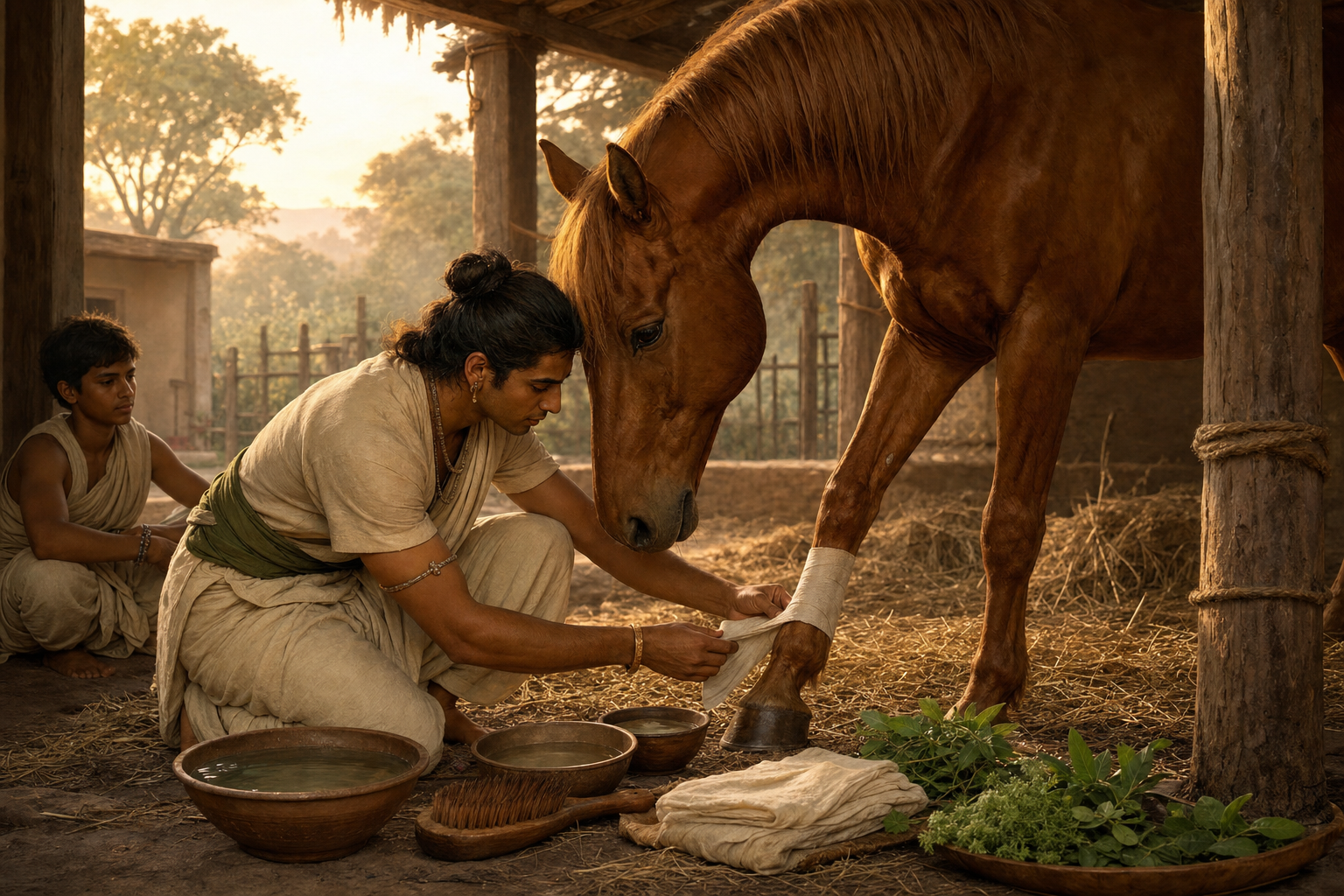
Care for horses has a restorative dimension. A keeper must notice condition, preserve routine and respond to signs of strain. The work is directed toward maintaining life and recovering steadiness, not merely extracting speed or labour from an animal.
This does not justify turning Granthika into a physician when the episode identifies him as a keeper of horses. Healing is the safer interpretive term: attentive care protects strength, corrects disorder and restores an animal’s ability to function. It describes the orientation of the work without enlarging the narrative claim.
The same symbolism reaches back toward Nakula. Incognito existence could fragment a person if every familiar marker of identity were treated as indispensable. Regular, skilled service gives him continuity. He may be hidden from the kingdom, but he is not idle, careless or detached from meaningful action.
There is a practical lesson here for any season of enforced waiting. Preserve one discipline directly connected to the person you intend to remain. Study when you cannot yet teach. Train when you cannot yet compete. Maintain your tools when public work is unavailable. Care for a living responsibility when recognition has receded. The object is not constant productivity; it is to prevent a temporary restriction from becoming inner neglect.
Horse keeping also corrects a common misunderstanding of heroic strength. Readiness is not maintained by dramatic action alone. It is maintained through repeated acts of care that keep power healthy enough to be used when its proper time arrives.
Key takeaways for reading Nakula’s disguise
- The narrative foundation is specific: Nakula becomes Granthika, keeper of horses, during the Pandavas’ required incognito year in King Virata’s kingdom.
- The disguise works through continuity: his public identity changes, but the role retains a genuine connection to his skill and temperament.
- The horse signifies disciplined vitality: power is neither discarded nor displayed recklessly; it is cared for, governed and kept ready.
- The healing symbolism lies in maintenance: attentive service preserves condition and restores steadiness without requiring an unsupported claim that Granthika served as a physician.
- The practical question is conduct: when your title or visibility changes, identify the discipline that will carry your character through the hidden period.
The next time you encounter an incognito identity in the Mahabharata, pause over the work chosen for it. Ask what that work allows the person to conserve. In Nakula’s case, the answer is not merely knowledge of horses. It is the ability to keep strength healthy, quiet and ready until concealment has fulfilled its purpose.
References
