
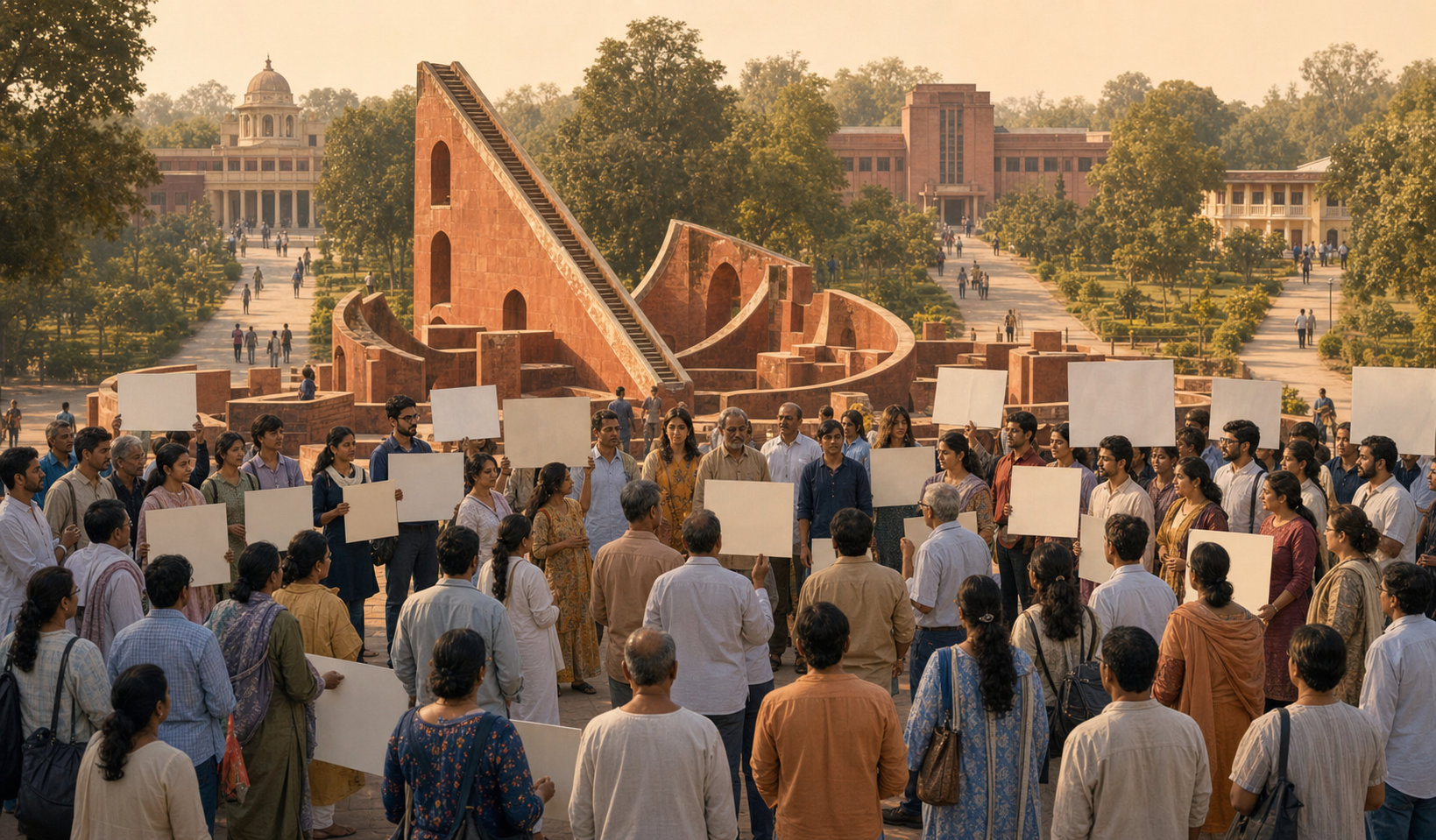
If you are deciding whether the Jantar Mantar demonstration deserves your support, do not begin with its loudest slogan or its most insulting label. Begin with the education grievances, identify the authority responsible for each one, and ask what remedy the protesters actually want.
That discipline matters because three different disputes have been bundled into one political event. Examination integrity, a contested University Grants Commission regulation and alleged CBSE marking irregularities do not have the same evidence, decision-maker or route to resolution.
Key takeaways
- The publicly described sequence places Education Minister D. Pradhan as the initial target and Modi as the later target. That shift turns an administrative dispute into a broader political confrontation.
- The protest brings together a paper-leak allegation, opposition to the UGC equity regulations and complaints about CBSE Class XII onscreen marking. Each claim must be tested separately.
- The Supreme Court stay concerning the UGC regulations matters, but a stay is not the same as a final judgment on the merits.
- The label “Cockroach Janata Party” is polemical language. It establishes nothing about the truth or falsity of the protesters’ complaints.
Three grievances require three separate tests

Bundling grievances is politically effective. A larger banner can draw people who have been harmed by different parts of the education system. But the same bundle can conceal weak evidence, blur responsibility and allow a general demand for justice to replace a remedy that an institution can implement.
- The examination-paper allegation: The first grievance concerns what has been described as a “NEET-UGC” paper leak, with Bihar and 2024 identified as the earlier reference point. The combined examination label is not precise enough for serious accountability. Before repeating the allegation, ask for the exact examination name, session, paper involved and official complaint or proceeding being relied upon.
- The UGC regulations: The University Grants Commission (Promotion of Equity in Higher Education Institutions) Regulations, 2026 were notified on January 13, 2026. They generated resentment among parts of the General Category Hindu community and were subsequently stayed by the Supreme Court. The useful questions are what provisions produced the objection, what the stay covers and what relief remains under consideration. “The Court stayed it” should not be inflated into “the Court finally decided it.”
- The CBSE marking complaint: The third grievance alleges irregularities in the onscreen marking used for Central Board of Secondary Education Class XII results. A persuasive case must identify the marking problem, show how it affected a result and state whether the existing verification or re-evaluation route was used. A general suspicion about digital marking cannot substitute for a documented discrepancy.
You do not need to dismiss the demonstration merely because its agenda is broad. You do need to resist transferring proof from one grievance to another. Evidence of a marking error would not prove a paper leak. Objections to an equity regulation would not establish that examination results were mishandled. Solidarity can connect people; it cannot connect facts that have not been demonstrated.
The change of target reveals the political strategy
Directing the first phase of pressure at Education Minister D. Pradhan follows the administrative chain. The listed grievances concern examinations, higher-education regulation and school-board marking. A ministerial target forces questions about departmental responsibility, institutional oversight and corrective action.
Moving the focus to Modi changes the scale of the protest. It can increase visibility and concentrate public anger, but it can also replace several answerable questions with one sweeping verdict on the government. That is the point at which an education protest becomes a vehicle for wider political positioning.
| Actor or institution | Role in the dispute | Question you should ask |
|---|---|---|
| Protest organisers | Combine grievances, choose targets and frame the public demand | What exact remedy is requested for each grievance? |
| Education Minister D. Pradhan | Faces executive accountability for matters placed within the education portfolio | Which problem can the ministry decide, investigate or refer? |
| Modi | Becomes the target of broader national political pressure | What intervention is being sought beyond action by the education authorities? |
| UGC and CBSE | Are the institutions directly named in the regulatory and marking disputes | Which rule, record or review process answers the allegation? |
| Supreme Court | Provides the judicial setting for the stay concerning the UGC regulations | What has actually been stayed, and what remains undecided? |
This map helps you detect political substitution. If a speaker attacks the highest-profile figure but cannot name the official capable of granting the requested relief, attention may have overtaken resolution. If an institution hides behind the political controversy instead of answering a documented complaint, bureaucracy may be using the noise as cover. Apply the same test to both.
Partisan language is not a substitute for political analysis
The abbreviation CJP has been paired with the expression “Cockroach Janata Party.” That wording is an insult, not an explanation. Unless demonstrators formally use a name themselves, you should not convert a hostile description into their verified organisational identity. More importantly, nothing about the insult establishes whether a paper leaked, whether a regulation is defensible or whether marks were mishandled.
Dehumanising language also gives political actors an easy escape. Supporters can avoid answering weak claims because they are busy condemning the insult. Opponents can avoid examining valid grievances because the label has already declared the protesters contemptible. In both cases, rhetoric protects someone from scrutiny.
Before you forward a clip, endorse a slogan or reject the protest, run five checks:
- Name the claim precisely. “Education is corrupt” is not testable. A specified examination-paper leak, regulation or marking discrepancy is.
- Separate allegation from established action. A protest demand, a reported irregularity, a regulatory notification and a court stay are different kinds of facts.
- Ask for the primary record. Look for the relevant notification, order, result record, complaint or official response rather than relying on a slogan about it.
- Match the demand to the authority. Identify who can investigate, suspend, revise, re-evaluate or adjudicate. A target who cannot supply the requested remedy may be politically useful but administratively irrelevant.
- Watch for identity inflation. Resentment among parts of the General Category Hindu community does not authorise anyone to speak for every General Category Hindu, much less for all Hindus.
This method does not require political neutrality in the sense of having no convictions. It requires evidentiary consistency. A claim made by people you favour deserves the same document check as a claim made by people you oppose.
A dharmic response must hold truth and justice together

A pro-Hindu response should take the stated resentment within the General Category Hindu community seriously without turning communal identity into proof. Concerns about fairness, discriminatory treatment or inaccessible grievance procedures deserve a hearing. They become stronger, not weaker, when tied to the exact language of a regulation and a clearly defined remedy.
The same standard applies to students alleging examination or marking failures. Their futures should not become props for a party narrative. Ask what happened, which record supports it, who has jurisdiction and what correction would restore fairness. That keeps attention on the person affected rather than on whichever political camp benefits from the controversy.
Satya and nyaya cannot be separated here. Truth without a path to justice becomes sterile commentary. A demand for justice without disciplined truth becomes a weapon that can be turned against anyone. Our public conduct should refuse both failures.
If you choose to support the Jantar Mantar protest, support a precise demand: one claim, its best available evidence, the authority responsible and the remedy sought. If those four elements cannot yet be supplied, present the matter as a question requiring investigation, not as a conclusion others are morally obliged to repeat.
References
