
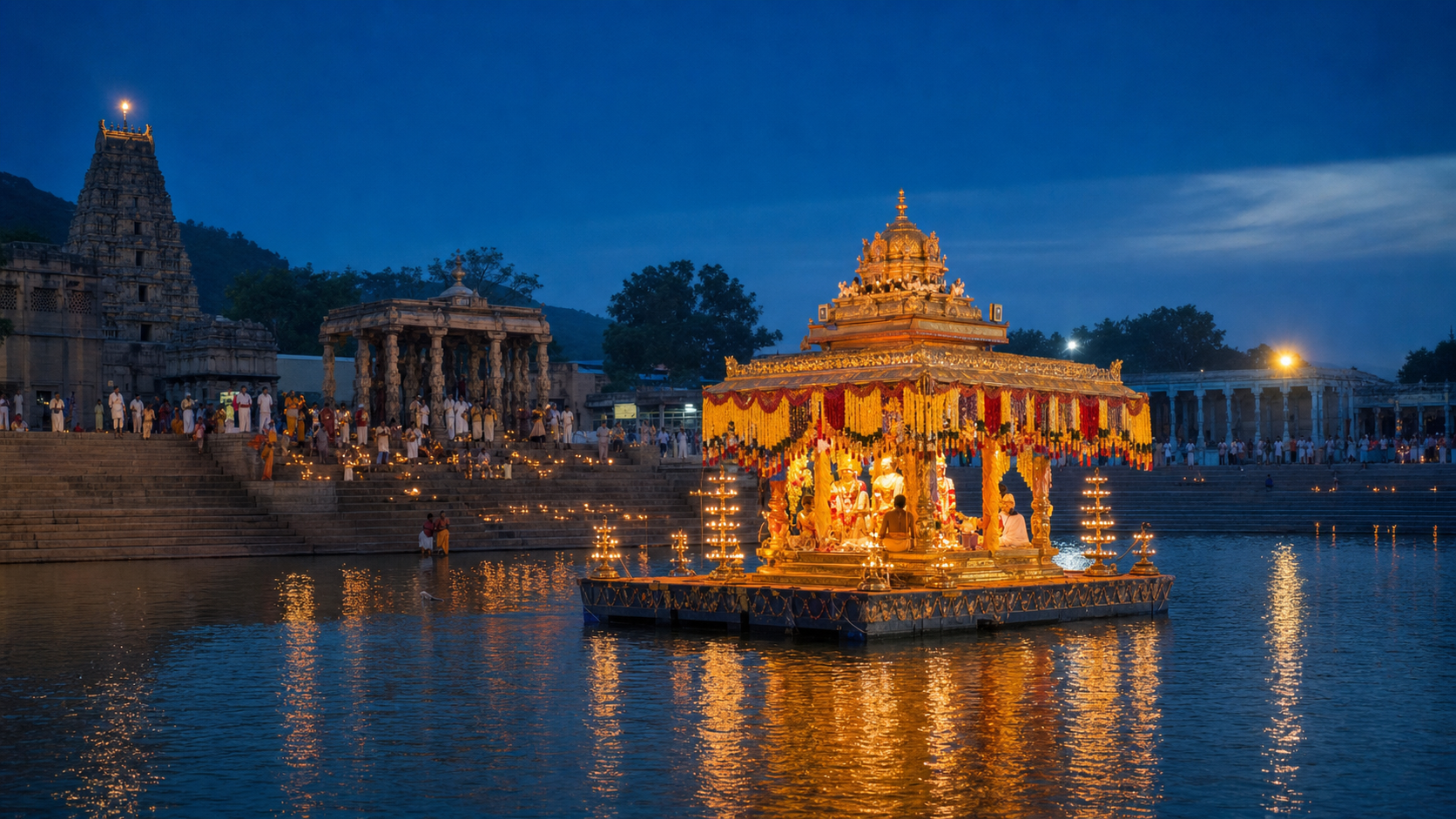
If 2 and 3 March sit back-to-back on your Tirumala itinerary, treat them as two different pilgrimage days. The first centres on the Float Festival finale at Swami Pushkarini; the second brings an eclipse-related pause in TTD Annaprasadam services in Tirupati and Tiruchanoor.
Your plan therefore needs two firm anchors: settle the festival-day logistics before you arrive, and make your meal arrangements for 3 March independent of an assumed reopening time. That does not mean treating every TTD activity or every restaurant as closed. It means distinguishing a confirmed food-service advisory from details that still require local verification.
The two-day pinch point: 2 March into 3 March
The most important fact is the sequence. Srivari Salakatla Teppotsavam reaches its concluding evening on 2 March, when Sri Malayappa Swamy with Sridevi and Bhudevi is taken on the illuminated float upon Swami Pushkarini. The finale is expected to attract the largest congregation of the festival. On the following day, TTD-operated Annaprasadam centres in Tirupati and Tiruchanoor pause distribution for Chandra Grahan observances.
| Date | What changes | What you should do |
|---|---|---|
| 2 March 2026 | Srivari Salakatla Teppotsavam concludes at Swami Pushkarini, with a large evening gathering expected. | Confirm the timing locally, arrive well before access corridors fill, and keep the rest of the evening flexible. |
| 3 March 2026 | TTD Annaprasadam distribution in Tirupati and Tiruchanoor is suspended through the eclipse observance and subsequent purification. | Arrange suitable food beforehand and do not base medication, onward travel or family needs on an estimated reopening hour. |
The common planning error is to treat these as two ordinary consecutive dates: attend an after-dusk utsavam, return late, and assume that the familiar TTD meal network will operate normally the next day. Remove that dependency before you travel. A festival crowd can delay movement on 2 March, while ritual purification makes the end of the 3 March food-service pause uncertain.
Build an itinerary that can absorb both disruptions
You do not need an elaborate schedule. You need a schedule with the right dependencies removed.
- Book accommodation and any eligible darshan arrangements through official TTD channels well in advance. Festival demand can tighten room availability, and an unconfirmed room makes every later decision harder.
- Check three items separately when you reach the area: the Teppotsavam start time and viewing access, any changes to darshan or queue routing, and the eclipse-day reopening status of the food centre you intend to use. Confirmation of one does not confirm the others.
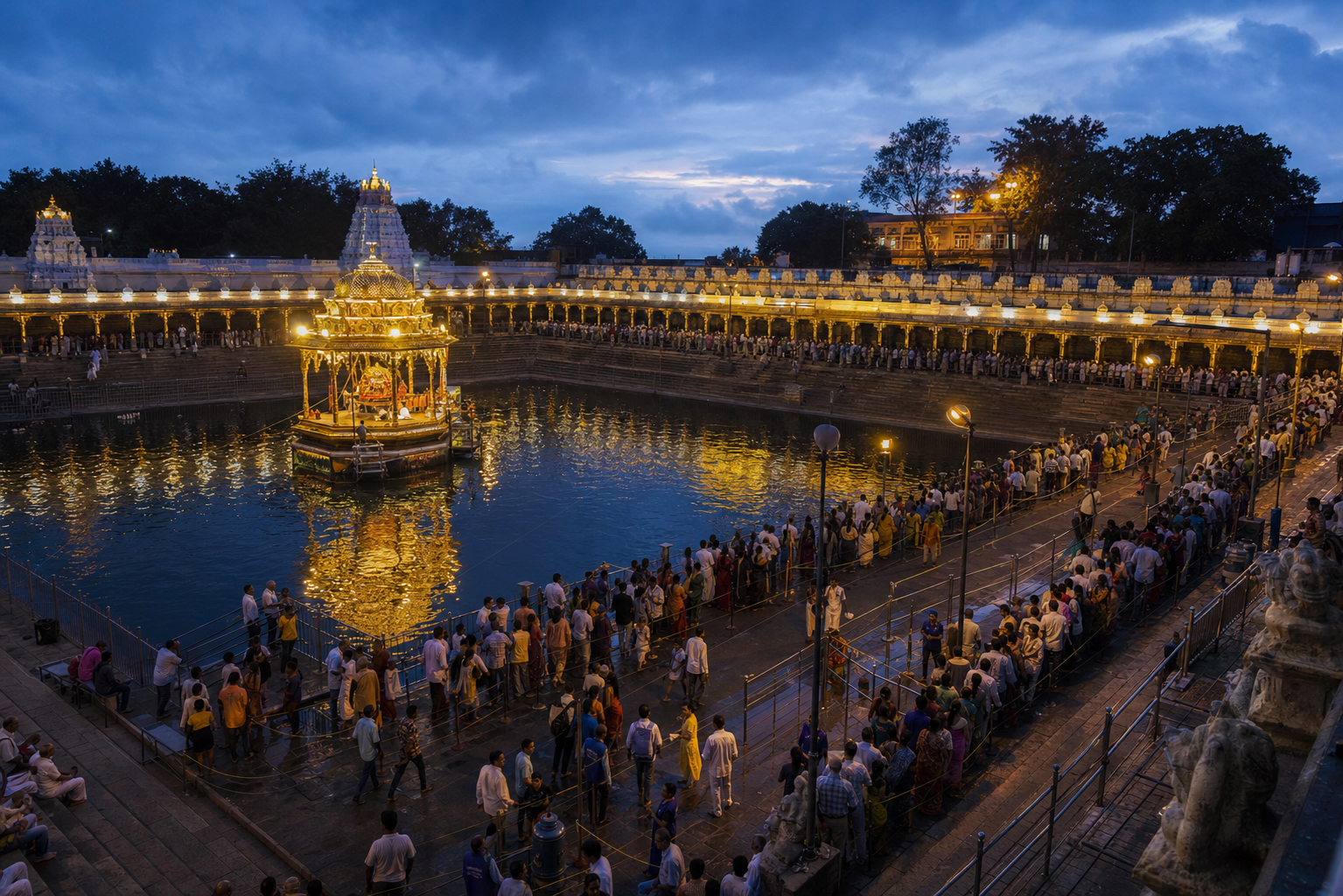
- For the Float Festival, reach the Pushkarini approaches well before the announced proceedings. No reliable universal arrival hour can be given because security corridors, phased admission and circulation routes depend on TTD’s operational plan.
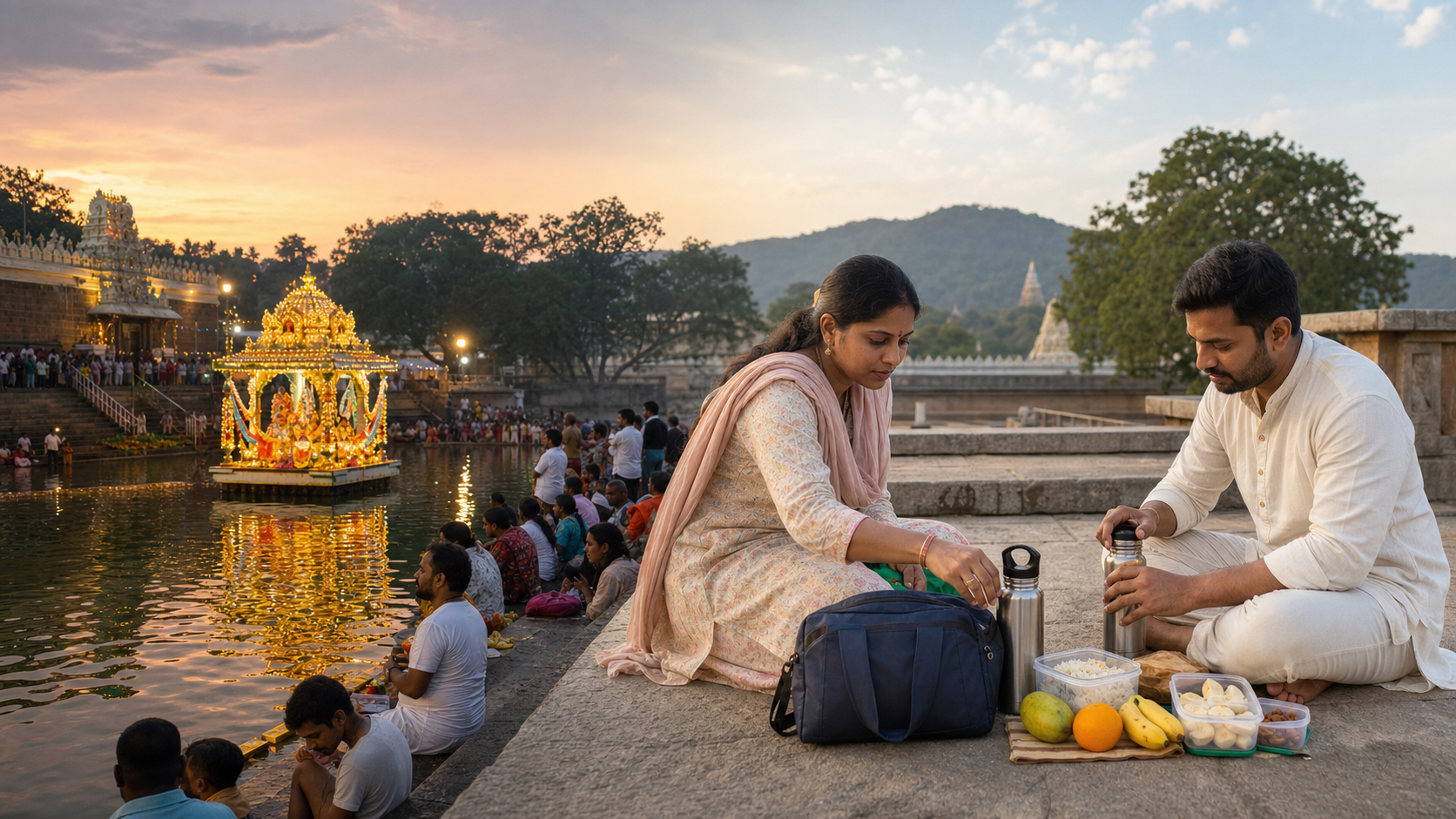
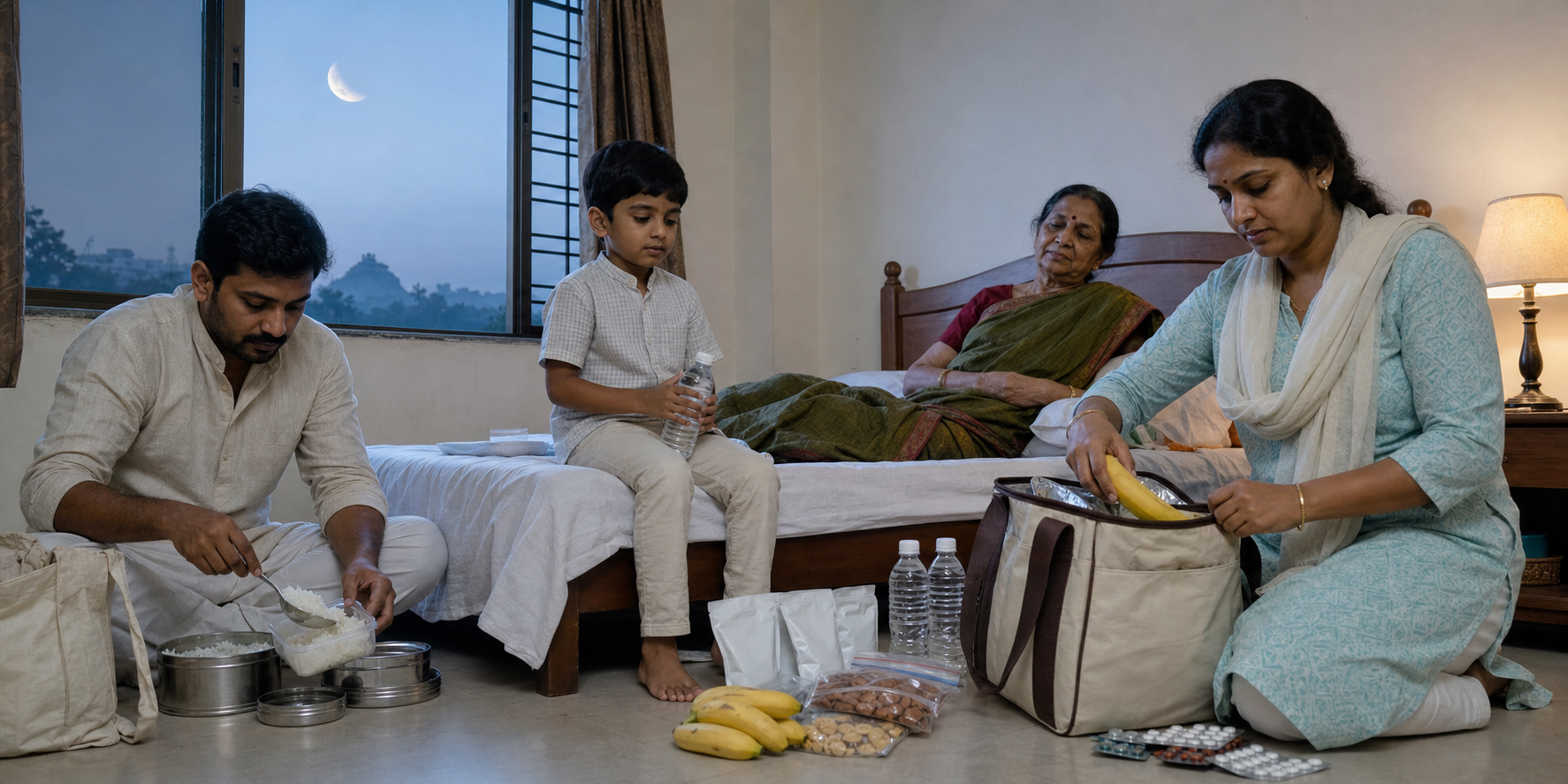
- Complete essential meal preparation on 2 March. If it accords with your vrata and personal circumstances, keep satvika, ready-to-eat provisions available for 3 March. Keep this plan separate from temple entry because phones, cameras, luggage and other belongings may need to be deposited at designated counters.
- Do not place a fixed onward journey immediately after the time you expect Annaprasadam to resume. Service restarts only after the prescribed purification and naivedyam sequence, so the local announcement matters more than an unofficial estimate.
- If you are travelling with children, elders or anyone who needs regular food or medication, identify rest points near the Mada streets and Pushkarini approaches, agree on a meeting point, and keep their health requirements ahead of a voluntary fast.
On 3 March, use TTD notice boards in Tirupati and Tiruchanoor and SVBC announcements for same-day clarification. An accommodation desk, volunteer or local sign can help you understand the service point in front of you, but it should not be treated as confirmation for every TTD facility.
Know exactly what the eclipse advisory covers
The announced suspension covers TTD-run Annaprasadam centres in Tirupati and Tiruchanoor. This includes the SV Nitya Annaprasadam building at Thollappa Gardens in Tiruchanoor, the employees’ canteen in the TTD Administrative Building at Tirupati, and select canteens serving major TTD rest facilities in the twin towns. Privately operated eateries fall outside this TTD notice; that means their status must be checked independently, not that every private establishment is guaranteed to open.
The distinction matters because an Annaprasadam closure is not merely a staffing or supply interruption. Annaprasadam is connected to naivedyam offered to the deity. During the period of Sutak associated with Chandra Grahan, cooking, naivedyam and distribution of sanctified food are withheld. Temple kitchens then resume only after the prescribed sequence, including alaya shuddhi, punyahavachanam, cleansing of utensils and restoration of the naivedyam order.
Traditional reckoning places the beginning of Sutak nine hours before a lunar eclipse. That number does not give you a safe reopening time. The service pause continues through the eclipse and the purification rites that follow, and the completion of those rites must be confirmed locally.
At Vaikhanasa Agama temples, including the principal shrine at Tirumala, routine nitya and naimittika kainkaryams are suspended within the applicable period of ritual impurity and resume after shuddhi procedures. Do not convert that liturgical rule into an invented public-access timetable. The available advisory establishes the food-service closure in Tirupati and Tiruchanoor; specific darshan access, queue arrangements and seva changes still require a TTD update.
Institutional kitchens apply a uniform discipline, but household practice commonly allows relaxation for children, pregnant women, elders and people who are ill. If you or a family member requires food, water or medication at regular intervals, safeguard that need. A temple kitchen’s collective protocol is not a reason to disregard an individual’s health requirements.
Turn the waiting period into deliberate practice
If you observe Sutak, choose your practice before the day becomes logistically demanding. Mantra-japa, dhyana and svadhyaya are traditionally suitable; Vishnu Sahasranama or Bhagavad-gita parayana gives the period a defined focus. Carry what you need for that practice in an appropriate form rather than depending on an improvised plan after services have paused.
The same inward turn can be expressed across the wider dharmic family. A Jain pilgrim may give greater attention to samayik or pratikraman, a Buddhist practitioner may dedicate the period to meritorious practice, and a Sikh may choose Gurbani paath or seva. The disciplines are not interchangeable, but they share a refusal to let unusual celestial or public circumstances dissolve ethical attention.
See the Float Festival without making the crowd the centre
The 2 March finale is worth planning around because the utsava murti comes into the larger temple landscape. As the float moves around Swami Pushkarini, the combination of lamps, Vedic recitation, mangala vadyam and devotional singing turns darshan into an experience of sustained attention rather than a brief glimpse at a doorway.
Festival evenings customarily unfold after dusk, but the precise 2026 timing and route remain subject to TTD’s arrangements. Arriving early improves your chance of finding an authorised position along the Pushkarini bunds before crowd controls tighten. It does not guarantee an unobstructed view, and it should never be used to justify blocking a corridor, ignoring a barricade or resisting staff directions.
March generally brings warm, dry days and more pleasant evenings in Tirumala. Carry hydration appropriate to your needs, wear dignified and modest clothing, and allow extra time for security and the deposit of mobile phones, cameras or luggage. Avoiding plastic and keeping pathways clear are not minor courtesies in a dense gathering; they reduce the burden on the sacred environment and on the people managing it.
If you are travelling with an elder or child, a stable resting place and an easy exit route are more valuable than the closest possible viewpoint. If the line of sight is imperfect, let the recitation, music and movement of the procession hold your attention. The theological purpose of the utsavam is the deity’s accessibility to the gathered community, not competition for a privileged photograph.
Key takeaways for your March pilgrimage
- Keep 2 March flexible for the Teppotsavam finale and arrive early enough to follow phased access around Swami Pushkarini.
- Assume no TTD Annaprasadam availability in Tirupati or Tiruchanoor on 3 March until officials announce that post-eclipse purification is complete.
- Remember that the advisory covers TTD food services; it does not by itself supply a complete darshan-closure schedule or determine whether a private eatery will open.
- Arrange satvika provisions in advance where appropriate, but do not put fasting ahead of the needs of children, pregnant women, elders, sick pilgrims or anyone dependent on regular food and medication.
- Use official booking channels before travel, then rely on TTD notice boards, on-site directions and SVBC announcements for changing operational details.
Before you leave for Tirumala, write down your three non-negotiables: where you will stay, how you will manage food on 3 March, and where you will verify the latest TTD instructions. Once those are settled, the two days can recover their proper purpose: attentive darshan on the water, disciplined observance during the eclipse, and consideration for every pilgrim sharing the journey.
References
- DharmaRenaissance Blog — TTD’s Important Advisory: Annaprasadam halted on Chandra Grahan, 3 March 2026
- DharmaRenaissance Blog — TTD March 2026 Festivals Guide: Unmissable Utsavams, Float Festival Finale, Darshan Tips
