
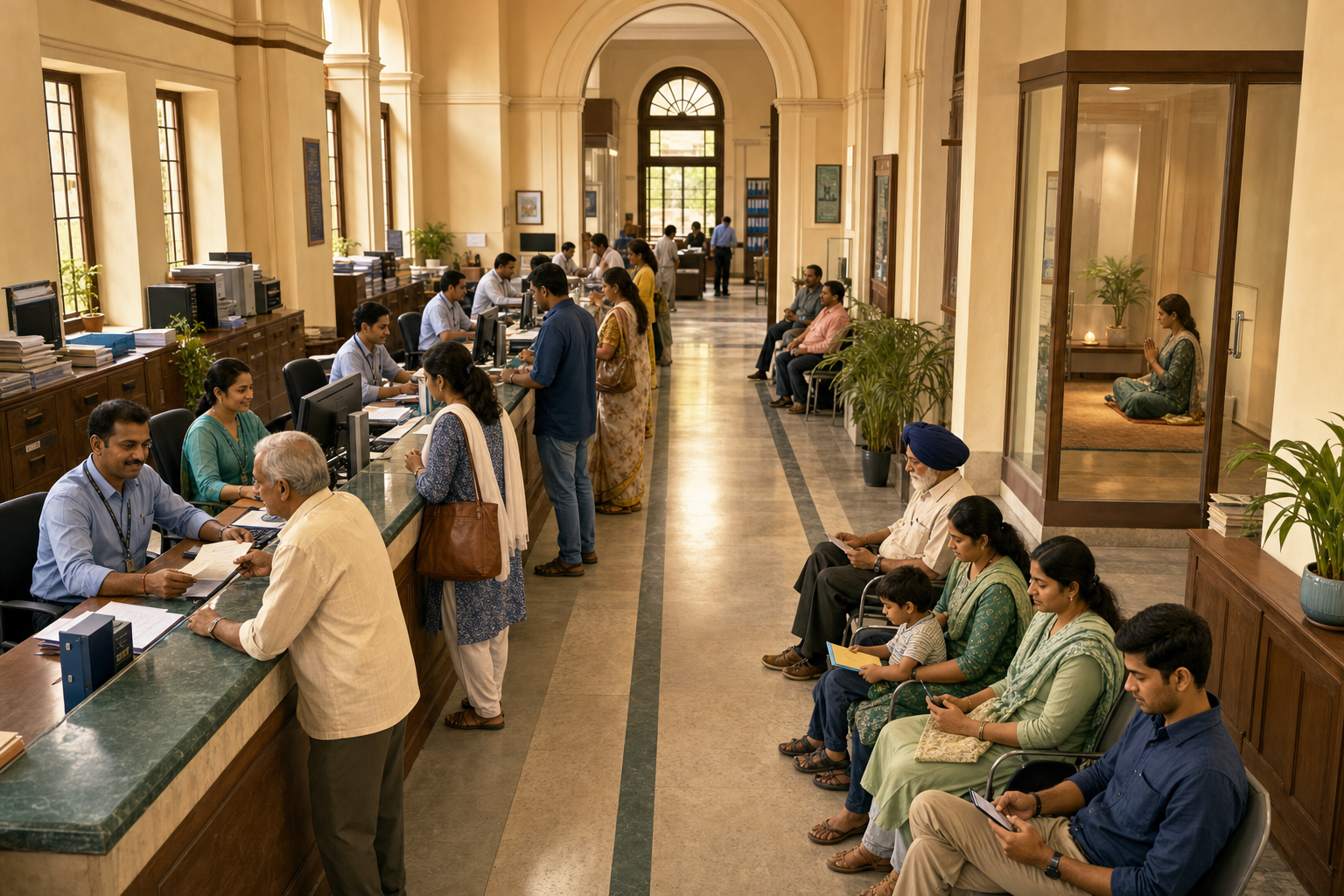
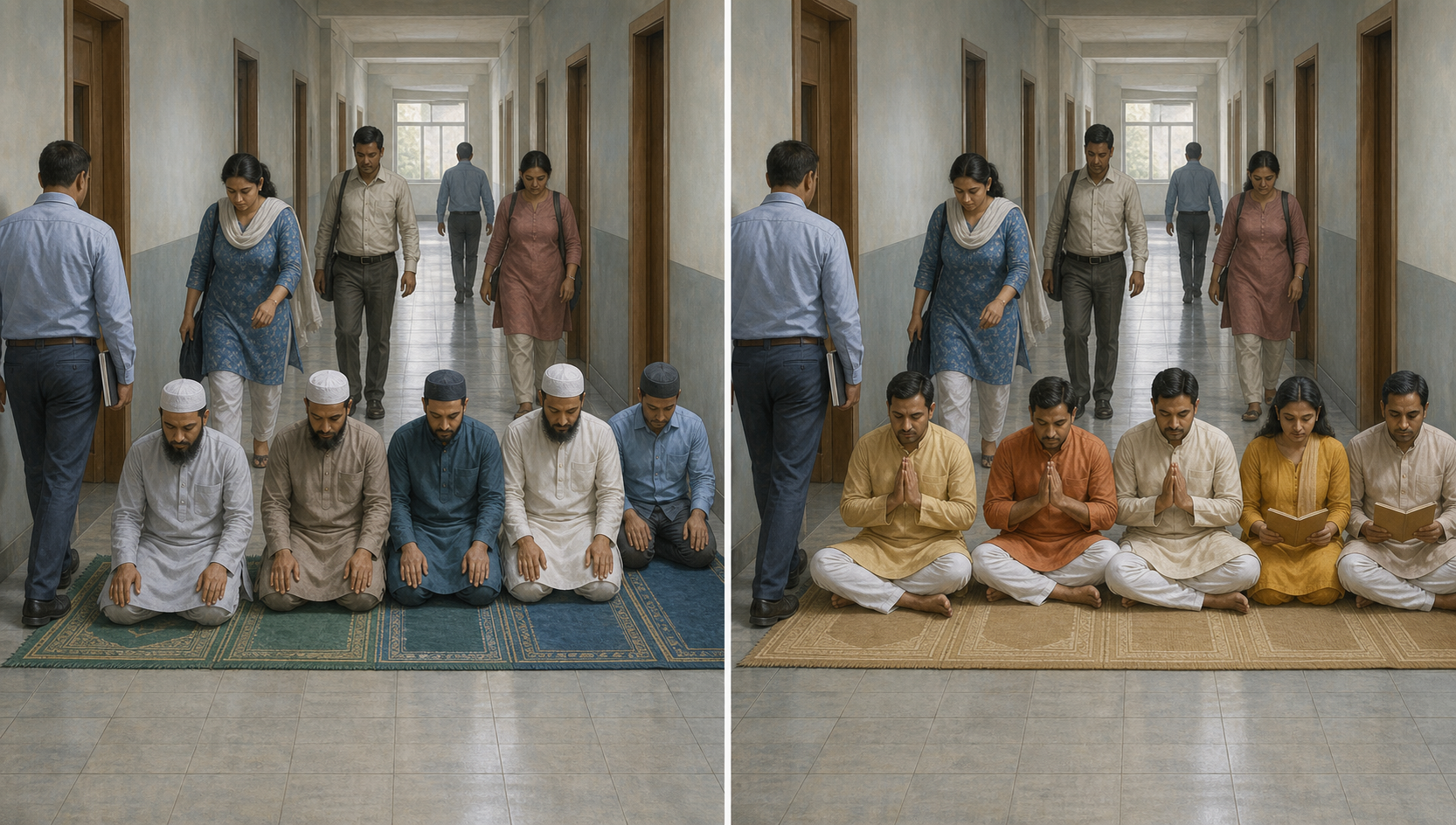
You walk into a municipal office and find a group prayer under way while counters, corridors, or staff are meant to be serving the public. The immediate question may seem obvious: if one faith can pray there, should every other faith respond in the same place? That sounds like equality, but it can turn one possible breach into several. The better question is whether the office had a neutral rule and applied it equally.
The distinction became urgent after the Malegaon confrontation reported on 2 March 2026, in which Hanuman Chalisa recitation reportedly followed Namaz inside a municipal office and police subsequently registered a case against several activists. If you face a similar situation, you do not have to choose between accepting a double standard and staging an instant counter-recitation. You can document what happened, obtain the permission record, demand one rule for everyone, and keep a sacred practice from becoming fuel for escalation.
The test is conduct, not the name of the prayer
India’s constitutional framework protects religious conscience and practice, but it does not give any community an unlimited claim over a particular government room, corridor, working hour, or sound system. Article 25 protects religious freedom subject to public order, morality, and health. The freedoms of expression and peaceful assembly are also protected, while reasonable regulation remains possible. Article 26 protects the affairs of religious denominations, but it does not displace the state’s responsibility to keep public institutions functioning.
A government office is not interchangeable with a temple, mosque, gurdwara, monastery, community hall, street, or public ground. Its primary purpose is administrative service. Citizens must be able to reach the counter, employees must be able to work, and visitors must not have to participate in or pass through a congregation to obtain a public service. That functional purpose is why the state may regulate the time, place, and manner of collective activity without deciding whether one prayer is more worthy than another.
Four questions usually reveal the real issue:
- Was there prior written permission? Do not assume that an activity was unauthorised merely because you saw it inside an office. Ask for the applicable campus rule and the permission status. An informal assurance from a sympathetic employee is not the same as a recorded approval from the competent authority.
- Was government work or public access impeded? Note whether counters closed, staff stopped work, queues were displaced, doors or passages were blocked, visitors were delayed, or unwilling people were drawn into the activity. These observable effects are stronger evidence than an argument about motives.
- Was the same rule available to every community? A permission system is not neutral merely because it exists on paper. Comparable requests must be assessed using the same criteria, with recorded reasons for approval or refusal.
- Did the conduct create a foreseeable risk of disorder? Amplification, provocative slogans, rival mobilisation, refusal of a lawful direction, or an act deliberately presented as a reply to another community changes the situation. It may become a public-order event rather than a simple devotional observance.
| Situation | Decisive issue | Practical response |
|---|---|---|
| Silent japa, remembrance, or brief personal prayer | Whether it interrupts work, occupies shared space, or pressures others to participate | Apply the office’s neutral rule for quiet personal observance |
| Collective prayer or recitation | Written permission, location, timing, capacity, and equal availability | Verify the approval and move the gathering if official work or access is affected |
| Amplified or obstructive activity | Noise, access, safety, and compliance with lawful directions | Stop the disruption and offer a suitable alternative location where feasible |
| Prayer organised as a reply to another faith | Whether the act has become a protest or counter-mobilisation | Separate the groups, apply the same rule to both, and prevent further mobilisation |
These distinctions prevent three common mistakes. Religious liberty is not an entitlement to every venue. Equal treatment does not mean duplicating an unapproved act. Government neutrality does not require citizens or employees to become irreligious; it requires the institution not to privilege, sponsor, or selectively burden a faith.
Brief personal devotion is therefore different from commandeering a common area. A silent mantra before beginning work, a private remembrance, or a short prayer that neither delays service nor recruits a congregation will often present little operational concern. That does not create a universal legal entitlement, however. Secure facilities, specialised workplaces, and offices with limited space may need stricter rules. The policy, rather than the religious identity of the person, should decide.
If the rule looks unequal, build a record before a protest

If you believe one community received access that Hindus, Sikhs, Buddhists, Jains, or others would be denied, your strongest response begins with facts. A viral clip may show a prayer but omit whether permission existed, where the group was authorised to assemble, what happened before filming began, or what directions officials gave afterward. Do not turn an incomplete record into a public accusation that can later obscure the original grievance.
Use this sequence:
- Protect access and safety first. Do not push through a group, touch religious objects, interrupt a recitation, cross a security barrier, or provoke participants. If a person is in immediate danger, alert on-site security or police. A policy dispute can be pursued after the immediate risk is contained.
- Identify the exact government space. Record the office name, department, room or common area, date, approximate time, and the public service normally conducted there. A complaint about a named location is actionable; a claim that prayer happens throughout government is not.
- Separate what you observed from what you inferred. Write down the number of people only if you can do so responsibly, the duration you personally observed, whether sound was amplified, which entrances or counters were affected, and any directions you heard an official give. Do not assign an organiser, intention, or political affiliation without evidence.
- Ask for the rule and the permission status. Politely request the written campus-use policy, the authority competent to approve gatherings, and confirmation of whether the activity was official, permitted, tolerated without permission, or under review. Follow the office’s records or grievance procedure rather than demanding personal information about participants.
- Obtain a receipt for your representation. Address it to the municipal commissioner, department head, estate or security authority, or designated grievance officer, depending on the institution. Keep a copy and obtain a diary number, acknowledgement, or other proof of submission.
- Request a neutral remedy. Ask the office to disclose and enforce one rule for all collective activities, publish the permission process, restore unobstructed public service, and identify an alternative venue where appropriate. This is more precise than asking officials to ban or favour a named religion.
- Escalate the record, not the temperature. If the first response is inadequate, submit the acknowledgement, policy request, and documented operational effects to the appropriate supervisory or legal channel. Avoid summoning a crowd while the basic permission facts remain unresolved.
A useful written representation can be short. State what you personally observed, identify the government function affected, ask whether written permission existed, request a copy or citation of the applicable policy, and seek equal future enforcement. Remove adjectives about the participants’ character or patriotism. Administrators can answer a factual request; they cannot productively answer a quarrel about presumed motives.
If you record an incident, obey local security and recording restrictions. Do not enter a restricted area to obtain footage, focus unnecessarily on private individuals, edit the sequence to conceal what preceded it, or publish unverified names. Preserve the original file and its context. The relevant evidence is often the location, timing, official directions, effect on public service, and permission record rather than a close-up of worshippers.
Once an FIR, police notice, arrest risk, or allegation of provocative speech enters the matter, general commentary is no substitute for advice from a qualified local advocate. The presence of an FIR does not establish guilt. The legal significance of an assembly can depend on the governing law, a valid official order, each person’s conduct, actual obstruction, words used, and the reasonably foreseeable risk of disorder. Preserve notices, original recordings, permission documents, and the chronology; do not attempt to decide criminal liability from a short clip or coordinate public versions of events.
A workable campus policy answers predictable questions

Many confrontations begin because an office has no published rule, relies on informal custom, or acts only after rival groups arrive. A one-page policy issued before the next controversy is more valuable than a long statement issued after it. It should govern religious and non-religious gatherings alike, because the operational issue is collective use of government property.
A usable policy should include:
- Scope. Identify the buildings, courtyards, corridors, meeting rooms, entrances, staff areas, and external grounds covered by the rule. State whether it applies to employees, visitors, office-holders, contractors, and outside organisations.
- Clear categories. Distinguish brief personal observance from a collective act, an official ceremony, a public meeting, a demonstration, and an amplified event. If these categories are left vague, frontline staff will make inconsistent decisions.
- A written permission route. Provide one application point and identify the deciding authority. The form should ask for the organiser, proposed place and time, expected attendance, duration, equipment, amplification, and any effect on routine services. The office should decide within a stated period and record reasons.
- Neutral decision criteria. Use capacity, existing bookings, continuity of service, public access, safety, security, noise restrictions, and available staff. Do not assess the truth, popularity, or political strength of a religion.
- A non-disruption baseline. No gathering should block a counter, passage, entrance, emergency route, or citizen’s access to a service. No visitor should be required to participate in, display assent to, or wait through an observance as a condition of receiving government service.
- Rules for sound and equipment. State when loudspeakers, instruments, temporary structures, electricity, decorations, or recording equipment require separate clearance. A religious label cannot convert avoidable noise into an entitlement.
- Alternatives. Where space permits, a quiet reflection room may be available for brief personal use under the same conditions for everyone, without congregation or amplification. Larger activities can be directed to an external, bookable public area governed by a neutral queue.
- Records and review. Keep permission decisions, reasons, official directions, and incident reports. Provide a channel through which a denied applicant or affected citizen can request review without assembling at the office.
The permission process itself must be genuinely accessible. A formally neutral rule can still produce discrimination if only favoured organisers know whom to call, if approvals remain oral, or if reasons are never recorded. A single application route, a visible decision standard, and a written outcome let citizens compare like cases without relying on rumour.
Frontline officials also need a pre-agreed incident sequence. When an unplanned collective act begins, they should verify the facts and permission status; keep rival groups apart; state the applicable rule without debating theology; offer a neutral alternative venue where feasible; restore public access; record directions and responses; and issue a short, time-stamped clarification before an incomplete video defines the event. The record should describe conduct consistently: unauthorised gathering, blocked corridor, amplified sound, refusal of direction, or peaceful compliance. Labels such as provocative community should not substitute for observed facts.
Supreme Court guidance supports this operational approach. Himat Lal K. Shah v. Commissioner of Police, Ahmedabad (1972) recognised the importance of peaceful assembly while affirming the state’s authority to regulate it for order. Church of God (Full Gospel) in India v. K.K.R. Majestic Colony Welfare Association (2000) made clear that religious freedom does not confer a right to inflict noise on others. In Re: Noise Pollution (2005) upheld restrictions on loudspeakers, including limits associated with night-time use. The administrative lesson is straightforward: write lawful time-place-manner rules before conflict occurs and enforce them without changing the standard to suit the identity of the group.
Proportion also matters. A person who immediately complies with a clear direction does not present the same problem as an organiser who deliberately obstructs work, mobilises a rival crowd, or defies a lawful order. Warnings, education, or restorative measures may be suitable for a first, non-violent misunderstanding where the governing process permits them. Conduct that creates a serious public-order risk can justify a firmer response. Equal enforcement means comparable treatment for comparable conduct, not mechanically identical punishment regardless of circumstances.
Retaliatory prayer weakens a legitimate Hindu claim
If Namaz occurred without permission, replying with an unapproved Hanuman Chalisa may feel symmetrical. It is not equality in the constitutional sense. It gives the administration a second gathering to control, increases the possibility of confrontation, and allows the original question of selective permission to disappear behind a dispute over the response.
Hindus should not be expected to accept a double standard. The strongest demand, however, is not that every unauthorised use be matched by another. It is that officials disclose whether the first act was permitted, apply the same rule and proportionate consequences to comparable conduct, and publish a process that cannot be quietly reserved for one community. That demand remains coherent whether the activity is Namaz, Hanuman Chalisa, paath, kirtan, a Buddhist chant, a Jain prayer, or a non-religious political meeting.
A sacred recitation should not become an administrative measuring device or a tool for baiting rivals. Once worship is announced as a counter to another community, observers and authorities may reasonably treat the gathering as protest activity. The words remain sacred to devotees, but the public conduct acquires a different purpose and risk. If your aim is to defend the dignity of Hindu practice, do not hand control of its timing and meaning to an opponent’s provocation.
A Dharmic response is not passive. Satya requires verifying the permission record before repeating a claim. Ahimsa requires avoiding a foreseeable escalation, not surrendering the demand for justice. Karuna requires correction without collective humiliation; it does not require tolerating favouritism. Hindu, Buddhist, Jain, and Sikh traditions express these disciplines differently, but truthfulness, restraint, and concern for the dignity of others provide a practical civic method.
Community leaders can set the tone in the first public statement. They should say that they are seeking the full permission record, oppose obstruction and selective enforcement by any group, request one written policy, and ask supporters not to assemble at the office while facts are being established. That language preserves the claim, discourages rumour, and gives officials a specific remedy to provide.
The same discipline should govern media and social-media use. Ask what occurred before the clip, whether the space was booked, which official directions were given, whether public work stopped, and how comparable applications were handled. Share a time-stamped official clarification when one becomes available. Do not let the most inflammatory few seconds become a substitute for the administrative record.
Key takeaways for the decision in front of you
- Quiet personal devotion and organised collective worship are not the same use of a government workplace.
- Ask four questions: Was there written permission? Was service or access impeded? Was the same rule available to all? Did the conduct create a foreseeable risk of disorder?
- Equal treatment means one neutral rule for comparable conduct. It does not require you to imitate a possibly unauthorised act.
- If you witness apparent favouritism, record observable facts, request the policy and permission status, obtain an acknowledgement, and ask for an equal administrative remedy.
- If you administer a public campus, publish the rule before an incident, use recorded operational criteria, provide an accessible booking route, and train staff in de-escalation.
- If an FIR or police notice is involved, remember that an allegation is not proof. Preserve the record and obtain advice from a qualified local advocate rather than relying on social-media interpretations.
Your next move should be small and exact: ask the office for its written campus-use policy and the permission status of the event you observed. If no clear rule exists, request one that protects personal faith, keeps collective activity from disrupting public work, and applies without fear or favour. That is a firmer defence of religious dignity than a contest over who can mobilise the next prayer.
References
