
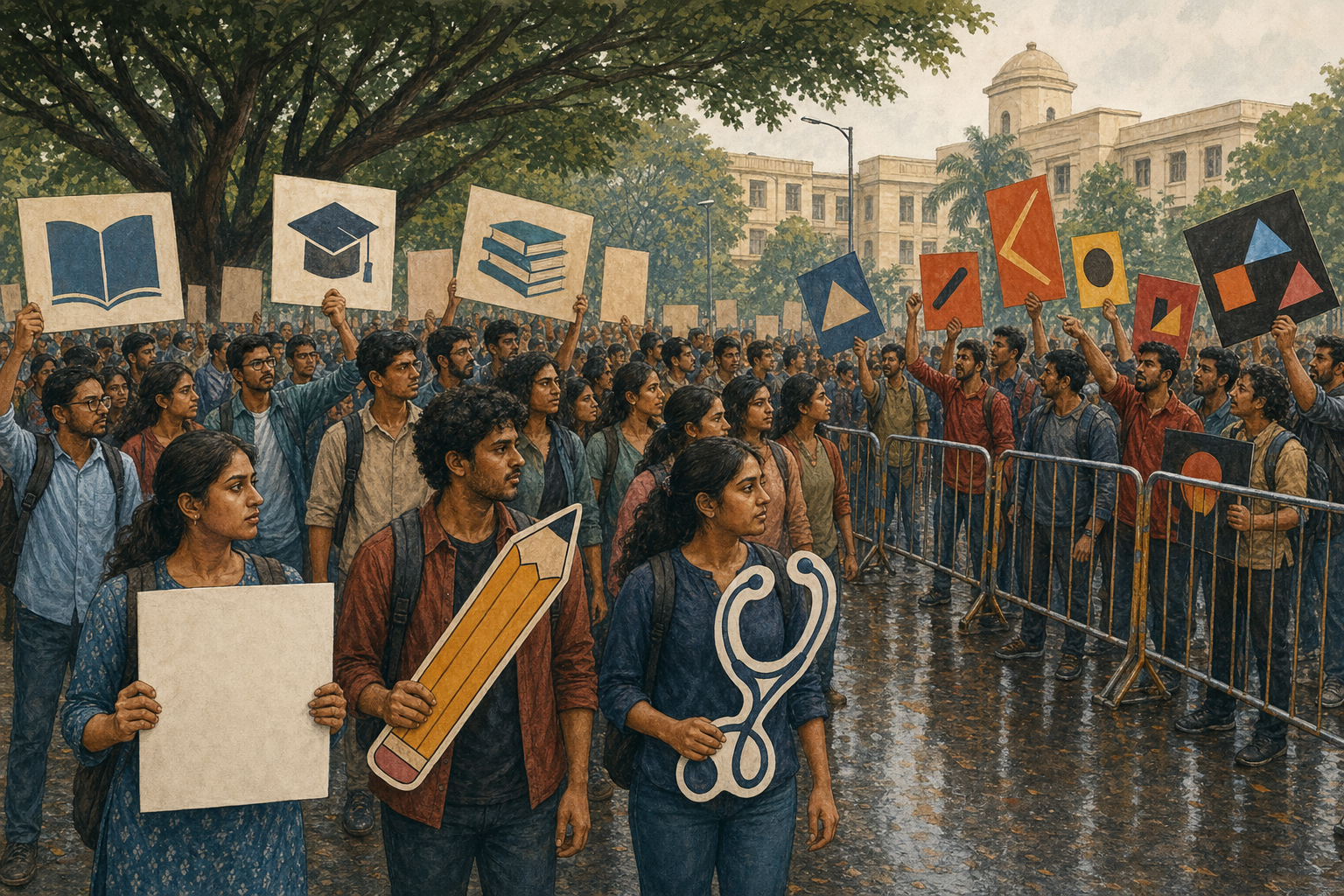
If you saw the placards from Bengaluru and wondered whether NEET was merely a pretext, the evidence supports a more precise answer. The slogans introduced an unmistakably unrelated political agenda into an education protest, but their presence alone does not prove that every participant or organizer endorsed that agenda.
You can take the incident seriously without turning an allegation against one woman into a verdict on an entire crowd. The useful questions are who displayed the messages, how widely they were repeated, how organizers responded, and what the police can actually establish.
The protest had an education agenda, then visibly departed from it
The demonstration at Freedom Park was organized by student groups after an alleged police lathi-charge on students in Delhi. Its declared demands included the resignation of Union Education Minister Dharmendra Pradhan, and the gathering was estimated to have drawn 1,000-1,500 participants.
That stated purpose matters. It gives you a baseline against which to judge everything that followed. A placard about NEET, examinations, student safety, police conduct or the education minister would have remained within the announced dispute. Slogans praising Umar Khalid and Sharjeel Imam did not.
A police complaint alleges that an unidentified woman displayed placards bearing Umar Khalid Zindabad, Sharjeel Imam Zindabad and Ukhaad Le BLR Police. Placards concerning Palestine and Kashmir were also reportedly present. Whatever position you hold on those issues or on the criminal cases involving Khalid and Imam, none was necessary to state a grievance about NEET.
This is agenda drift: a platform assembled for one identifiable cause begins carrying messages from a wider ideological programme. It can happen through organizer design, tolerance by marshals, coordinated intervention by a faction or the conduct of an individual participant. The visible result may look similar, but responsibility is not the same in each case.
Key takeaways
- The pro-Khalid and pro-Imam slogans had no evident connection to the protest’s stated education demands.
- Their appearance legitimately raises questions about agenda capture, movement discipline and organizer response.
- A placard at a large gathering does not, by itself, establish that every participant endorsed its message.
- An FIR records a police allegation and begins a criminal process; it is not a finding of guilt.
- The strongest public response is to demand the full context without minimizing the provocative conduct or exaggerating what it proves.
Why one set of placards could change the whole protest

It would be a mistake to dismiss the placards as irrelevant merely because one unidentified woman was reportedly holding them. Public demonstrations are communicative events. A message displayed inside the crowd can redirect cameras, alter how undecided citizens interpret the gathering and force organizers to answer for a cause they may not have announced.
- The placards displaced the students’ claim. Attention moved from NEET and alleged police conduct to two jailed political figures facing serious criminal charges.
- They blurred the boundary of endorsement. A viewer seeing a sign inside a crowd cannot automatically tell whether it represents one participant, an organized bloc or the demonstration as a whole.
- They escalated the encounter with police. The confrontational Bengaluru Police slogan was not a demand for an education-policy remedy; it challenged the authority policing the venue.
- They made the original coalition harder to defend. Students who joined over examinations or police conduct could now be associated with messages they never accepted.
That is why protest discipline is substantive, not cosmetic. A movement that invites the public to judge institutions must also show that it can govern its own stage, banners and slogans. If organizers fail to define the boundary of their cause, the most provocative participant may define it for them.
Yet visibility is not the same as representativeness. One striking image can dominate coverage precisely because it is exceptional. The correct inference is that the unrelated messaging occurred and affected the protest. The stronger claim that the entire NEET mobilization was only a pretext requires evidence of planning, authorization or broad adoption.
Use an evidence ladder before deciding who was responsible

The police complaint reportedly attributes similar slogan-raising to hundreds of protesters. That allegation deserves examination, but the word similar should not be silently converted into proof that hundreds repeated each exact slogan. Crowd noise, overlapping chants and selective video clips make precision important.
You can avoid both denial and collective blame by moving through four levels of evidence:
- Occurrence: Was the placard visibly displayed at the venue? Police personnel say CCTV footage and their own recordings showed the unidentified woman deliberately holding it.
- Participation: How many people repeated or visibly approved the message? Establishing this requires clear, continuous footage or other reliable evidence, not an isolated frame of a crowd.
- Tolerance: Did organizers or marshals see the unrelated message, and what did they do? A warning, removal attempt, public disavowal or deliberate inaction would each support a different conclusion.
- Coordination: Was the message approved, supplied or planned by an organizing group? That conclusion would require communications, instructions, common materials or other evidence connecting the placard to decision-makers.
Do not jump from the first rung to the fourth. The presence of the placard can be established without proving organizer coordination. Conversely, the absence of proof about coordination does not make the displayed slogan harmless or relevant to NEET.
The police officer also alleged that personnel tried to reach the woman and seize the placards, but other protesters concealed them before officers could recover them. If established, that conduct would matter because it suggests active assistance rather than passive proximity. It still would not, without more, prove that the organizers planned the display.
The FIR is a public-order allegation, not a verdict

Bengaluru Police registered an FIR against the unidentified woman under Section 192 of the Bharatiya Nyaya Sanhita, 2023. The police case alleges that the display was intended to incite unrest and disturb public peace. When the FIR was reported, investigators were still attempting to identify the woman.
Keep the procedural terms separate. A complaint records an accusation. An FIR initiates an investigation. Neither establishes identity, intention or guilt. Those questions require evidence and the legal process. Saying this does not weaken the demand for public order; it prevents a legitimate concern from being undermined by overstatement.
It is equally important not to identify the woman through online guesswork. A partial face, similar clothing or a reposted clip is not a reliable identification. Naming an uninvolved person can expose her to harassment and create legal consequences for those spreading the claim. If you possess original footage, preserve the complete file and its context and provide it to the investigating authorities rather than publishing a speculative name.
The same discipline applies to descriptions of Khalid and Imam. You may accurately say that slogans praised them and that they face serious criminal charges. Do not turn an accusation into a conviction or a political label into a proved legal fact. For a Dharmic public culture, satya and accountability must operate together: we need neither indifference to ideological mobilization nor guilt assigned beyond the evidence.
How students and citizens can prevent agenda capture

If you organize a student protest
- Publish a narrow statement of purpose before the gathering. Name the policy, incident and remedy being protested so participants know what belongs on the platform.
- State that unrelated placards and slogans will be rejected regardless of which faction introduces them. Apply the rule consistently.
- Assign identifiable marshals who can ask participants to remove an unrelated message without starting a physical confrontation.
- Record the organizer response. If a participant refuses to comply, a clear public instruction and a contemporaneous record help distinguish the movement’s position from that person’s conduct.
- Issue a prompt factual statement after any disruption. Identify the message, say whether it was authorized, describe the action taken and return attention to the original demand.
If you attend a protest
- Read the announced demands and the organizing groups’ public material before lending your presence to the crowd.
- Do not repeat a chant merely because people around you begin shouting it. Once a slogan departs from the stated cause, silence and physical distance are clearer than ambiguous participation.
- If you document a disputed incident, capture enough context to show the location, sequence and crowd response. Do not interfere with police or try to seize another person’s property.
- If the event becomes a platform for causes you did not agree to support, leave and state your reason without speculating about motives you cannot prove.
If you are judging a viral clip
- Ask whether the clip shows the person holding the sign, the surrounding response and any intervention by organizers or police.
- Separate what you can see from what the caption asks you to infer.
- Look for an organizer statement before treating an individual’s message as the position of the whole demonstration.
- Use precise language: displayed, alleged, investigated, charged and convicted are not interchangeable terms.
The Bengaluru placards warrant scrutiny because they redirected a student protest toward political causes unrelated to NEET. The responsible conclusion is neither that nothing happened nor that every student present shared the message. Demand the missing evidence, expect organizers to enforce the boundaries of their cause, and judge each person or group only at the level the evidence supports.
That standard is useful beyond this incident. It lets you defend Bharat’s public order, protect legitimate student grievances and resist ideological appropriation without sacrificing accuracy. When the next viral placard appears, apply the evidence ladder before sharing the conclusion.
References
