
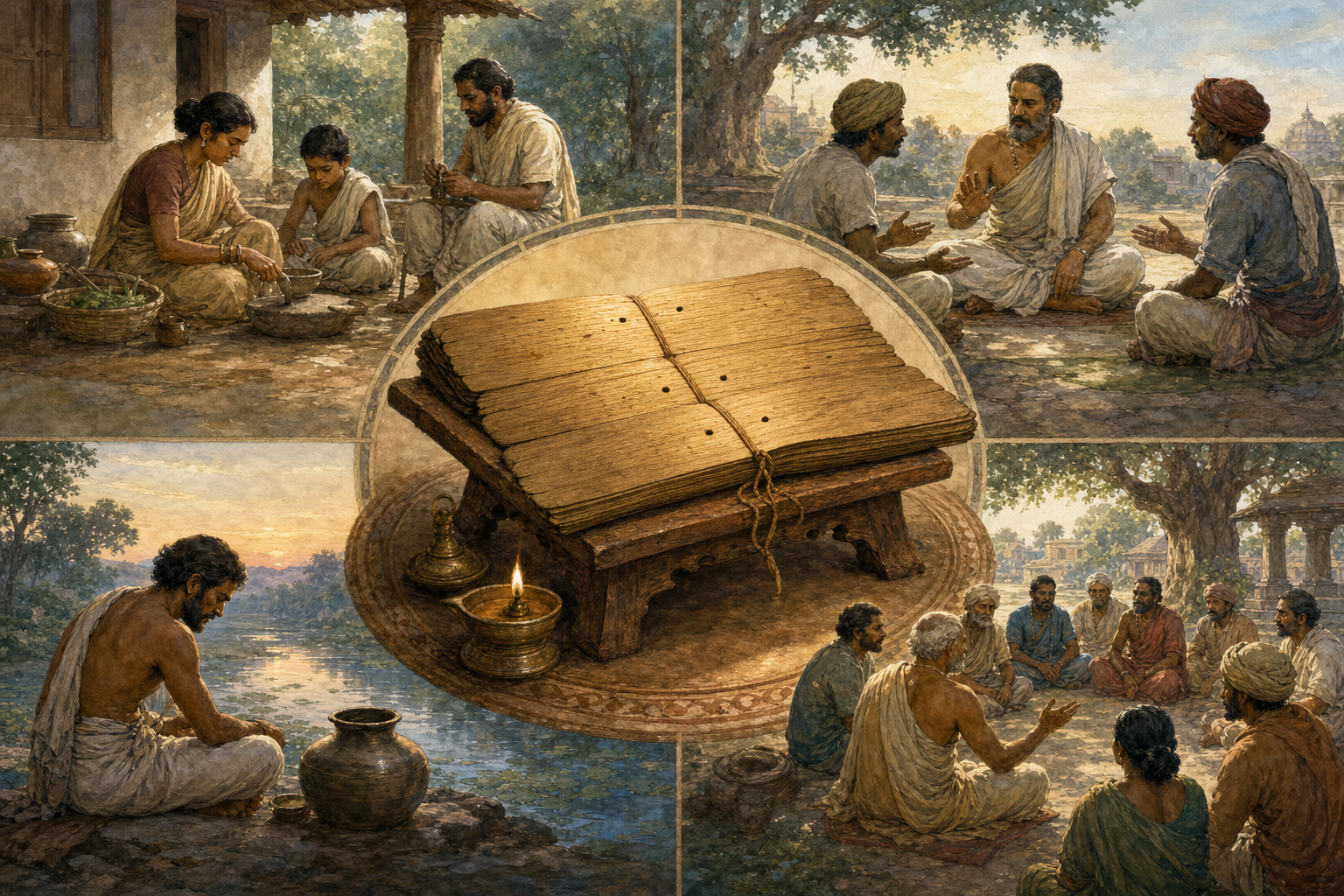
You may have reached Laghu Vishnumurti through a quotation about caste, marriage, punishment, kingship, or penance and wondered whether that single verse represents Hindu dharma as a whole. It does not. Before you accept either a defence or a denunciation of the verse, you need to know what kind of authority you are reading, which problem the passage addresses, and what interpretive limits surround it.
The most useful approach is to treat this compact work as a map of juristic reasoning. It connects personal conduct, household responsibility, dispute resolution, moral repair, government, charity, and disciplined practice. Once you see those connections, isolated rules become easier to assess without turning an ancient norm into either a timeless command or a disposable curiosity.
Begin by identifying the work precisely

The word laghu signals concision. Here that description is literal: the basic textual anchors are five chapters, 114 verses, and a likely date before the 12th century CE. The date remains approximate, so it should not be converted into an exact year or an unsupported claim about one ruler, region, or historical event.
Place Laghu Vishnumurti within the broader Vishnu legal-literary stream, but do not confuse it with the larger Vishnu Smriti or with the Vishnu Dharmasutra. The compact work functions as an epitomized smriti: a tightly organized aid for learning and consultation rather than an encyclopedic treatment of every question. That distinction matters when someone presents silence as prohibition or expects one short formulation to supply all the qualifications found in a larger legal corpus.
Its predominantly anuṣṭubh verses compress substantial reasoning into memorable lines. Brevity helps memorization, but it also creates a danger: a translated sentence can look self-contained even when its meaning depends on classification, context, an exception, or a customary qualification.
- Confirm that the citation actually belongs to Laghu Vishnumurti rather than another Vishnu-associated work.
- Ask for the chapter and verse, not merely an image or an unattributed English sentence.
- Record the edition or manuscript basis when available. Limited but meaningful variation among surviving manuscript witnesses can affect verse order, chapter boundaries, and disputed readings.
- Distinguish a translation from a paraphrase. A polished modern sentence may contain an interpreter’s conclusion as well as the underlying rule.
- Treat a missing edition reference as a verification problem, not automatic proof that the quotation is false.
These checks are especially important in online arguments. A quotation may be genuine while the title, scope, or historical conclusion attached to it is wrong.
Use the five chapters as one ethical and legal system

The five-part arrangement moves through conduct, legal procedure, penance, duties of rulers, and beneficent disciplines such as gifts and vows. Read in sequence, these fields answer different stages of one social question: how should people act, what happens when they disagree, how can wrongdoing be repaired, what must power do, and how are generosity and self-restraint cultivated before another dispute arises?
| Field | Question to ask | Common misreading |
|---|---|---|
| Ācāra | Which duties sustain the person, household, and community? | Reducing conduct to private etiquette or extracting one status without its obligations. |
| Vyavahāra | How should a dispute move from allegation to remedy? | Treating an ancient procedure as present-day statutory law. |
| Prāyaścitta | How should fault be acknowledged and its effects repaired? | Assuming penance is either mere punishment or a ritual escape from responsibility. |
| Rājadharma | What duties make the exercise of power legitimate? | Reading authority as privilege without protection, restraint, or accountability. |
| Dāna and vrata | Which repeated practices form character and support society? | Treating giving and vows as decorative additions unrelated to justice. |
This map changes how you read the varṇa-āśrama framework. Within its own juristic logic, social position creates a network of duties, restraints, and forms of support. Hierarchy is present and should not be hidden, but status cannot be read honestly as privilege alone. The householder, for example, occupies a sustaining position because economic activity, hospitality, support for dependants, and ritual continuity converge there. Students, teachers, elders, householders, dependants, and renunciants appear within relationships of obligation.
Domestic rules also belong to this relational structure. Marriage, fidelity, household stability, inheritance, care for dependants, and strīdhanam concern the ordering and protection of a household rather than unrelated private choices. When you encounter one such rule, ask two questions before judging its purpose: whose conduct is being restrained, and whose interest is being protected? Then ask a third question that the ancient formulation may not fully answer: whose voice or welfare remains insufficiently represented?
That three-question test avoids two opposite errors. You need not erase the protective or prudential aim of a rule merely because its social form is ancient. You also need not declare every inherited form eternally binding merely because a jurist connected it to dharma.
Read rules through hierarchy, custom, purpose, and context
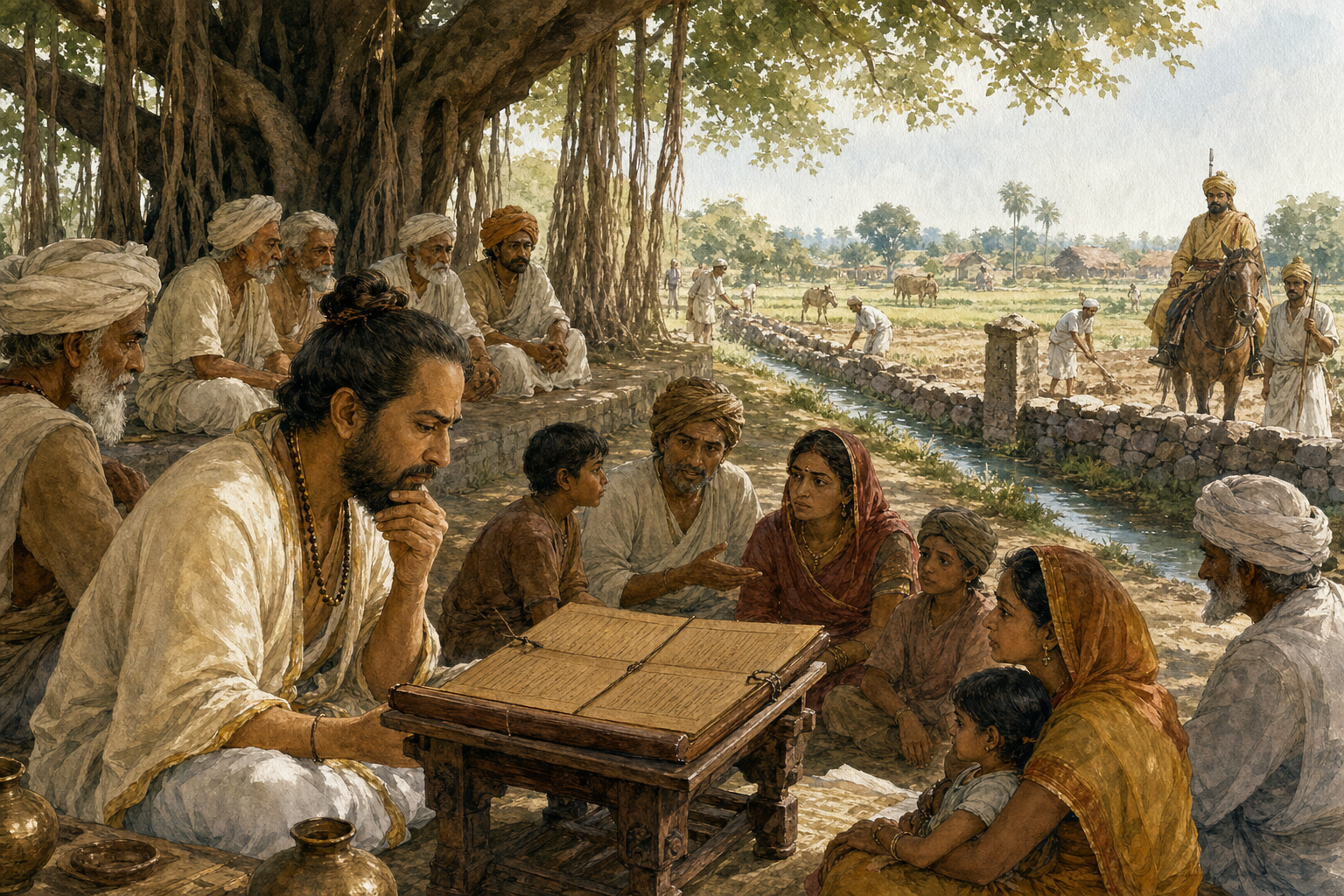
Dharmashastra interpretation is not accomplished by finding one translated line and applying it mechanically. A familiar hierarchy gives priority to śruti, then smriti, then good custom or sadācāra. Regional custom and family custom, deśācāra and kulācāra, can carry real authority so long as they do not contradict higher norms. Definition, exception, reconciliation, and reasoned equity help resolve cases in which rules appear to collide.
Custom therefore does not mean that every local habit becomes dharma. Nor does textual hierarchy mean that local life is irrelevant. The interpretive task is to determine whether a practice expresses a legitimate application of a general duty, supplies detail where a concise rule is silent, or violates the moral boundary the hierarchy is meant to preserve.
- Define the actual question. Do not begin with a conclusion such as Hinduism permits this or forbids that. State whether the passage concerns conduct, evidence, property, penance, government, charity, or another defined field.
- Read the neighbouring verses. Determine whether the line is a rule, a list item, a qualification, an exception, or a consequence attached to an earlier condition.
- Identify the parties and life situation. A duty directed to a ruler, householder, student, witness, wrongdoer, or renunciant cannot automatically be transferred to everyone.
- Look for the protected purpose. Possible purposes within this work include truthfulness, household stability, protection of life and property, support for dependants, fair adjudication, moral correction, and social solidarity.
- Test custom within the hierarchy. Ask whether regional or familial practice clarifies the rule and whether that practice remains consistent with higher principles.
- Separate prescription from history. A normative rule shows what a juristic tradition sought to uphold. It does not by itself prove that every community followed that rule in every period.
The last step is indispensable. If your question is historical rather than theological or ethical, pair normative material with inscriptions, narrative literature, archaeological evidence, and other evidence of practice. Agreement strengthens a historical conclusion; divergence can reveal negotiation, resistance, regional variation, or the difference between an ideal and ordinary life.
Carry forward the principles without freezing ancient institutions

In a dispute, protect procedure before choosing a side
Vyavahāra follows a recognizable sequence: plaint, reply, evidence, deliberation, verdict, and remedy. Documents, witness testimony, and surrounding circumstances contribute to proof, while false testimony carries moral as well as procedural weight.
You can use the underlying discipline whenever a community disagreement becomes heated. Write down the allegation in a form the other party can answer. Separate testimony from inference. Disclose relevant documents. Allow deliberation before announcing a verdict. Specify a remedy rather than stopping at blame. This does not turn an ancient smriti into current law. Any dispute involving present-day legal rights, criminal allegations, property, employment, or financial liability must be handled under the applicable law and, where necessary, with qualified legal advice.
After wrongdoing, connect discipline to repair
Prāyaścitta varies with intention, harm, and context. Confession, restitution, fasting, and ritual observance provide different means of acknowledging fault and returning to disciplined life. The important structure is restorative: failure has consequences, but it need not make moral return impossible.
When you apply that principle within family or community life, ask in order: Was the act deliberate? Who or what was harmed? What can be restored? What discipline can reduce repetition? What would responsible reintegration require? A private vow may train the wrongdoer, but it should not be used to bypass restitution to the harmed person.
Judge power by the duties attached to it
Rājadharma binds authority to protection of life and property, enforcement of agreements, and conditions supportive of learning, trade, and worship. Taxation is justified through moderation and reciprocity: resources gathered from society carry a corresponding duty to sustain security, justice, and welfare. Daṇḍa, or punishment, is best understood within this framework as calibrated correction rather than cruelty.
For a present-day reader, the transferable test is straightforward. Do not evaluate public power only by the ruler’s identity, declared intention, or cultural symbolism. Examine the reciprocal duties: Is life protected? Are decisions intelligible? Are agreements upheld? Is revenue returned through public responsibility? Is punishment proportionate and ordered toward protection? These principles can inform judgement without pretending that an ancient model supplies a ready-made modern constitution.
Compare Dharmic traditions by function, not by forced sameness
A wider Dharmic lens can sharpen the theme of responsible return. Buddhist communal discipline, Jain pratikraman, and the Sikh emphasis on seva and justice each connect ethical formation to accountable conduct. Truthfulness, restraint, compassion, service, and disciplined responses to failure create genuine points of conversation among these traditions.
Comparison should clarify rather than flatten. Distinct traditions do not become one legal code merely because they address similar human failures. Compare the function of a practice: How is wrongdoing named? How is harm repaired? How is the person disciplined? How is service restored? This approach reveals shared ethical concerns while respecting different scriptures, institutions, metaphysics, and histories.
Key takeaways for a responsible reading
- Verify the exact work, chapter, verse, translation, and edition before building an argument around a quotation.
- Read all five fields together: conduct, adjudication, atonement, government, and beneficent discipline form a connected social vision.
- Interpret status through reciprocal duties and restraints, while remaining honest about hierarchy and historically excluded perspectives.
- Use śruti, smriti, sadācāra, legitimate custom, context, and reasoned reconciliation as parts of one interpretive method.
- Understand prāyaścitta as accountable moral repair: intention matters, harm matters, restitution matters, and return remains possible.
- Do not mistake prescription for a census of historical behaviour or treat an ancient formulation as controlling modern law.
For your next reading, make a one-page record with eight entries: exact title, edition, verse, domain, parties addressed, governing rule, exception or custom, and protected purpose. Add historical evidence in a separate column rather than mixing it with the norm. That small discipline will make your understanding of Laghu Vishnumurti more accurate, more Dharmic in method, and much harder to manipulate through isolated quotations.
References
