
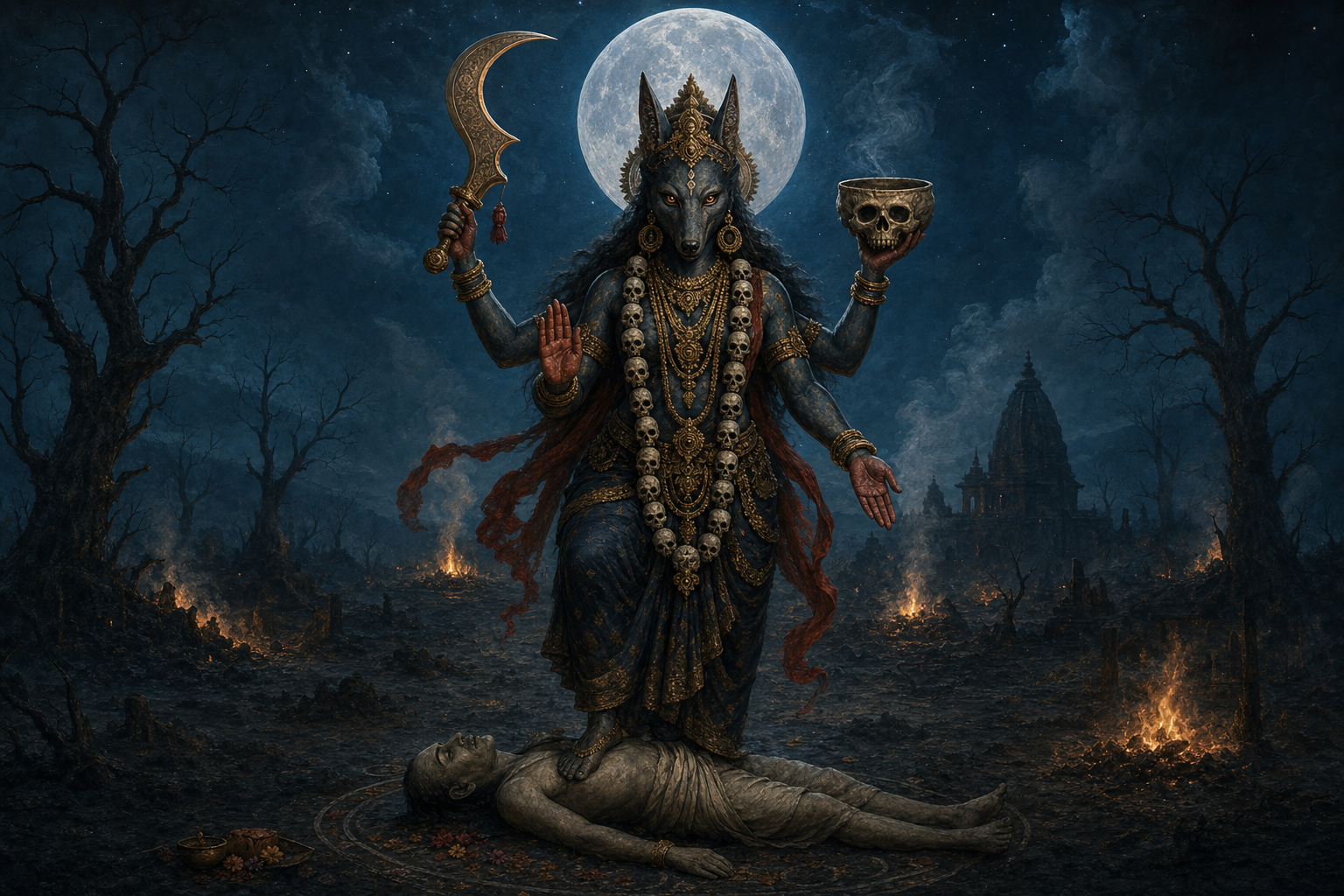
You encounter a jackal-faced Goddess standing over a corpse, holding a chopper and skull-bowl, and surrounded by the visual language of the cremation ground. Is this a demonic figure, a form of Kali, a Yogini, Chamunda, or specifically Kokamukha?
The honest answer depends on more than the face. Fierce Shakta images work as clusters of symbols, and Kokamukha belongs to a regional, Tantric, and sometimes uncertain field of identification. If you learn to read the face, posture, implements, setting, and local name together, the apparent horror resolves into a disciplined theology of protection, impermanence, and fearlessness.
Begin with what the fierce image is doing
The first mistake is to divide sacred images into pleasant forms that must be benevolent and frightening forms that must be malevolent. Shakta iconography does not accept that division. Kokamukha is remembered as a fierce and protective manifestation of Mahakali: terrible toward disorder, but protective toward the devotee and the moral order the Goddess guards.
That distinction changes your reading. A skull is not merely decoration meant to shock you. A corpse is not automatically a victim in a narrative scene. A jackal is not present simply because the artist wanted a monstrous animal. Each belongs to an iconographic grammar concerned with death, time, ego, pollution, exclusion, and the power that remains sovereign over all of them.
The jackal is especially important because it inhabits boundaries: village and wilderness, habitation and cremation ground, life and decomposition. Kokamukha wears the face of this liminal being. The image declares that the Goddess does not lose authority where ordinary social confidence ends. The feared margin is still within Shakti.
When you face such an image, begin with two questions: What boundary does this symbol occupy, and what fear does the Goddess master there? Those questions will take you further than asking whether the figure looks beautiful or ugly.
Read Kokamukha in four passes
No single attribute securely identifies Kokamukha. Read the whole composition in four passes, moving from the most visible feature to the image’s ritual and architectural context.
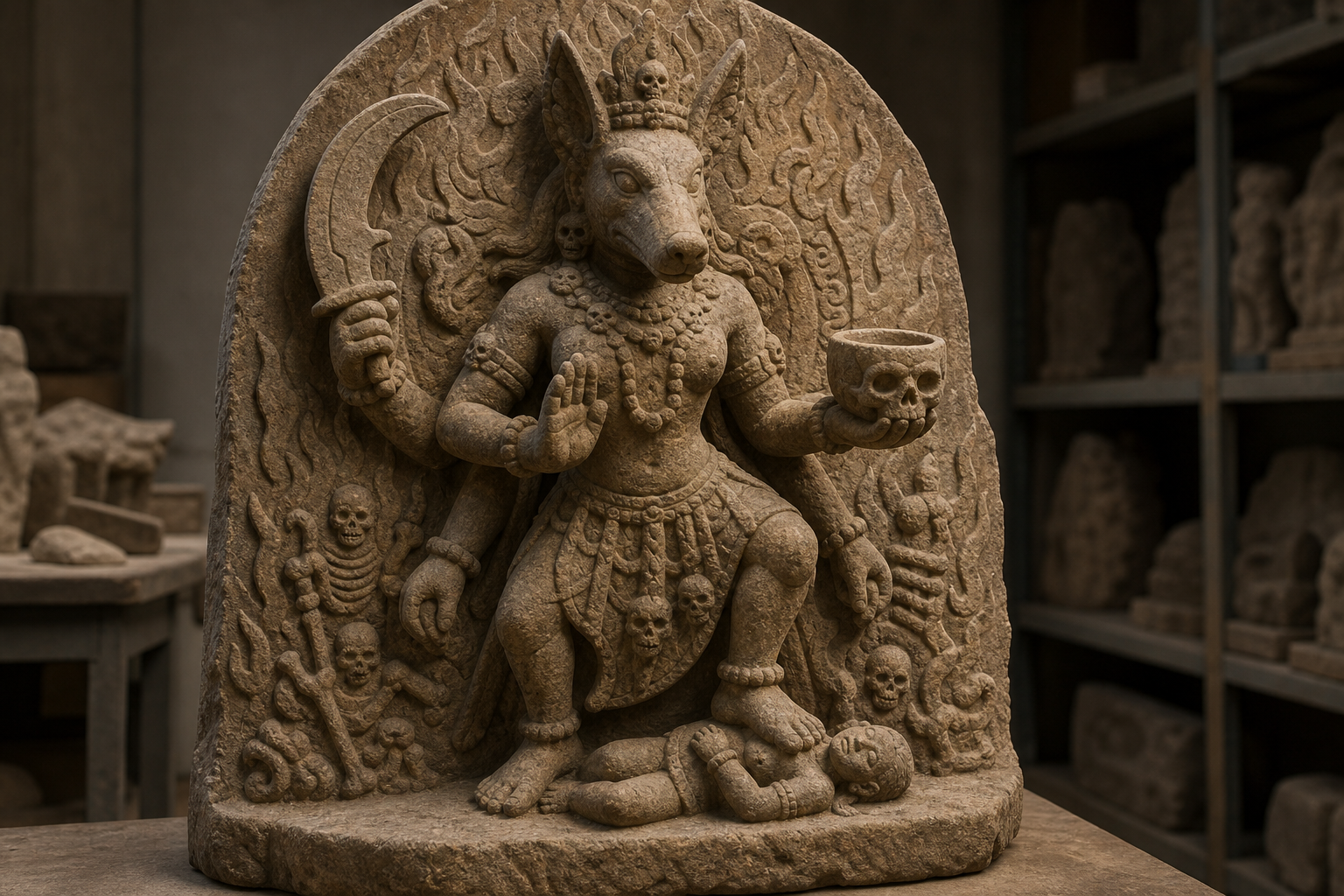
- Examine the face without naming it too quickly. Look for an elongated muzzle and upright ears that plausibly indicate a jackal. Record what you actually see before deciding what it means. Weathered stone can make a jackal, dog, or another animal difficult to distinguish. Even the name requires care: mukha plainly means face, while koka has been associated with the jackal in select medieval or vernacular registers; mainstream Sanskrit more commonly uses shrigala. Regional, Prakrit, and Apabhramsha layers can therefore matter when interpreting the epithet.
- Inventory the bodily signs and ornaments. Kokamukha shares the broader visual language of Mahakali and allied fierce goddesses. A skull garland, or mundamala, dishevelled hair, bone ornaments, and serpents place the figure within a world of dissolution and untamed divine power. One of these features alone is not decisive. Their convergence is what matters.
- Identify the implements as a pair. A curved chopper, or kartrika, and a skull-bowl, or kapala, frequently accompany fierce Shakta forms. Read them within a symbolic act of confronting and severing attachment, not as evidence of ordinary cruelty. Attributes vary across regions and surviving images, so their absence does not automatically rule out an identification.
- Read the posture and ground. A dynamic pratyalidha stance over a corpse, or shava, belongs to the cremation-ground grammar associated with Kali and related forms. The corpse signifies the transcendence of ego and time. It should not be read as a straightforward depiction of a human killing unless the larger narrative context demands that reading.
After these four passes, step back and ask whether the elements form a coherent whole. Jackal-like face plus Kali attributes plus cremation-ground setting plus a local Kokamukha tradition is meaningful convergence. A canine muzzle on an isolated, damaged sculpture is only a clue.
This method also keeps symbolism connected to function. The skulls bring mortality into view. The corpse removes the illusion that status can defeat time. The jackal governs the border people fear to cross. The dynamic stance shows active mastery rather than passive contemplation. Together they present a Goddess who protects by making you look directly at what ordinary consciousness avoids.
Use an evidence ladder before naming the figure
Kokamukha is not standardized across every widely circulated Puranic enumeration of Devi. Specialized names often survive through regional sthalapuranas, Tantric paddhatis, temple handlists, priestly memory, and local liturgy. That makes the tradition significant, but it also makes a universal identification based on appearance alone unreliable.
Use the following ladder when you describe a sculpture, photograph, or shrine:
- Explicitly named: Use “Kokamukha” when the shrine or living temple tradition clearly gives that name, especially when the name is reinforced by a readable inscription, ritual list, or consistent local memory.
- Locally identified: Write “a jackal-faced Yogini locally identified as Kokamukha” when the local name is clear but the surviving epigraphic evidence is incomplete or disputed. This wording respects temple memory without pretending that every historical question has been settled.
- Iconographically plausible: Use “a canine- or jackal-faced fierce goddess, possibly Kokamukha” when the attributes fit but no secure name survives. If you are cataloguing an object, include its provenance and the condition of any inscription.
- Unresolved: Keep the identification open when the face is badly weathered, the object has been removed from its original setting, or the accompanying attributes point in different directions. “Unidentified animal-faced Yogini” is more accurate than an impressive but unsupported name.
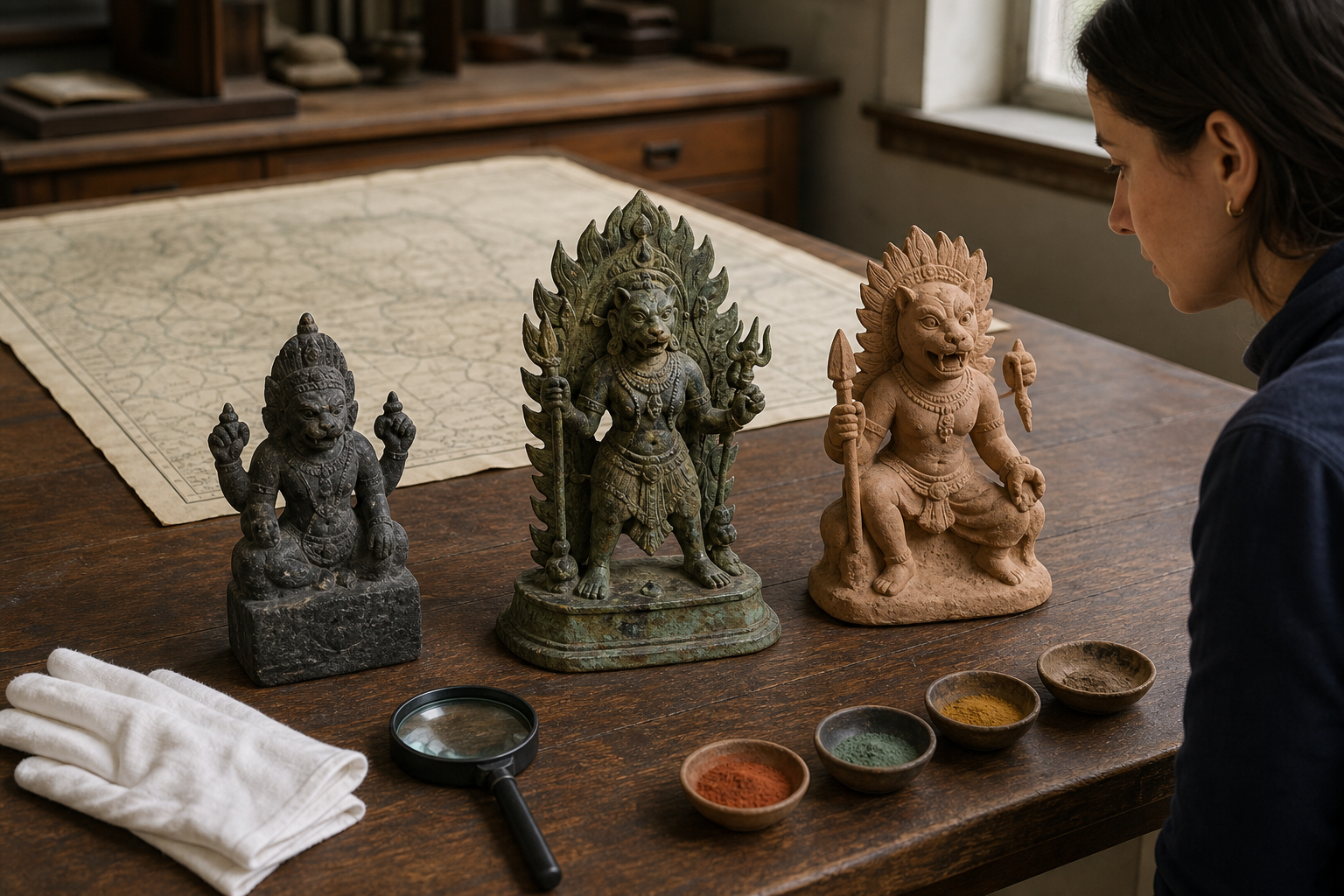
This caution is particularly important in the orbit of the 64 Yogini traditions of Hirapur, Bhedaghat, Khajuraho, and related sites. Animal-faced and human-faced Yoginis appear in these traditions, but names can shift across inscriptions, priestly lists, regional transmission, and modern scholarship. Weathering and paleographic uncertainty can produce more than one reading of the same damaged record.
Do not collapse Kokamukha into Chamunda
Chamunda is the closest familiar comparison, not an automatic substitute. Both can inhabit the cremation-ground world, appear with jackals or death imagery, and exercise a fierce guardianship over thresholds. Kokamukha, however, foregrounds the jackal face as the identifying key. Chamunda has a broader and more widely standardized iconographic identity.
If the local community names a figure Kokamukha, replacing that name with Chamunda merely because Chamunda is better known can erase a meaningful regional distinction. If no local name survives, calling every fierce, emaciated, or animal-associated Goddess Kokamukha makes the opposite error. Treat resemblance as evidence of a shared Shakta family, not proof that two names are interchangeable.
Let the image move from interpretation to practice
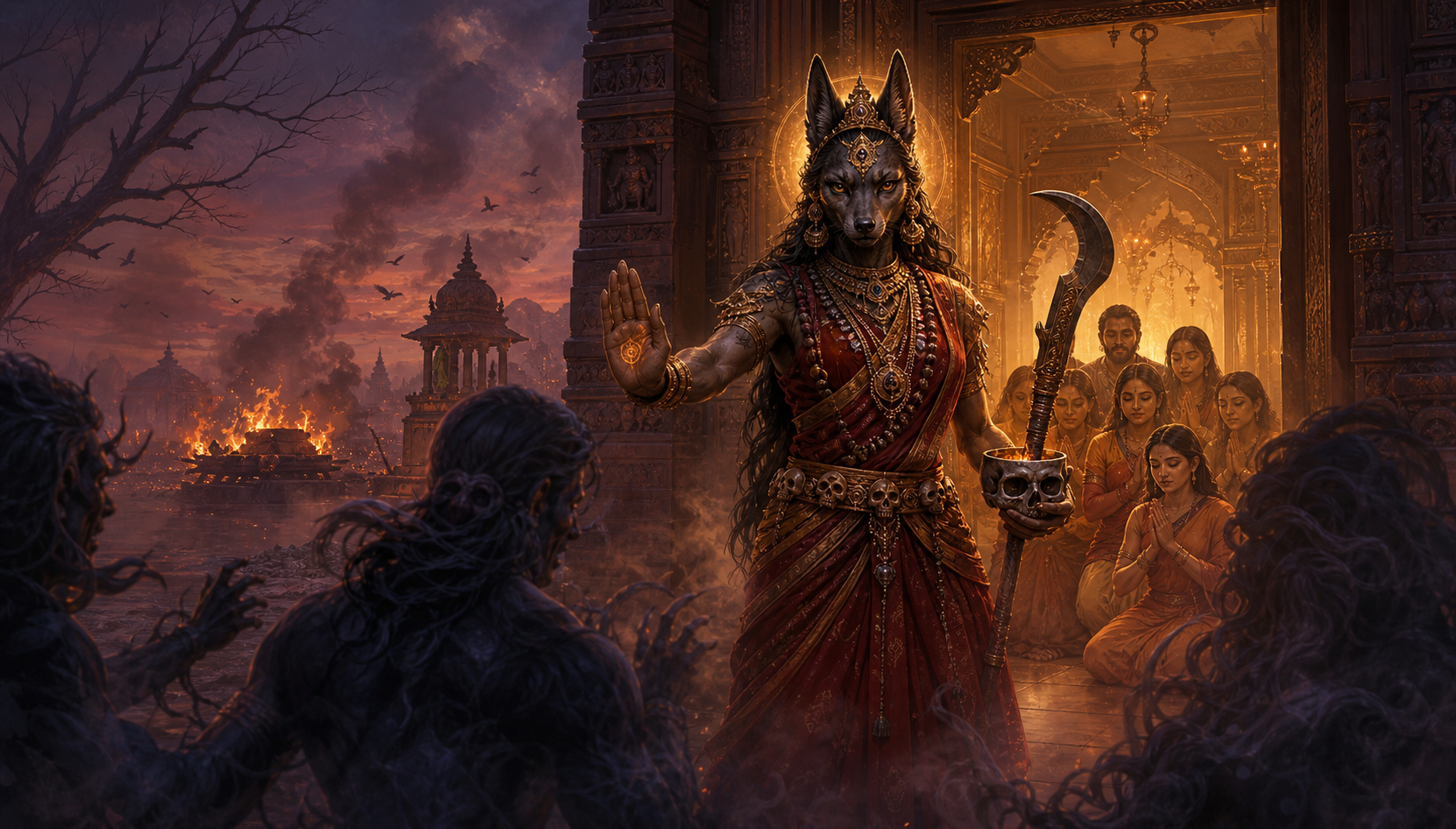
Kokamukha’s iconography becomes useful when it changes how you meet fear. The cremation ground strips away the ordinary protections of reputation, possession, and social rank. The jackal lives comfortably at that edge. The Goddess takes its face to show that divine care reaches into conditions people reject as impure, frightening, or beyond control.
You can contemplate that teaching without inventing an esoteric ritual:
- Name the boundary before you. It may be bereavement, a family transition, the end of a role, or another confrontation with impermanence. State it plainly rather than using fierce imagery as a vague promise of power.
- Choose the symbol that answers it. Use the jackal to contemplate vigilance at a threshold, the corpse to examine ego and time, or the skull garland to remember that mortality levels social pretension. Stay with one symbol long enough to understand its demand.
- Translate fearlessness into dharma. Abhaya is not recklessness or emotional numbness. In this context, it means steadiness before what is real. Ask what duty toward family, community, or a marginalised being becomes clearer once avoidance loosens its hold.
- Keep ritual proportionate to your authority. A striking image is not an initiation into a Tantric procedure. Follow the forms taught by your family, temple, or lineage. Mainstream household and temple observance often uses vegetarian, sattvic substitutions in keeping with local dharmic norms.
In parts of western India, fierce forms of the Goddess receive particular attention on certain Navaratri evenings and during Kali Chaudas, also known as Naraka Chaturdashi. This is a regional ritual context, not a universal rule for Kokamukha worship. If a temple maintains such an observance, follow its established paddhati rather than reconstructing offerings from cremation-ground imagery.
The ethical movement matters as much as the metaphysical one. Kokamukha wears a form associated with the rejected edge of society and consciousness. If devotion produces fascination with terror but no greater compassion toward beings at the margins, the central symbol has been missed. The Goddess reclaims what fear excludes; the devotee is asked to stop reproducing that exclusion.
Related Dharmic traditions illuminate this pattern without making all traditions identical. Vajrayana charnel-ground dakinis can turn places of death into fields of awakening. Jain yakshas and yakshis exercise protective functions within a religious world governed by restraint and nonviolence. The Chandi memory in Sikh tradition gives fierce divine power a language of righteous courage. These are parallels in the use of protective intensity, not evidence that the figures or doctrines are interchangeable.
Key takeaways
- Kokamukha is best understood as a jackal-faced, protective form within Mahakali’s fierce spectrum, but the name is regionally transmitted rather than universally standardized.
- Identify the figure from a cluster: face, ornaments, implements, posture, cremation-ground setting, provenance, and local naming.
- A canine-like muzzle alone does not establish Kokamukha. Use qualified language when inscriptions or context are incomplete.
- Chamunda is a close theological and iconographic relative, but the two names should not be treated as automatic synonyms.
- The fierceness serves protection and awakening. It confronts death, ego, impurity, and fear rather than glorifying cruelty.
- For worship, rely on an established family, temple, or lineage practice. Iconographic study does not by itself authorize esoteric ritual.
The next time you meet an animal-faced Yogini or a fierce Mahakali image, resist both reflexes: do not dismiss it as grotesque, and do not force the most dramatic name onto it. Read the full composition, preserve uncertainty where it remains, and let the form direct your attention toward the threshold it was made to guard.
References
