
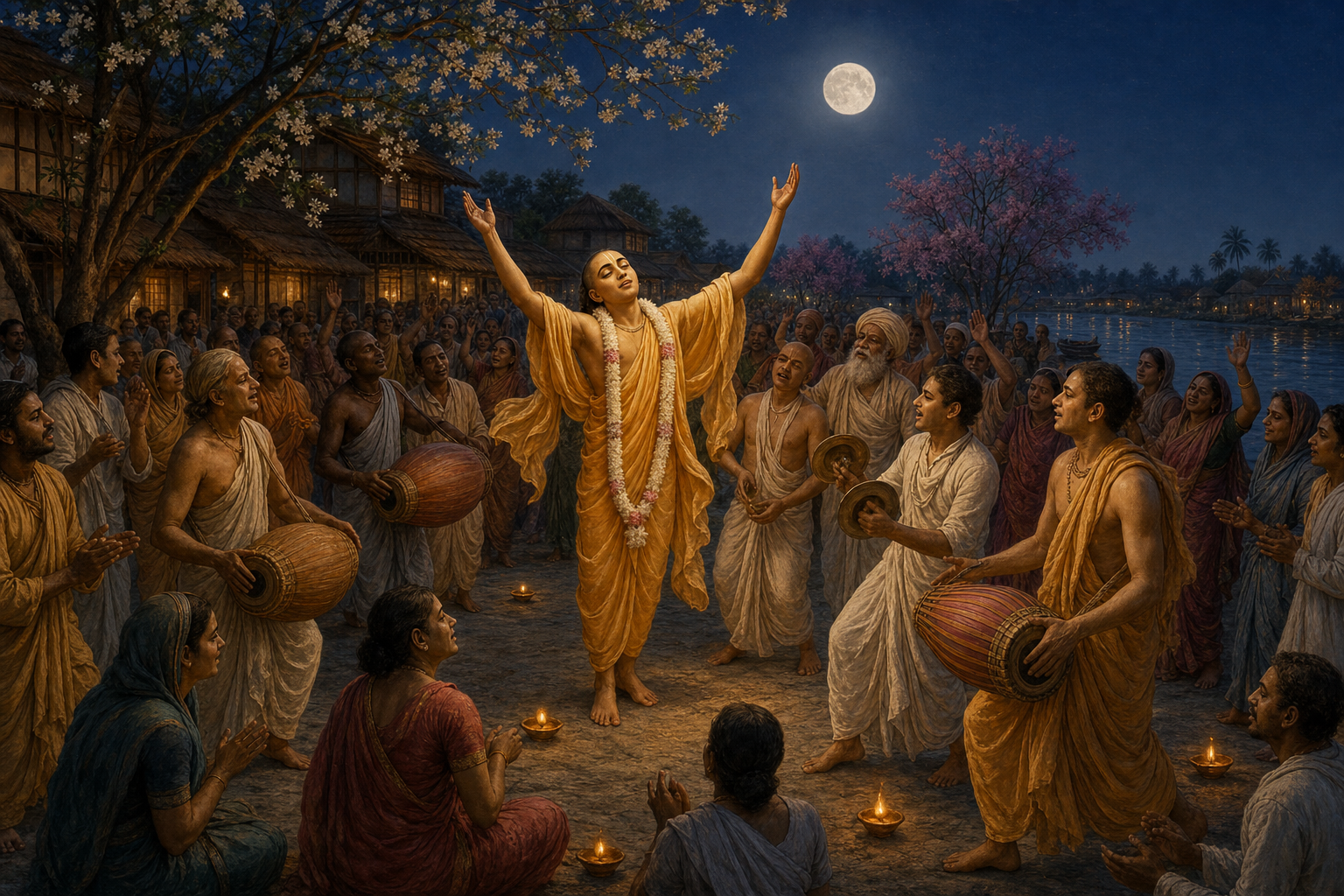
If you are deciding how to observe Gaura Purnima, the easiest mistake is to make the day busy while leaving Mahaprabhu’s mission untouched. You can fast, attend a programme, take prasada, and still miss the question at the heart of the festival: how will the holy name become more central, more generous, and more visible in your life?
Gaura Purnima falls on the full-moon tithi of Phalguna and commemorates Sri Caitanya Mahaprabhu, who appeared in Navadvipa in 1486 CE. Its purpose is not remembrance alone. The day gives you a practical way to unite nama-japa, sankirtana, study, restraint, seva, and hospitality around Mahaprabhu’s gift of prema-bhakti.
Read the child Nimai as a preview of the mission
Before He became the leader of a public devotional movement, Caitanya Mahaprabhu was known as Visvambhara and affectionately called Nimai. His childhood lilas are not incidental decoration around the theology. They show, in miniature, what His mature mission would offer.
When the crying child heard elders chant the name of Krishna, distress gave way to delight. The scene points beyond a charming childhood episode. Sacred sound is already the centre: it gathers people, changes the emotional atmosphere, and turns an ordinary domestic moment toward remembrance. The child who responded to Krishna’s name would later bring that name into courtyards and streets through congregational chanting.
Nimai’s scholarship carries the same pattern. As Nimai Pandita, He mastered grammar, but learning was not allowed to remain an exhibition of cleverness. Language became a path to Krishna. This matters if your own spiritual life has split into two compartments: ideas that occupy the intellect and practices that move the heart. Mahaprabhu’s example refuses that division. Study should sharpen remembrance, while devotion should make you more attentive rather than less thoughtful.
Use your festival reading accordingly. Do not measure success by the number of pages completed. Read one childhood episode slowly enough to ask two questions: What does this lila teach about the power of nama, and what habit in my life is being redirected? If a passage stays only in the past, read it again until you can name its present demand.
Hold Mahaprabhu’s two purposes together
Gaudiya theology identifies an external and an internal purpose for Mahaprabhu’s advent. Here, “external” does not mean superficial or unimportant. It names the mission directed outward: distributing the rarely given treasure of prema-bhakti through the yuga-dharma of sankirtana. Devotion was not to be guarded as the possession of a learned or socially privileged circle. The holy name could be sung by scholars and labourers, householders and renunciants.
The internal purpose is more intimate. Caitanya is understood as Krishna desiring to relish Sri Radha’s love for Him, appearing with Her devotional mood and golden radiance. That is why Gaura Purnima celebrates more than the founding of a movement. It celebrates divine love entering the position of the devotee and revealing the depth of surrender from within.
These purposes correct two common reductions. If you treat sankirtana only as uplifting music or cultural solidarity, you lose its orientation toward Krishna-prema. If you treat devotion only as a private emotion, you lose Mahaprabhu’s insistence that grace be shared. His mission is inwardly absorbed and outwardly generous at the same time.
Sri Caitanya’s place in Kali-yuga is associated with the description in Srimad-Bhagavatam 11.5.32 of the Lord who is connected with Krishna’s name, is not dark in complexion, and is worshipped through sankirtana with His associates. The Kali-santarana Upanishad gives the mantra that became inseparable from Mahaprabhu’s public mission: Hare Krishna Hare Krishna Krishna Krishna Hare Hare, Hare Rama Hare Rama Rama Rama Hare Hare.
You do not need advanced Sanskrit, a musical role, or public status to begin. You need attention, humility, and willingness to participate. That accessibility is not a simplified version of the mission. It is one of its defining features.
Acintya-bheda-abheda, the teaching of inconceivable simultaneous oneness and difference, gives this devotional life its philosophical frame. The Divine and the devotee are intimately related without becoming interchangeable. Unity does not erase distinction, and distinction does not require estrangement. As a social analogy rather than a substitute for theology, this principle also helps a plural Dharmic society hold conviction and respect together.
Build the observance around moonrise, not a crowded checklist
A good Gaura Purnima plan has a clear devotional centre. Confirm the local tithi and moonrise, decide how you will observe the vrata, reserve time for the holy name and Gaura-lila, and know where the evening sankirtana will take place. Making those decisions beforehand keeps logistics from consuming the day itself.
- Confirm the calendar locally. Use a reliable panchanga or the calendar followed by your temple community. The observance is tied to the Phalguna Purnima tithi, so a generic civil-calendar reminder is not enough.
- Choose the vrata responsibly. A common observance is to abstain from grains and beans until moonrise. Follow your lineage or temple’s guidance. If fasting conflicts with a health need, do not neglect medical care to imitate someone else’s austerity; seek an appropriate, safe form of observance from a qualified health professional and trusted spiritual guide.
- Make “increased chanting” concrete. Decide before the day whether you will add an attentive period of nama-japa, join a longer congregational kirtana, or do both. An undefined intention is easily displaced by festival errands.
- Read for recognition. Select a manageable passage from Sri Caitanya-caritamrita or Sri Caitanya-bhagavata. Look for the relationship between lila and mission: how does the episode disclose compassion, nama, humility, or prema?
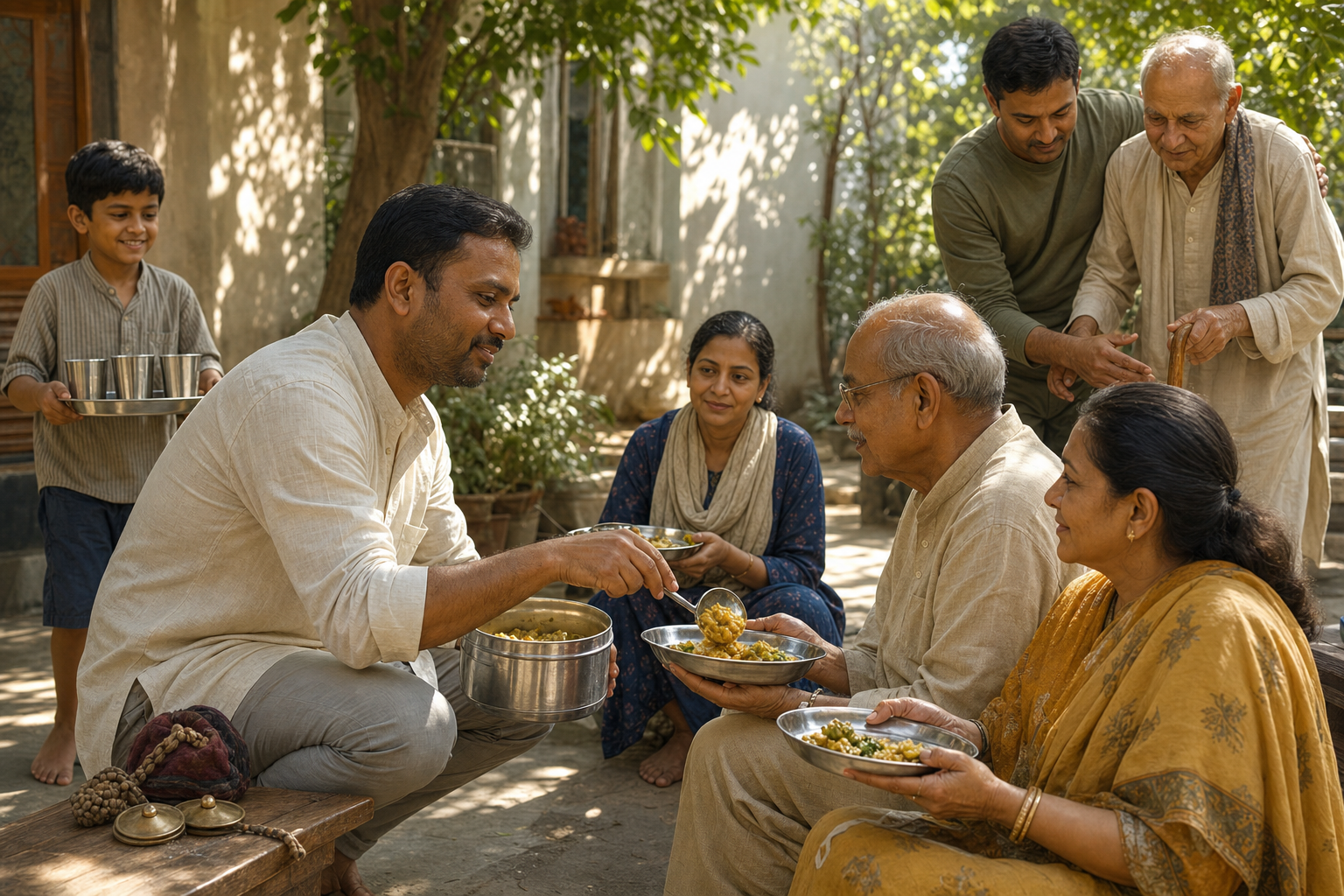
- Gather and share at moonrise. Join collective sankirtana where possible, offer preparations to Gaura-Nityananda with gratitude, and honour prasada according to the vrata followed by your community. Include someone beyond your usual circle by sharing prasada or making the gathering easier to enter.
If you cannot attend a large programme, the day has not been lost. A home observance can still contain its essential movement: verify the tithi, chant the maha-mantra attentively, read about Mahaprabhu, make an offering, and share prasada. Scale is secondary. The real test is whether remembrance becomes focused and generosity becomes concrete.
If a lunar eclipse coincides with the festival
Do not let “blood moon” language displace Gaura Purnima’s meaning. A totally eclipsed Moon can look copper-red because sunlight passes through Earth’s atmosphere before reaching the lunar surface; shorter wavelengths are filtered more strongly. The colour has a physical explanation and is not, by itself, evidence of an approaching catastrophe.
Astronomical explanation and Dharmic observance need not be placed in conflict. Grahana customs can treat an eclipse as a period for restraint and intensified remembrance without turning it into a fear campaign. Consult your local temple or panchanga for applicable timings. Common Jyotisha-based practices include minimising consumption during the eclipse, engaging in mantra, and bathing for purification after the umbra has passed.
If an eclipse and festival observance overlap, preserve the devotional centre while following the custom of your community. Chant more; speculate less. Do not forward apocalyptic claims merely because dramatic language has been attached to a predictable celestial event.
Let sankirtana change how your community is built
Mahaprabhu’s sankirtana was public, but “public” should not be confused with “performed before an audience.” The mission is participatory. A gathering reflects that mission when people can enter the chanting without first proving their education, caste standing, fluency, or musical skill.
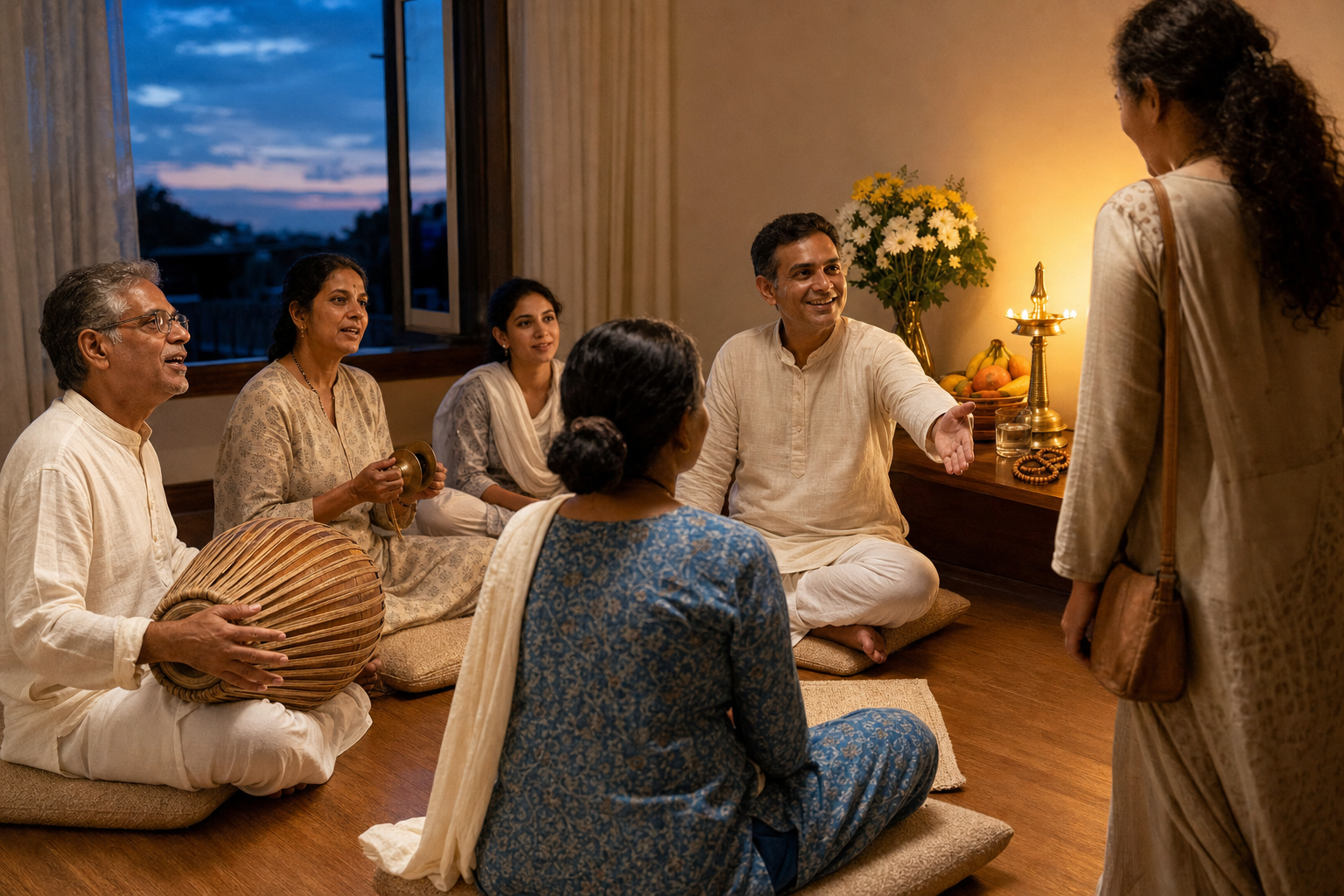
If you help organise Gaura Purnima, examine the gathering from the position of a newcomer. Keep the refrain clear enough to follow. Briefly explain the call-and-response pattern and the meaning of the occasion. Create visible seva roles beyond leading the music, including welcoming people, arranging seating, serving prasada, and cleaning. Hospitality is not an administrative detail added to sankirtana; it shows whether the theology of freely distributed grace has shaped the room.
The same test applies after the music ends. Nama should be accompanied by ahimsa, compassion, humility, service, and ethical steadiness. Loud chanting followed by contempt for others is not a strong defence of Dharma. The name should make your conduct more truthful and your service more dependable.
This also gives you a sound way to speak with people from neighbouring Dharmic traditions. Sikh gurbani kirtan, Buddhist mantra and sutra recitation, and Jain stavana show that disciplined sacred sound has a wide Dharmic resonance. That kinship should be honoured without pretending the traditions have identical theologies. You can recognise a shared grammar of remembrance, compassion, restraint, and service while explaining clearly that Gaudiya sankirtana is directed toward Krishna-prema and grounded in Mahaprabhu’s distinctive identity and mission.
Before the festival ends, choose one practice that will survive the festival atmosphere: protect a regular period of japa, join recurring community kirtana, maintain steady study of Gaura-lila, or make prasada distribution and another form of seva part of your routine. Choose one commitment you can actually keep. A festival has done its work when the next ordinary week is different.
Key takeaways for your observance
- Gaura Purnima commemorates Mahaprabhu’s appearance, but its practical centre is His distribution of Krishna-prema through sankirtana.
- Keep His two purposes together: the public giving of prema-bhakti and the intimate relishing of Sri Radha’s love for Krishna.
- Plan around the local Phalguna Purnima tithi and moonrise, with clear time for vrata, nama-japa, Gaura-lila, congregational kirtana, offering, and prasada.
- Treat eclipse customs as occasions for restraint and mantra, not as permission to circulate fear or unsupported prophecy.
- Make sankirtana genuinely accessible, and let chanting produce visible humility, compassion, hospitality, and seva.
- Carry one repeatable practice beyond the festival so that Gaura Purnima becomes a renewal of sadhana rather than a single crowded day.
When Gaura Purnima arrives, begin with the holy name and let every other choice serve it. Then leave moonrise with one durable promise: to remember more attentively, serve more humbly, and make Mahaprabhu’s invitation easier for another person to receive.
References
