
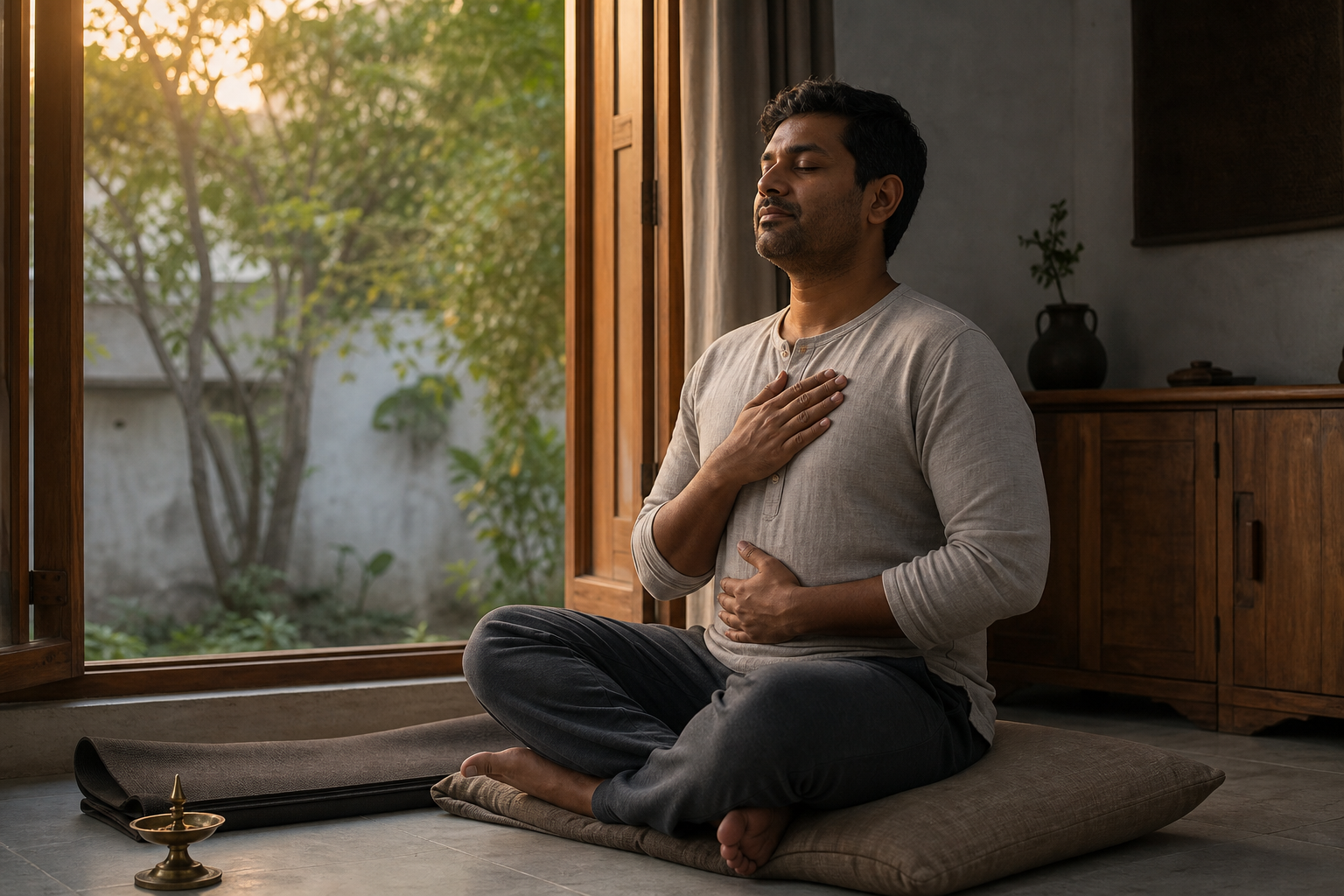
You finish the urgent task, but your body does not receive the message that the urgency is over. Your shoulders stay raised, your attention keeps jumping, and even rest begins to feel like another obligation. In that state, a demanding spiritual routine is unlikely to help. You need a small recovery rhythm that your nervous system can actually accept.
The plan below uses breath, mindful movement, meditation, deep rest, compassionate attention, and seva in a deliberate order. You can begin it without a retreat, special equipment, or a dramatic change to your schedule. The aim is not to eliminate every source of stress in seven days. It is to restore enough steadiness that you can meet those sources without remaining permanently braced against them.
Match the practice to the state you are in
Accumulated stress is not proof that your discipline or faith is weak. When recovery windows remain too short, the body carries a rising allostatic load: the cumulative strain of repeatedly activating the stress response without enough time to settle. Sleep becomes less restorative, attention fragments, impulses become harder to regulate, and complicated decisions start looking like stark either-or choices.
This is why the right first question is not, Which spiritual practice is best? Ask, What is happening in me right now? A racing mind, a braced body, depleted energy, and social disconnection do not call for the same response.
| What you notice | Begin with | What to do |
|---|---|---|
| Short breath, tight jaw, raised shoulders | Slow breathing or bhramari | Reduce effort and lengthen the breathing cycle gently; do not force a deep inhalation. |
| Attention jumping between worries and unfinished tasks | Sensory orientation | Name three things you see, three you hear, and three you physically feel. |
| Restlessness or stiffness after prolonged sitting | Mindful movement | Take a ten-minute contemplative walk or use a slow yoga sequence suited to your capacity. |
| Exhausted but unable to disengage | Yoga Nidra or non-sleep deep rest | Lie down for a guided rest period rather than demanding more concentration from yourself. |
| Cynicism, resentment, or isolation | Maitri, simran, or capacity-matched seva | Turn attention toward goodwill, remembrance, or one useful act that does not deplete you further. |
Dhyana, sati, samayik, and simran belong to distinct Hindu, Buddhist, Jain, and Sikh paths; they are not interchangeable labels for a generic relaxation method. Yet each tradition recognizes that attention can be trained and that reduced reactivity makes wiser action possible. Respect the integrity of the tradition you follow, while beginning with the form that meets your present condition.
Work in this order: regulate, orient, then reflect
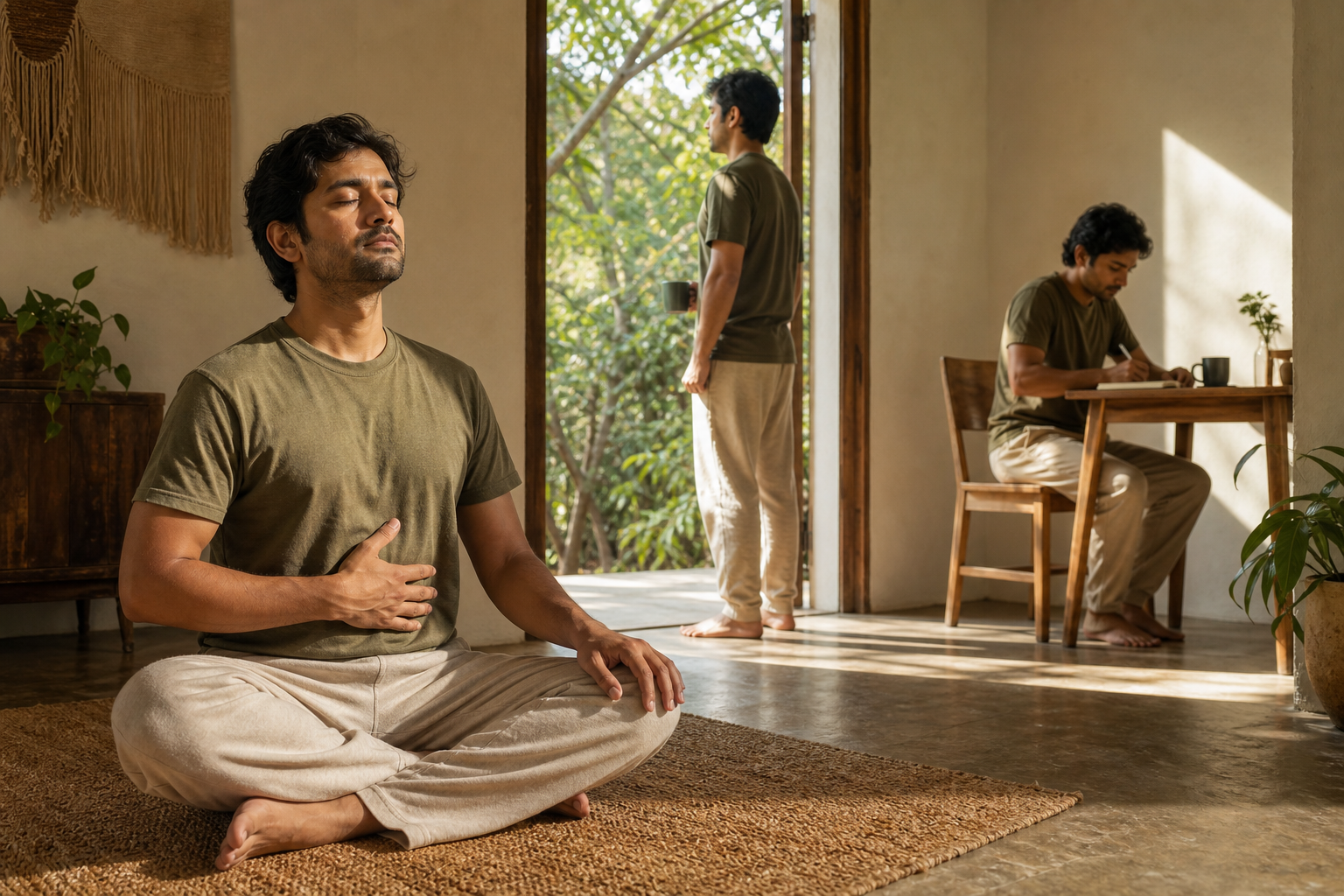
When you are highly activated, beginning with analysis can deepen the loop. The mind searches for an explanation, discovers ten more problems, and treats each one as an immediate demand. Start with the body. Then establish contact with the present environment. Only after that should you meditate on thoughts, values, or decisions.
First, make the breath quieter
Set aside two to five minutes. Let the breath descend comfortably toward the diaphragm and slow toward five or six cycles per minute. That means each full inhalation-and-exhalation cycle lasts roughly ten to twelve seconds. Treat this as a direction, not a performance target. The breath should feel smooth and sustainable.
You can also use bhramari: inhale gently, then exhale with an easy humming sound. The vibration and extended exhalation can help settle the threat response. Another option is nadi shodhana, alternating the nostrils without holding the breath. Choose one method and repeat it two or three times during the day instead of continually searching for a better technique.
Never turn breath regulation into a contest. If counting produces dizziness, tingling, air hunger, or greater panic, stop the exercise and allow your normal breathing to return. A practice that consistently intensifies your symptoms is not the right self-guided tool for that moment.
Next, locate yourself in the room
Look around slowly and identify three visible objects. Then notice three sounds and three bodily sensations, such as your feet meeting the floor, your back touching the chair, or air moving across your skin. Name what is present without explaining it. The purpose is not to prove that everything is fine. It is to interrupt rumination long enough for attention to register what is actually happening here.
Use this reset after a tense conversation, before entering your home after work, or whenever you switch between demanding tasks. Those transition points often carry stress from one part of the day into the next.
Move before asking yourself to sit still
If your muscles are braced or your body is restless, take a ten-minute contemplative walk, perform a slow sequence of familiar asanas, or adapt Surya Namaskar to your present capacity. Keep attention on pressure through the feet, movement around the joints, and the changing rhythm of the breath. This is not a fitness test. Mindful movement releases some of the effort being spent on holding the body rigid and prepares attention for seated practice.
Then choose one mode of meditation
Use focused attention when you feel scattered. Rest awareness on the breath, a mantra, the sound of simran, or a steady visual point. Each time the mind wanders, return without turning the return into a reprimand. The return is the practice.
Use open monitoring when you are steady enough to observe without being swept away. Notice a thought as a thought, a sensation as a sensation, and an emotion as a changing condition. Do not argue with what appears or build an identity around it. Focused attention develops steadiness; open monitoring develops perspective. You do not have to force both into every session.
Make recovery easier than reactivity
A calmer nervous system cannot be sustained by meditation alone if the rest of the day remains saturated with alerts, clutter, irregular sleep, and unbroken task switching. The most effective change may be subtractive: fewer incoming signals, fewer unnecessary commitments, and a few places where nothing is asking you to respond.
Start with your phone. Disable nonessential notifications, batch messages into chosen checking periods, and protect one technology-free hour for rest, meaningful conversation, contemplative reading, or time outdoors. Partial attention carries a switching cost. Even when no single interruption feels serious, repeated interruptions keep the body near a background state of readiness.
Support sleep through rhythm rather than last-minute negotiation. Keep your wake time consistent, seek morning light, reduce bright light in the evening, and include light-to-moderate movement during the day. Yoga Nidra or another non-sleep deep rest practice can help when you need deliberate downshifting. A brief afternoon session may restore mental energy, while an evening session can become part of the transition toward sleep.
Create a modest refuge rather than waiting for a perfect retreat. A chair near a window, a clean corner, a balcony, a garden path, sacred art, music, or open sky can provide the gentle attention that an overloaded mind needs. Put the object used for practice there before you need it. Friction matters: a visible cushion or journal is easier to use than one buried in a cupboard.
End the day with three written questions:
- What is present?
- What matters now?
- What is one small act aligned with my values?
Let satya guide the first answer: describe your condition honestly, without dramatizing or minimizing it. Let aparigraha guide the second: notice which commitments, possessions, inputs, or expectations you are holding beyond their usefulness. Let the final answer remain small enough to perform.
Do not omit other people from recovery. Shared silence, kirtan, simran, study circles, communal practice, and dependable companionship can provide co-regulation that solitary effort cannot. Seva can also turn repetitive self-concern toward contribution, but it must remain aligned with capacity. Taking on an exhausting responsibility while already depleted is not compassionate service. Sometimes ahimsa requires declining a request, simplifying an obligation, or resting before you offer help.
Follow a seven-day reset that stays small

This reset is designed to reduce load, not become a new standard against which you judge yourself. Keep the earlier practices as you add each new element. If the full week feels unmanageable, repeat the first day for a week and call that a complete beginning.
- Day one: reduce incoming signals. Disable nonessential notifications and schedule two five-minute breathing windows. Put them next to events that already happen, such as after waking and after ending work.
- Day two: bring attention into the body. Add a ten-minute mindful walk or a gentle yoga sequence. In the evening, answer the three journal questions without trying to produce elegant responses.
- Day three: train one-pointed attention. After the breath has settled, rest attention on a mantra, the breath, or a visual point. When distracted, return gently. Finish while the practice still feels repeatable.
- Day four: interrupt carry-over stress. Use the three-things-seen, three-things-heard, and three-things-felt orientation after task changes or difficult interactions. Notice whether tension is being carried into the next room or relationship.
- Day five: soften isolation. Practise maitri or karuna, engage in simran, or perform one bounded act of seva. Choose an act that expresses care without creating another unsustainable commitment.
- Day six: hold a home retreat hour. Keep one hour free of screens and administrative work. Use nature, sacred music or art, contemplative reading, gentle movement, silence, or Yoga Nidra. Do not fill the whole hour with techniques; leave some of it unstructured.
- Day seven: build your minimum viable rhythm. Review what changed your breathing, attention, sleep, or reactivity. Keep the smallest combination you can repeat: for example, two brief breathing periods, one ten-minute walk, protected device-free time, and one regular community practice.
Evaluate the week by noticing function, not by chasing a special state. Did you recover more quickly after an interruption? Did you pause before reacting? Was it easier to begin sleep, return to one task, or speak without carrying the previous conflict into the conversation? Small changes in recovery time are more useful than one unusually peaceful session.
Keep the rhythm, and know when it is not enough

Key takeaways
- Begin with your present state: use breath for bracing, orientation for rumination, movement for restlessness, deep rest for depletion, and compassionate connection for isolation.
- Regulate the body before asking the mind to analyse its problems.
- Short practices repeated consistently are more workable than an ambitious routine used only in crisis.
- Reduce notifications, commitments, and sensory clutter so that practice is supported by the rest of your day.
- Use satya to name your actual condition, aparigraha to release excess, ahimsa to set humane limits, and seva to reconnect recovery with contribution.
These practices can support ordinary stress recovery, but they are not substitutes for medical or psychological care. If distress keeps disrupting sleep, work, eating, relationships, or basic daily functioning, arrange an assessment with a qualified medical or mental health professional. Chest pain, fainting, severe difficulty breathing, sudden confusion, immediate danger, or thoughts of harming yourself require urgent help rather than another self-guided breathing or meditation exercise.
For today, make only two decisions: choose the two moments when you will breathe slowly, and switch off the notifications that do not deserve immediate access to you. Let abhyasa begin as repetition, not intensity. Once a small refuge becomes dependable, deeper practice has somewhere to take root.
References
