

Your mandir can fill a hall for a festival and still fail to notice when a family quietly disappears. A large gathering can inspire people, but it is rarely small enough to recognize an absence, accompany a newcomer, support home practice, or respond quickly when someone needs help.
If you are trying to turn occasional attendance into durable sangha, do not begin with a larger calendar. Build a layered network in which the home sustains daily bhakti, a small circle creates belonging, a locality hub coordinates resources, and the wider institution protects standards. Seva then becomes more than an occasional project: it becomes the way the congregation learns to care.
Start with the smallest unit that can notice an absence
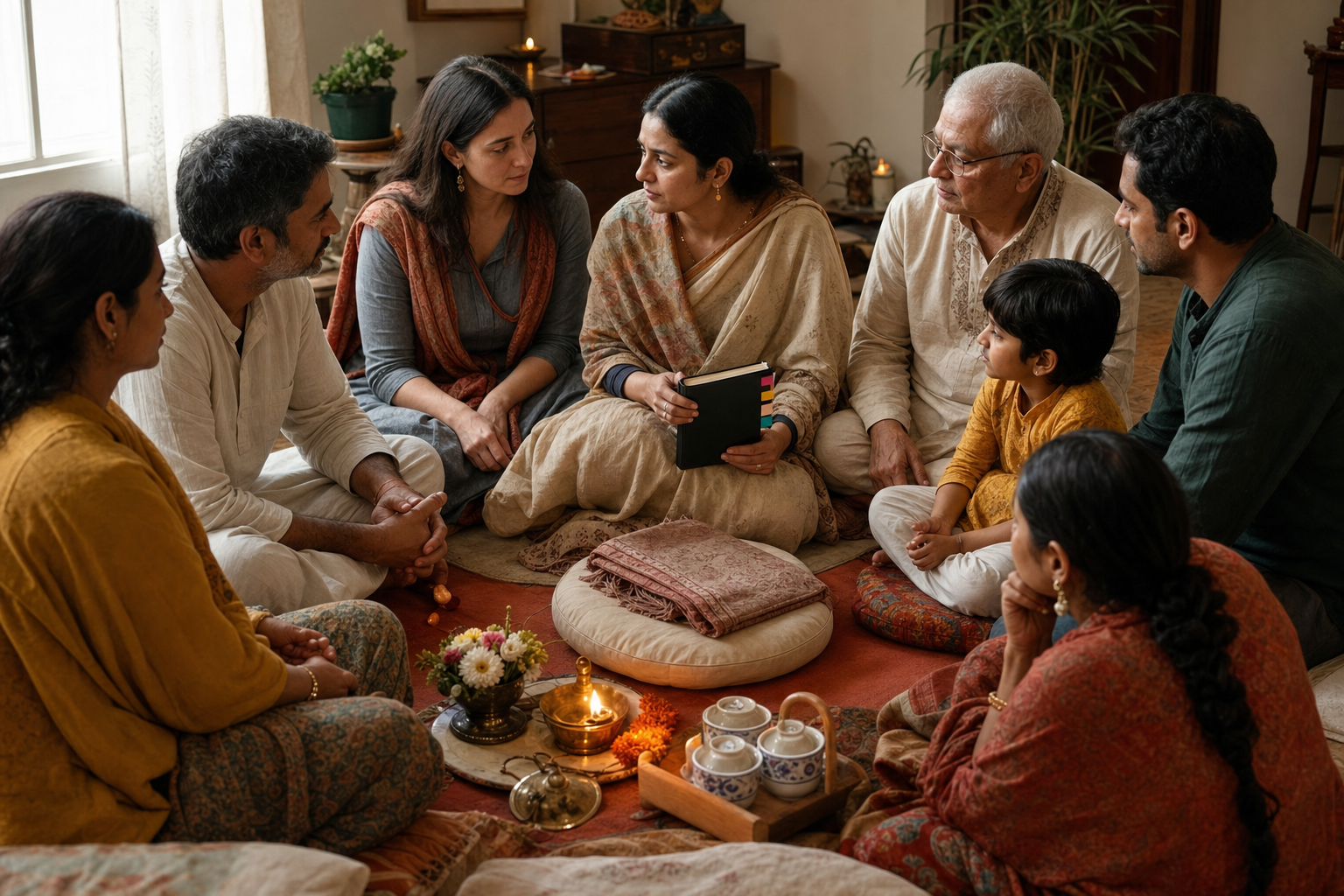
Bhakti-vriksha is useful because it organizes congregational life around small, household-centered circles for scripture, kirtan, devotional practice, mutual care, and local seva. Its strength is not a particular room or meeting format. Its strength is proximity: the circle should be small enough for every participant to speak, be heard, and become known.
Do not choose the size by copying another community’s attendance target. Use functional tests. Can each person contribute without competing for attention? Can the facilitator follow up without turning care into surveillance? Can the circle complete a modest act of service and learn from it? If not, the gathering is already too anonymous for the work you expect it to do.
A reliable gathering can follow this sequence:
- Welcome and check-in. Give people a voluntary opportunity to name a joy, difficulty, or practical need. No one should have to disclose private circumstances to belong.
- Shared devotional practice. Use kirtan, nama-smarana, prayer, or another practice appropriate to the community’s tradition and level of familiarity.
- A manageable passage. Read enough scripture to support reflection, not so much that the meeting becomes a lecture. State which text, teaching lineage, or commentary is being used.
- Facilitated conversation. Ask what the teaching reveals, where it challenges ordinary conduct, and what it could change before the next gathering.
- Care and seva. Identify a real need that the circle can address responsibly. Assign ownership only after the volunteer has freely agreed.
- Clear closure. Confirm the next gathering, any promised follow-up, and what will happen with unresolved questions. Shared prasada can close the meeting with hospitality and ease.
The facilitator’s role is to hold the process, not to perform omniscience. When a doctrinal question exceeds the facilitator’s competence, record it accurately and seek guidance from a qualified teacher. When a personal disclosure involves abuse, danger, or a serious health concern, follow the applicable safeguarding or emergency procedure. Congregational warmth is valuable, but it is not a substitute for professional help.
Psychological safety also depends on ordinary disciplines: do not ridicule questions, do not turn an absence into gossip, do not circulate prayer requests without permission, and do not allow the most confident speaker to consume the meeting. Listening first and teaching second is especially important when newcomers are still deciding whether the group is trustworthy.
Accessibility is part of the spiritual design. Use the language people actually speak at home. Adapt music and examples to regional culture without blurring the teaching itself. When travel, disability, caregiving, or distance makes physical attendance difficult, hybrid participation and short asynchronous materials can preserve continuity. Make sure a remote participant can speak and receive follow-up rather than merely watch.
Train a backup facilitator before multiplying the circle. A healthy Bhakti-vriksha should survive a host’s absence, a facilitator’s holiday, and an ordinary change in family circumstances. Expansion is premature when every decision, teaching task, contact list, and pastoral relationship still depends on one person.
Give every household a path from welcome to responsibility

A guest should not have to reverse-engineer congregational life. The next step should be visible, voluntary, and proportionate to the person’s readiness. A structured pathway removes ambiguity without converting spiritual formation into a rank chart.
| Moment | Useful structure | What the coordinator should do |
|---|---|---|
| First household contact | Damodara Outreach or another hospitable home observance | Explain the practice plainly, avoid pressure, and ask permission before sending another invitation. |
| Early learning | Bhakti Steps | Offer a clear next lesson or practice rather than an undifferentiated library of material. |
| Domestic continuity | Bhakti Homes | Help the family choose accessible worship, reading, kirtan, and prasada practices that fit its actual rhythm. |
| Children’s formation | Bhakti Kids | Use age-appropriate stories, music, art, and participation under explicit safeguarding and digital-safety rules. |
| Readiness to serve | Mentored micro-seva | Give the volunteer a defined task, a person to consult, and an opportunity to reflect after completion. |
| Readiness to facilitate | Supervised practice | Let the emerging facilitator observe, assist, lead part of a gathering, receive feedback, and develop gradually. |
Bhakti Steps, Bhakti Homes, Bhakti Kids, and mentored leadership address different points in this journey. They should connect, but they should not collapse into a single standardized course. A returning practitioner may need community more than introductory instruction. A parent may need home resources before accepting a volunteer role. A newcomer may wish to attend quietly before joining a service team.
At the end of each contact, offer one intelligible invitation: return to the circle, try a home practice, attend a learning session, help with a defined seva, or speak with a mentor. Do not present every possible commitment at once. Too many options conceal the next step as effectively as having no pathway at all.
Home practice must remain attainable. Encourage a family to establish a rhythm it can sustain with locally available materials, rather than reproduce an elaborate public observance in a domestic setting. The home is not a miniature stage. It is where remembrance, hospitality, food, speech, and family relationships can acquire a devotional cadence.
Damodara Outreach offers a gentle household doorway during the Kartik season through lamp offering and remembrance. Use that hospitality to create trust, not to manufacture urgency. Tell guests what will happen before the observance begins, let them decline any action comfortably, and seek consent before retaining their contact information. A sacred invitation loses its character when follow-up feels like capture.
Children require more than shortened adult lectures. Guardians should know who is teaching, what will be taught, how attendance is recorded, whether photographs are allowed, and how digital communication works. Never place a child in a private messaging relationship with an unrelated volunteer. Joyful storytelling and music matter, but safeguarding is what makes sustained trust possible.
Most importantly, do not confuse progress through a learning pathway with spiritual superiority. Milestones should answer, “What support would help you continue?” They should never answer, “Who deserves greater respect?” A pathway exists to reduce uncertainty and prepare service, not to create a new hierarchy of belonging.
Use Nama-hatta as connective tissue, not a command center

Household circles need connection, but connection does not require central control. Nama-hatta works as a locality-based micro-center for festivals, training, shared resources, coordinated seva, and inter-household support. It gives small circles capabilities they could not efficiently maintain alone while allowing care to remain close to the people involved.
Separate responsibilities clearly:
- The household owns its voluntary domestic practice, hospitality, privacy, and family rhythm.
- The Bhakti-vriksha circle owns its regular gathering, consensual follow-up, peer care, local language, and manageable seva.
- The Nama-hatta hub coordinates facilitator training, shared materials, cross-circle events, volunteer deployment, and needs that exceed one circle’s capacity.
- The temple or community trust, where involved, provides an institutional anchor, appropriate ritual and teaching support, transparent governance, and escalation routes that a household group cannot supply by itself.
The hub should convene, train, route, and support. It should not dictate every song, discussion prompt, household custom, or local service decision. Keep decisions close to the circle unless they affect safeguarding, finances, shared resources, doctrinal accountability, or the wider calendar. That boundary allows adaptation without turning each group into an isolated project.
Give every seva project a short written brief. It does not need to be bureaucratic, but it should answer:
- What need has been identified, and who confirmed that it is real?
- What does the person, family, or community receiving help actually want?
- What is inside the project’s scope, and what is outside it?
- Who coordinates the work, and who can step in if that person becomes unavailable?
- Which resources, permissions, or funds are required?
- What personal information is truly necessary, and who may see it?
- How will the team know the commitment has been completed responsibly?
This discipline keeps compassion from becoming improvisation at someone else’s expense. Practical care may include meals during a difficult transition, study companionship, help among neighboring households, or coordinated assistance during an emergency. Volunteers should promise only what the network can deliver and should not publicize a recipient’s hardship as evidence of success.
For cooperation across Hindu, Buddhist, Jain, and Sikh communities, begin with an agreed service need rather than a demand for theological sameness. Ahimsa, satya, dana, and karuna can support shared service while each tradition retains its own authorities, vocabulary, discipline, and sacred boundaries. Dharmic unity is credible when friendship survives difference, not when difference is hidden.
A joint invitation should therefore state who is hosting, what devotional elements are included, whether participation in those elements is optional, what service will be performed, and how resources will be used. Do not use seva as covert proselytizing. If teaching is part of an inter-community event, let each tradition be represented accurately by a qualified voice rather than interpreted casually by someone else.
Protect people and measure what matters before you scale

Growth multiplies both care and failure modes. A congregation should establish its protective rules before multiplying circles, collecting extensive personal information, or entrusting volunteers with children and vulnerable participants. Devotional sincerity does not remove the need for accountability.
- Publish a code of conduct. Define respectful behavior, anti-harassment expectations, confidentiality limits, and consequences for misuse of authority.
- Establish child safeguarding. Control access to children, photography, transportation, private communication, and digital platforms. Make guardians’ consent meaningful rather than assumed.
- Create a usable grievance route. A complaint about a facilitator must not have to pass only through that facilitator. Explain where a report goes, who can access it, and what the response process will be.
- Minimize personal data. Obtain consent, collect only what supports a legitimate congregational purpose, restrict access by role, and remove information that is no longer needed.
- Make finances traceable. Record who authorized spending, what was purchased, and how designated donations were used. Appreciation for a volunteer is not a substitute for documentation.
- Care for volunteers. Use mentoring, reflective supervision, peer coaching, backup roles, and permission to pause. Repeatedly rescuing an overloaded system is not sustainable seva.
- Define referral boundaries. Train facilitators to listen without pretending to be doctors, therapists, legal advisers, or emergency responders. Serious concerns should move through qualified local services and applicable safeguarding procedures.
Measurement should help leaders make better pastoral decisions. Counting attendance alone rewards spectacle. A healthier scorecard combines visible activity with evidence of continuity, care, capacity, and ethical practice.
| What to review | Useful question | Warning sign |
|---|---|---|
| Continuity | Can the circle maintain its cadence and follow up appropriately when someone is absent? | A large festival count conceals weak participation between events. |
| Participation quality | Can quieter members, newcomers, elders, and remote participants contribute? | The same voices teach, decide, and volunteer every time. |
| Household practice | Are families finding sustainable ways to continue bhakti at home? | Completion records replace any discussion of whether the practice is livable. |
| Mutual care | Were practical needs noticed and addressed with consent? | Private stories are circulated for promotion or volunteer recognition. |
| Leadership capacity | Are backup and emerging facilitators receiving supervised practice and useful feedback? | The network stops whenever a central leader is unavailable. |
| Seva quality | Was a locally relevant need met, and did the people served have a voice in evaluating the work? | The team celebrates the number of projects without checking their effects. |
| Safety | Do participants know the code of conduct and how to raise a concern? | The absence of complaints is treated as proof that no harm is occurring. |
A practical measurement chain connects gatherings, training, and service activity to stable practice, community cohesion, inter-household support, ethical action, and civic trust. If activity increases but the intended outcome does not, do not merely intensify the same activity. Ask whether facilitation, accessibility, follow-up, local relevance, or safeguarding needs to change.
Use stories alongside counts, but obtain consent before recording or sharing a testimony. Remove identifying details when they are unnecessary. The purpose of a story is to reveal what the numbers miss, not to convert a participant’s vulnerability into publicity.
Volunteer health belongs on the same scorecard. Ask not only what the team accomplished but also which duties are concentrated, which promises are repeatedly late, and what needs to stop or rotate. Recognition should express gratitude without turning seva into competition. The person who serves quietly and sustainably should not be eclipsed by the person whose work is easiest to display.
Key takeaways: are you ready to multiply?
- A participant can be missed and contacted with care, but never monitored without consent.
- A newcomer receives one clear next step instead of a confusing catalogue of commitments.
- Home, Bhakti-vriksha circle, Nama-hatta hub, and temple each have an understood role.
- A backup facilitator can lead without reproducing one founder’s personality or authority.
- Children, volunteers, and vulnerable participants have visible safeguarding and grievance routes.
- Personal information is collected because it supports a defined decision, not because a platform offers another field.
- Seva begins with a verified need, respects the recipient’s agency, and ends with accountable follow-through.
- Dharmic cooperation protects genuine theological difference while building trust through shared ethical action.
- Success is judged by continuity, care, household practice, leadership capacity, and safety as well as attendance.
If any of these conditions is missing, do not compensate with a larger festival or a more elaborate digital system. Repair the weak layer first. A neglected grievance route, exhausted facilitator, or confused newcomer will not be helped by greater reach.
Your next move can be concrete: identify a host household, facilitator, and backup; agree on the gathering rhythm, conduct rules, and escalation route; then invite a circle into a simple meeting it can actually sustain. Connect that circle to a Nama-hatta hub when shared training and coordinated seva will strengthen local relationships rather than replace them. Growth should first be felt as better remembrance, steadier practice, and more dependable care.
References
