
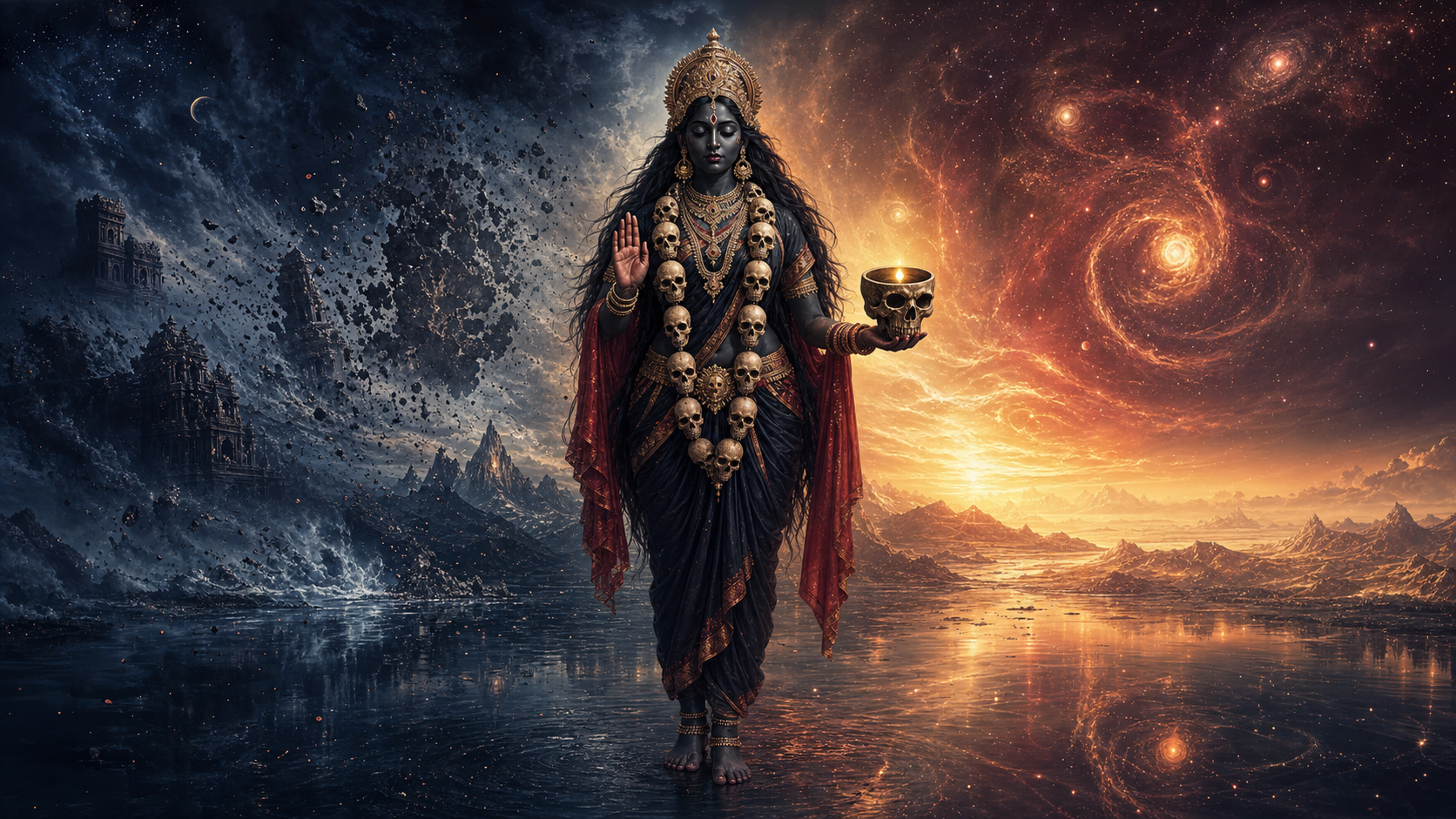
You may have encountered Kapalini as a skull-bearing Goddess and wondered whether the image is simply glorifying death, terror or destruction. That reading stops one step too early. Kapalini becomes intelligible when you ask not only what has been destroyed, but what must be preserved when an entire order can no longer continue.
In Shakta cosmology, she stands at the charged boundary between dissolution and renewed creation. Familiar forms disappear, yet creative possibility does not. Kapalini bears that possibility through the interval. Once you see this function, the skull, the storm and the cosmic waters form a coherent teaching rather than a collection of frightening symbols.
Place Kapalini at the hinge, not merely in the cremation ground
Kapalini should not be understood only as a deity operating inside an already ordered universe. Her most revealing setting is the moment when that order has withdrawn. Day and night can no longer be distinguished, a violent storm has erased stable boundaries, and water alone appears to remain. Across that expanse, Shakti moves while safeguarding the causal substance from which another world can emerge.
This makes her relationship to destruction precise. Kapalini does not preserve every expired form. She preserves the capacity for ordered manifestation after those forms have been relinquished. Destruction is therefore neither the final reality nor an accidental interruption of creation. It is one phase within a larger rhythm governed by Shakti.
The rhythm can be read through the five cosmic acts, or pañcakṛtya:
- Sṛṣṭi is emanation, the appearance of differentiated names and forms.
- Sthiti is maintenance, through which an ordered world acquires continuity.
- Saṁhāra is withdrawal, when formed things are reabsorbed rather than independently sustained.
- Tirobhāva is concealment, the obscuring of manifest order and ordinary distinctions.
- Anugraha is grace, the liberating or renewing power that prevents concealment from being the last word.
Kapalini is especially helpful for contemplating the passage from Saṁhāra toward a new Sṛṣṭi. Tirobhāva explains why the interval looks dark and indeterminate; Anugraha explains why it is not barren. If you reduce her to destruction, you lose the two powers that make the transition meaningful: concealment removes the exhausted pattern, and grace carries possibility beyond it.
The word pralaya also needs care because Hindu cosmology applies it at more than one scale. Not every ending is the same kind of ending, and Kapalini’s cosmic role should not be flattened into a vague slogan about change.
| Form of pralaya | What it describes | How it relates to Kapalini |
|---|---|---|
| Nitya-pralaya | The continuous perishability of formed things, visible in moment-by-moment change. | It supplies an everyday analogy, but it is not the principal scale of the cosmic tableau. |
| Naimittika-pralaya | The occasional dissolution associated with the close of a cosmic day, or kalpa. | Kapalini closely fits this threshold between the withdrawal of one ordered world and the possibility of another. |
| Prākṛtika-pralaya or mahāpralaya | The great reabsorption in which the elements return to primordial nature. | This is the grandest cosmological horizon for her guardianship of causal potential. |
| Atyantika-pralaya | The end of individual bondage in mokṣa. | It offers a liberating parallel, although the storm and waters primarily describe a cosmic rather than merely individual event. |
This distinction gives you a simple interpretive test. When Kapalini is invoked, ask what scale is in view: the passing of a thought, the end of an embodied condition, the withdrawal of a cosmos, or release from bondage. The imagery may illuminate all four, but they should not be treated as interchangeable claims.
Read the skull-bearing image as a map of transformation

The epithet Kapalini identifies the Goddess through the kapāla, the skull or skull-bowl. A skull naturally confronts you with mortality, but its shape matters as much as its origin. It is an emptied form that has become a vessel. What once enclosed a particular identity can now receive something that exceeds that identity.
That reversal is central to the icon. Emptiness is not treated as mere deprivation. Once attachment to an expired form has been removed, the resulting capacity can bear the seed of renewal. The kapāla therefore joins impermanence and receptivity in one object.
- The kapāla signifies the emptied form and, contemplatively, a mind no longer overflowing with residues from the previous cycle. Its lesson is not to worship vacancy, but to become capable of receiving what fixation had excluded.
- The khaṭvāṅga, when present, is a staff crowned with a skull. It can be read as an axis joining the manifest and unmanifest. It prevents dissolution from being imagined as a sealed realm with no relation to renewed appearance.
- The muṇḍamālā, or garland of severed heads, can represent letters, sounds and cognitions arising and subsiding in cyclic time. It points beyond biological death to the repeated formation and withdrawal of the categories through which a world becomes intelligible.
- The cremation-ground association removes the social identities by which ordinary life disguises impermanence. As an inner symbol, it asks what remains when status, possession and self-description can no longer support the person who clings to them.
These symbols belong to a Tantric grammar, not to a single universal codebook. A khaṭvāṅga is not present in every depiction, and a garland should not be assigned an exact enumeration unless a particular lineage supplies one. The reliable interpretive core is functional: the kapāla, khaṭvāṅga and muṇḍamālā express mastery over forms that arise, become meaningful and pass away.
This also clarifies why terrifying does not mean evil. Kapalini is terrifying to the demand that a temporary arrangement remain permanent. Her grace is severe because it does not protect a form whose time has ended. It protects continuity at a deeper level.
Follow the causal seed through the cosmic waters

Brahma-substance is potential, not a miniature finished world
The Brahma-substance held by Kapalini is best approached as brahma-tattva, an undifferentiated causal matrix from which nāma-rūpa, names and forms, can again condense. It should not be pictured as a tiny completed universe waiting to be unpacked. A finished arrangement belongs to manifestation; the substance in the skull-cup belongs to the causal condition preceding that arrangement.
Hiraṇyagarbha, the golden embryo, and avyakta, the unmanifest, offer allied ways of thinking about this causal depth. They need not be collapsed into exact synonyms. The decisive Shakta emphasis is that potential does not activate itself as an inert blueprint. Shakti bears it, moves with it and sets differentiation in motion.
The language of memory helps if it is used carefully. Kapalini does not need to carry every discarded object from the previous cosmos. What endures is the intelligible potential for order: a continuity of possibility rather than an archive of obsolete forms. Renewal can therefore remember without merely repeating.
The waters represent capacity before differentiation
The boundless ocean is not decorative scenery. Water has form-giving capacity without insisting upon one permanent form of its own. In the pralaya tableau, it evokes primordial possibility after stable boundaries have disappeared. The indistinguishability of day and night makes the same point through time: familiar oppositions no longer organise experience.
The three guṇas explain how distinction can return. During dissolution, the composite formations produced through sattva, rajas and tamas move back toward equilibrium. Creation begins when equilibrium gives way to a measured differentiation: rajas impels activity, sattva illumines, and tamas supplies substantiality and resistance. None of the three is independently a complete cosmos. Their patterned interaction permits one.
Kapalini stands at the turn between those conditions. This is why her movement matters. She is not passively floating through a dead expanse; she embodies the dynamic potency by which equilibrium can again become articulated order.
When you evaluate an interpretation of Kapalini, use four checks:
- Does it account for both dissolution and continuity, rather than discussing only death?
- Does it preserve Shakti’s active sovereignty, rather than reducing her to a container for someone else’s creative power?
- Does it distinguish causal potential from an already formed universe?
- Does it explain why the frightening emblems are vessels of transformation rather than ornaments of morbidity?
An interpretation that cannot answer those questions may describe the surface of the icon, but it has not yet reached its cosmological function.
Use Kapalini as a discipline for facing real endings

A personal loss is not literally a mahāpralaya, and it is unwise to tell someone in grief that an ending was necessary merely because creation is cyclic. The practical value lies elsewhere. Kapalini gives you a disciplined way to separate the form that has ended from the capacities, duties and truths that may still deserve to be carried forward.
You can adapt the cosmological sequence for reflection without pretending to perform a Tantric rite:
- Name the withdrawal. State exactly what has ended: a role, plan, institution, relationship pattern or assumption. Avoid the larger claim that everything has been lost when only one structure has dissolved.
- Permit concealment. Do not force an immediate explanation simply to escape uncertainty. Tirobhāva names the interval in which the next form is not yet visible.
- Empty the cup. Separate what belonged only to the expired arrangement from what remains true. A title may vanish while a duty survives; a project may fail while the knowledge gained from it remains usable.
- Identify the causal seed. Choose the principle, capacity or obligation that should cross the threshold. Keep it smaller than a complete replacement plan. The seed is not the new world.
- Recognise grace as possibility, not entitlement. Anugraha does not guarantee that the next form will reproduce your preferred past. It makes wise re-articulation possible.
- Give the seed a maintainable form. Begin the new cycle with one action you can sustain. Sṛṣṭi without Sthiti produces another impressive beginning that cannot endure.
Suppose a community programme ends. The Kapalini approach is not to preserve every committee, title and procedure out of fear. Nor is it to erase the entire effort. The useful question is which obligation still carries dharma: care for elders, transmission of language, protection of a shrine or education of children. That obligation is the seed. The next organisational form should serve it, rather than becoming a memorial to the previous structure.
The same method applies inwardly. The cremation ground becomes a discipline of allowing an identity to lose its claim to permanence. The mind becomes kapāla-like when it can hold clarity without filling every silence with an old story. This is not blankness for its own sake. It is deliberate receptivity.
Some Shakta lineages work with seed mantras such as HRĪM or KRĪM as expressions of the Goddess’s vibratory power. Their appearance in some lineages does not establish a universal Kapalini formula. Do not invent correspondences or select a mantra merely because it appears beside an image online. Without lineage-specific instruction, you can remain with the icon, the five acts and the question of what should be relinquished or carried.
Yogic language about prāṇa balancing in suṣumṇā describes a more specialised experiential framework. You do not need to claim that state in order to understand the cosmology. The immediately available discipline is simpler: stop treating the absence of an old pattern as proof that no wise pattern can emerge.
Compare Dharmic traditions without erasing their differences
Kapalini belongs to a specifically Shakta and Tantric theological setting, but her symbols participate in a wider Dharmic conversation about impermanence, cyclicality and the transformation of consciousness. Comparison is most useful when it identifies a shared problem without pretending that every tradition gives the same answer.
Vajrayāna Buddhist ḍākinīs may carry a kapāla in charnel-ground imagery, where impermanence is faced directly and defilements are transformed into wisdom. Jain cosmology describes the immense ascending and descending movements of Utsarpiṇī and Avasarpiṇī, presenting cosmic change as ordered rather than arbitrary. Sikh teaching centres Ik Onkar and Hukam, under whose sovereignty worlds arise and subside.
These are meaningful resonances, not evidence that Kapalini secretly occupies the same doctrinal position in Buddhism, Jainism and Sikhism. The Buddhist transformation of defilement, the Jain architecture of cosmic time, the Sikh sovereignty of Hukam and the Shakta primacy of the Goddess must retain their own vocabularies. Shared civilisational concerns become clearer when differences are preserved.
Use three rules when making the comparison:
- Compare functions before identities. Two symbols may both confront impermanence without naming the same deity or metaphysical principle.
- Keep each tradition’s operative terms. Translating everything into a generic spirituality removes the very distinctions that make comparison worthwhile.
- Look for ethical consequence. A serious encounter with cyclicality should deepen responsibility, compassion and non-clinging, not provide an excuse for passivity.
This last rule matters beyond contemplation. If forms are interdependent and resources pass through cycles, reckless consumption cannot be justified by saying that another creation will follow. Kapalini protects the seed; she does not endorse the careless exhaustion of what has been entrusted to us. At the human scale, repair, reuse and responsible regeneration are more faithful responses than waste followed by metaphysical consolation.
Key takeaways
- Kapalini presides over the threshold where withdrawal becomes renewed manifestation; she is not adequately understood as a Goddess of destruction alone.
- The skull-cup joins impermanence to receptivity: an emptied form can become the vessel of causal possibility.
- The cosmic waters, indistinguishable day and night, and balanced guṇas describe an unmanifest condition in which ordinary distinctions have ceased.
- The Brahma-substance is the potential for ordered manifestation, not a complete former world kept intact.
- In personal reflection, preserve the seed of dharma rather than every structure in which it previously appeared.
- Dharmic parallels can illuminate shared concerns about cyclicality and transformation, provided their theological differences are not erased.
The next time you encounter Kapalini, read the image in sequence. Ask what has withdrawn, what has become unmanifest, what the vessel still holds and which form can now serve that seed. Those questions turn a disturbing icon into a practical map for meeting an ending without clinging to it and beginning again without becoming rootless.
References
