
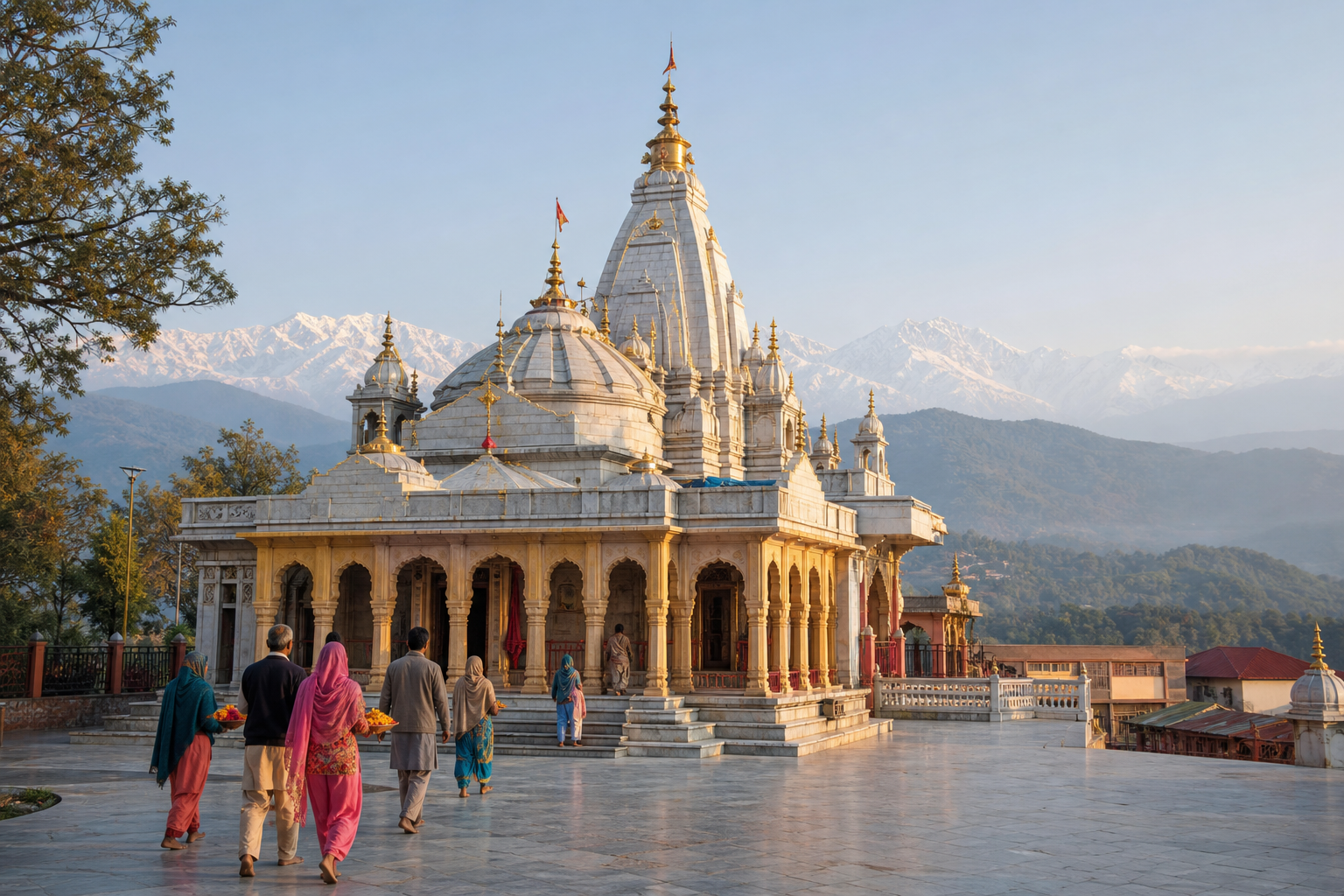
If you are planning darshan in Kangra and keep encountering the names Nagarkot Mata, Brajeshwari Devi and Vajreshwari, you are not looking at three different destinations. They name the same Shakti shrine in Kangra, but each name reveals a different layer of its identity.
Understanding those layers will help you do more than add another temple to a pilgrimage itinerary. You will know how to approach its Shakti Peeth tradition, how seriously to take the Pandava connection, which festival best matches the darshan you seek, and what the reconstructed temple can still teach you about civilizational continuity.
Key takeaways for your visit
- Nagarkot Mata Mandir, Brajeshwari Devi Temple and Vajreshwari refer to the same sacred center in Kangra.
- Kangra is revered as a Shakti Peeth associated with Sati’s left breast, although traditional enumerations of the Peeths vary in both number and location.
- The Pandava connection belongs to temple tradition, local katha and regional sacred memory; it is not an episode found in the critical textual recension of the Mahabharata.
- Chaitra and Sharada Navratri offer an intense communal festival experience, while Makar Sankranti centers a distinctive butter anointment associated with healing and restoration.
- The present temple should be read as a living, repeatedly renewed shrine, not as an untouched structure surviving from the age of the Mahabharata.
- Kangra Airport at Gaggal, road routes from Dharamshala and Pathankot, and the Kangra Valley Railway provide the main approaches, with local transport needed for the final connection.
One shrine, three names and one theological center
The three names are not interchangeable labels without meaning. Nagarkot binds the shrine to Kangra’s historical sacred landscape. Brajeshwari is its widely used devotional name. Vajreshwari draws attention to vajra-shakti: the lightning-like, protective power of the Devi.
Use those names as an interpretive map. Nagarkot directs you toward place and inherited memory. Brajeshwari directs you toward the Mother who receives worship. Vajreshwari directs you toward a force that illuminates, protects and restores. The Goddess encountered here is therefore both sovereign and maternal. These are complementary aspects of Shakti, not competing identities.
The shrine’s traditional association with the falling of Sati’s left breast reinforces that maternal dimension. The symbolism is not merely anatomical. It evokes nourishment, fecundity and the sustaining abundance of the Kangra valley. Sacred geography turns the landscape into a bearer of theology: the devotee travels to a place where divine power is remembered as embodied rather than abstract.
This gives you a useful way to enter the temple. Do not approach the garbhagriha only to identify an image or complete a ritual transaction. Notice how protective power and maternal care coexist. Shakti here is not strength stripped of compassion; nor is motherhood presented as passive softness. The name Vajreshwari holds force and care together.
A broader Dharmic reader may notice thematic kinship with Buddhist reverence for Prajnaparamita or Tara and Jain devotion to Yakshis such as Ambika. Kinship, however, is not identity. Each tradition has its own theology, discipline and vocabulary. The responsible comparison notices a shared capacity to honor feminine sacred power without flattening doctrinal differences.
Read the traditions in layers, not as a fact contest
A Shakti Peeth network without one universal count
A Shakti Peeth is a sacred location where the presence of Shakti is anchored in the story of Sati and Shiva. The Peeths collectively map divine presence across the Indian subcontinent, joining distant regions through pilgrimage, memory and worship.
You will encounter lists containing 51, 52, 64 or 108 Shakti Peeths. Classical traditions, including those associated with the Kalika Purana and Devi Bhagavata Purana, do not produce one universally uniform enumeration. That variation should change the question you ask. Instead of demanding a single modern-style register, ask how a particular community has preserved its relationship with Shakti at a particular place.
At Kangra, that site-specific identification is the left breast of Sati. You can hold this local tradition together with the wider Sati narrative without pretending that every inherited list must use identical names, numbers or geographical mappings. The unity of the Shakti Peeth tradition lies in its sacred network, not in bureaucratic standardization.
The Pandava connection is sacred memory, not a Mahabharata citation
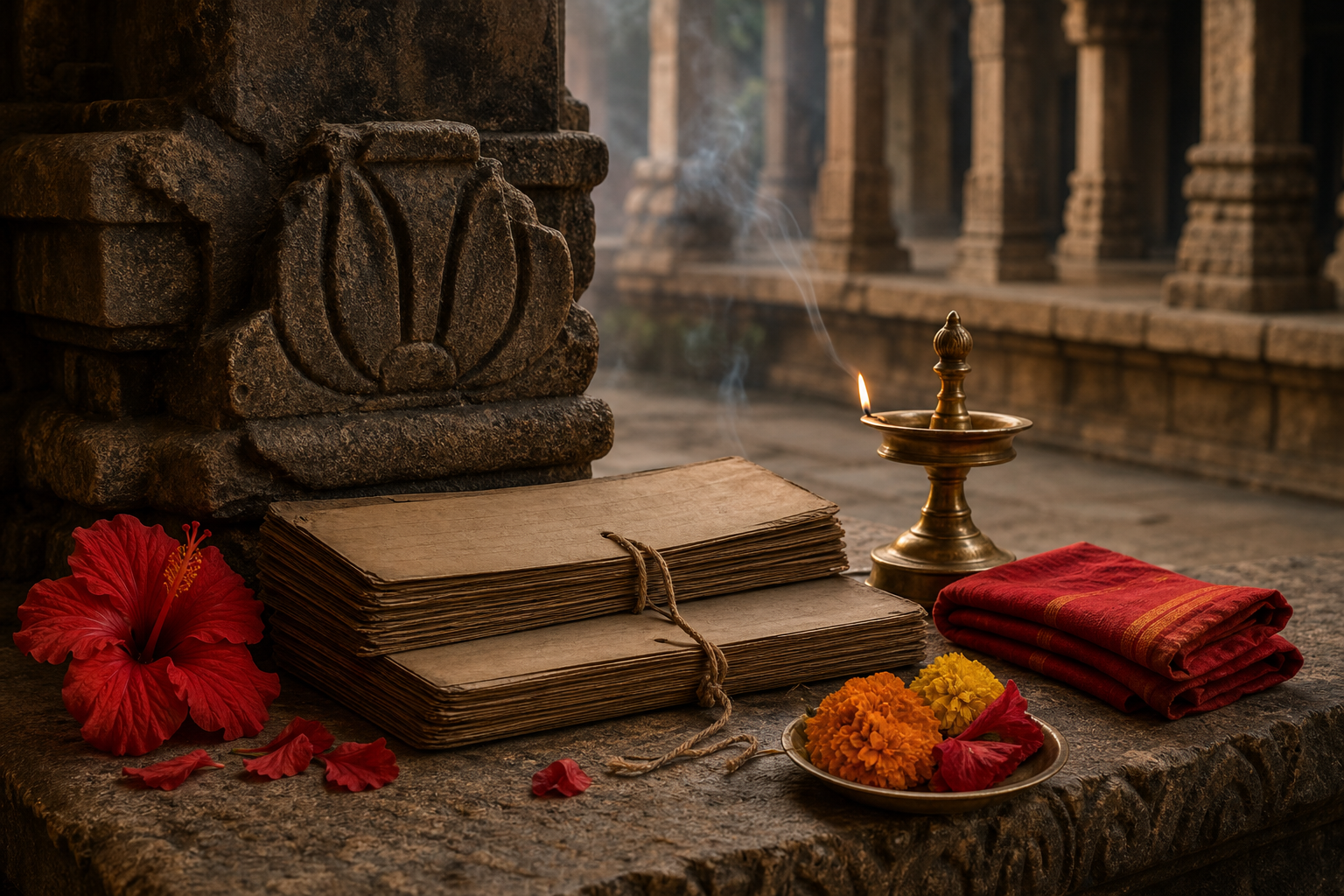
Local tradition remembers the Pandavas receiving a svapna-adesha, a divine instruction in a dream or vision, from the Devi. Some tellings place this during their vanavasa or agyatavasa; others place it after the Kurukshetra War. They are then said to have established or restored the sanctity of Nagarkot, installed a sacred emblem and performed rites of propitiation.
The variation in timing matters. It tells you that this is a living temple katha rather than a fixed narrative episode with one textual location. The Pandava story is not part of the critical textual recension of the Mahabharata. It should therefore not be introduced with the claim that the Mahabharata itself records the foundation of the shrine.
The careful formulation is also the more illuminating one: temple and regional tradition connect the Pandavas with Nagarkot. Textual attestation and sacred memory answer different questions. The first asks what appears in an established textual corpus. The second asks how a community has located epic personalities within its own moral and sacred landscape.
Read this memory for its ethical force. Whether imagined during exile or after a catastrophic war, the Pandavas turn toward the Devi when worldly action has reached its limit. The katha makes a Dharmic claim: power and victory are incomplete without alignment to Shakti, humility and moral restoration. That claim remains available even when the story is described with proper textual caution.
The building carries rupture as well as continuity
Do not judge Nagarkot’s antiquity by asking whether every visible wall is ancient. Chronicles associated with al-Utbi’s Kitab al-Yamini record Mahmud of Ghazni’s plunder of Nagarkot’s sacred wealth in 1009 CE. The Kangra earthquake of 1905 caused major structural damage, followed by sustained community reconstruction. Political violence, Himalayan seismicity and renewal all belong to the temple’s physical history.
This makes the shrine no less historical. It clarifies where its deepest continuity resides: in worship, transmitted memory, seasonal rites and the community’s repeated decision to rebuild. Treating only untouched masonry as authentic would make living temples less intelligible precisely because living communities repair the spaces they continue to use.
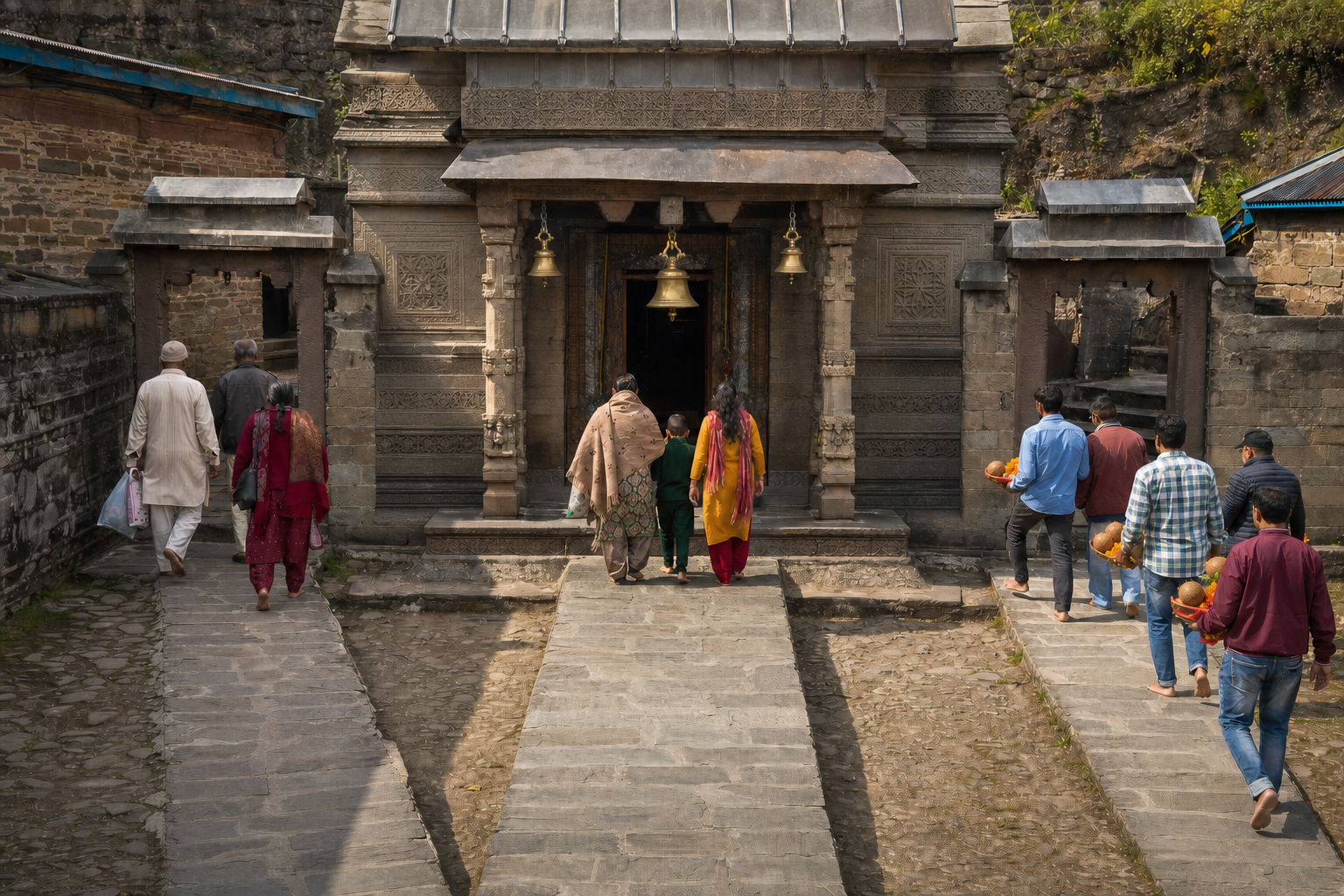
You can still read a regional Nagara architectural sequence in the garbhagriha, antarala and mandapa, together with enclosure walls, gateways and a path for pradakshina. Pay attention to movement rather than searching only for isolated decorative details. The route contracts toward the sanctum, then opens into collective worship and circumambulation. The fortified character of the precinct also reflects Kangra’s defensive historical landscape.
Let the ritual calendar decide what kind of visit you make
There is no single ideal date for darshan. The better choice depends on what you want to encounter. Nagarkot’s ritual calendar gives you three distinct possibilities.
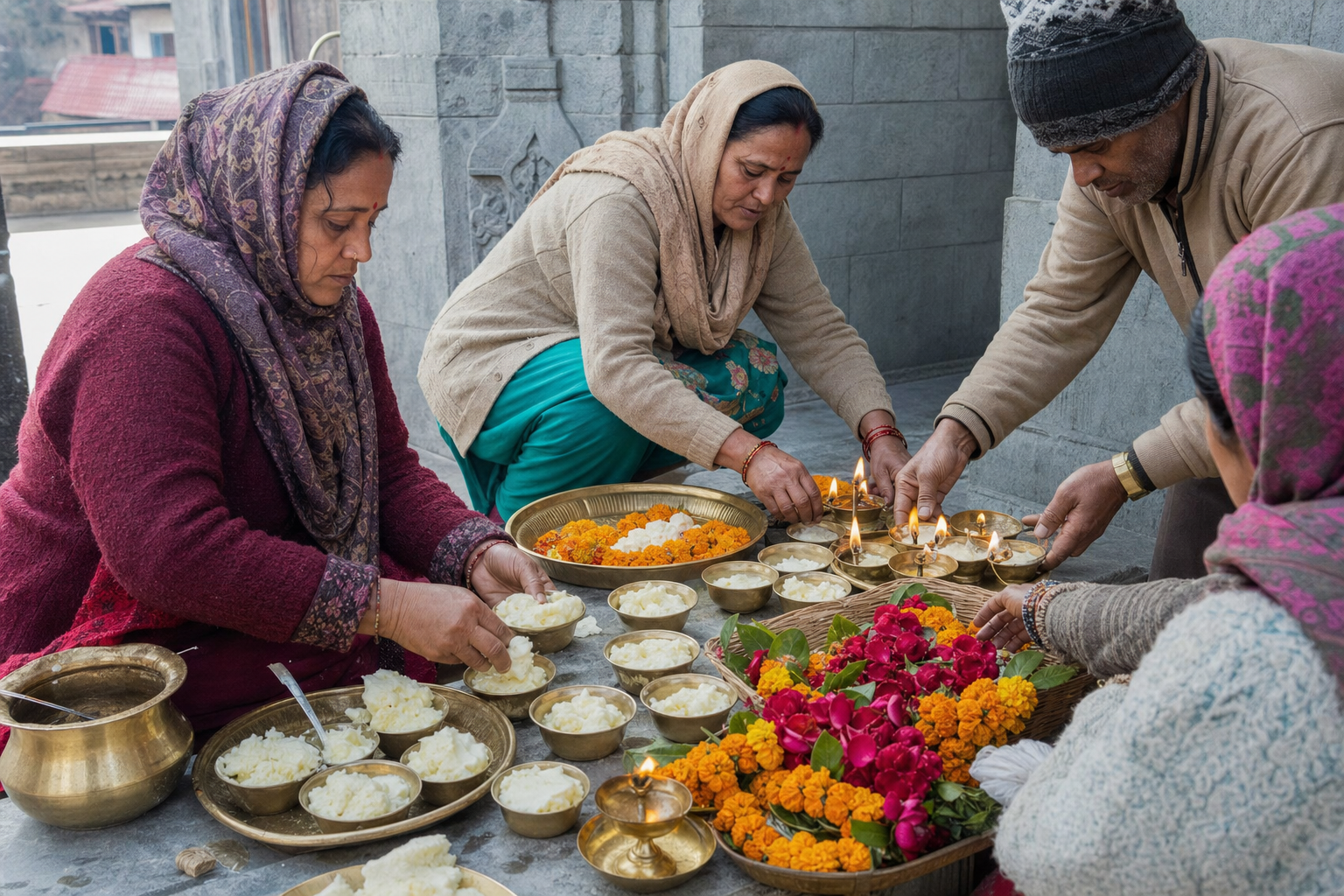
- Choose Chaitra or Sharada Navratri for collective Shakti worship. The nine-night observance brings recitation, devotional music, fasting and a culminating Kanya Pujan. Go during Navratri if you want to experience the shrine as a large devotional community rather than as a quiet monument. Peak attendance also means you should expect compressed movement and give the pilgrimage more time.
- Choose Makar Sankranti for Nagarkot’s distinctive healing symbolism. A ritual coating of butter, or navanita-lepana, recalls the regional belief that the Goddess was treated after combat with asuric forces. The rite presents restoration as part of divine power: Shakti defeats disorder but also heals after the struggle.
- Choose a non-peak period when sustained attention matters more than festival intensity. Navratri and Makar Sankranti are peak occasions. A visit outside them is better suited to a pilgrim who wants to follow the movement from the relative hush of the inner sanctum toward the shared cadence of aarti. Confirm current opening and aarti times locally before setting out.
Whichever period you choose, temple etiquette is part of the darshan rather than an administrative inconvenience. Wear modest clothing. Keep moving when the corridor is crowded. Do not block another devotee’s view to prolong your own. Follow current temple instructions concerning offerings, photography and access. Use the pradakshina path only where the local flow and directions permit it.
Kanya Pujan deserves particular care. Its meaning lies in honoring living embodiments of Shakti, not in treating children as festival scenery. The same principle applies throughout the visit: a sacred person, rite or image should never be reduced to material for a photograph.
During aarti, notice the movement from inward attention to communal sound. The bells, flame, fragrance and gathered voices do not interrupt contemplation; they give it a social form. Allowing that sequence to unfold without constant phone use will tell you more about the temple than a large collection of images taken inside it.
Plan the journey around darshan, not a shrine checklist
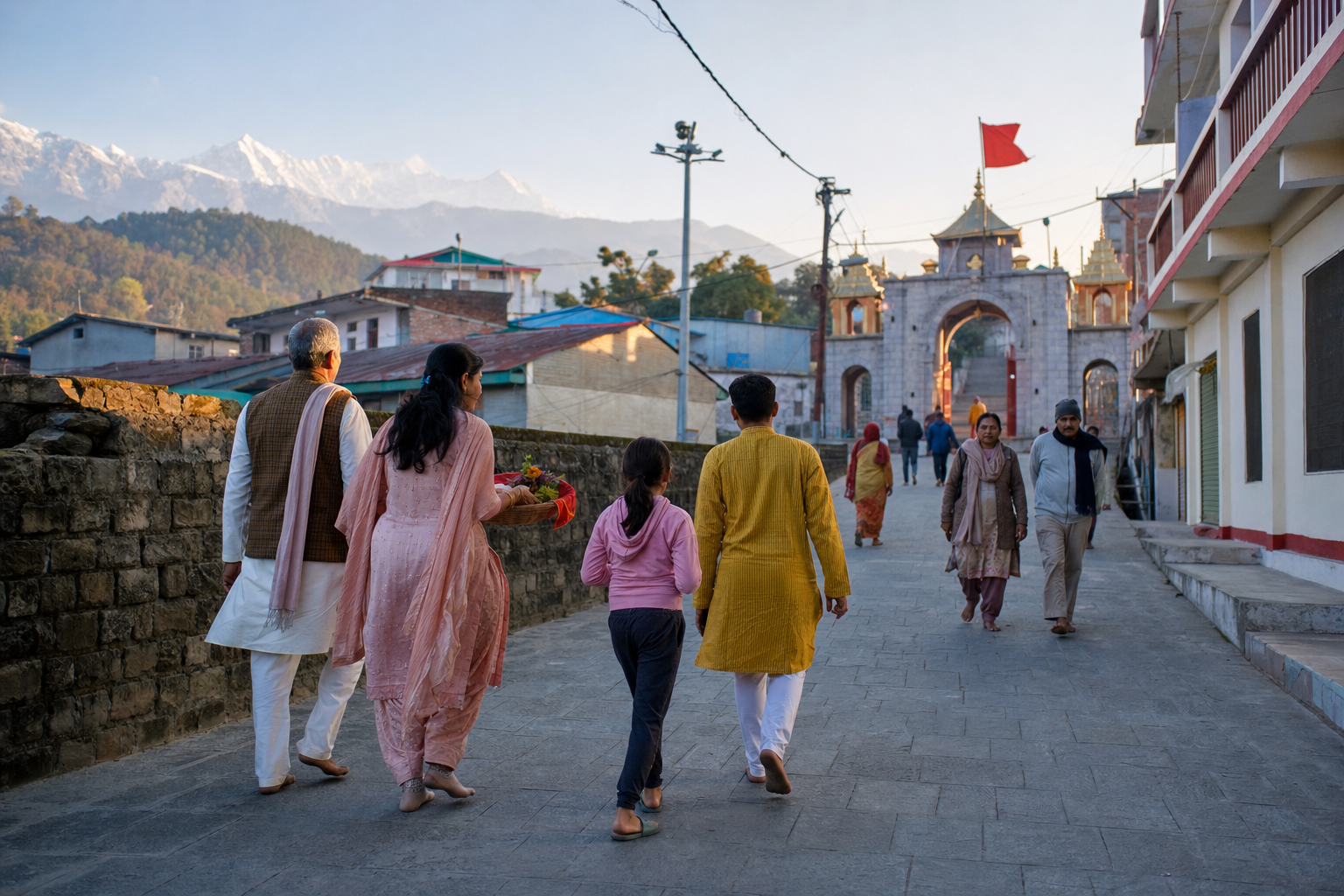
The practical routes are straightforward. Kangra Airport at Gaggal serves the region. Kangra is connected by road with Dharamshala and Pathankot, while the narrow-gauge Kangra Valley Railway provides another approach, followed by local transport to the temple precinct. Transport schedules, temple hours and access arrangements can change, so verify them close to your travel date rather than building a tight itinerary around remembered timings.
Nagarkot is often included in a wider Himachal Shakti circuit with Naina Devi, Jwalamukhi, Chintpurni and Chamunda; some pilgrims extend the northern journey to Vaishno Devi. This network is valuable, but it can tempt you to turn darshan into a race between destinations. More shrines do not automatically produce a deeper pilgrimage.
Use one shrine as the interpretive anchor for the circuit. If Nagarkot is that anchor, carry four questions to the other sacred places:
- Which name or form of Shakti is central here?
- How does the local landscape participate in the shrine’s sacred identity?
- Which ritual distinguishes this place from the others?
- What moral quality does the form of the Devi ask the devotee to cultivate?
A simple preparation sequence will keep logistics from consuming the pilgrimage:
- Decide whether your priority is Navratri participation, the Makar Sankranti butter rite or a less compressed darshan.
- Choose your main approach through Gaggal, Dharamshala, Pathankot or the Kangra Valley Railway, then confirm the final local connection.
- Add time for queues and slower movement during peak observances; do not make a tightly timed onward departure depend on a quick darshan.
- Arrive prepared for the temple’s dress and crowd etiquette, and treat instructions at the precinct as more current than any saved travel note.
- After darshan, move away from the traffic flow before pausing to reflect, so your contemplation does not obstruct another pilgrim.
Before leaving Kangra, give the Pandava memory a practical answer. Ask where your own exercise of strength has become separated from care, humility or restoration. Then identify one action that would bring the two back together. Nagarkot’s challenge is not merely to admire Shakti, but to let power become Dharmic through the way you use it.
References
