
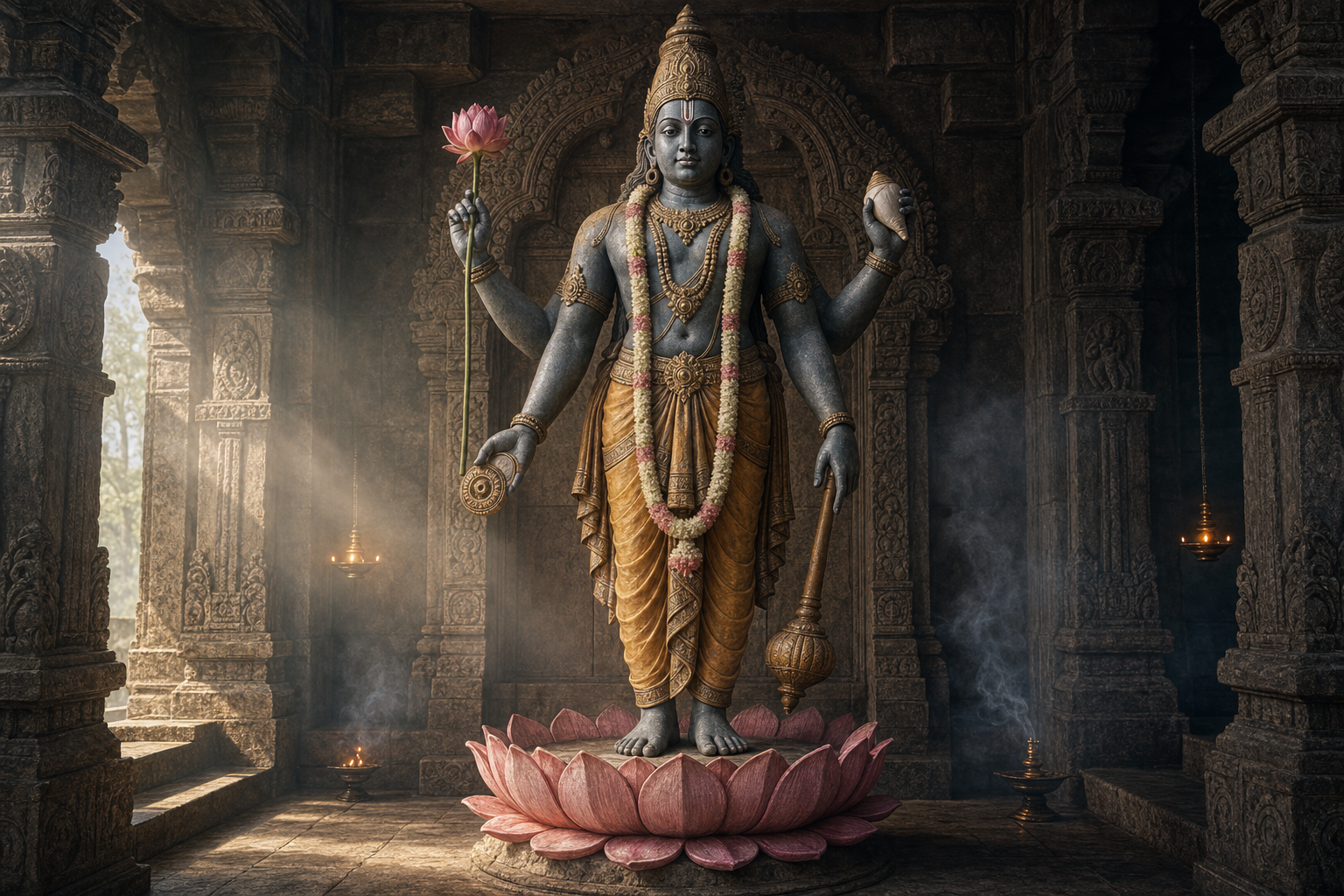
You are standing before a Hindu mūrti and see lotuses everywhere: beneath the deity, in one hand, perhaps even rising from another divine figure. If you translate every lotus as nothing more than “purity,” you have found the foundation of the symbol, but not the message of the image.
Begin with one practical question: what is the lotus doing? A flower supporting the deity and a flower carried by the deity have different iconographic functions. The first establishes the condition from which divine power operates. The second identifies a quality being expressed, awakened, or bestowed. Once you see that distinction, an apparently decorative flower becomes readable theology.
Start with the lotus’s relationship to the deity
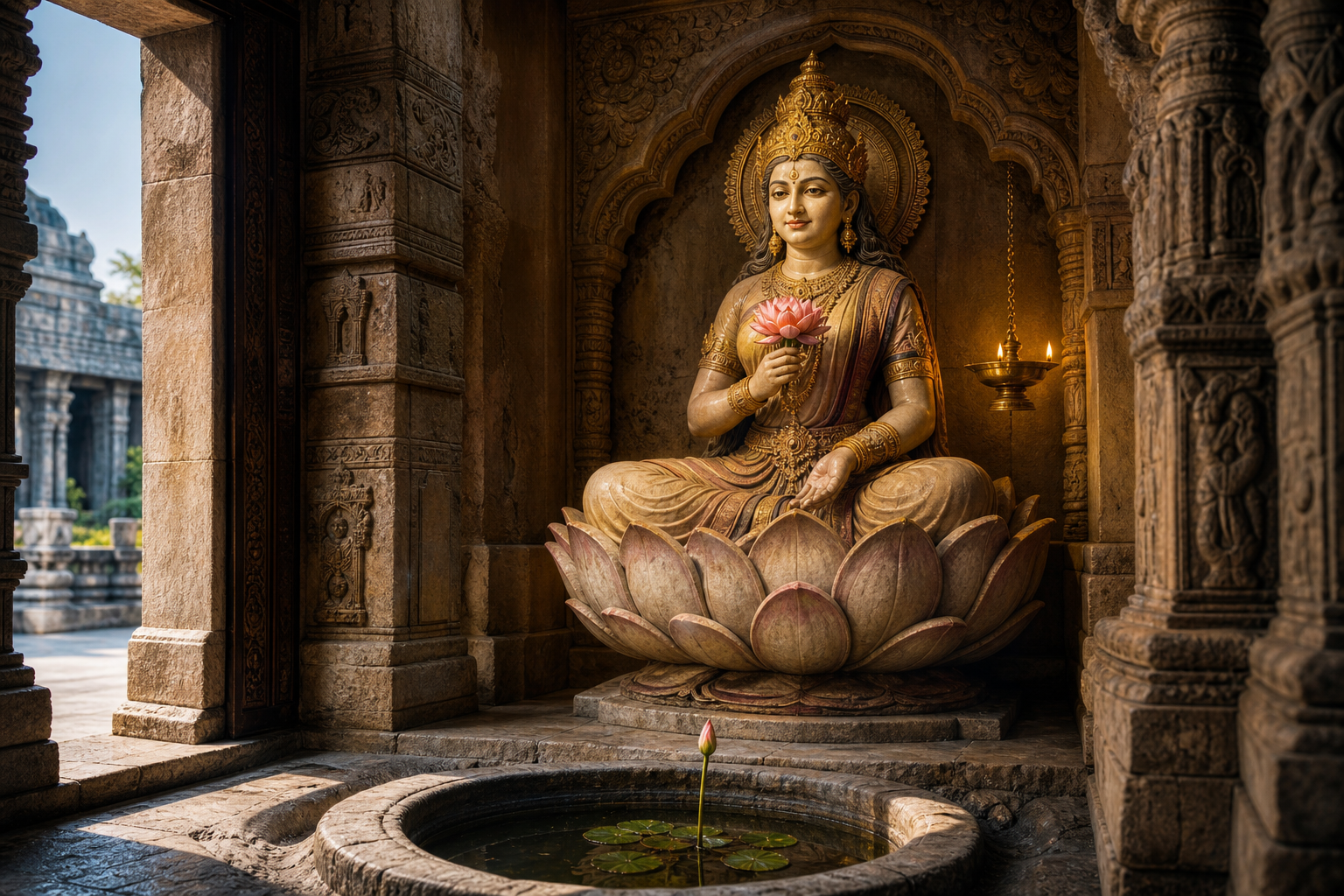
The lotus rises from muddy water without surrendering its beauty to the mud. Hindu visual language turns that natural image into a lesson about purity, resilience, detachment, and awakened awareness. Yet those meanings become more precise when you notice where the flower appears.
- A lotus beneath the deity is a throne or pedestal, commonly called a padma-pīṭha and sometimes kamalāsana. It communicates spiritual status, transcendence, and sovereignty grounded in cosmic and moral order.
- A lotus in the deity’s hand, described through terms such as padma-hasta or utpala-dhārin, points to a divine quality in action. Purity, abundance, wisdom, compassion, or auspicious potential is being made available to the world.
- A throne and held lotus together create a fuller statement. The deity abides in an unsullied state while extending the corresponding grace to the devotee.
- A lotus emerging from the body may indicate a cosmological event rather than a throne or handheld attribute. The best-known example is the lotus growing from Viṣṇu’s navel and bearing Brahmā.
The throne is therefore not ornamental furniture. It locates the deity within a sacred order. In serene forms, its open petals often reinforce a sāttvika mood of clarity, balance, and luminous authority. A carefully formed “world-lotus,” or viśva-padma, can expand that meaning from personal purity to the harmonious structure of the cosmos.
Do not confuse the lotus pedestal with the deity’s bodily posture. Padmāsana is a cross-legged posture; padma-pīṭha is the lotus support. A deity may sit in padmāsana, in royal ease or lalitāsana, or in a comfortable upright seat called sukhāsana, while the lotus beneath the body continues to perform its own symbolic work.
Use a reliable sequence instead of guessing from one detail
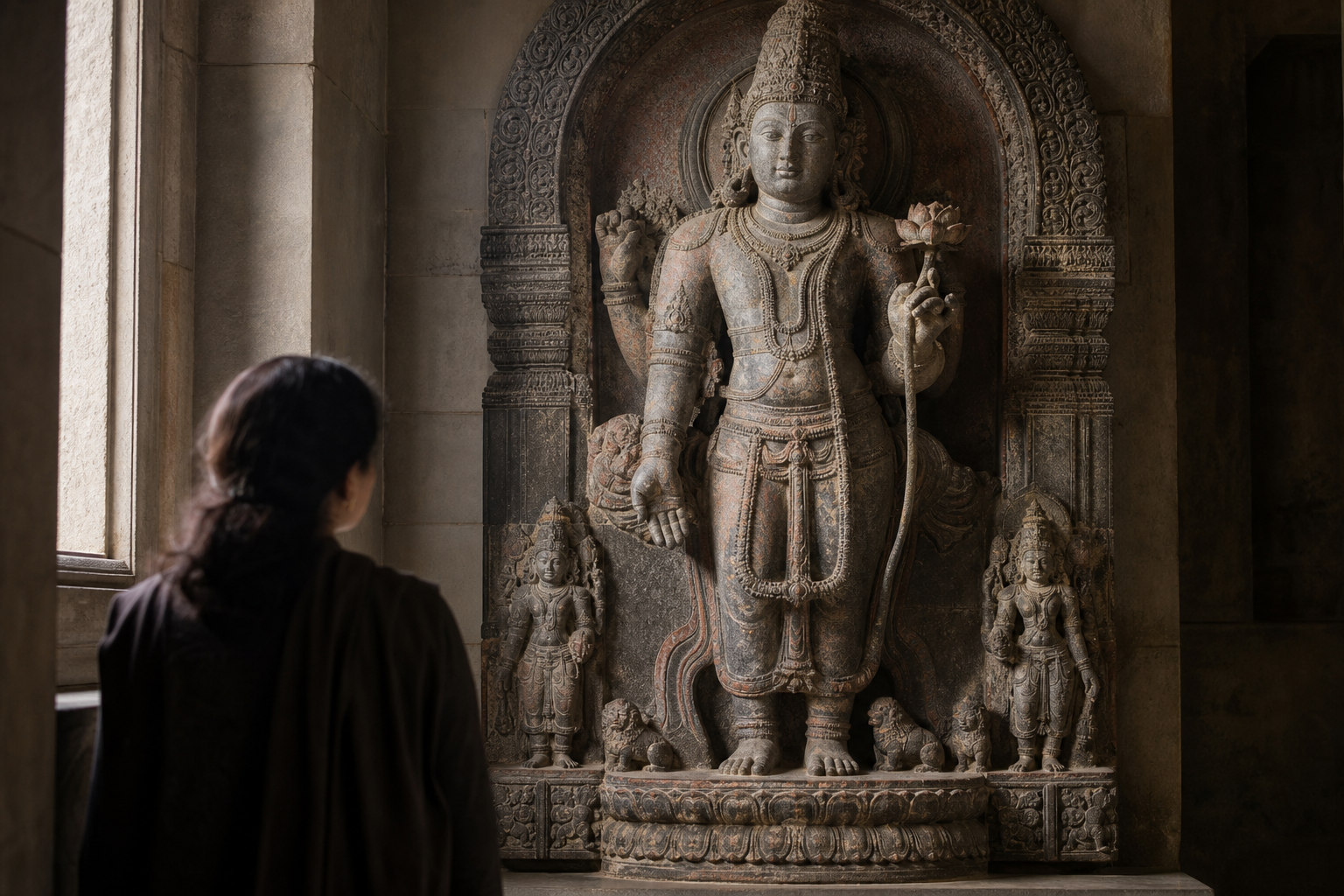
Hindu iconography works more like a grammar than a codebook. No isolated colour, petal, or gesture should overrule the complete image. When you encounter a lotus in a temple, manuscript, bronze, or museum sculpture, read it in this order:
- Locate the flower. Decide whether it supports the figure, is held as an attribute, is presented toward the viewer, or emerges as part of a larger cosmological scene. This establishes the lotus’s basic function.
- Examine its stage and direction. A bud suggests latent power, grace not yet fully unfolded, or spiritual potential. A fully open flower suggests manifest auspiciousness or maturity. An upward-facing bloom encourages a reading of ascent and aspiration; one offered toward the viewer emphasizes reception and bestowal.
- Notice the colour where it is genuinely visible. White, or śveta, commonly strengthens associations with sattva, clarity, and truth. Red, or rakta, carries auspicious vitality and abundance and is closely associated with Lakṣmī. A blue or dark utpala or nīlotpala directs attention toward inward and profound knowledge.
- Read the posture and mood. A composed face, balanced posture, and lotus throne work together differently from a dynamic pose. The flower supports the figure’s bhāva; it does not erase it.
- Identify the deity and accompanying attributes. The same lotus becomes more specific beside Viṣṇu’s conch and discus, Sarasvatī’s vīṇā and book, or Lakṣmī’s imagery of abundance. The deity’s function determines which possibility should lead your interpretation.
Colour should refine your reading, not control it. A red lotus does not automatically make every figure Lakṣmī, just as a white lotus does not automatically identify Sarasvatī. Begin with the deity, physical relationship, posture, and other attributes; then allow colour to sharpen the conclusion.
It also helps to separate observation from interpretation. First say, “The deity sits on an open lotus and holds a bud angled toward the viewer.” Only then ask what that arrangement means. If a hand, stem, or blossom is damaged, stop at what remains visible rather than inventing the missing gesture.
Let the deity determine which meaning comes forward
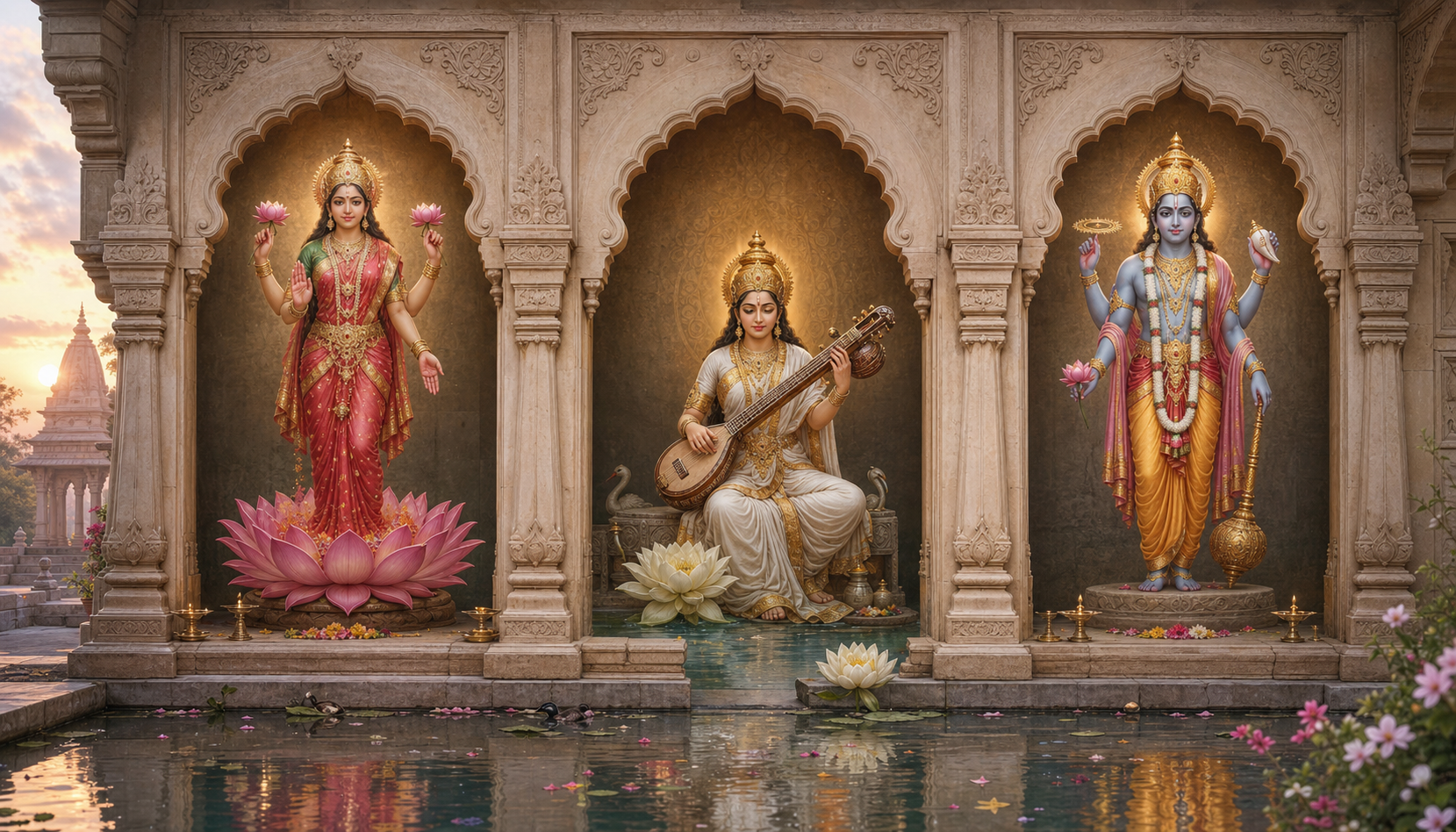
Lakṣmī: auspicious order established and shared
Lakṣmī, also known as Padmā and Kamalā, displays the most complete lotus vocabulary. When she stands or sits upon an open red or pink lotus, prosperity is not portrayed as a loose collection of possessions. The image presents śrī—radiant wellbeing, fertility, beauty, and auspicious order—as established upon a pure foundation.
When Lakṣmī holds lotuses, often one in each hand, the emphasis shifts toward what she gives and awakens. Abundance and purity are able to unfold in the devotee’s life as the flower unfolds. If throne and handheld flowers appear together, read both parts: auspiciousness is securely enthroned and actively distributed.
This distinction is especially useful with Aṣṭalakṣmī images. Do not let the recurring lotus make the eight manifestations seem interchangeable. Use the remaining attributes and posture to identify the particular domain of wellbeing being nurtured, while treating the lotus as the continuing sign of Lakṣmī’s grace.
Viṣṇu and Brahmā: preservation joined to creation
In the image of Padmanābha, a lotus rises from Viṣṇu’s navel and supports Brahmā. Here the flower is not merely a seat placed beneath a deity. It is the medium through which ordered creation emerges from the waters of potentiality. Brahmā’s lotus support identifies manifestation itself as intelligible and sacred rather than impure because it has entered form.
Viṣṇu may also carry a lotus among his four principal emblems: śaṅkha, cakra, gadā, and padma. The lotus contributes purity, compassion, and dharmic governance to that ensemble. It prevents a narrow reading of divine protection as power alone. Preservation also requires clarity, restraint, and care for the order being protected.
A lotus pedestal beneath a standing or seated Viṣṇu reinforces the same principle at another level. His sustaining action proceeds from detachment and balance. If the cosmic navel-lotus, handheld lotus, and pedestal appear in related imagery, distinguish creation, bestowed quality, and sovereign foundation rather than collapsing them into a single generic meaning.
Sarasvatī, Śākta deities, and Gaṇeśa: clarity takes different forms
A white lotus beneath Sarasvatī places knowledge upon clarity. Its whiteness intensifies the sāttvika qualities of luminance and truth, while the surrounding suggestion of water evokes an inexhaustible depth of wisdom. Her vīṇā, book, and rosary usually identify her more decisively than the lotus does.
When Sarasvatī carries a lotus, the flower points toward the opening of discrimination, or viveka, and refined speech, or vāk. The throne tells you the condition of wisdom; the handheld flower tells you that wisdom can flower through learning, reflection, and disciplined expression.
In Śākta and Tantric imagery, Tripurasundarī and Kamalā may be enthroned upon lotuses to proclaim sovereignty over desire, abundance, and wisdom brought into harmony within awakened consciousness. Some forms of Gaṇeśa carry a lotus among their attributes, directing the symbol toward the auspicious flowering of the insight that clears obstacles. The flower remains recognizable, but the deity determines its operative emphasis.
Let workmanship and Dharmic context refine the reading
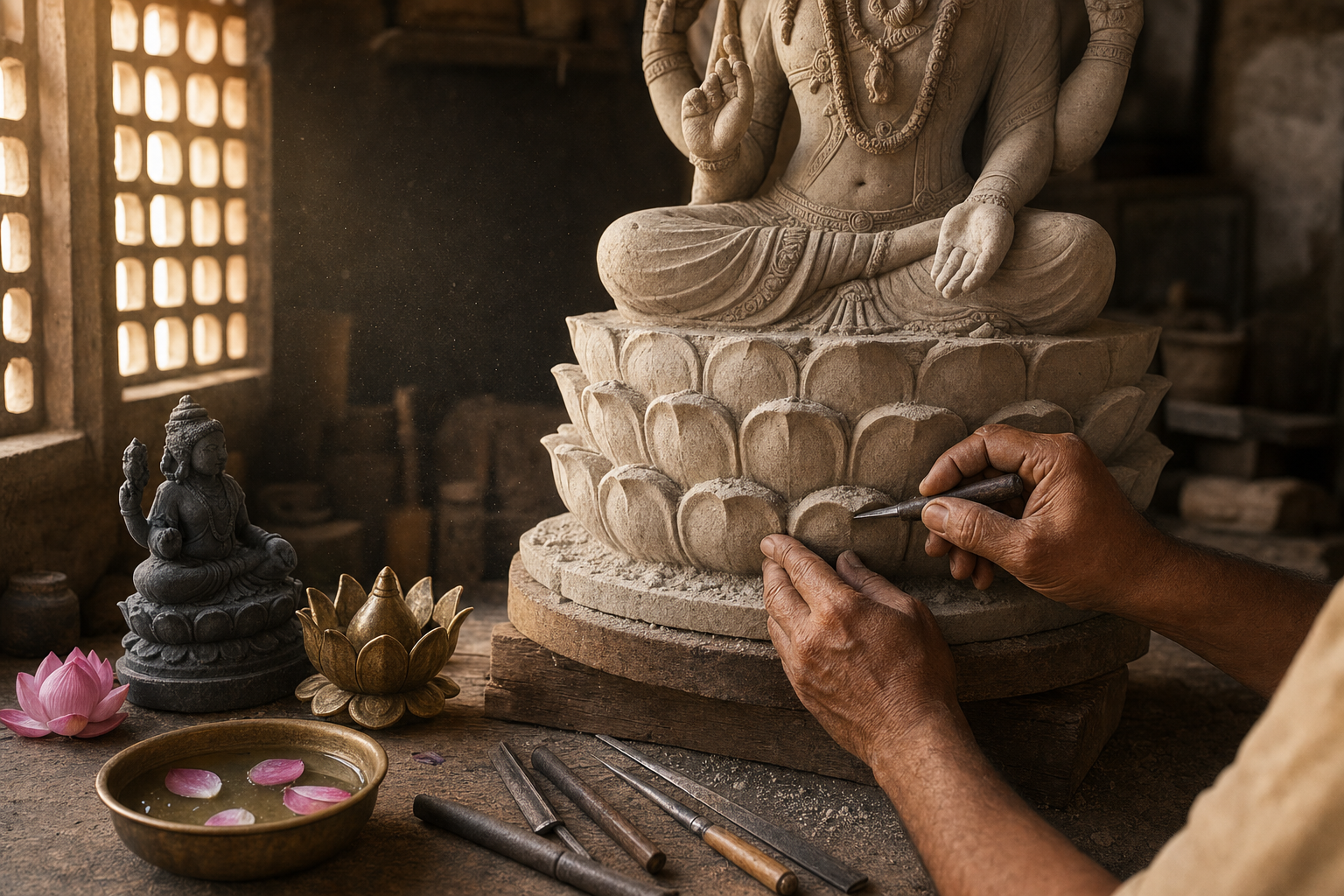
The pedestal’s construction can reinforce the image’s mood. A double-lotus base, with petals opening in complementary bands, gives visual stability while lifting the figure beyond ordinary ground. Regular, rhythmically arranged petals encourage serenity; deeply carved petals make the support appear alive as light moves across it.
Regional workmanship supplies useful context. Chola-period South Indian bronzes often place the deity over a crisply modelled double lotus. Hoysala and Vijayanagara stone carving can use deep, undercut petals whose shadows intensify the sensation of a living bloom. Pāla-Sena and related eastern Indian traditions employ closely related lotus pedestals in Hindu and Buddhist images. Treat such workmanship as a contextual clue, however, not as enough evidence by itself to date or identify an object.
The lotus also belongs to a wider Dharmic vocabulary. Buddhas and bodhisattvas sit upon lotus thrones as signs of awakened clarity. Avalokiteśvara as Padmapāṇi holds an utpala, directing the flower toward compassion that can open amid suffering. Jain imagery uses lotus thrones as well; Padmaprabha’s very identity joins the flower to victory over karmic obscuration. Sikh scriptural poetry turns to the lotus to express life in the world without being inwardly stained by it.
This continuity should improve your reading without erasing differences among traditions. Purity amid difficult conditions, awakening, wisdom, and compassionate action form a shared civilizational intuition. The particular figure, doctrine, ritual setting, and community still decide how that intuition is articulated.
Tantric and yogic traditions also move the lotus inward. The cakras are envisioned as lotuses with differing numbers of petals, culminating in the sahasrāra, the thousand-petalled lotus at the crown. This subtle-body imagery helps explain why an external lotus can signify consciousness unfolding. It does not mean that every lotus pedestal is secretly a cakra diagram. Make that identification only when the surrounding visual or ritual context supports it.
Key takeaways
- Ask first whether the lotus supports, is carried by, is offered by, or emerges from the deity.
- Read a lotus throne as the deity’s sacred foundation: transcendence, purity, sovereignty, and harmony within cosmic order.
- Read a held lotus as an active quality or blessing. A bud indicates potential; an open flower indicates manifestation or maturity.
- Use colour and direction to refine an interpretation, never to override the deity, posture, mood, and accompanying attributes.
- With Lakṣmī, distinguish auspiciousness established beneath her from abundance and purity extended through the flowers in her hands.
- Recognize the lotus as shared Dharmic language while preserving the theological distinctions among Hindu, Buddhist, Jain, and Sikh uses.
At your next temple or museum visit, record what you can actually see: the lotus’s location, whether it is a bud or bloom, its direction, its colour, the deity’s posture, and the neighbouring attributes. Then express the image as one sentence: who abides in what sacred condition, and what power or grace flows from that condition? That habit turns looking into attentive darśana and keeps interpretation answerable to the mūrti before you.
References
