
If you have wondered whether dharma requires you to have children, or feared that your family line will end because parenthood is not possible or right for you, Jaratkaru’s encounter offers a demanding but humane answer. Ancestral duty is real, yet lineage cannot be reduced to producing an heir.
You inherited more than a surname. You received language, memory, ritual, knowledge, protection, and unfinished responsibilities. The question is therefore larger than whether someone will carry your genes: what has been entrusted to you, and how will you keep it available to those who come after you?
Why the hanging ancestors changed an ascetic’s path
Jaratkaru had organised his life around renunciation. His austerity was so severe that even his name evokes emaciation. He wandered as an ascetic, devoted to tapas rather than household life, until a forest vision exposed the cost of treating personal discipline as his only obligation.
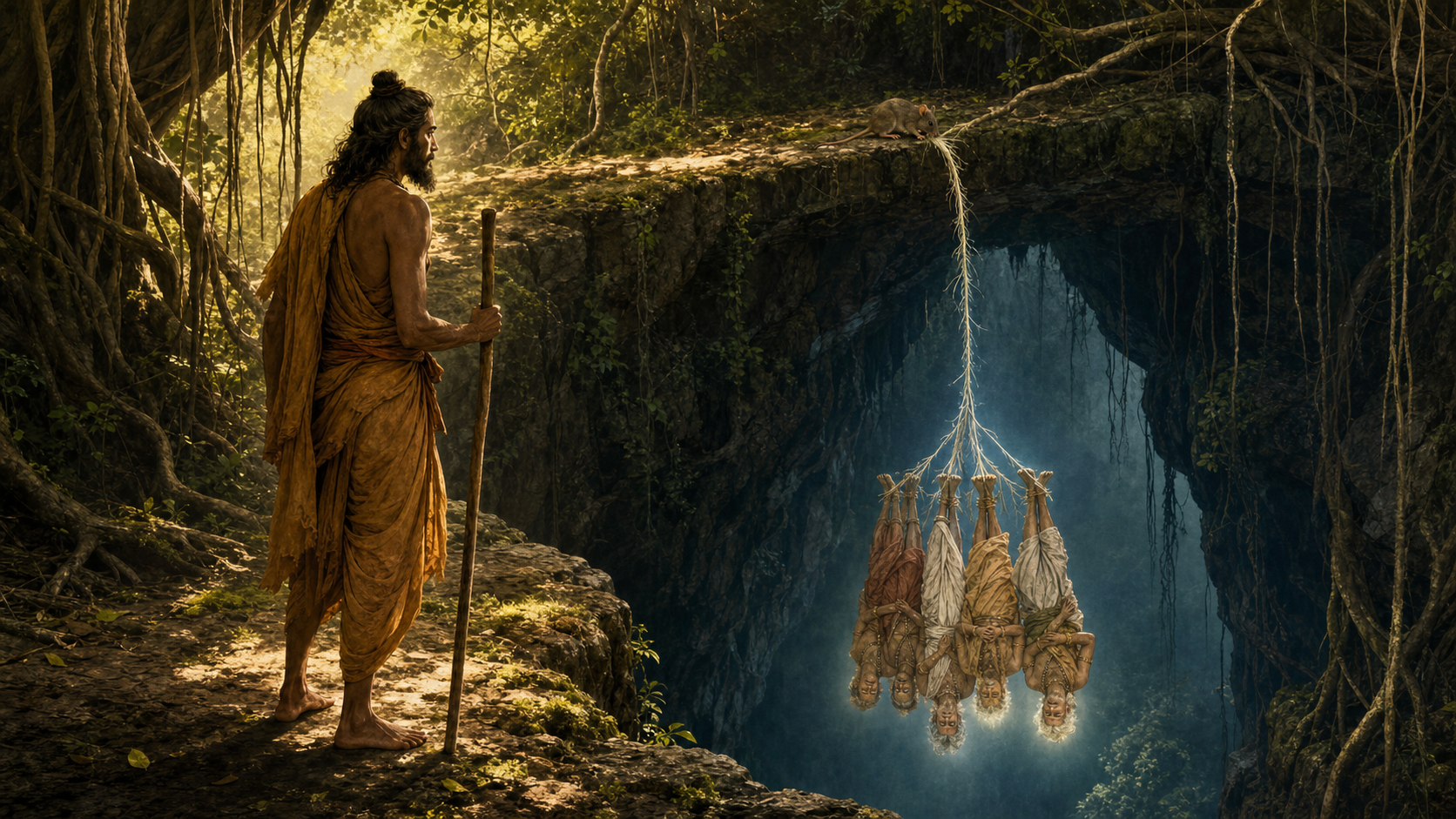
In the Adi Parva’s Astika-parva, he encounters his ancestors hanging upside down above an abyss. Their survival depends on a single fibre of kusa grass while a mouse gnaws at it. The ancestors identify themselves as members of his own line. Because Jaratkaru has embraced permanent celibacy and no descendant remains to continue the family, their final support is about to break.
The symbolism is precise. The fibre is the last continuity of the lineage. The mouse is Time, which never stops consuming what has been left unprotected. The abyss is not merely physical destruction; it is the disappearance of remembrance, offerings, obligations, and identity. A lineage can possess great inherited merit and still become precarious when nobody accepts responsibility for carrying it forward.
Jaratkaru does not conclude that his tapas was worthless. He recognises that it had become incomplete. His pursuit of liberation had left an ancestral debt unattended. He therefore agrees to marry, not because his spiritual purpose has vanished, but because dharma has disclosed another claim upon him.
His conditions reveal both the sincerity and the severity of that decision. He will marry a woman who is freely given in marriage, whose support will not become a material burden upon him, and who bears his own name. The naga king Vasuki offers his learned sister Jaratkaru, joining a human ascetic line to a naga line already facing danger.
The marriage remains governed by a difficult vow: if his wife acts against a condition he has imposed, he will leave. When she wakes him at sunset because she fears that he will miss sandhya, she must choose between disturbing her husband and allowing a sacred observance to lapse. He prepares to depart, but confirms that she carries the child through whom the necessary work will be completed.
You do not need to imitate this ancient domestic arrangement to receive its ethical force. It would be a misuse of the episode to turn Jaratkaru’s conditions into permission to control a spouse or pressure a relative into parenthood. Marriage, conception, and adoption require willing participation and enduring care. The point is that even a sincere vow can collide with another duty, and spiritual seriousness does not excuse you from noticing who bears the consequences.
Pitri-rna is an obligation, not a hereditary panic
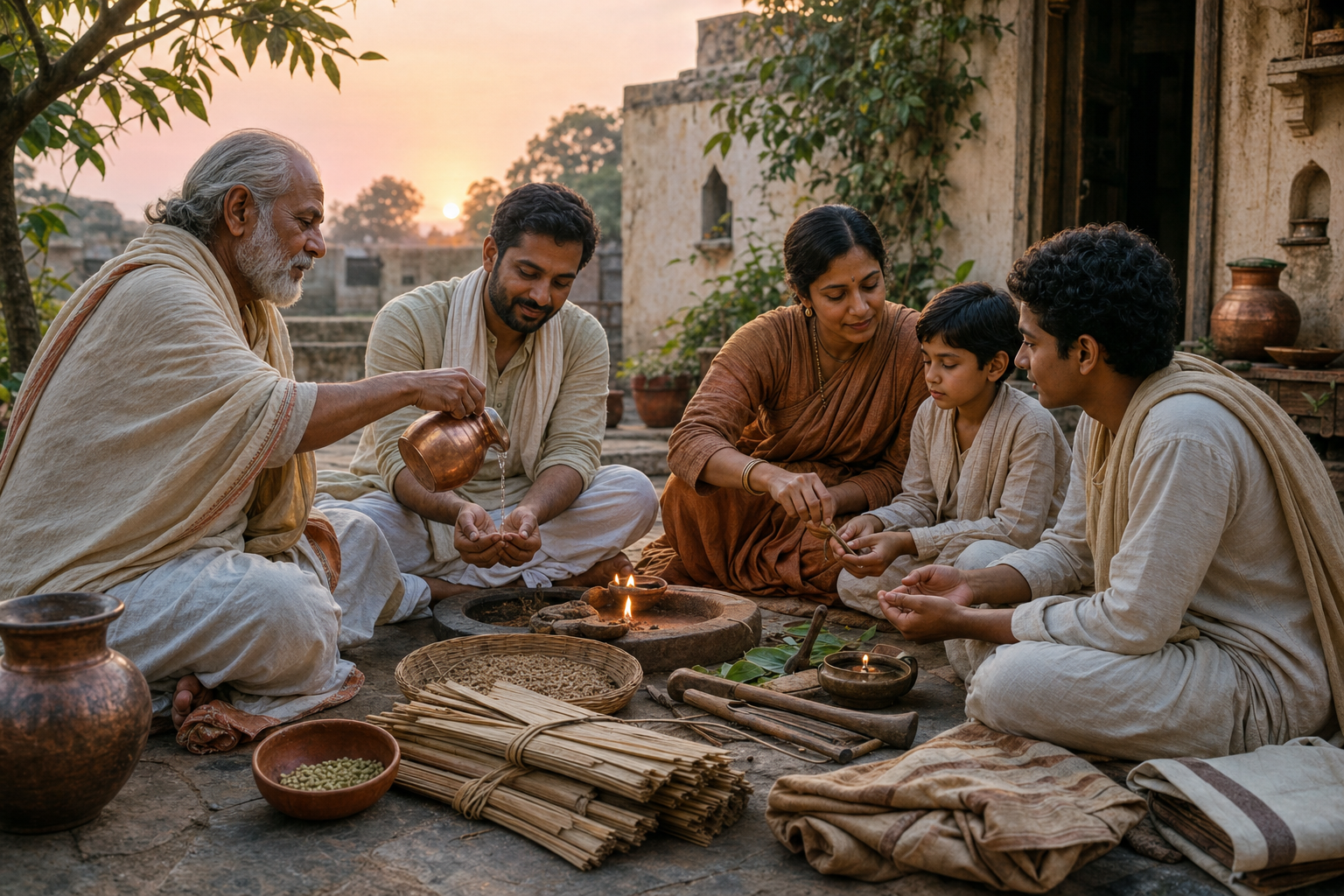
Jaratkaru’s decision becomes clearer through the three inborn debts, or rna-traya, traditionally associated with human life. Deva-rna concerns what is owed to the devas through offering and righteous participation in cosmic order. Rishi-rna concerns study, teaching, and preservation of the knowledge received from the seers. Pitri-rna concerns what is owed to parents and ancestors through remembrance, continuity, and responsible transmission.
Debt here does not mean that your ancestors own your body or may dictate every life choice. It names a moral fact: none of us is self-created. Your capacity to choose was itself made possible by gifts you did not manufacture. Gratitude becomes dharmic when it changes how you use those gifts.
Biological descent carries unmistakable weight in Jaratkaru’s situation. His ancestors need a descendant capable of sustaining the line and its rites. Yet the underlying duty is not exhausted by biology. Dharmashastra traditions historically recognised adoption and other kinship arrangements, although their legal and ritual forms varied by place and community. Teaching, mentorship, social service, and preservation of knowledge can also create cultural and spiritual succession.
This distinction matters when you make a personal decision. If you hope to become a parent, pitri-rna can help you see parenthood as stewardship rather than possession. A child is not a device for preserving status, performing a future ceremony, or soothing fear about a surname. You accept responsibility for forming a person who can receive an inheritance critically, live by dharma, and contribute beyond the family.
If you cannot or do not become a biological parent, your responsibility does not disappear, but neither does it justify shame. Ask what form of succession is actually available to you. Adoption may be one path when it is entered for the welfare of the child rather than as an instrument of ancestral anxiety. Supporting younger relatives, mentoring a student, preserving family memory, teaching a practice, caring for elders, or sustaining a community institution may carry parts of the obligation in other circumstances.
The grihastha, or householder, stage is important for the same reason. It is not a spiritual consolation prize for those who could not renounce. Household life supports care, ritual, learning, hospitality, and social continuity. The principle of lokasangraha, the holding together of the world, asks whether personal discipline also supports the conditions in which other lives can flourish.
Your honest question is therefore not simply, “Must I have children?” Ask instead: “Which debts have reached me, which can I rightly carry, and who or what will suffer if I carry none of them?” That formulation leaves room for circumstance and vocation without turning freedom into indifference.
Turn lineage into a practice rather than a slogan
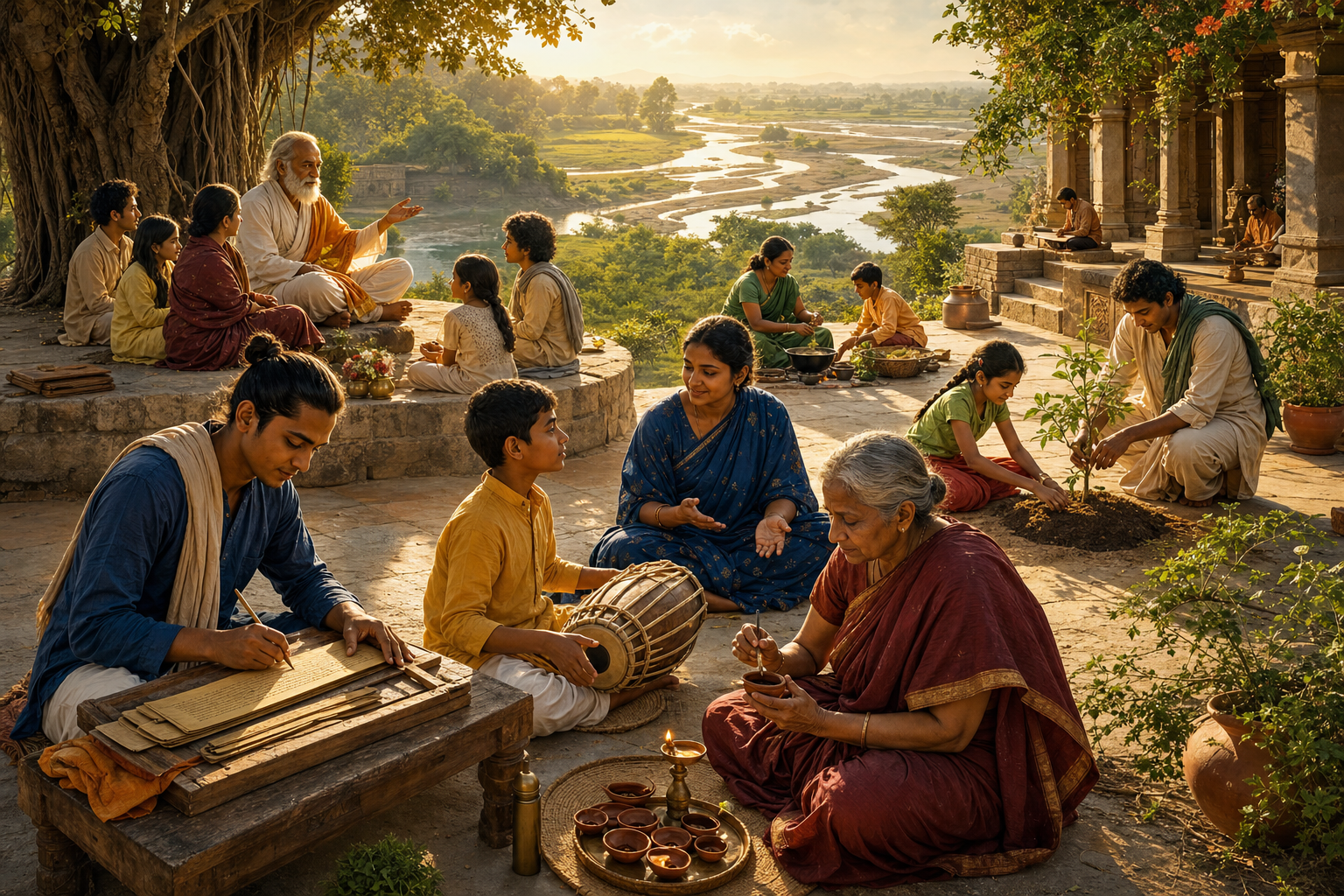
Lineage remains sentimental until something is actually transferred. A family may speak proudly about its ancestry while losing its prayers, languages, ethical disciplines, local histories, and responsibilities. The thread breaks not only when a family has no children, but whenever received knowledge has no prepared recipient.
Begin with a lineage inventory. Record enough to answer these questions without relying on a single person’s memory:
- Which people must be remembered, and what did each of them preserve, sacrifice, teach, or leave unresolved?
- Which family practices, sacred observances, languages, stories, and forms of service are still alive?
- Which knowledge is held by only one elder or practitioner and could disappear without warning?
- Which responsibilities, including care for relatives or community institutions, have quietly become nobody’s assigned duty?
- Who has the interest, consent, and capacity to receive each inheritance?
Then move from inventory to transmission. The following sequence keeps remembrance from becoming an archive that nobody uses:
- Name what you received. Separate living inheritances from mere prestige. A practice you can explain and perform is alive; a grand claim about ancestry that changes nobody’s conduct is not.
- Find the fragile thread. Look for the memory, rite, relationship, or body of knowledge that depends on one ageing person, one unwritten account, or one neglected connection.
- Choose a willing recipient. This may be a child, an adopted family member, another relative, a student, or a community custodian. Succession imposed on someone who does not understand or accept it is unlikely to last.
- Transfer the practice, not only information about it. Let the recipient observe, participate, ask questions, and eventually carry the responsibility without your supervision.
- Make continuity visible. Keep records where the appropriate people can find them, identify who is responsible for maintaining them, and revisit the arrangement when family circumstances change.
- Join memory to service. Use inherited knowledge to care for elders, teach the young, sustain a tradition, or meet a real community need. This prevents lineage from shrinking into clan vanity.
Shraddha and tarpana give ritual expression to ancestral remembrance, especially during Pitru Paksha. Their forms differ across regions and family traditions, so learn the practice from a trustworthy elder, teacher, or practitioner within your own tradition rather than assuming that every Hindu household follows an identical procedure. The common purpose is acknowledgement: you stand within a flow of care that began before you.
Ritual and practical responsibility should reinforce each other. An offering to an ancestor sits uneasily beside neglect of a living parent. Preserving a genealogy while refusing to teach anyone what it means also leaves the work unfinished. Conversely, imperfect ritual knowledge need not prevent you from listening to an elder, recording a family history, repairing a relationship, or passing on a discipline you genuinely understand.
Be equally careful about what should not be transmitted. Lineage is not a command to preserve every inherited prejudice, grievance, or destructive habit. Dharmic succession requires discernment. Honour the people who made your life possible while refusing to hand avoidable harm to another generation. Gratitude without discernment becomes captivity; discernment without gratitude becomes rootlessness.
Astika reveals what a lineage is ultimately for
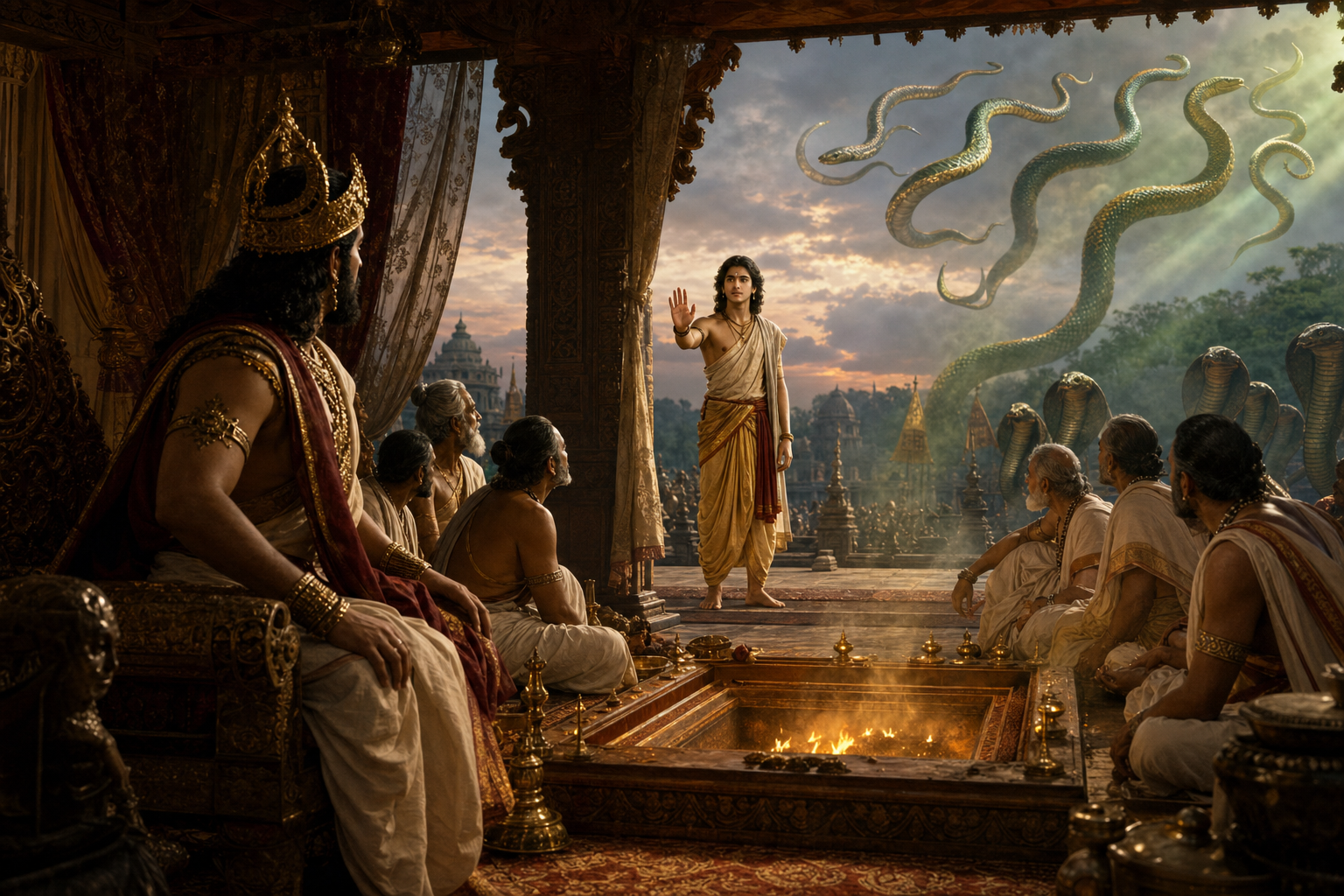
The birth of Astika does more than prevent Jaratkaru’s family from disappearing. Because his mother belongs to the naga line of Vasuki, Astika stands between human and naga worlds. His learning, restraint, and eloquence become decisive when King Janamejaya conducts the Sarpa Satra, a sacrifice threatening the naga race with annihilation.
Astika brings the sacrifice to a halt and saves Takshaka along with the surviving nagas. The descendant born to answer an ancestral crisis does not merely protect his father’s name. He restrains destructive excess, preserves his mother’s people, and restores a moral balance larger than either side.
This is the test that keeps lineage from becoming tribal self-worship. Continuity is not successful merely because your group survives. It succeeds when inherited strength protects life, moderates zeal, preserves knowledge, and enables reconciliation. Astika honours both sides of his ancestry by serving a good that neither lineage could have secured alone.
The same test applies to cultural inheritance. If you teach a younger person only whom to resent, you have transmitted injury rather than dharma. If you give them practices of self-command, truthful memory, reverence, learning, and service, you give them tools with which to meet circumstances you cannot foresee. A durable lineage prepares its successors to act wisely, not merely to repeat the past.
This principle also creates a bridge across the Dharmic family. Hindu ancestral rites, Buddhist duties toward parents and teachers, Jain household ethics of care and non-violence, and Sikh practices of collective remembrance are not interchangeable. They nevertheless share a refusal to imagine the spiritual person as an isolated individual. The seeker is also an inheritor, and an inheritance becomes worthy when it is returned as care.
Key takeaways
- Jaratkaru changes his course because sincere asceticism does not cancel pitri-rna, the debt owed to parents and ancestors.
- Biological continuity matters within his particular crisis, but the broader dharma of lineage includes remembrance, adoption, teaching, mentorship, service, and preservation of knowledge.
- Neither ancestral duty nor an ancient marriage arrangement licenses coercion. Parenthood and succession require consent, care, and responsibility for the person receiving the inheritance.
- Shraddha, tarpana, and Pitru Paksha embody remembrance, while their precise observance should follow the relevant family, regional, or sampradaya tradition.
- Astika demonstrates the purpose of continuity: inherited power should protect life, restrain excess, and serve more than one’s own group.
At your next conversation with an elder, ask which memory, practice, relationship, or duty must not disappear. Record it, learn it, and identify a willing person who can receive it. That is how the vulnerable fibre in Jaratkaru’s vision becomes a living lineage rather than a source of fear.
References
