
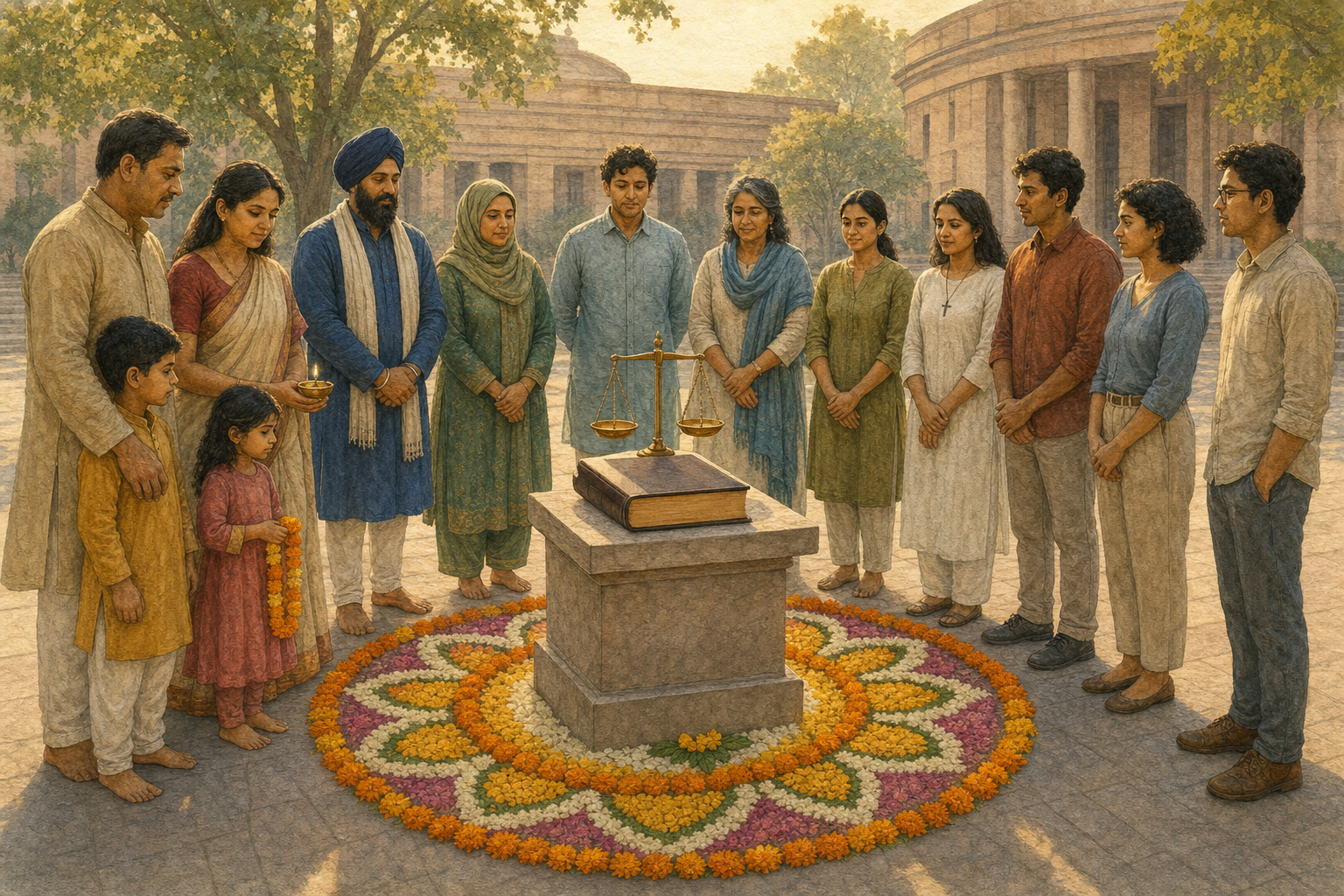
Perhaps you want your child’s school to acknowledge Holi. Perhaps you are preparing a Dharma-centred public meeting, defending a visible Hindu practice, or deciding how to answer the claim that any public expression of Dharma is automatically sectarian. You shouldn’t have to choose between silence and needless confrontation.
The decisive question is not whether Dharma may appear in public. It is what kind of act you are proposing, who is acting, whether anyone is being coerced, and whether the same rule protects people of other convictions. Get those distinctions right and you can defend Dharmic identity without weakening constitutional order, pluralism, or your own principles.
Key takeaways for your next public decision
- Visible religion in public life is not the same thing as state-sponsored religion. Identify whether the act is personal expression, cultural education, religious observance, or civic advocacy before making a constitutional argument.
- Describe observable conduct instead of relying on labels. Hinduism, Hindutva, cultural heritage, worship, and political mobilization are not interchangeable categories.
- State both the right you are invoking and the limit you accept. A credible constitutional claim protects conscience, equality, safety, and due process for everyone.
- In a public-school setting, teach about Holi through history, literature, art, geography, or music. Do not ask children to profess belief or participate in devotion.
- In civic advocacy, define harms such as coercion, stalking, trafficking, fraud, or cyber-harassment in religion-neutral terms. Seek evidence-based remedies and reject intimidation, profiling, and collective punishment.
First identify the act instead of arguing over a label

Many public disputes become confused before the constitutional question is even reached. One person says culture, another hears worship, and a third applies the word Hindutva to the entire scene. You can prevent that confusion by classifying the proposed act in concrete terms.
| Kind of act | What is actually happening | The question you should ask |
|---|---|---|
| Personal expression | An individual wears, speaks about, or otherwise manifests a Dharmic identity. | Is a generally applicable rule being enforced equally, or is the identity itself being targeted? |
| Cultural education | A school or public institution teaches the history, stories, arts, or social setting of a tradition. | Is there a genuine educational purpose, with no demand that participants accept a belief? |
| Religious observance | Participants pray, perform puja, recite a mantra devotionally, or undertake another act of worship. | Who chose the observance, and is the state sponsoring or coercing participation? |
| Civic advocacy | Citizens assemble, petition, campaign, or seek a change in policy. | Are the means peaceful and lawful, and would the proposed remedy protect equal rights and due process? |
A classroom story about Prahlada and Holika, presented as literature and heritage within a lesson on Holi, is cultural education. A color-theory craft is not a profession of faith. Asking children to recite a mantra as believers or conducting puja through a public school would cross into religious observance. A citizen asking the school to treat Holi with the same educational seriousness as other traditions is engaged in civic advocacy.
This precision also protects the meaning of Hindu identity. Sanatana Dharma is a diverse religious and civilizational matrix containing paths of bhakti, jnana, karma, yoga, and many local traditions. Hindutva is used variously for a political ideology and for cultural nationalism. Because the latter term carries contested meanings, it is a poor substitute for examining what people are actually doing. Treating an age-appropriate Holi activity as ideological recruitment does not make it so.
The reverse error also matters. Calling an explicitly devotional exercise merely cultural will weaken your credibility and may expose a public institution to a legitimate complaint. Name the act honestly. Constitutional confidence does not require disguising worship, and Dharmic self-respect does not require turning every cultural activity into worship.
Match your constitutional method to the institution

There is no single rule called public secularism that works identically in every country and institution. A public school, a private preschool, a municipal venue, and a citizen-led assembly do not occupy the same legal position. Before invoking a constitutional principle, identify the jurisdiction, the institution, the decision-maker, and the exact action being requested.
In Bharat, connect identity to rights, equality, and lawful means
India’s constitutional framework gives you a disciplined vocabulary. Article 14 concerns equality before the law. Article 19 protects freedoms that include speech and peaceful assembly. Article 21 protects life and personal liberty. Articles 25 and 26 protect religious freedom within the constitutional framework. A Dharma-centred campaign can therefore speak from conviction while grounding its public claim in equality, conscience, peaceful assembly, personal liberty, and rule of law.
Those guarantees are not magic words that settle every dispute. Your proposal still needs a defined injury, a competent authority, a proportionate remedy, and protections against misuse. If the concern is the safety of women or young people, for example, describe the conduct at issue: coercion, deception, trafficking, stalking, abduction, harassment, or online abuse. Do not treat a person’s religious identity as proof that one of those acts occurred.
Scale does not change the method. A Dharma-centred gathering of nearly 11,000 people in Hupari drew legitimacy from peaceful, organized participation and repeated reliance on constitutional action. A large crowd may give a cause visibility, but it does not confer investigative authority, suspend due process, or justify vigilantism.
If you are organizing a Sabha or policy campaign, put four commitments in the invitation or charter: the public purpose, the constitutional means, the conduct prohibited at the event, and the lawful remedy being sought. That short statement helps participants, officials, journalists, and critics evaluate the actual campaign rather than an imagined one.
In a US school, separate neutral teaching from state devotion
The US public-school question turns on state action and educational purpose. The Establishment Clause does not require schools to erase religion from history or culture. It does require public institutions to avoid religious endorsement, denigration, coercion, and proselytization.
Engel v. Vitale in 1962 and Abington v. Schempp in 1963 barred state-sponsored devotional practices while leaving room for academic study of religion. Florey v. Sioux Falls School District, decided by the Eighth Circuit in 1980, permitted neutral education about religious holidays. More recent Establishment Clause jurisprudence has used a history-and-tradition lens in certain contexts, but a public school still should not turn a lesson into worship or pressure a child to affirm a creed.
A private or parochial preschool may operate under a different mission and legal structure. A publicly affiliated preschool is much closer to the public-school neutrality framework. Do not assume that a rule governing one automatically controls the other. If a formal complaint, threatened lawsuit, disciplinary decision, or government directive is involved, obtain advice from a qualified lawyer in the relevant jurisdiction rather than relying on a general framework.
Put the principle into the design, not just the defence
A well-designed program is easier to understand and defend than an improvised one. The safeguards should exist before controversy begins, not appear afterward as explanations.
For a Holi or Dharmic cultural lesson
- Write one secular learning objective. Use a concrete aim such as identifying India on a map, comparing global spring festivals, examining color theory, hearing a traditional story as literature, or learning how festivals create community.
- Tell families what children will actually do. Send a brief advance note naming the story, craft, music, food, and materials. State plainly that the activity teaches about a tradition and is not a religious service.
- Keep belief separate from knowledge. You can explain what a mantra, puja, deity, or sacred story means to practitioners. Do not ask children in a public school to recite a mantra as a declaration of belief or perform puja as worship.
- Provide a respectful alternative. An opt-in or opt-out arrangement, where appropriate under institutional policy, should not shame a family or leave a child without a meaningful learning activity.
- Plan for bodies as well as ideas. If color powder is used, choose non-toxic, hypoallergenic material and account for sensory sensitivities. Paper crafts or other low-contact color activities can preserve the lesson where powder is unsuitable.
- Use parent expertise under teacher supervision. A parent can help with pronunciation, regional diversity, clothing, food, music, or family custom, while the teacher retains control of the lesson and its educational purpose.
- Demonstrate parity across the curriculum. Place Holi within a wider pattern of serious cultural literacy that can include Christmas, Hanukkah, Eid, Vesak, Hola Mohalla, and other relevant traditions. Parity means a fair educational principle, not identical activities stripped of their distinct meanings.
- Publish context with any image or clip. A caption should name the curricular unit and activity. A few seconds of children playing with colors can be misread when the educational setting disappears.
- Record what worked. Afterward, note questions from families, accessibility problems, inaccurate materials, and changes needed next time. This turns controversy prevention into an institutional practice.
This approach benefits Hindu children without making classmates into Hindus. It lets a child see family heritage treated as intelligible rather than exotic, while classmates gain the vocabulary to live alongside a tradition they may not share. The civic result is neither conversion nor cultural replacement. It is literacy.
For a Dharma-centred civic campaign
- Define the harm without an identity-based presumption. If you mean coercion, fraud, trafficking, stalking, or cyber-harassment, use that term and identify the evidence needed to establish it.
- Name the authority and remedy. Decide whether you are asking police to enforce an existing law, a school to adopt a safety protocol, legislators to refine a rule, or a community body to provide education and support.
- Separate allegation, evidence, and finding. A slogan is not evidence, and an accusation is not a verdict. This distinction protects victims, the wrongly accused, and the legitimacy of the campaign.
- Build safeguards into the demand. Ask for narrow definitions, religion-neutral application, independent oversight, periodic review, due process, and proportionate consequences where wrongdoing is proved.
- Pair enforcement with practical support. Legal-literacy sessions, confidential help, digital-safety education, counselling referrals, shelter access, and legal aid can prevent harm or help a person act before a crisis deepens.
- Demand usable data. Better reporting, transparent categories, and independent evaluation help distinguish demonstrated patterns from viral impressions. Evidence should guide resources and training.
- Prohibit extra-legal action. Put the rejection of intimidation, doxxing, profiling, collective punishment, and vigilantism in writing. If your own volunteers cannot follow that rule, the campaign is not constitutionally or Dharmically ready.
When pressure rises, let Dharma discipline the response
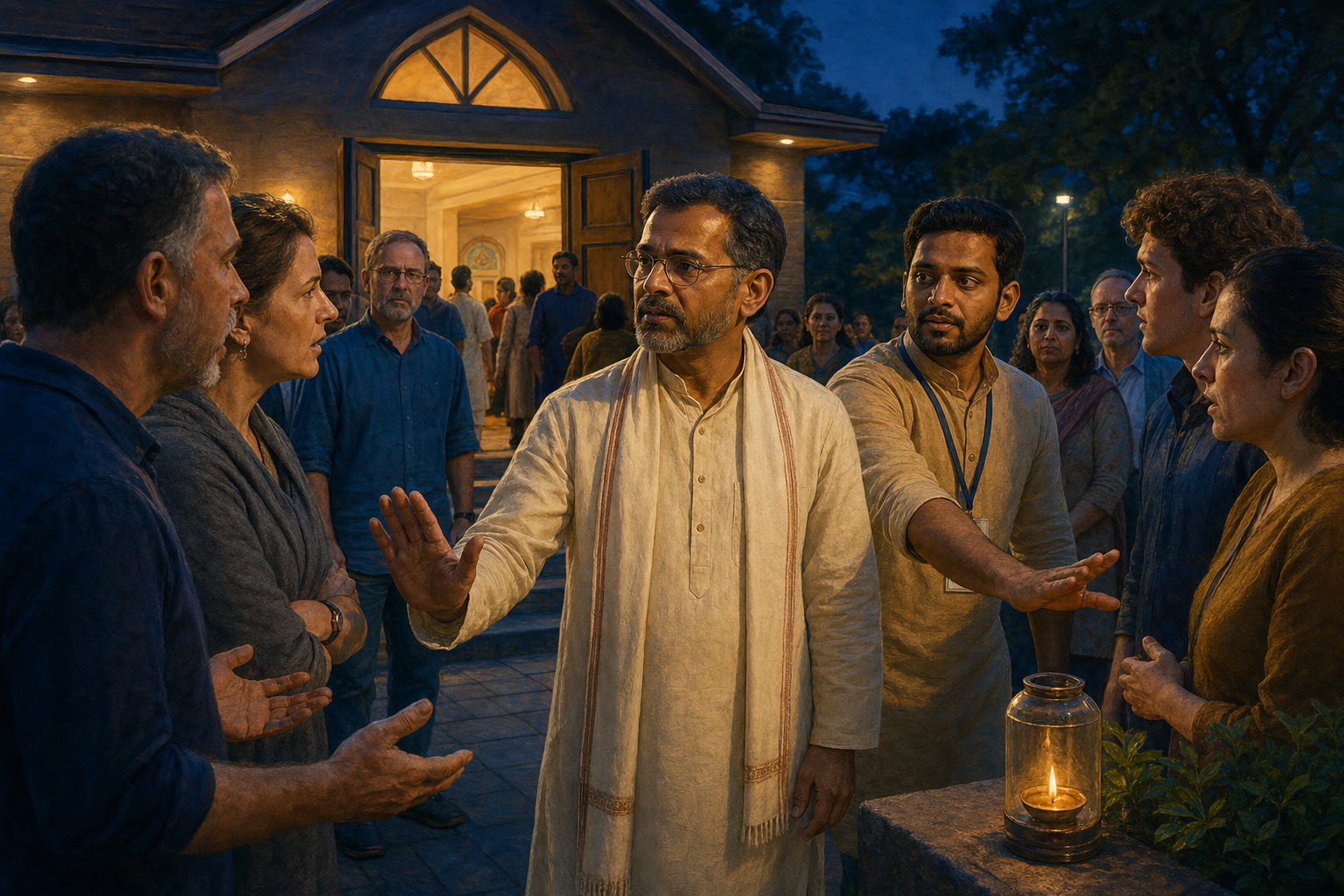
Online outrage compresses context. A child-centred Holi activity can be recast as political capture; a peaceful Sabha can be portrayed as a threat simply because its identity is explicit. In one US preschool controversy, a viral framing described a Holi event as Hindutva replacement. The useful response is neither panicked retreat nor retaliatory hostility. Restore the missing facts.
Prepare a short public statement that answers five questions: What happened? What was the educational or civic purpose? What participation was expected? What devotional or political activity did not occur? Where can someone review the full policy, lesson description, invitation, or safeguards? Keep the answer narrow enough that every sentence can be verified.
You should name Hinduphobia when the conduct warrants it. Blanket suspicion that any Hindu cultural presence is political, casual mockery of deities, deliberate distortion of Om or the Dharmic swastika, and portrayals of ordinary Hindu ethics as inherently backward can all stigmatize Hindu life. But the term should identify specific conduct, not silence every policy objection. A parent asking whether participation is voluntary may be raising a legitimate question; a campaign insisting that Holi’s mere visibility constitutes replacement is making a different kind of claim.
Do not answer prejudice against Hindus by vilifying Christians, Muslims, Jews, or any other community. That move abandons both constitutional equality and Dharma. Correct the claim, defend the right, document any threat or harassment, and use the appropriate institutional, platform, or legal channel. If doxxing, stalking, threats, or intimate-image abuse is involved, preserve the available evidence and seek qualified local assistance; do not organize retaliation.
Dharmic traditions are not interchangeable, but they offer a strong civic grammar. Ahimsa rules out intimidation. Jain anekantavada reminds you that a partial view should be tested before it becomes an accusation. Seva and the Sikh aspiration of sarbat da bhala direct public energy toward service and the welfare of all. Buddhist compassion keeps the person affected by a policy from disappearing behind the slogan. Hindu respect for plural paths allows conviction without requiring uniformity.
These principles do not ask you to become passive. They tell you what strength must look like: truthful claims, lawful organization, equal rules, protection of the vulnerable, and refusal of collective guilt. Dharma enters constitutional life most powerfully when it governs the means as well as the goal.
Before you send the next school email, publish an event notice, or take a civic demand to officials, write four sentences: our purpose is this; our constitutional or policy basis is this; our safeguard for conscience, equality, and safety is this; our lawful remedy is this. If you cannot complete all four clearly, revise the proposal. If you can, you are ready to carry Dharmic identity into public life with both confidence and discipline.
References
- Hindu Existence — From Viral Backlash to Bridge-Building: Holi at a US Preschool, Facts, Law, and Unity
- Hindu Janajagruti Samiti — Hupari: 11,000 unite at Hindu Rashtra Jagruti Sabha for Dharma, safety, and rule of law
