
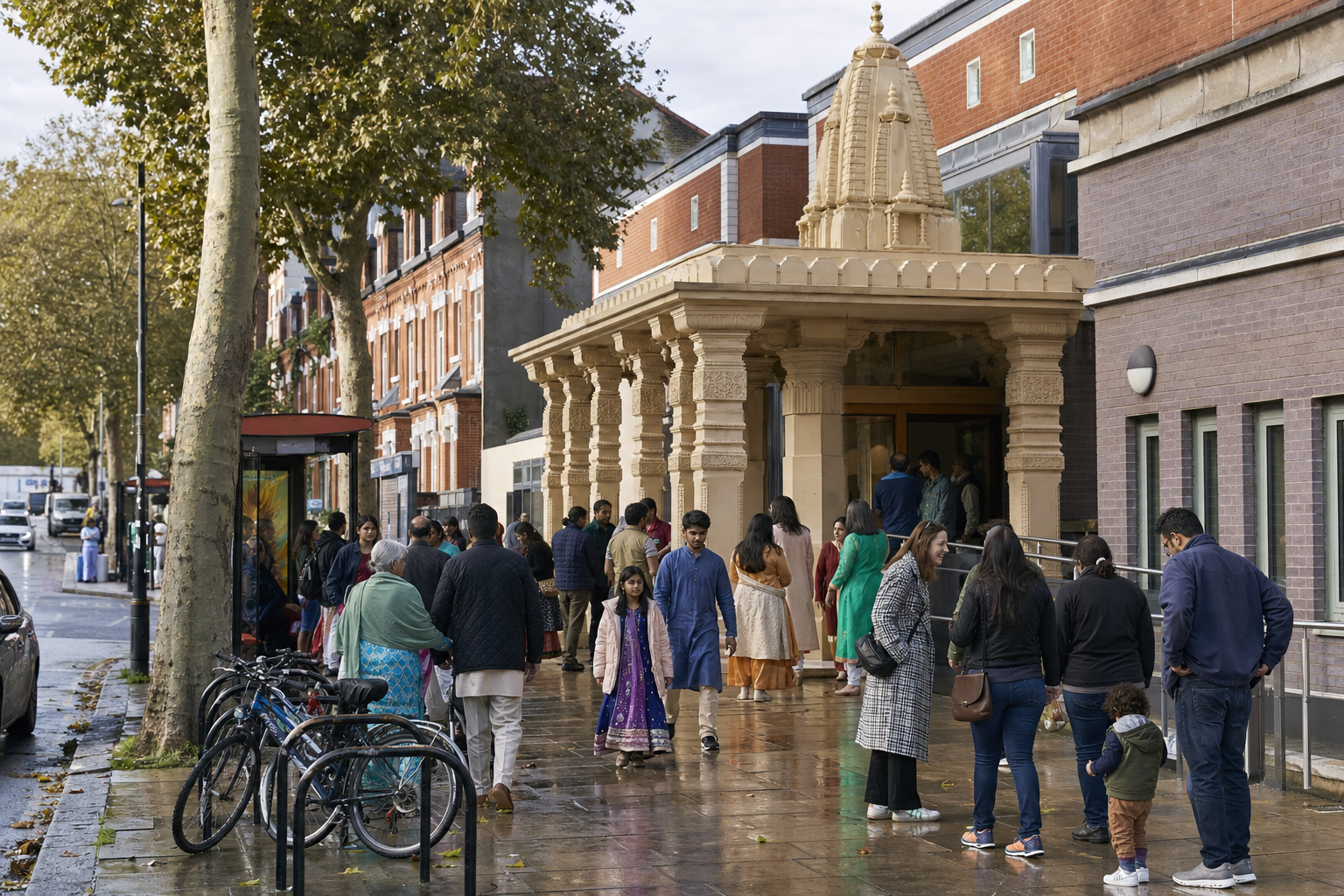
If you help run a mandir in Britain, you may recognise the pattern. During Holi or Diwali, public attention settles on colour, dance and celebration. When a lease, planning issue or council decision arises, the same temple may suddenly be treated as little more than a building, a parcel of land or a competing use.
Your task is not to make the mandir less Hindu so that public institutions can understand it. It is to make its full reality legible: a consecrated place of worship, a home of cultural memory, a centre of seva and a durable part of British civic life. That requires confident hospitality, year-round relationships, documented community value and disciplined preparation for property risk.
Why public visibility is not the same as civic security
A public visit can change how neighbours and national institutions see a Hindu temple. In Leicester, Catherine, Princess of Wales, accepted a floral-and-pearl mala, removed her shoes at the mandir threshold and joined women in a traditional dance. Those gestures communicated respect without requiring a long explanation. The visitor entered on the community’s terms, and Hindu practice appeared as a living part of British life rather than a distant curiosity.
Recognition of that kind matters, but it does not secure a temple’s tenure, compel fair consultation or preserve a building during a dispute. In Peterborough, early court relief preserved the position of the Bharat Hindu Samaj Temple while questions about a proposed council disposal, equality duties and procedural fairness were examined. Interim protection was not a final judgment on the dispute. Its immediate value was that an irreversible step did not overtake legal scrutiny.
These are different dimensions of public life. Visibility asks whether the temple is known, understood and welcomed. Security asks whether its rights, records and public value will be taken seriously when an authority makes a consequential decision. A healthy mandir prepares for both during ordinary times.
Key takeaways
- Keep Hindu protocol visible. Respectful public participation begins at the sacred threshold, not at the camera position.
- Use festival attention to begin lasting relationships with schools, cultural bodies, neighbours, interfaith partners and local institutions.
- Record seva, education and community activity as it happens. General claims about public benefit are weak without dates, participation records, partners and outcomes.
- Know whether the mandir owns, leases or merely occupies its site, and keep every governing and property document accessible to trustees.
- If a public decision threatens the temple, challenge the process with evidence and timely professional advice. Do not turn a governance dispute into hostility towards another faith community.
Make the sacred threshold legible, not negotiable
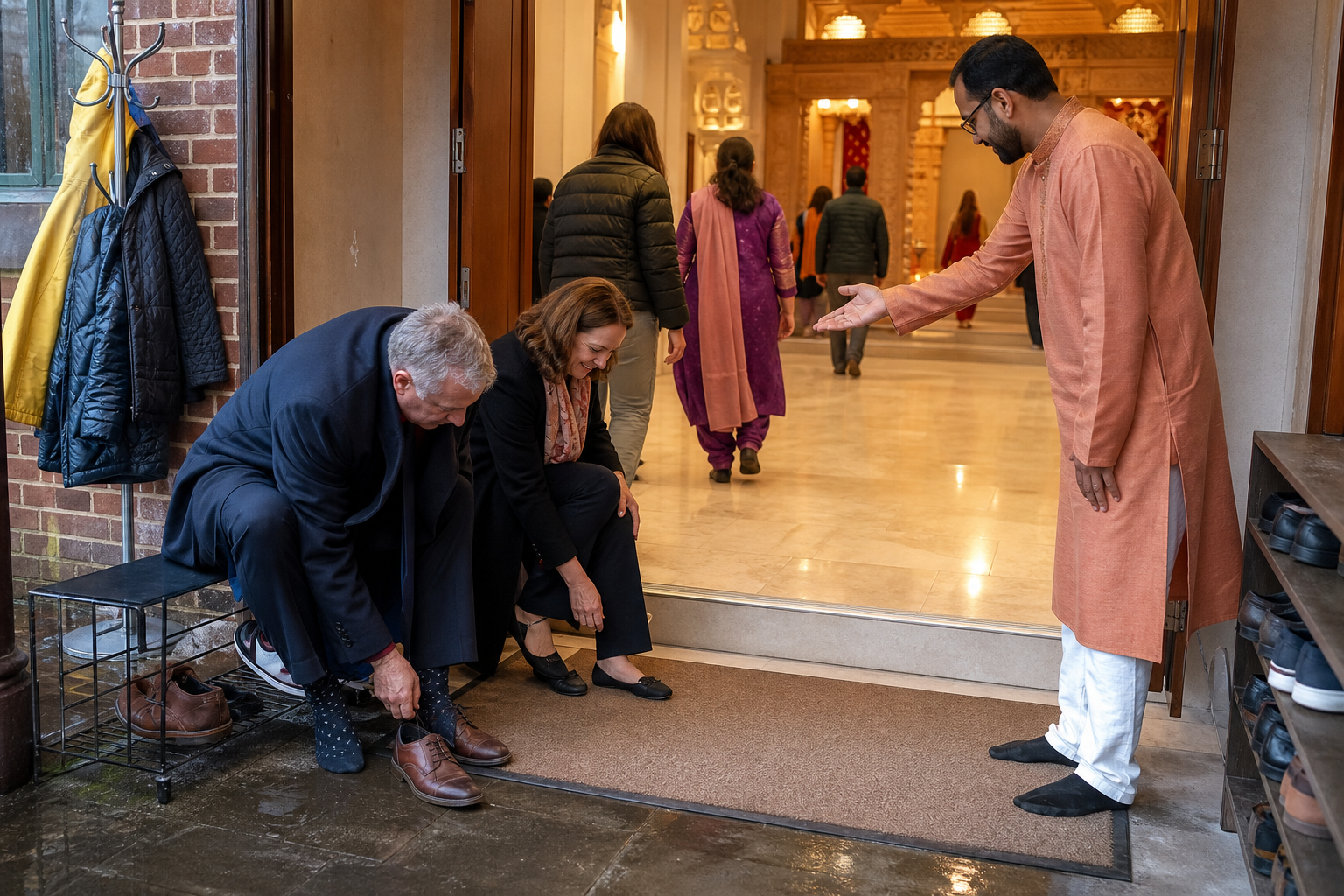
Temple leaders sometimes feel pressure to flatten a visit into a generic cultural event. That is unnecessary. A guest can be welcomed warmly without interrupting puja, relocating every sacred element for a photograph or treating worship as a performance.
Start with a short visitor briefing before arrival. Explain that footwear is left outside the consecrated interior, identify any expectations concerning modest clothing, say where photography is permitted and describe what the guest will encounter. If aarti, bhajan, abhishekam or darshan will occur, explain the sequence in plain language. A visitor who knows when to stand, observe, accept prasad or remain quiet is less likely to feel awkward and less likely to disrupt the congregation.
The explanation should preserve meaning. Removing footwear is not a colourful custom added for atmosphere. It marks the movement from the dust and traffic of the outer world into sacred space. Darshan is not merely looking at an image; it is devotional beholding. A mala is not event jewellery. In the Leicester encounter, garlanding, barefoot entry and collective dance carried distinct meanings of honour, reverence and welcome.
Give the guest choices rather than manufacturing devotion. Make clear which moments are invitations to observe and which allow voluntary participation. A national figure, councillor, teacher or neighbour should never be pushed into an act of worship for a photograph. The most convincing encounter is one in which the mandir remains recognisably itself and the guest participates with informed freedom.
Designate a named host who understands both ritual practice and the purpose of the visit. That person should know the correct names and pronunciations of the deities, the significance of the festival, the boundaries around photography and the order of events. Temple volunteers can then direct practical questions to the host instead of offering conflicting instructions at the door.
Shared dharmic etiquette can also create familiarity without erasing difference. Sikhs remove footwear before entering a gurdwara, Jains before a derasar and Buddhists before a vihara. That common grammar of reverence can support cooperation among dharmic communities, but each place must still be described according to its own theology, discipline and identity.
Finally, protect the congregation’s dignity. Tell worshippers in advance when public guests or media will be present. Obtain permission before making an individual, especially a child or vulnerable person, the focus of publicity. Mark areas where photography is restricted. Hospitality should open the mandir to public understanding without making devotees feel that their sacred life has become scenery.
Turn seva and cultural continuity into usable evidence
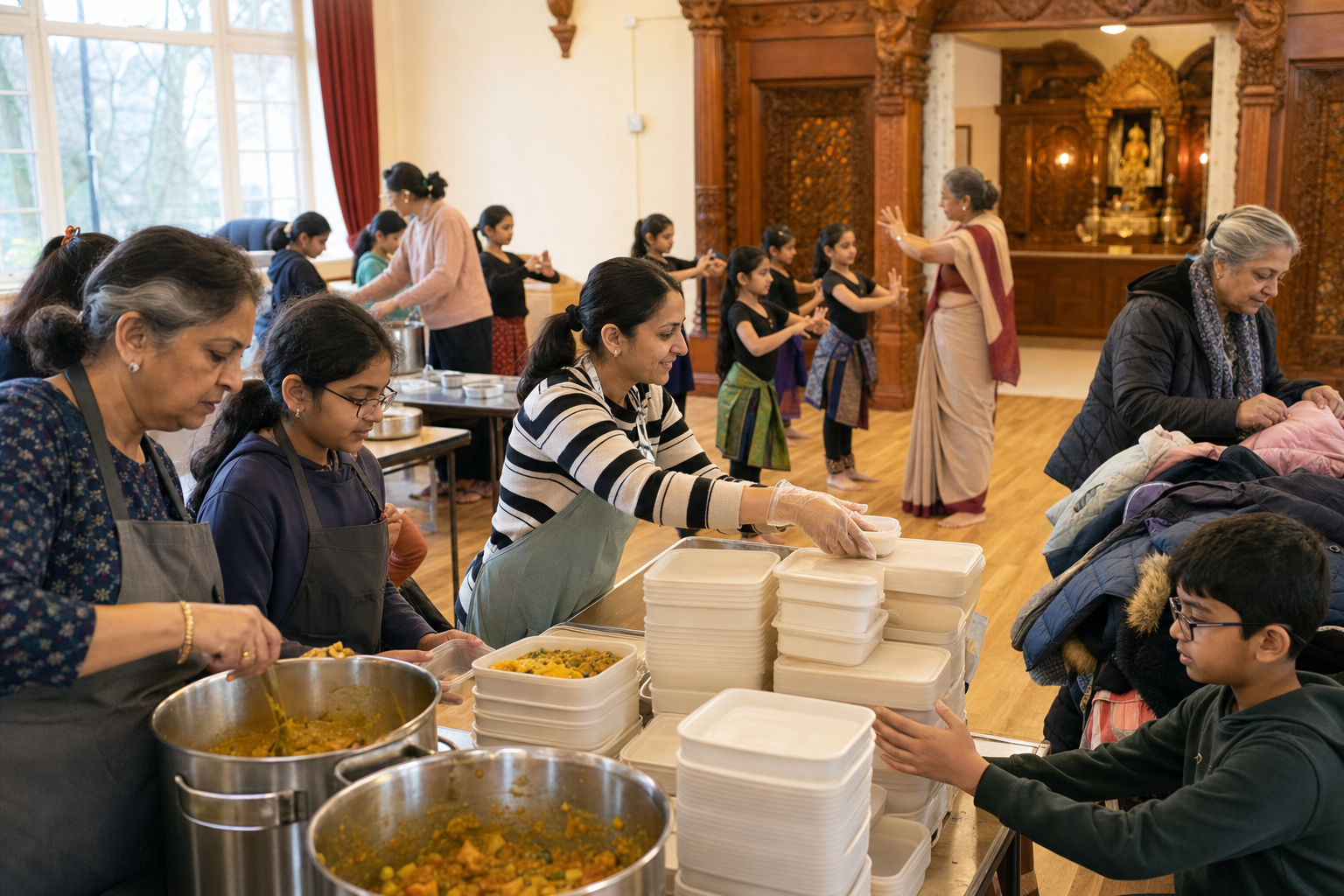
A mandir’s first purpose is worship. It should not have to disguise that purpose as social work to deserve respect. Yet many temples also provide language teaching, youth mentorship, support for elders, dharmic education, festival programmes and interfaith hospitality. If your mandir does this work, document it accurately. Public value that exists only in communal memory is difficult to place before a council, funder, court or potential partner.
Begin with an activity register maintained during the year. For each programme, record what occurred, when and where it occurred, who organised it, the intended beneficiaries, participation, volunteer effort, partner organisations and any identifiable outcome. Keep claims proportionate. A well-attended celebration is evidence of cultural participation; it is not automatically evidence of poverty relief, health improvement or educational attainment.
| Temple reality | Evidence to retain | What it helps establish |
|---|---|---|
| Worship and festivals | Calendar, attendance records, volunteer plans and photographs used with permission | Regular religious use, continuity and the scale of congregational dependence |
| Dharmic and language education | Timetables, curriculum descriptions, enrolment records and teacher or volunteer roles | Intergenerational transmission and sustained educational activity |
| Seva and welfare activity | Session logs, anonymised participation data, partner letters and a clear description of assistance provided | Community benefit without exaggerating outcomes |
| Youth and elder programmes | Programme schedules, safeguarding records where applicable, feedback and accessibility needs | The effect that displacement or closure could have on people who rely on the space |
| Interfaith and neighbourhood work | Invitations, joint-event records, correspondence and supporting statements | Contribution to good relations and local social cohesion |
| Dependence on the building | Room-use schedules, storage needs, ritual requirements and practical limits of alternative venues | Why relocation may disrupt worship and services rather than merely change an address |
Use aggregated information wherever individual identities are not necessary. Do not turn confidential welfare conversations, children’s details or records of personal hardship into publicity material. Evidence can be strong without exposing the people a temple serves.
The resulting evidence pack should sit alongside the temple’s governing documents, title or tenure records, trustee minutes, financial statements and official correspondence. Property records, negotiations, programme data and trustee decisions become especially important when a charity must show that it acted diligently or when a public authority’s account of community impact is incomplete.
Ask trustees to review the pack during normal governance meetings. Correct gaps while organisers still remember an event and partners are easy to contact. Waiting for a disposal notice or legal letter creates two problems at once: the temple must defend its position while hurriedly reconstructing years of activity.
If you are a congregant rather than a trustee, you can still help. Offer dated photographs, programme records, volunteer logs or a concise account of how a particular service depends on the mandir. Submit it through the temple’s designated process instead of launching a separate campaign that may produce contradictory claims.
Build civic relationships before a festival or dispute
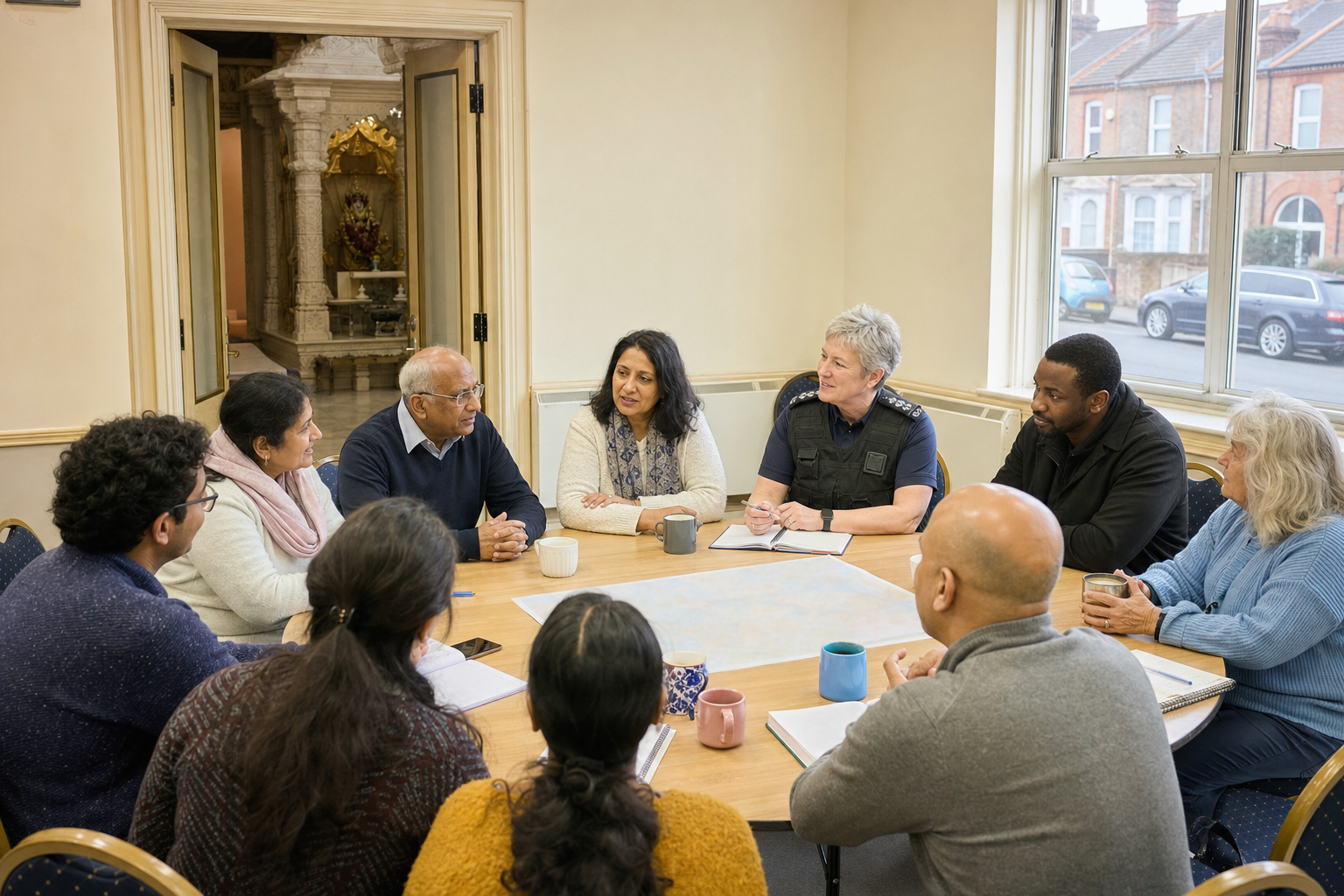
A public figure’s visit is most valuable when it becomes a doorway, not a self-contained spectacle. Holi is unusually legible in public life because colour, music, reconciliation and collective joy cross social boundaries. In diaspora life, it can also connect children with inherited tradition, bring different linguistic and regional Hindu communities together and give neighbours an accessible first encounter with the mandir.
That does not mean every public relationship should begin with the largest festival. An ordinary visit often gives a school, local cultural body, interfaith partner or civic representative a clearer view of the temple’s daily life. Show how worship, classes, volunteer organisation and care for elders use the same physical space. Let visitors meet the people responsible for those activities rather than presenting only a polished stage programme.
Before any high-profile visit, agree on its purpose. Is the guest coming to mark a festival, learn about worship, recognise volunteer service or discuss a local concern? Then settle the ritual protocol, speaking roles, photography boundaries, accessibility arrangements and factual message. A vague invitation encourages the visitor’s office or the media to define the encounter for you.
During the visit, connect symbol to substance. If a guest receives a mala, explain honour and welcome. If footwear is removed, explain the sacred threshold. If dance or music is included, connect the performance to the living arts ecosystem that sustains cultural knowledge. If the temple provides education or seva, introduce the people who organise it and show the records that demonstrate continuity.
Afterwards, convert recognition into a working relationship. Send a factual note recording what occurred, correct any misdescription of the temple or festival and propose a relevant next engagement. That might be a school visit, an interfaith gathering, a discussion of neighbourhood needs or a meeting about the temple’s long-term premises. Public attention fades; an agreed channel of communication remains useful.
Build a wider circle as well. Hindus, Buddhists, Jains and Sikhs can cooperate around seva, youth development, elder care and cultural continuity while retaining distinct religious identities. Letters from schools, cultural institutions, interfaith partners and nearby residents can later demonstrate that a mandir’s value is recognised beyond its own membership. Such support is strongest when it grows from real collaboration, not an emergency request for signatures.
If the temple’s home is threatened, defend process rather than division
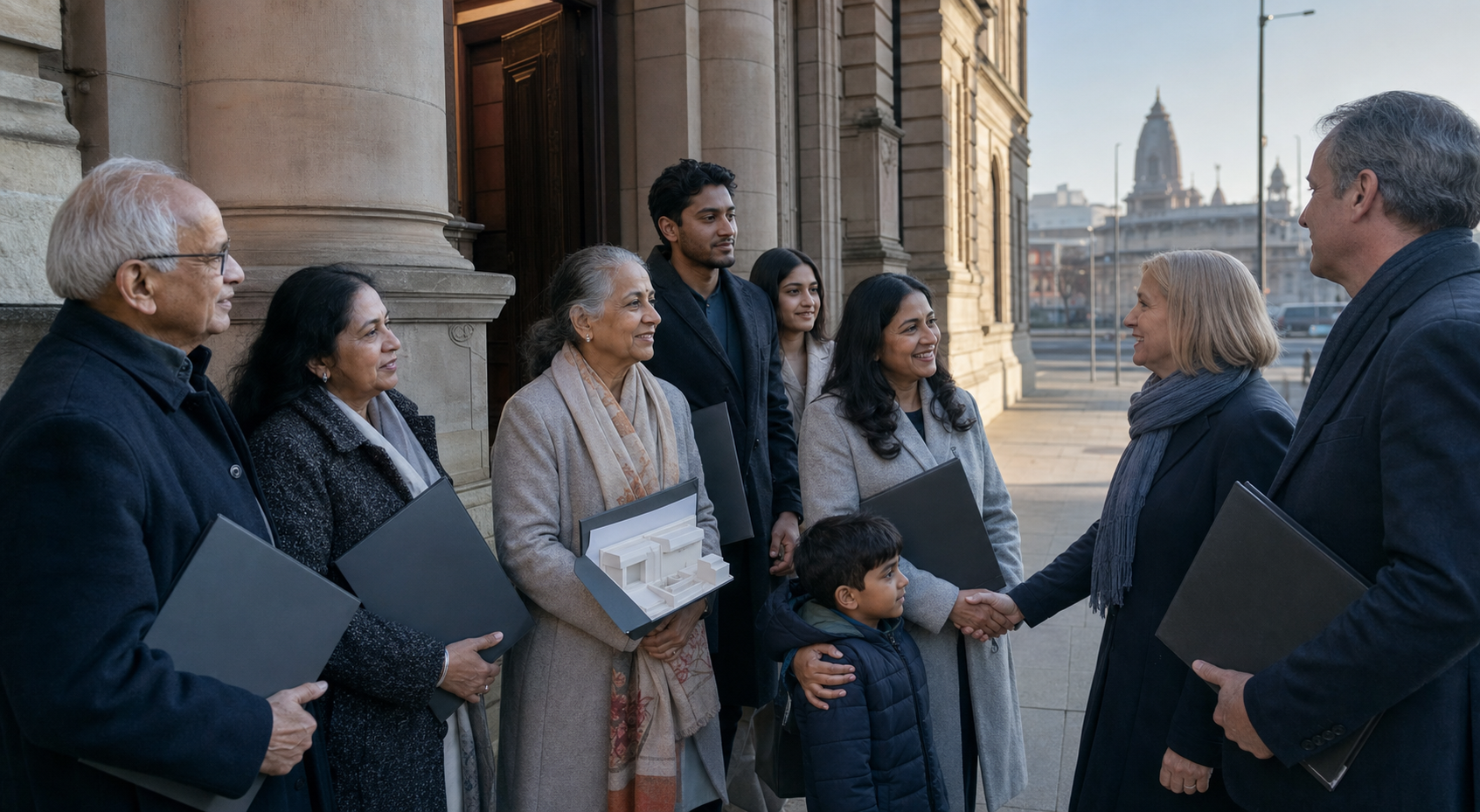
A threat to a mandir’s premises can provoke understandable anger. It is also the moment when trustees need the greatest discipline. Start with the legal and factual problem: ownership, lease terms, a council disposal, planning control, equality analysis, consultation or charity governance. Do not begin with slogans or assumptions about another community’s motives.
The legal points below are a general orientation, not advice on a particular dispute. Public-law deadlines can be short, and a property decision may involve several legal regimes at once. Trustees facing an active notice, proposed sale, termination or court process should promptly consult a solicitor with the relevant public, charity and property-law experience.
Identify the decision and the legal lane
First establish what right the temple actually holds. A freehold, lease and licence do not provide the same security. Read the executed documents, not an informal recollection of what an official or former trustee once intended. Record renewal provisions, termination clauses, restrictions, correspondence and any clear promises concerning consultation or stability.
If a council is disposing of land, section 123 of the Local Government Act 1972 generally directs attention to the best consideration reasonably obtainable unless an applicable exception permits another course. The General Disposal Consent (England) 2003 can allow disposal at an undervalue within its conditions when economic, social or environmental well-being is furthered. The practical questions are therefore not limited to which bidder was preferred. Trustees and their advisers should examine valuation evidence, the stated decision-making power, reasons for any social-value judgment and the audit trail leading to the decision.
A transfer designed around social outcomes or financial advantage may also raise questions under the Public Services (Social Value) Act 2012 or the Subsidy Control Act 2022. Their relevance depends on the actual arrangement. Do not place every statute into a public statement as if each automatically invalidates the decision; ask the legal adviser which duties genuinely apply.
Planning is a separate lane. Following the 2020 changes to the Use Classes Order, places of worship commonly fall within Use Class F1. A change from one faith body’s worship use to another may not by itself require planning permission when the use remains within that class. Physical alterations, intensified activity, parking effects, listed-building status or conservation constraints can still require distinct assessment. A favourable planning position does not prove that a disposal was lawful, and a disputed disposal does not by itself decide planning permission.
Test equality, consultation and community impact
Section 149 of the Equality Act 2010 contains the Public Sector Equality Duty. For a decision affecting a place of worship, the relevant record should show genuine attention to discrimination, equality of opportunity and good relations among religious groups. An Equality Impact Assessment can help reveal whether the effects on worshippers, children, elders, women, volunteers and community programmes were actually examined.
Submit concrete impacts rather than a generic claim that the community will be hurt. Explain which rituals require the existing space, which programmes would stop or shrink, whether realistic alternatives exist, which groups would face barriers to travel and what mitigation was proposed. Link each point to supporting records from the evidence pack.
Consultation also needs to be assessed on its facts. Preserve notices, meeting notes, emails, published criteria and promises made by the authority. A clear assurance about engagement, tenure or the method of disposal may be relevant to a legitimate-expectation argument, but only a qualified adviser can assess whether the words and surrounding circumstances meet the legal test.
Consider protective routes without overstating them
An Asset of Community Value nomination under the Localism Act 2011 may be worth examining where the eligibility requirements are met. Listing does not give the temple an automatic right to buy the property and does not permanently prevent a sale. Its practical value is the potential moratorium associated with a proposed disposal, which can create space for a community bid and make the property’s civic significance harder to ignore.
Judicial review can test whether a public authority acted lawfully, fairly and within its powers. It is not an appeal in which the court simply substitutes its preferred outcome. Interim relief may preserve the existing position when there is a serious issue requiring determination and later damages would not repair the harm. The Peterborough temple’s early relief illustrates the importance of preventing irreversible change while contested procedure is examined, but it should not be mistaken for a final decision on the merits.
Where a registered charity is involved, trustees must also demonstrate responsible stewardship under the Charities Act 2011. Minutes should record the information considered, conflicts managed, professional advice obtained, risks assessed and reasons for decisions. Article 9 of the Human Rights Act 1998, concerning freedom of thought, conscience and religion, and A1P1, concerning peaceful enjoyment of possessions, may inform the analysis in an appropriate case. Neither provision guarantees that a temple will retain a particular property.
Keep the public case principled and non-sectarian
When another faith organisation wants the same site, scarcity can quickly be narrated as a civilisational contest. Resist that move. The mandir can firmly challenge an opaque valuation, inadequate consultation, weak equality analysis or disregard of community impact without denying Muslim, Christian or any other neighbours their own need for worship space.
Direct public criticism towards the decision, evidence and responsible authority. Keep statements accurate, distinguish interim orders from final victories and correct supporters who circulate exaggerated claims. Where practical, dialogue may identify alternative premises, sequencing, mitigation or shared arrangements. None of those possibilities should be promised before trustees assess ritual requirements, safeguarding, governance and legal implications, but respectful discussion is not surrender.
At the next trustee meeting, place three living records on the agenda: the visitor protocol, the community-evidence pack and the property-and-tenure file. Record who maintains each one and when it will next be reviewed. A Hindu temple earns durable standing in British public life when sacred confidence, visible service, civic relationships and sound governance reinforce one another. Begin that work before the next camera arrives or the next official notice lands.
References
- Hindu Human Rights – Princess of Wales’ Viral Holi Visit: Barefoot at Leicester Temple, Honouring Hindu Traditions
- Hindu Existence – Peterborough’s Bharat Hindu Samaj Temple Wins Early Court Relief: Due Process and Pluralism
