

A confident claim reaches you about scripture, history, politics or spiritual experience. It may come with an image, a quotation and thousands of approving reactions. The immediate pressure is to choose a side. Accept it, reject it or pass it on.
There is a better first move. Ask how the claim could be known. Indian philosophy gives you a precise vocabulary for answering that question. The pramāṇas help you separate observation from interpretation, testimony from proof, a useful analogy from a valid inference, and genuine absence from something you simply failed to find.
Do not start with belief; start with the route to knowledge
Pramāṇa means a reliable means of knowing, while pramā is the valid cognition produced through it. The distinction matters. A conclusion is not made trustworthy by confidence, repetition, emotional force or agreement with your existing worldview. You must examine the route by which the mind reached it.
Suppose you see a photograph of an inscription accompanied by a dramatic historical claim. You directly perceive an image on a screen. You do not directly perceive the inscription’s age, provenance, translation or historical significance. Those further conclusions depend on testimony, comparison and inference. Treating the entire package as something you have personally seen collapses several different acts of knowing into one.
Valid cognition is also open to correction. Indian philosophers repeatedly examine how an apparently convincing awareness can be defeated by a stronger one. A rope mistaken for a snake in poor light is not vindicated by the sincerity of the fear. Better perception corrects the error. Reliability therefore does not mean that you must wait for impossible certainty. It means that your present conclusion has an appropriate basis and has not been overturned by a relevant defeater.
Key takeaways
- Identify the means of knowledge supporting a claim before deciding whether the conclusion deserves assent.
- Match the method to the kind of claim. Direct experience, historical dating, scriptural meaning and metaphysical truth do not require identical evidence.
- Check the conditions that make each pramāṇa reliable. Seeing is useful only when the conditions for seeing are adequate; testimony is useful only when competence, honesty and understanding are present.
- Actively search for a defeater: a counterexample, a hidden condition, a stronger perception, a rival explanation or a break in the chain of testimony.
- Give the conclusion only as much confidence as its route supports. Unknown, plausible and established are different judgments.
Use the six pramāṇas as six different questions
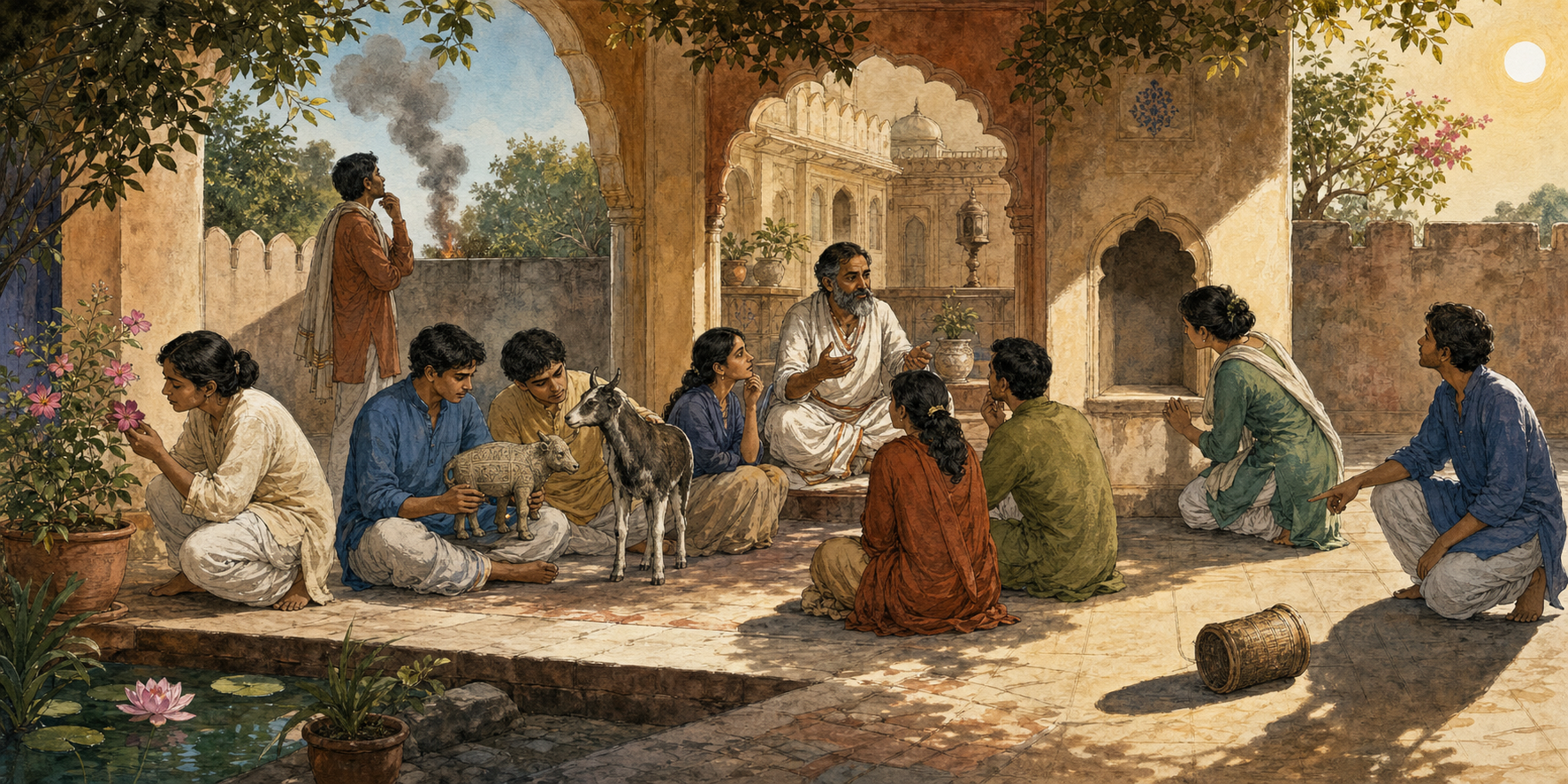
Six pramāṇas are widely discussed in Hindu philosophy, although not every darśana accepts all six as independent. You do not need to settle that technical dispute before using the framework. For practical reasoning, each one directs your attention to a different kind of warrant and a different kind of failure.
| Pramāṇa | Question to ask | Proper use | Main reliability check |
|---|---|---|---|
| Pratyakṣa, perception | What is immediately present to functioning senses or to the mind? | Observing an object, event or internal state such as pain, pleasure or desire. | Check attention, lighting, distance, sensory impairment, expectation and the difference between what appeared and how you labelled it. |
| Anumāna, inference | What conclusion follows from an established connection between a sign and what it signifies? | Reasoning from smoke to fire, or from another dependable indicator to an unobserved fact. | Establish the connection, seek positive and negative cases, search for counterexamples and rule out hidden qualifying conditions. |
| Upamāna, comparison | What unfamiliar thing can be identified through a relevant likeness? | Recognising something new after its salient resemblance to something familiar has been explained. | Specify which features are relevant. Similarity in one respect does not establish similarity in every respect. |
| Arthāpatti, postulation | What unobserved fact must be posited to make the accepted facts coherent? | Resolving an apparent conflict by identifying a missing explanatory condition. | Confirm the starting facts, compare rival explanations and do not turn a merely convenient guess into a necessity. |
| Anupalabdhi, non-cognition | What absence is known because the expected thing was not perceived? | Knowing that an object is absent when it would have been detected under the available conditions. | Verify that the place, instrument, time, access and observer were adequate for detection. |
| Śabda, verbal testimony | Whose words are carrying the knowledge, and why are they trustworthy here? | Learning from scripture, teachers, witnesses, specialists, records and ordinary competent speakers. | Examine competence, honesty, access, context, transmission and whether the hearer has understood the words correctly. |
Pratyakṣa is more demanding than the slogan that seeing is believing. Nyāya distinguishes an initial, not-yet-classified awareness, called nirvikalpaka, from conceptually determined perception, called savikalpaka. Whether or not you adopt every detail of that account, the practical discipline is powerful: record what appeared before adding the name, cause or story. You saw a flash in the sky; you did not yet see its cause. You felt calm during a practice; you did not thereby perceive a universal metaphysical proposition.
Anumāna begins when a sign is connected with something not presently perceived. The classical smoke-and-fire example works only because the relation, vyāpti, is treated as dependable: smoke of the relevant kind does not occur without fire. Before accepting a modern inference, translate it into the same structure. What is the sign? What is the conclusion? Why should the sign reliably indicate that conclusion? Under what condition would the connection fail?
Upamāna helps you recognise what you have not encountered before. The traditional example concerns someone who is told that a gavaya resembles a cow and later identifies the unfamiliar animal through that taught likeness. Comparison is especially useful in learning, translation and cross-traditional discussion. Its limit is equally important. Calling the mind like a mirror may illuminate one function of mind; it does not prove that every property of a physical mirror belongs to consciousness.
Arthāpatti is used when accepted facts seem unable to stand together without an additional fact. The classical case concerns Devadatta, who is stout but is known not to eat during the day; eating at night is postulated to reconcile the observations. This is close to reasoning toward the best explanation, but it is not permission to invent whatever completes a preferred story. The postulate earns support by resolving a real tension with fewer unsupported commitments than its rivals.
Anupalabdhi makes negative evidence intelligible. If you look at a well-lit floor with an unobstructed view and no pot is perceived, the non-perception can disclose the pot’s absence. If the room is dark, the view is blocked or you never examined the relevant place, the same conclusion does not follow. The absence of evidence becomes evidence of absence only when the missing thing should have appeared through a reliable channel.
Śabda recognises that much of what you know comes through words rather than personal observation. Hindu thinkers distinguish Vaidika testimony, associated with the Vedas’ apauruṣeya status, from laukika testimony supplied by human speakers. In ordinary testimony, the relevant ideal is the āpta: someone competent and honest concerning the matter at hand. The listener also has work to do. Grammar, context, intended meaning and overall coherence can determine whether the transmitted cognition is valid.
Run a claim through a pramāṇa audit
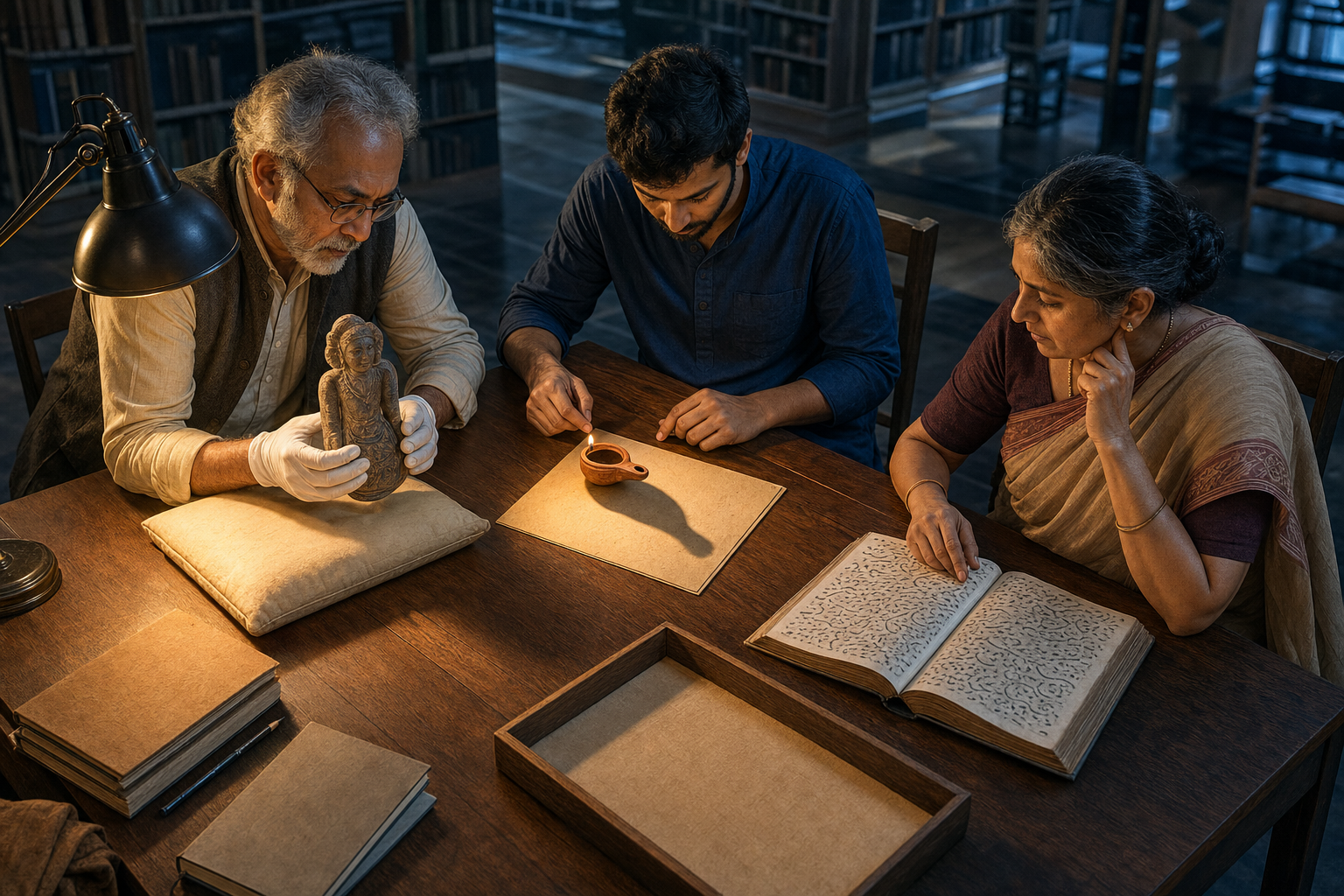
You can use the framework without turning every decision into a philosophical treatise. Suppose a widely shared image is presented as proof that a newly noticed inscription overturns a familiar account of history. Before forwarding it, make a short record with five fields: exact claim, proposed pramāṇa, reliability conditions, possible defeater and present confidence.
- Write the smallest exact claim. Separate the claim that an image exists from the claims that it depicts an authentic object, that the reading is accurate and that the reading proves a larger historical conclusion.
- Classify each input. The visible pixels belong to your present perception. The caption and translation reach you through testimony. Dating may depend on comparison and inference. A reconstruction of missing context may be arthāpatti.
- Describe perception without interpretation. Note what can actually be seen, what is obscured and what requires closer inspection. Better resolution is not the same as established provenance.
- Expose the inference. Identify the sign, the proposed conclusion and the supposedly invariable connection between them. Look deliberately for cases in which the sign occurs without the conclusion.
- Use analogy and postulation to generate possibilities, then test them. Resemblance to a known script may support a candidate identification, but resemblance alone does not establish date, authorship or authenticity. A missing fact that makes the story coherent remains provisional while equally adequate explanations survive.
- Test every argument from silence. Ask whether the object, name or event really should appear in the record being searched. An incomplete catalogue, damaged archive or irrelevant search field cannot sustain a strong conclusion from non-cognition.
- Grade the testimony. Ask who first encountered the object, who transcribed it, who translated it, whether those people had relevant competence, and whether you possess their words or only a later paraphrase. A long chain of repetition does not become independent confirmation.
- State the result at its earned level. You may conclude that the image is genuine but the translation is unsettled, or that the reading is plausible but the historical claim outruns it. A divided conclusion is often more accurate than one sweeping verdict.
The same audit prevents confusion in spiritual discussion. The statement that a passage occurs in a particular text is principally a matter of testimony and interpretation. The statement that you experienced quiet, fear or expanded attention during practice concerns internal perception. The movement from that experience to a doctrine about the ultimate nature of reality is an inference requiring an additional bridge. Personal experience need not be dismissed, but it should not be made to prove more than it discloses.
Domain matching is crucial. A realised teacher may be a trustworthy guide to a sādhana without thereby becoming an authority on manuscript dating. A trained epigraphist may assess a script without settling a Vedāntic question. Trustworthiness is not a magical property that transfers unchanged across every subject.
Find the exact point where reasoning fails

Indian logic does more than tell you to be sceptical. It gives you diagnostic names for failed reasons, or hetvābhāsas. Instead of saying that an argument feels weak, you can identify the defect and ask for the particular repair it requires.
- Asiddha, the unproved reason: the alleged sign has not been established. If an object’s date is inferred from a feature that no qualified examination has confirmed, the argument fails before the larger conclusion is reached.
- Viruddha, the contradictory reason: the reason supports something incompatible with the thesis. More rhetoric cannot repair a premise that points in the opposite direction.
- Anaikāntika or savyabhicāra, the inconclusive reason: the sign occurs both where the proposed conclusion is present and where it is absent. Popular repetition, for example, accompanies both true and false claims, so popularity cannot establish truth.
- Satpratipakṣa, the counterbalanced reason: an equally supported reason points toward the contrary conclusion. The responsible response is further discrimination, not louder restatement.
- Bādhita, the defeated reason: a stronger cognition contradicts the conclusion. A speculative inference cannot overrule clear perception when perception is operating under adequate conditions and concerns the same object in the same respect.
Nyāya’s five-membered presentation makes the inferential chain public: state the proposition, give the reason, provide a familiar example of the connection, apply that connection to the case and draw the conclusion. For the traditional case, the hill has fire; smoke is the reason; smoke accompanied by fire is illustrated through a familiar instance; the observed hill has smoke of that relevant kind; therefore the hill has fire. Each stage can be challenged separately.
The concept of upādhi adds another indispensable check. A correlation that appears universal may depend on a concealed qualifying condition. Before asserting that X proves Y, ask whether some third condition produces both, whether X occurs without Y, and whether the observed cases cover the conditions found in the present case. This is the classical pressure point behind what we would now call a confounder.
Tarka, probative reasoning, helps you stress-test the connection. Assume the proposed explanation is false and follow the consequences. Assume it is universally true and look for absurd or contradictory results. Tarka does not excuse you from supplying a means of knowledge; it helps reveal whether the proposed account can survive disciplined questioning.
Perceptual error should be handled just as specifically. The familiar rope-snake and nacre-silver cases show why a vivid appearance can still be revised. When perception is disputed, improve the conditions: look again, change the angle, increase the light, reduce haste and separate the initial appearance from memory-driven classification. The later cognition defeats the earlier one only when it has genuinely better access to the same matter.
Non-cognition has its own common abuse. Searching badly and finding nothing is not anupalabdhi. Before claiming absence, name the detection condition that was satisfied. If you cannot explain why the missing object or statement would have been available to a competent observer there and then, the proper conclusion is not absent but not established.
Why Dharmic schools count the pramāṇas differently
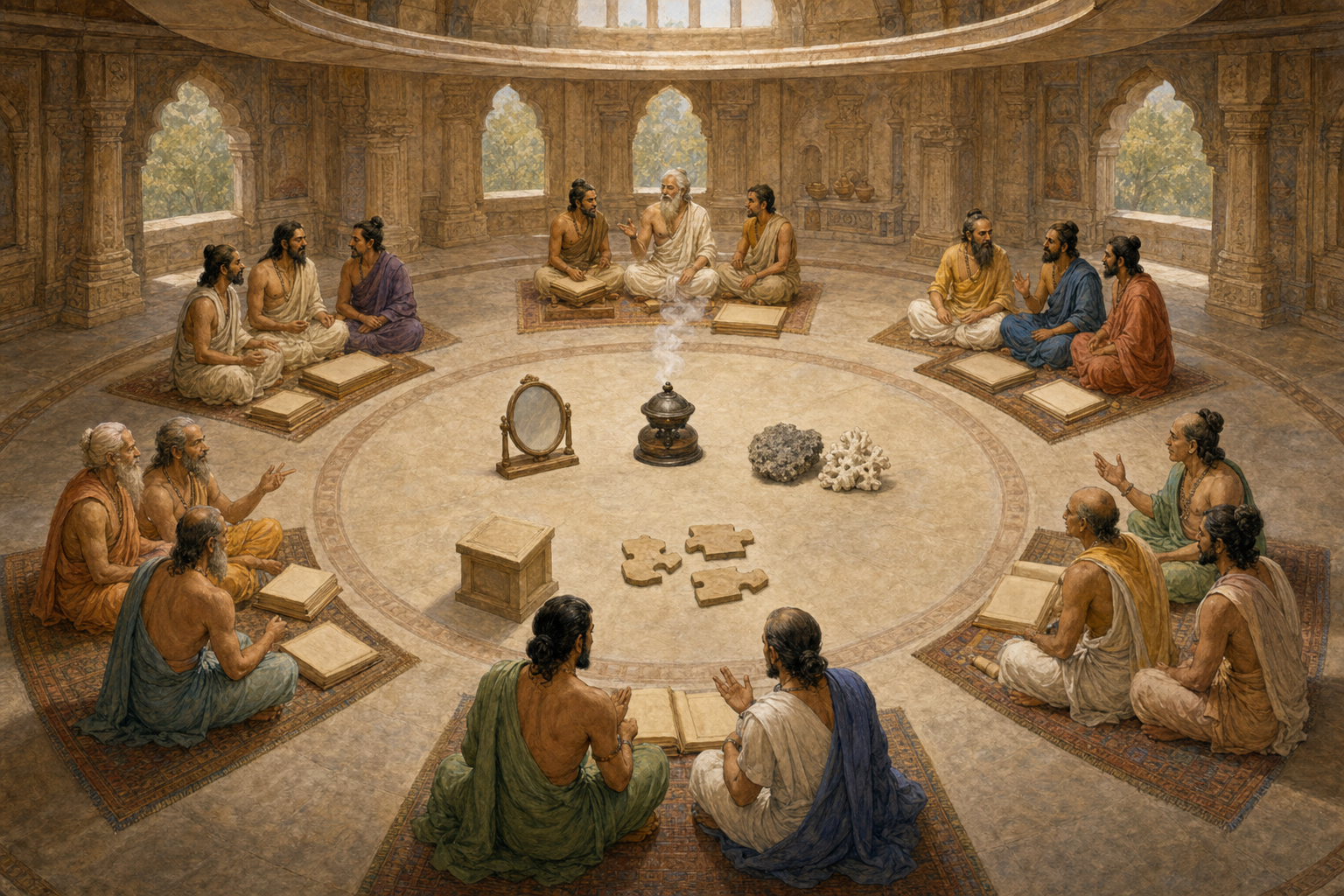
There is no single pan-Dharmic list accepted in precisely the same way by every tradition. The disagreement is philosophically useful because it asks whether a kind of cognition needs an independent explanation or can be analysed through another pramāṇa.
Carvāka gives decisive priority to perception. Buddhist epistemologists such as Dignāga and Dharmakīrti centre perception and inference, with a particularly sharp distinction between non-conceptual perception and conceptually structured cognition. Sāṃkhya and Yoga generally accept perception, inference and trustworthy testimony. Nyāya and later Nyāya-Vaiśeṣika accept four: perception, inference, comparison and testimony. They commonly handle postulation and non-cognition through pramāṇas already admitted rather than granting each independent status.
Mīmāṃsā itself contains a revealing division. The Prābhākara lineage counts five and treats knowledge of absence without accepting anupalabdhi as an independent means. The Bhāṭṭa lineage generally admits all six. Advaita Vedānta also commonly accepts the sixfold set. These counts should not be read as a ladder on which the school with the largest number is automatically the most rational. The real issue is explanatory economy: is the cognition distinctive enough to require its own category?
Jain philosophy places individual means of knowledge within the discipline of Anekāntavāda and Syādvāda. For your own reasoning, the practical lesson is to qualify a claim by standpoint, respect and condition. Saying that a judgment is true in one respect is not evasive when reality has multiple aspects; it is often more exact than forcing a partial view into an unconditional statement.
Sikh thought should not be forced into a classical Hindu enumeration it does not formally adopt. It nevertheless gives śabda a central place as revelatory wisdom to be realised through practice, while reason and lived experience retain their proper roles. This guards against two opposite reductions: treating sacred speech as mere unexamined information, or treating individual experience as sufficient without disciplined understanding.
The traditions also debate how validity itself is known. Mīmāṃsā and Advaita commonly defend svataḥ-prāmāṇya: cognition carries an initial validity unless a defeater arises. Nyāya emphasises parataḥ-prāmāṇya, under which validity is secured through further conditions and checks. Both positions preserve the possibility of correction while locating certification differently.
For your own practice, this tension yields a sound two-stage rule. You do not need to doubt every ordinary cognition before acting; that would make life impossible. Accept a well-formed cognition provisionally when no relevant defect is apparent. When the claim is challenged, consequential or outside the speaker’s competence, perform the external checks. Initial trust and disciplined verification are not enemies.
The next time a claim asks for your allegiance, pause before asking whether it sounds Dharmic, modern, traditional or popular. Write down the exact claim, the pramāṇa carrying it, the conditions that make that pramāṇa reliable and the fact that would defeat it. If the support is analogy, call it analogy rather than proof. If detection conditions were poor, say unknown rather than absent. If testimony is all you have, examine the chain instead of pretending you personally perceived the conclusion. What survives that discipline has earned your confidence; what does not should not be carried forward in the name of truth.
References
