

If you are trying to explain Dharmic unity to a family member, a youth group, or an interfaith audience, saying that all paths are really the same may feel generous. It is also where trust begins to fray. A Buddhist does not need to accept an eternal atman to be Buddhist. A Jain understanding of the jiva cannot be reduced to a Hindu school’s account of Self. Sikh devotion to Ik Oankar, Naam, Hukam, and grace is not a renamed version of either.
There is a stronger basis for unity. Hindu, Buddhist, Jain, and Sikh paths give different accounts of reality and liberation, yet each trains the human being away from a binding form of ignorance, craving, passion, possessiveness, or ego. Each joins inner transformation to disciplined conduct. You can therefore defend a shared Dharmic purpose without manufacturing a single doctrine that none of the traditions actually teaches.
Shared liberation means a shared task, not one definition
The word liberation must be used carefully. Across these traditions, the destinations are named through moksha, nirvana or bodhi, kevala-jnana, and mukti. These terms belong to distinct accounts of the person, bondage, karma, knowledge, and ultimate reality. Treating them as interchangeable removes the very teachings that give each path its shape.
What is shared is the task of becoming free from whatever keeps perception distorted and conduct self-centered. Hindu paths may diagnose ignorance about the atman, entanglement in karma, or misdirected action. Buddhism traces dukkha through craving and grasping without positing a permanent self. Jainism describes the jiva as bound through passions, actions, and karmic matter. Sikh teaching places haumai, the egoic sense of separateness, at the center of the problem and turns the seeker toward Naam, Hukam, Seva, and grace.
This lets us speak of shared liberation in two responsible senses. It is parallel because practitioners follow their own disciplines toward the freedom their tradition teaches. It is relational because sincere practice changes how they treat other beings. Liberation is not made identical, but its ethical direction becomes visible in diminished grasping, greater truthfulness, restraint, compassion, courage, and service.
A useful Dharmic lens brings perspective-awareness, interconnectedness, and impermanence into that shared task:
- Perspective-awareness reminds you that a human standpoint is limited. Jain anekantavada gives this humility a disciplined logical form, while Sikh thought anchors limited perspectives in the non-relative reality of Ik Oankar. Humility does not mean that every claim is equally true; it means that you do not confuse your present angle with the whole.
- Interconnectedness exposes the fiction of an isolated moral life. Buddhism explains conditioned existence through dependent co-arising. Sikh thought sees the One as pervading and sustaining the many. These are not identical metaphysics, but both make indifference to others spiritually incoherent.
- Impermanence loosens possessiveness. Buddhism uses anicca to clarify the instability of conditioned phenomena. Sikh teaching places passing forms in relation to the Akal, the Timeless One. In either discipline, change is not a reason for nihilism. It is a reason to stop making status, control, and possession the center of life.
When you explain unity, use a sentence with clear boundaries: These traditions do not make identical claims about the self, but they converge in training us away from grasping and toward responsible conduct. That formulation is more accurate, and therefore more durable, than saying that doctrinal differences are merely different names.
Map the differences before claiming common ground

A good comparison keeps four questions separate: What binds us? What is liberation? What disciplines lead toward it? What conduct should follow? Confusion begins when an answer at one level is presented as agreement at every level.
| Tradition | Central account of bondage | Liberating orientation | Ethical expression |
|---|---|---|---|
| Hindu paths | Ignorance or confusion about true nature, karmic entanglement, and attachment within samsara | Moksha through combinations of karma, jnana, bhakti, and yogic discipline; schools differ over realization of atman and relation to the Divine | Dharma, disciplined duty, truthfulness, restraint, non-harm, and generosity |
| Buddhist paths | Dukkha sustained by trishna, grasping, and a mistaken self-story | Nirvana and bodhi through the Four Noble Truths and the Noble Eightfold Path, without a permanent self | Sila, mindfulness, wisdom, compassion, and non-harm |
| Jain paths | The jiva bound by karmic matter through passions, intentions, and actions | Kevala-jnana through right vision, right knowledge, right conduct, vows, and the shedding of karmic bondage | Exacting ahimsa, aparigraha, careful intention, truthfulness, and many-sided reasoning |
| Sikh path | Haumai, attachment, and the appearance of separateness from the One | Mukti through Naam, Shabad, grace, and alignment with Hukam while living and serving in the world | Seva, Sangat, honest and responsible living, shared provision through langar, and sarbat da bhala |
The table is not a claim that every school inside a tradition speaks with one voice. Hindu darshanas contain major internal differences, as do Buddhist lineages. It is a map of the distinctions you must preserve if unity is to remain honest.
Atman, anatman, jiva, and Ik Oankar should not be placed in a row and called synonyms. They do different philosophical work. Atman concerns the nature of Self in Hindu traditions that affirm it. Anatman dismantles the claim that a permanent, independent self can be found among conditioned aggregates. Jiva names the living soul in Jain metaphysics. Ik Oankar affirms the One reality in Sikh teaching; it is not simply another technical term for an individual self.
Before entering a disagreement, ask which level is actually under discussion. A dispute about what ultimately exists is metaphysical. A dispute about how craving or ego operates is psychological and soteriological. A decision about violence, honesty, possessions, or service is ethical. Traditions can disagree at the first level, illuminate one another at the second, and cooperate substantially at the third. Naming the level prevents a fruitful ethical alliance from being wrecked by a metaphysical argument it was never meant to settle.
Build cooperation on a shared ethical floor

Ethics is not a consolation prize for people who cannot agree about metaphysics. In Dharmic practice, conduct is part of the mechanism of liberation. Harm, deceit, hoarding, and self-display reinforce the very passions and delusions a seeker is trying to overcome. Non-harm, truthfulness, giving, restraint, and service weaken those habits while making attention steadier and perception less self-serving.
The common floor is best understood as a family of commitments rather than a single rulebook:
- Non-harm asks you to notice who or what bears the cost of your action. Jain ahimsa presses this inquiry into intention and minute conduct. Buddhist compassion attends to suffering among sentient beings. Hindu dharma and Sikh concern for the welfare of all place restraint within wider obligations to life and community.
- Truthfulness requires more than avoiding a literal lie. It asks whether ego, faction, or desire is shaping what you select, exaggerate, or conceal. Jain many-sidedness adds another safeguard: a partial statement should be presented as partial, not promoted into an absolute.
- Generosity turns spiritual conviction into a transfer of time, food, knowledge, care, or resources. Dana, dasvandh, seva, and langar are not identical institutions, but each interrupts the assumption that what has come into your hands exists only for you.
- Non-possessiveness examines the attachment beneath accumulation. Aparigraha gives this discipline an especially explicit form, while Buddhist letting-go, Hindu action without possessive fixation, and Sikh service without self-display work on related habits.
- Service prevents contemplation from becoming private self-improvement. Teaching, feeding, healing, stewardship, and other forms of useful labor reveal whether remembrance and insight are becoming concern for others.
A decision filter for family, institutional, and public life
When a difficult choice is wrapped in religious language, slow it down with these questions:
- Who may be harmed by this choice, including people with less power, other living beings, and the natural world?
- What do we know directly, what are we inferring, and where is our standpoint incomplete?
- Are we protecting a genuine duty, or protecting possession, prestige, control, or group pride?
- Does the choice require deception, dehumanization, or needless cruelty to succeed?
- What concrete form of repair, generosity, or service would advance welfare beyond our own faction?
Then take the choice back through the discipline and authorities of your own path. The shared filter identifies moral pressure points; it does not replace scripture, Guru, vows, lineage, reason, or cultivated conscience.
This approach is especially useful when Dharmic communities cooperate. A temple, vihara, Jain center, and gurdwara do not need a blended worship service before they can feed people, teach children, restore a neglected space, or care for the vulnerable. For a joint project, agree in advance on the work, the recipients, the use of resources, the boundaries around prayer and representation, and the process for correcting mistakes. Shared service supplies the unity. Clear boundaries protect the integrity of each tradition.
Community itself is part of the training. Satsanga, Sangha, the Jain fourfold community, and Sikh Sangat give practitioners accountability that solitary aspiration often lacks. They also make ethics visible: a community can see whether its ideals produce shared food, disciplined speech, care in conflict, and responsibility for the weak.
Make dialogue a spiritual discipline rather than a slogan
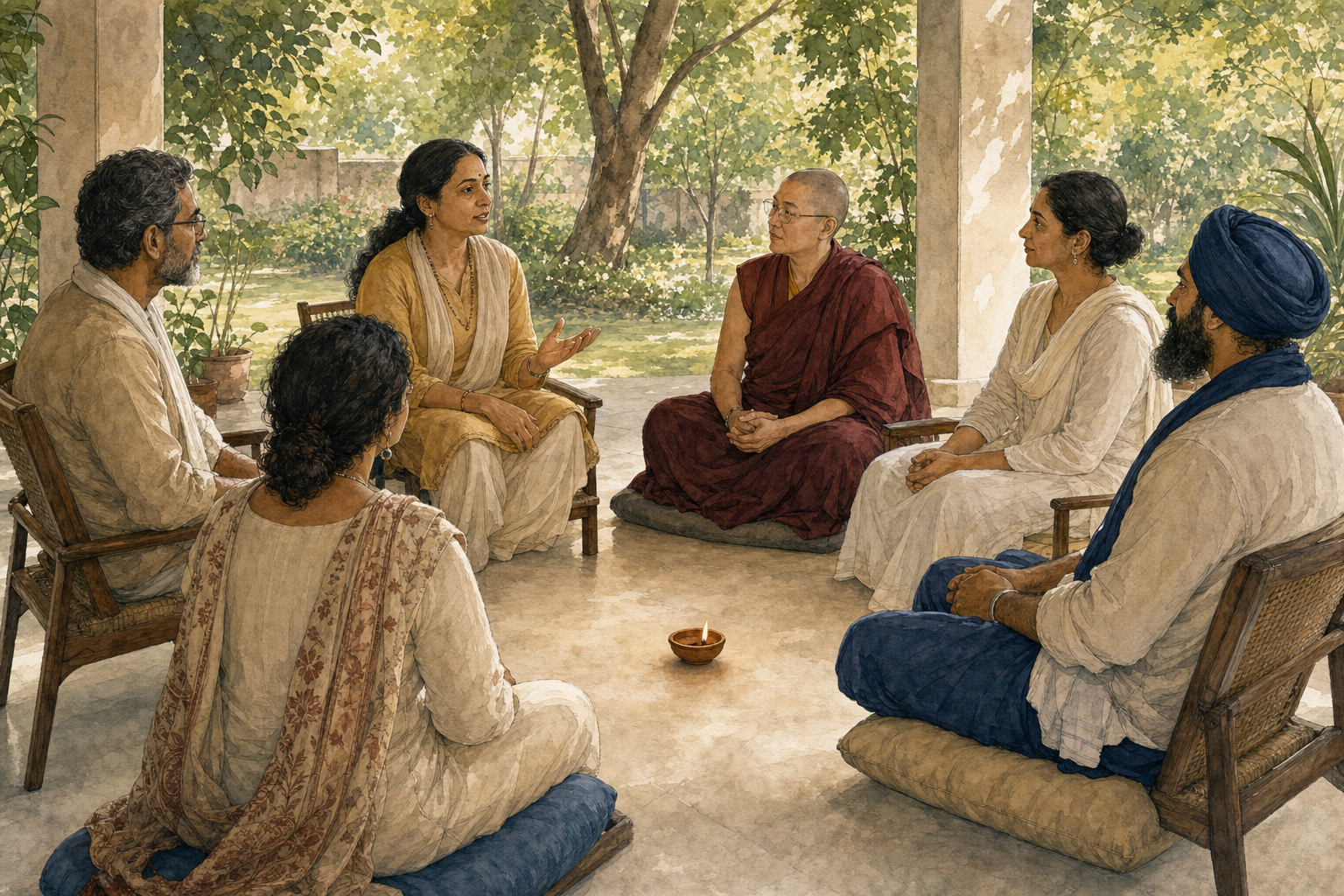
Intellectual humility is not a refusal to judge. Jain anekantavada and syadvada train the speaker to qualify claims by standpoint. Sikh perspective-awareness places finite understanding before the One rather than turning relativity into cynicism. The Hindu recognition of varied paths and chosen forms of devotion respects differences of temperament. Buddhist middle ways resist the urge to solve suffering by clinging to an extreme position. Each offers resources for firmness without arrogance.
Use the following sequence at a study circle, family gathering, classroom, or public forum:
- State the exact question. Do not let a discussion about ethical cooperation quietly become a contest over whose metaphysics is supreme.
- Describe your own teaching positively. Explain what it affirms and what practice follows, without defining another tradition mainly by what you think it lacks.
- Restate the strongest form of the other position and let its adherent correct you. Only then offer a criticism.
- Qualify the scope of your claim. Say this school teaches, in this context, or at the ethical level when that is what you mean.
- Return to consequence. Ask what kind of attention, character, and treatment of living beings the position is meant to cultivate.
This sequence gives doctrinal disagreement somewhere constructive to go. It also helps you notice when a debate is being driven by identity anxiety rather than a genuine search for truth. Impermanence is useful here: institutions, labels, reputations, and victories pass. That does not make tradition unimportant. It makes possessive defensiveness a poor substitute for faithful practice.
Shortcuts that weaken Dharmic unity
- All paths teach the same thing. This erases real teachings about self, soul, Divine reality, karma, and grace. Replace it with a precise statement about the level at which convergence exists.
- Doctrine does not matter as long as people are nice. Doctrine shapes the diagnosis of bondage, the purpose of discipline, and the meaning of ethical conduct. Cooperation does not require indifference to truth.
- Our tradition owns the shared value. Non-harm, truthfulness, generosity, restraint, and compassion have related but distinct expressions across the Dharmic family. Study those expressions before turning a common inheritance into a sectarian possession.
- Unity requires a synthetic ritual or creed. It does not. Communities can pray distinctly, study one another accurately, defend one another’s dignity, and work together on a clearly defined form of service.
- Every disagreement is hostility. Honest disagreement can show respect when it represents the other view accurately, avoids coercion, and leaves room for shared action.
A reliable organizer therefore begins with a limited promise: accurate representation, civil disagreement, and a specific ethical undertaking. Grand declarations of unity are easy to sign. A well-run langar, food distribution effort, teaching program, or act of restorative care shows whether the declaration has entered conduct.
Key takeaways you can put into practice
- Root yourself in your own tradition before trying to blend traditions. Depth makes respectful cooperation easier because you no longer need vagueness to feel secure.
- Compare like with like: metaphysics with metaphysics, liberating aims with liberating aims, disciplines with disciplines, and ethical consequences with ethical consequences.
- Use shared liberation to name a common struggle against binding ignorance, craving, passion, possessiveness, and ego, not an allegedly identical final state.
- Build ethical unity through non-harm, truthfulness, generosity, restraint, and service while allowing each community to explain those duties in its own vocabulary.
- In disagreement, restate the other position at its strongest, identify the limits of your standpoint, and say plainly where your own commitment remains firm.
- Let interconnectedness become a duty. If a spiritual insight never changes how you share, serve, speak, or repair harm, it has not yet done its full ethical work.
- Let impermanence reduce possessiveness rather than responsibility. You can care intensely for family, society, nature, and tradition without treating them as extensions of ego.
Before your next Dharmic conversation, write two sentences. Begin the first with We genuinely differ about. Begin the second with We can still stand together for. If both sentences are specific, you have the beginning of a unity that can survive disagreement and move into service.
References
- SikhNet – Relativity, Interconnectedness, and Impermanence in Sikh Philosophy: Clarity for Dharmic Unity
- SikhNet – The Thirst That Remains: A Transformative Journey Across Hindu, Buddhist, Jain, and Sikh Wisdom
