
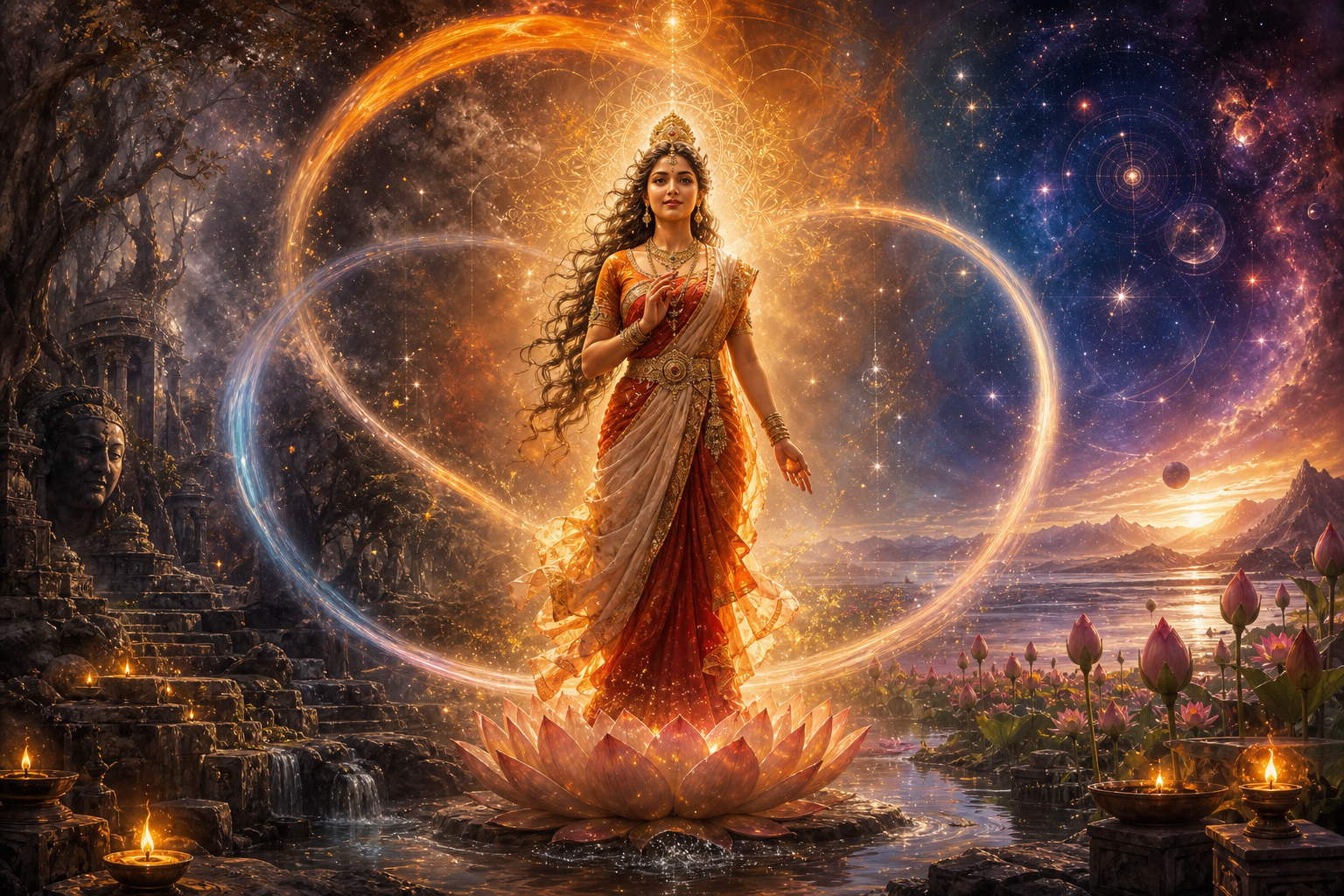
You may have encountered Trikala Devi in a regional narrative, a devotional image or a contemporary meditation and wondered what, exactly, the name denotes. Is she a scripturally fixed goddess with one accepted form, another name for a familiar Devi, or a modern theological synthesis?
You don’t have to choose between dismissing the name and accepting every claim made for it. The sounder approach is to understand Trikala Devi as a time-enfolding manifestation of Shakti while remaining honest about the absence of a universally standardized cult, iconography or liturgy. That distinction lets you contemplate her meaning without turning a living theological motif into a false historical certainty.
First, separate a divine name from a pan-Indic cult
The Sanskrit expression trikāla means the three times: bhūta, what has been; vartamāna, what is present; and bhaviṣya, what is to come. In much Hindu discourse, trikāla functions more often as a philosophical or spiritual qualifier than as the proper name of one universally recognized goddess. Trikāla-jñāna, for example, denotes knowledge extending across the three times.
This does not make Trikala Devi unreal or illegitimate. Hindu traditions do not operate through a single registry in which every valid divine form must possess an identical origin story, image and ritual in every region. A name may identify a local manifestation, an epithet, a meditative form or a theological way of gathering several divine powers into one presence. What must be qualified is not the devotional reality of the form, but the historical scope claimed for it.
Some interpretive and regional narratives connect Trikala Devi with the conjoined tejas, or radiance, and unified gaze of Brahmā, Viṣṇu and Śiva. The familiar pattern of a Goddess emerging from the assembled energies of the devas appears in the Devī Māhātmya. Links specifically involving the Varāha Purāṇa, however, belong to particular strands of exegesis and later regional narration. They should not be inflated into a uniform account found in every manuscript or accepted by every sampradāya.
When you encounter a strong claim about Trikala Devi, test it with three questions:
- What kind of claim is being made? A theological interpretation, local temple tradition and universal scriptural injunction are not interchangeable.
- Is the provenance named? If a specific Purāṇa is invoked, ask for the passage, recension or inherited commentary rather than relying on an unattributed caption.
- Does the claim allow regional variation? A fixed mantra, number of arms or origin story requires more evidence than the broad idea of time-spanning Shakti.
The most defensible formulation is therefore precise: Trikala Devi is an integrative manifestation or title of Shakti through which devotees can contemplate divine power acting in the past, present and future. A separate, standardized pan-Indic cult under that exact name is not established by the same claim.
The three triads answer three different questions
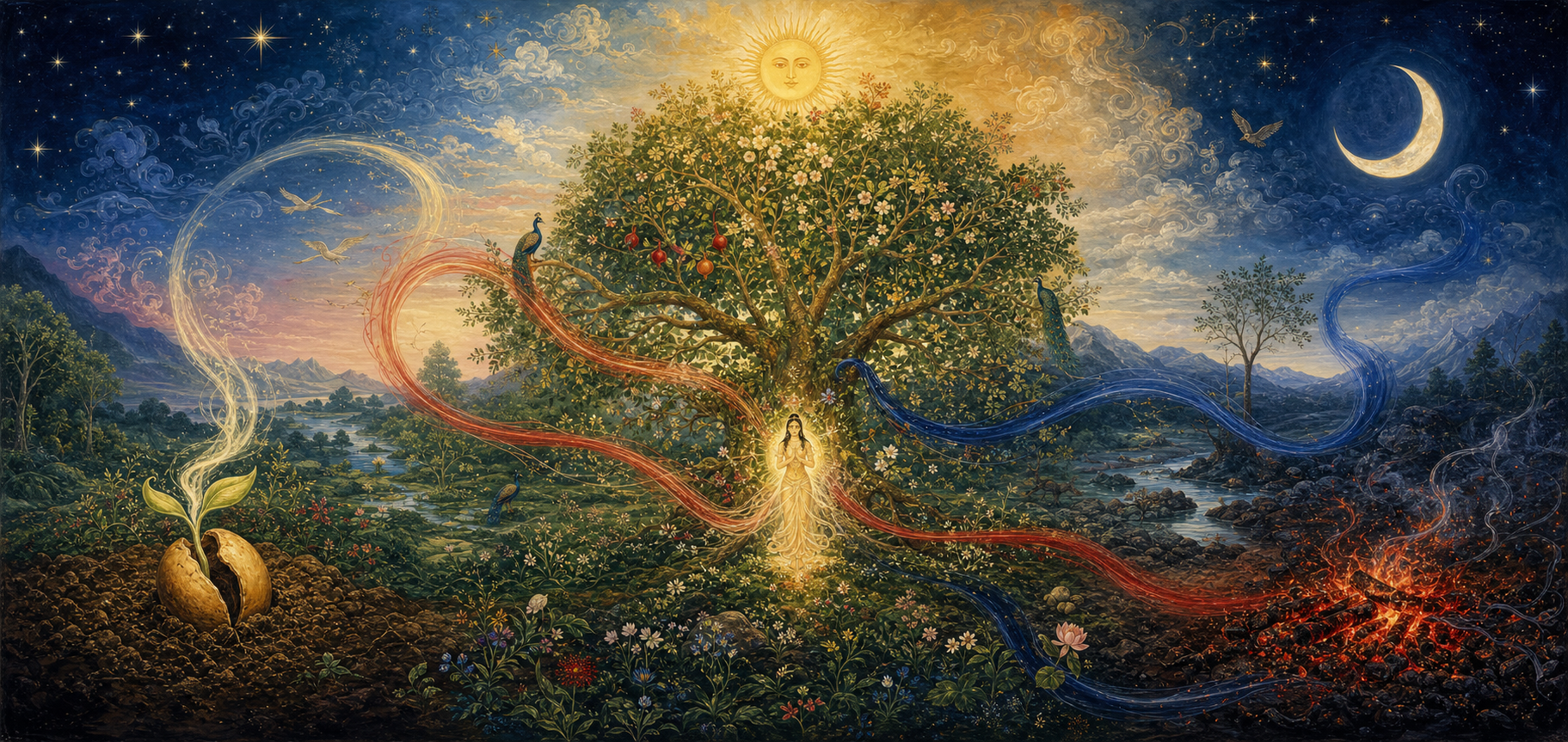
Trikala theology becomes clearer when you resist the temptation to make a rigid one-to-one chart. Past does not belong only to Brahmā, present only to Viṣṇu and future only to Śiva. Creation, preservation and dissolution all occur throughout time. Sarasvatī, Lakṣmī and Pārvatī or Durgā likewise cannot be confined to separate temporal boxes.
| Triadic lens | Its three terms | The question it answers |
|---|---|---|
| Time | Past, present, future | When does divine action and human consequence unfold? |
| Cosmic function | Sṛṣṭi, sthiti, saṁhāra | Is a form being created, sustained or transformed? |
| Divine capacity | Vidyā, śrī, śakti | What enables wise, sustaining and transformative action? |
The Trimurti names three cosmic functions: sṛṣṭi, creation; sthiti, preservation; and saṁhāra, dissolution or transformative ending. The Tridevi names three indispensable capacities: Sarasvatī as knowledge, Lakṣmī as sustaining abundance and Pārvatī or Durgā as power. Trikāla supplies the temporal field in which every one of these functions and capacities operates.
A better mental model is a woven grid. Knowledge remembers the past, interprets the present and prepares understanding for the future. Prosperity includes what has been inherited, what sustains life now and what is responsibly provided for those who come later. Power carries previous causes into present action and transforms existing conditions into future possibilities. In this reading, Trikala Devi is not a fourth goddess added beside the Tridevi. She is the horizon within which their powers become temporally whole.
This is also why Shakti should not be imagined as auxiliary fuel supplied to otherwise complete deities. The Shakta insight is more radical: no creation, preservation or transformation becomes effective without power, and no power acts outside time. Trikala Devi gives a single contemplative form to that mutual involvement of time, consciousness and agency.
Several Hindu philosophical languages approach this relationship differently. In Bhagavad Gītā 11.32, the supreme theophany reveals Time as the great transformer. Śaiva traditions speak of Mahākāla, while Kālī embodies the sovereign intensity of time in Śākta traditions. Vedāntic analysis can treat time as dependent reality illumined by consciousness, whereas Sāṁkhya explains cosmic cyclicality through the activity of prakṛti’s three guṇas. These views should not be flattened into one doctrine. Trikala Devi works as an integrative Shakta lens through which their shared concern with time can be contemplated.
A similar discipline is needed when looking across Dharmic traditions. Buddhist trikāla-jñāna, Jaina reflection on knowledge spanning the three times, and the Sikh name Akal Purakh all show that time and the Real are enduring civilizational concerns. They do not make Buddhist cognition, Jaina kevala-jñāna, Sikh teaching and Shakta theology identical. Notice the family resemblance, but let each tradition retain its own account of selfhood, knowledge, liberation and divinity.
Read the symbols as theology, not as a fixed portrait
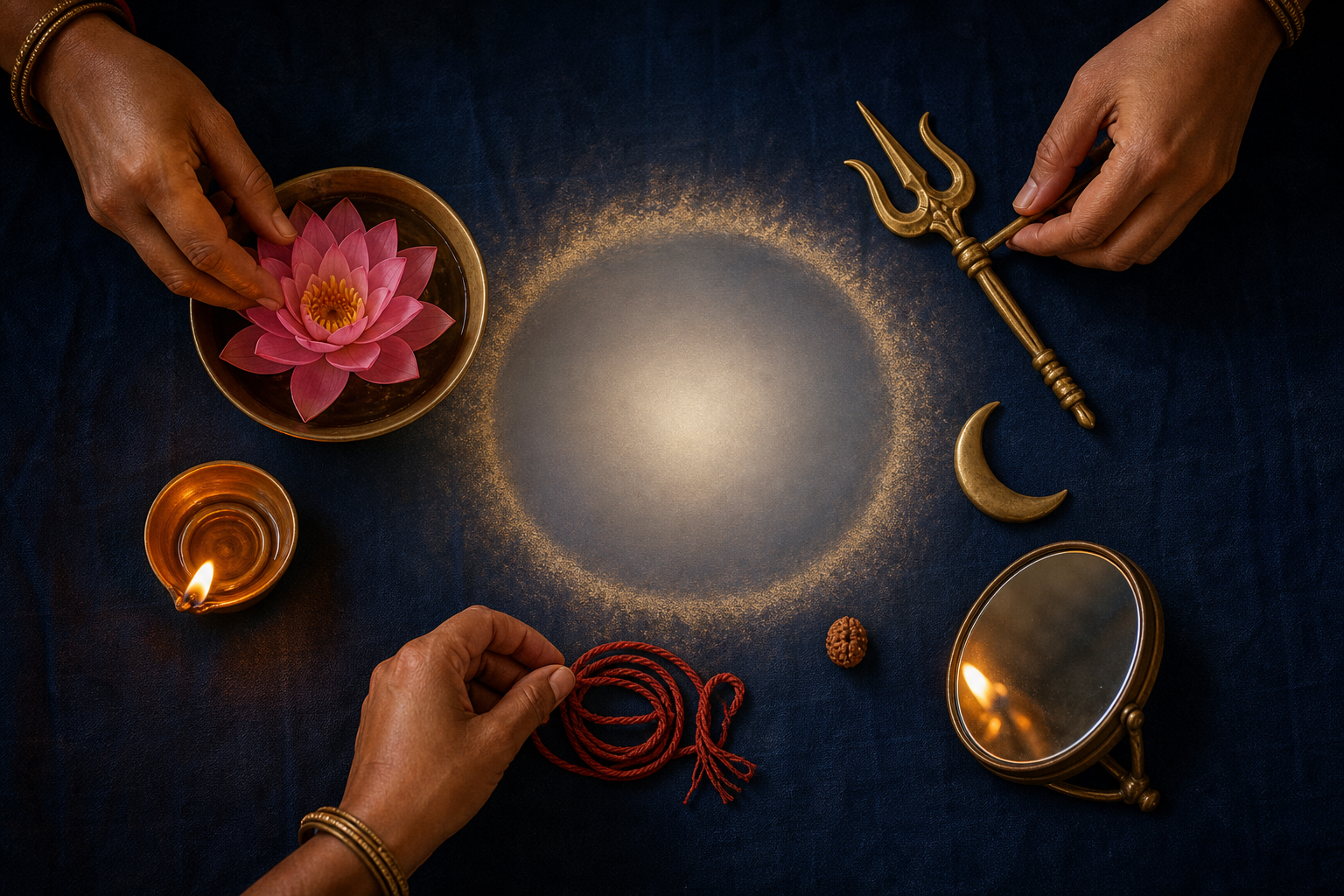
Because Trikala Devi has no single iconographic form standardized across all regions, a modern image may combine symbols usually distributed among several deities. That can be theologically meaningful without proving that the exact image descends unchanged from an ancient sculptural canon.
Three eyes can signify vision that is not trapped in the immediate moment. A trident can gather several threefold meanings, while a discus can indicate cosmic order and active sovereignty. A rosary and book evoke knowledge and disciplined recollection; a lotus and pot evoke auspiciousness, fertility and sustaining abundance. White, red and black may be used as a triad of knowledge, activity and profound or dissolving depth. The point is cumulative: powers that appear distinct are held by one Devi.
The Śrī Cakra and the name Tripurasundarī provide another useful comparison. Intersecting triangles and the sovereignty of the Goddess over three cities or worlds offer a visual grammar for unity across multiple domains. They do not, by themselves, establish that Tripurasundarī and Trikala Devi are interchangeable names in every lineage. Similar symbolism can illuminate a relationship without erasing distinct ritual identities.
Use this four-step method when examining an image labelled Trikala Devi:
- Identify its setting. A consecrated temple image, a lineage diagram, regional folk representation and contemporary digital artwork carry different kinds of authority.
- Name each attribute before interpreting the whole. Ask what the book, lotus, trident, discus, colors or eyes contribute instead of assuming that every symbol has one fixed meaning.
- Distinguish resemblance from identity. An emblem associated with Sarasvatī, Lakṣmī, Durgā, Viṣṇu or Śiva can express synthesis without making Trikala Devi merely another name for that deity.
- Keep historical and devotional questions separate. You can receive an image as a serious aid to contemplation while still asking when, where and within which community that form arose.
This approach avoids two equal mistakes. One is to call every composite representation ancient and universally canonical. The other is to reject a localized or recent representation merely because it is not uniform across Bharat. Fluidity, localization and thematic synthesis are normal features of Purāṇic and Tantric religious life; precision about provenance makes that richness easier, not harder, to honor.
Turn trikāla into a disciplined daily practice

The theology becomes useful when it changes how you act. Hindu ritual life already trains attention through trikāla sandhyā and morning, midday and evening worship cycles. Navarātri extends the same temporal sensibility across nine nights, allowing invocation, discipline and culmination to unfold rather than being compressed into one moment.
If your family, guru, temple or sampradāya transmits a specific liturgy, follow that inherited method. In the absence of such a method, don’t manufacture a bīja mantra and advertise it as an ancient Trikala Devi revelation. Use a simple three-times contemplation inside your existing Devi worship. It requires no claim of initiation and does not pretend to be a prescribed vrata.
- Morning: sanctify memory. Recall one blessing or inherited strength for which gratitude is due, then one past error whose lesson must govern today’s conduct. The purpose is not nostalgia or self-reproach. It is smṛti disciplined by discernment.
- Midday: return to present duty. Ask, “What does dharma require from me now?” Name one concrete obligation toward a person, task or living being, and complete the next visible action. This keeps spirituality from becoming an escape into either memory or fantasy.
- Evening: examine the future being formed. Look at one consequence your present habits are creating. Make one repair, provision or restraint that improves the direction of travel. Foresight here means responsible preparation, not fortune-telling.
You can test the rhythm for nine days in a notebook with three short entries each day: what must be learned from the past, what must be done in the present, and what future is being prepared. Treat the nine-day period as a personal contemplative exercise inspired by the temporal arc of Navarātri, not as a newly invented scriptural observance.
The same triad sharpens difficult decisions. Before acting in family life, seva, ecological stewardship or study, ask three questions:
- What causes, promises and inherited responsibilities from the past shape this choice?
- Who or what is affected now, and what duty cannot honestly be postponed?
- What habit, relationship or condition will this action create if it is repeated?
This is the ethical force of Trikala Devi. Memory without present responsibility becomes sentiment. Present action without memory becomes impulsive. Planning without either becomes fantasy. Held together, the three times turn devotion into accountable action.
Key takeaways
- Trikala Devi is most responsibly understood as a time-enfolding manifestation or theological title of Shakti, not as a goddess with one universally standardized cult and image.
- Trikāla means past, present and future; the Trimurti concerns creation, preservation and dissolution; the Tridevi expresses knowledge, abundance and power.
- Do not force a one-to-one equation among the three triads. Every cosmic function and every divine capacity operates across all three times.
- Composite symbols can communicate theological unity without proving that a particular image is ancient, universal or identical with Tripurasundarī, Kālī or another established form.
- A sound personal practice uses the past for discernment, the present for duty and the future for responsible preparation while respecting any liturgy inherited from one’s lineage.
Apply the three questions to one real decision before the day ends. Recover the relevant memory, perform the duty already in front of you, and change one consequence you are presently creating. That is where Trikala Devi ceases to be an intriguing name and becomes a demanding vision of Shakti within time.
References
