
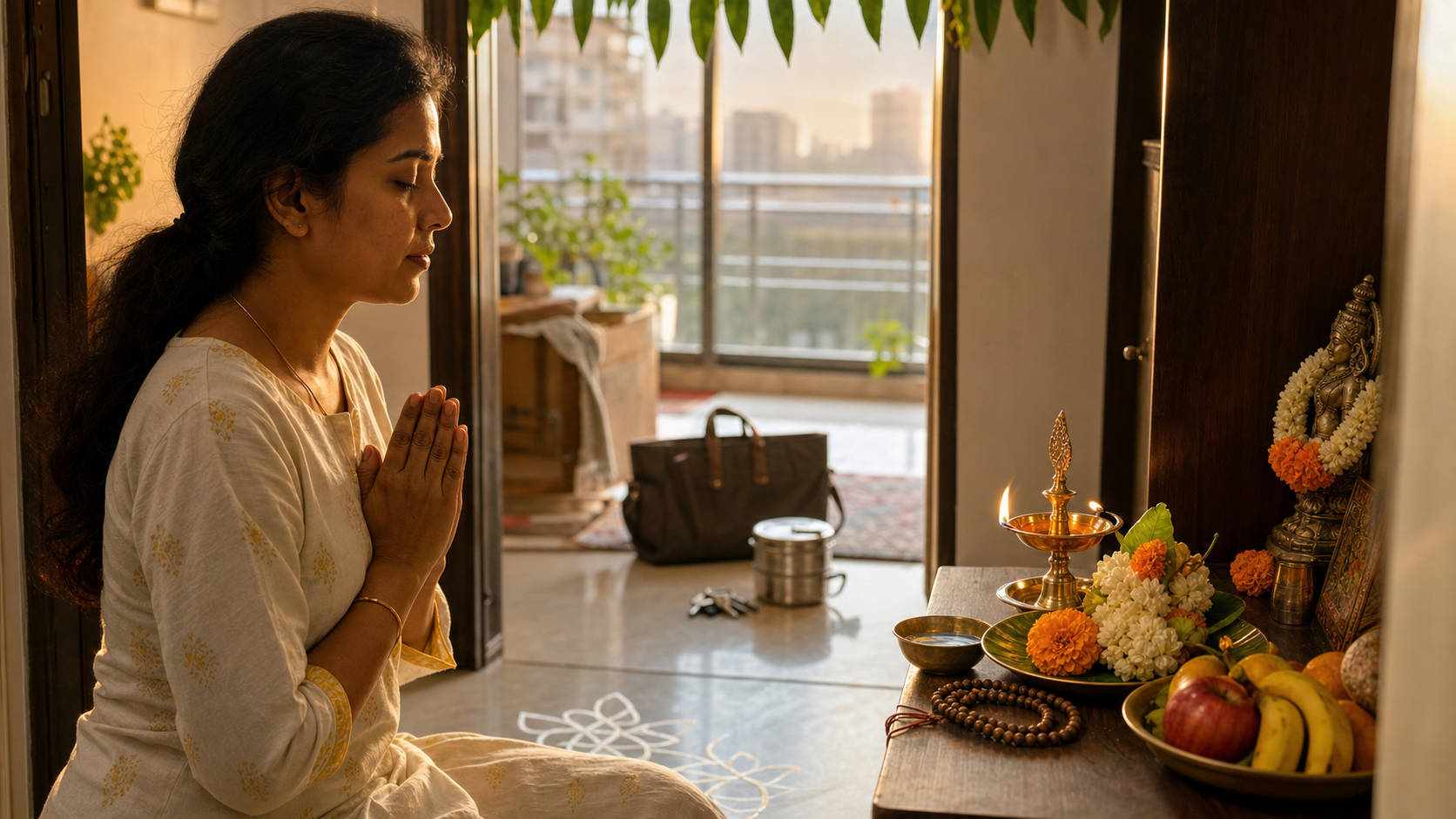
A New Year vow can feel perfectly clear during puja and strangely vague on the first hurried workday. The problem is usually not devotion. It is design: the resolution has no fixed cue, no visible action, and no way to recover after an interruption.
Whether your household marks the spring threshold as Ugadi, Vishu, Puthandu, or Mesha Sankranti, you can use it to establish a practice that fits ordinary life. Your aim is not to perform the maximum number of observances. It is to make a daily return to Dharma reliable enough that it begins to shape your speech, work, consumption, relationships, and service.
Key takeaways
- Protect one daily appointment. Use the same cue and the same device-free place for a simple 20–30-minute sadhana.
- Give the year one ethical centre. Choose one yama or niyama and define the action through which you will practise it.
- Keep only three tracked commitments. Combine daily sadhana, one conduct vow, and one weekly household or seva practice for 90 days.
- Put Dharma where temptation occurs. Your sankalpa needs a rule for the meeting, purchase, argument, or social-media post that usually tests you.
- Measure return, not spiritual mood. Review what you actually did each week, correct the design, and resume without drama after a missed day.
Build a morning practice that can survive a workday
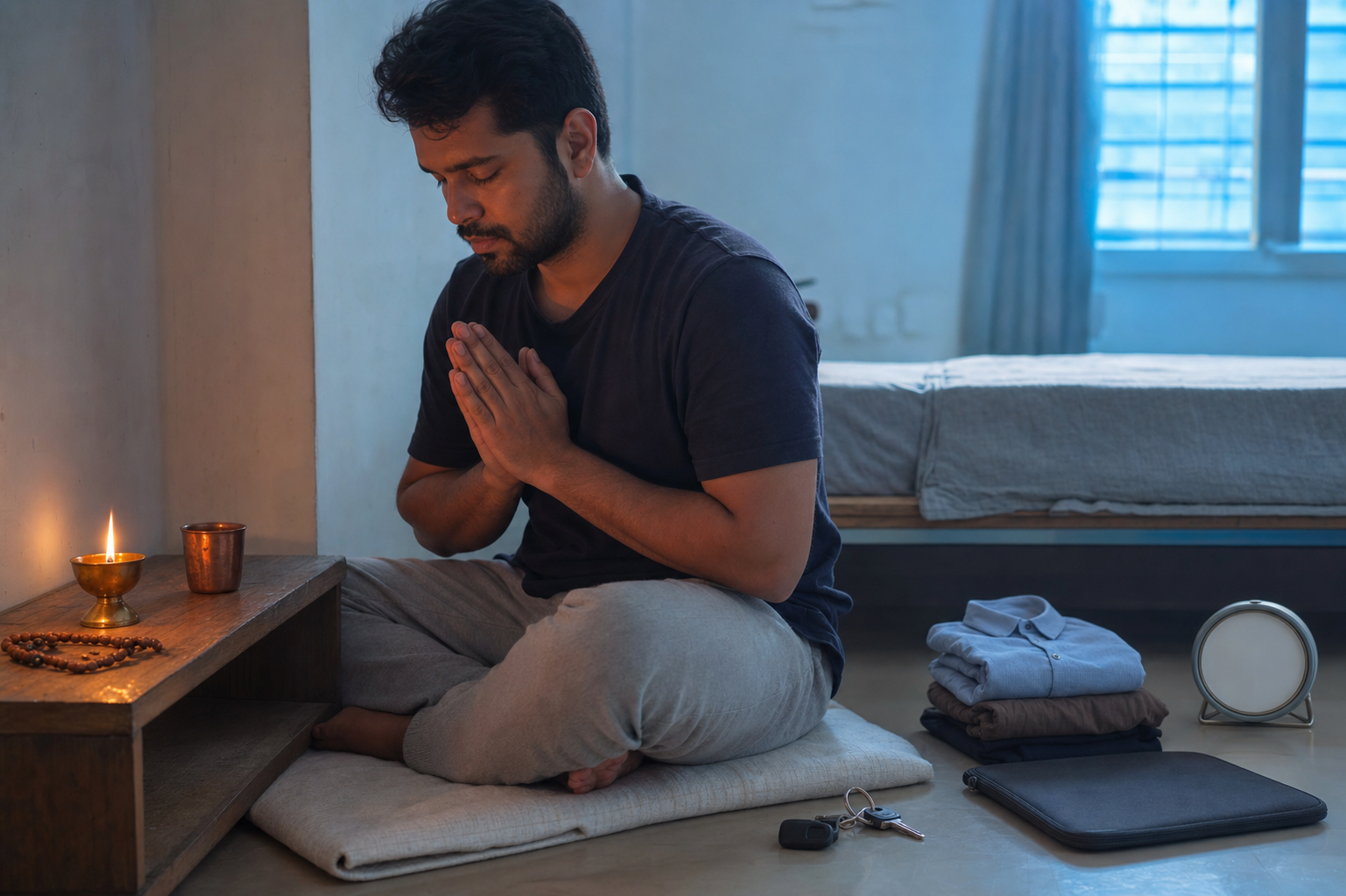
If your sampradaya, family, or guru has already given you a nitya practice, preserve that form. A generic routine should not displace an established discipline. If you do not yet have a stable routine, however, the following 20–30-minute daily frame gives breath, devotion, meditation, intention, and study a definite place.
| Time | Practice | What you do |
|---|---|---|
| First 3 minutes | Settling and breath | Sit steadily and let the breath become quiet. Use gentle diaphragmatic breathing or familiar anuloma-viloma without strain. |
| Next 5 minutes | Mantra japa | Repeat the mantra, nama, or prayer already honoured in your tradition. Bring the mind back to its meaning whenever repetition becomes mechanical. |
| Next 10 minutes | Dhyana | Rest attention on the breath, mantra, or form of the ishta-devata. When attention wanders, notice it and return without turning the distraction into a verdict on the session. |
| Next 2 minutes | Sankalpa | Name the virtue you intend to practise and the predictable situation in which you will need it that day. |
| Optional final 10 minutes | Svadhyaya | Read a small passage from the Bhagavad Gita, an Upanishad, or the text central to your lineage. Record one insight in your own words. |
Prepare the setting before you need it. Keep the text, mala, and asana together in a clean sacred nook, and keep the phone outside that space. If it is customary in your home, begin with achamana and light a dipa in a stable, safe place. A practice that requires searching for objects or clearing yesterday’s clutter every morning has been given unnecessary points of failure.
If work or care duties make morning practice impossible, attach it to the first dependable quiet point after waking. The cue matters more than an ideal clock time. On a disrupted day, use a minimum return: settle for three breaths, offer a brief prayer or japa, and state the day’s sankalpa. Do not repay a missed session by punishing yourself with an unsustainable session later. Resume the full practice at the next normal cue.
Breathwork should remain comfortable. If a technique causes dizziness, pain, or distress, stop the technique and return to natural breathing. Tapas is disciplined effort, not self-harm.
Give the year one ethical centre

A quiet mind is valuable, but daily sadhana becomes Dharmic only when it changes conduct. The root sense of Dharma is that which upholds. Your sankalpa should therefore identify what you mean to uphold and what you will do when that value becomes inconvenient.
Write the vow in a form you can observe: When this recurring situation arises, I will perform this visible action as my practice of this virtue. Choose one of the following as the ethical centre of the year. The list is a menu, not a demand to adopt everything at once.
- Ahimsa: Before replying to criticism, take three breaths and remove the sentence intended only to wound. If food is your chosen field of practice, introduce one plant-forward day each week; if your household is already vegetarian, focus instead on preventing food waste or reducing hostile speech.
- Satya: Verify a claim before forwarding it. Apply a 24-hour pause to emotionally charged posts, and distinguish the known fact, your interpretation, and your intention before speaking in a family disagreement.
- Asteya: Arrive five minutes early, name collaborators when presenting shared work, refuse digital piracy, and do not treat another person’s attention as an unlimited resource.
- Brahmacharya: For a householder, wise management of attention and intimacy can be a practical field of this discipline. Establish a 60-minute digital sunset before sleep and a weekly no-scroll period so stimulation does not consume the energy reserved for rest, study, relationship, and service.
- Aparigraha: Wait 48 hours before a non-essential purchase, apply a one-in, one-out rule to possessions, and donate usable items that are being kept without purpose.
- Sauca: Keep the puja or contemplation space free of devices. Once a month, remove distracting apps, unsubscribe from noise, and clean the digital environment as deliberately as the physical one.
- Santosha: Record three specific gratitudes at night. Name the person, event, or condition involved rather than writing a vague statement, and let gratitude become conduct by thanking a helper openly.
- Tapas: Keep one sustainable vrata: a regular dawn practice, an Ekadashi observance suited to your health, or a fixed seva hour. Do not turn fasting into a test of endurance. If food restriction is unsafe or conflicts with professional care, choose a non-food vrata instead.
- Svadhyaya: Read for 10–15 minutes, annotate one insight, and ask how it corrects a present habit. Recitation has greater practical value when you also attend to meaning.
- Ishvara-pranidhana: Offer work, skill, or resources without making recognition the reward. Judge the service by whether it brings tangible relief, not by whether it creates a photograph or public identity.
The vocabulary here comes from the yogic yamas and niyamas, but several practical affinities run through the wider Dharmic family. Buddhist Dhamma joins ethical conduct to liberation; Jain discipline gives profound weight to Ahimsa and Satya; Sikh dharam makes honest work, seva, and sharing concrete obligations. These affinities do not make the traditions interchangeable. They do show why truthful conduct, restraint, disciplined attention, and care for others remain strong foundations for a shared civic life.
Put Dharma on the household, work, and community calendar

A resolution remains fragile when it exists only in your head. Give it a place in the household calendar and in the settings where you make consequential choices.
Make heritage visible at home
- Daily: Light a dipa at dawn and dusk if that is part of your practice. Keep the sacred nook clean and let the household see that prayer has a protected place in the day.
- Weekly: Hold a brief family contentment circle, learn a foundational shloka with its meaning, or keep a shared no-scroll period. Choose the same recurring cue so it does not depend on whoever happens to remember.
- By the lunar calendar: Mark Ekadashi, Purnima, and observances important to your lineage before the month becomes crowded. Decide in advance whether each date calls for fasting, additional japa, study, dana, or a family visit.
- Monthly: Conduct digital sauca, donate unused goods, repair or reuse something before replacing it, and review whether the home is accumulating objects that no longer serve a purpose.
- Across the year: Keep Ugadi, Vishu, Mesha Sankranti, Puthandu, and your local utsavas in a family calendar as appropriate to your region. Children encounter heritage as lived culture when a sacred date changes what the household cooks, studies, sings, offers, or does for others.
If you live alone, the same rhythm can be held with a relative, friend, satsanga, or temple group. Accountability does not require a large household. It requires someone who knows the commitment and will ask about the practice without turning the exchange into surveillance.
Treat work and the phone as fields of sadhana
Before sending a consequential email, forwarding a charged claim, entering a contract, or claiming completed work, pause for a practical Dharma check:
- Is the statement accurate, or have fact, interpretation, and intention been blended together?
- Have the people who contributed received clear credit?
- Are you respecting another person’s time, including by being ready five minutes before a commitment?
- Does the decision transfer avoidable harm or cost to someone who has little power to refuse it?
- Would a 24-hour pause improve the response, or is delay being used to avoid a duty that should be performed now?
The Bhagavad Gita’s concern for lokasangraha places work within the maintenance of social order, not outside spiritual life. Skill, honest contracts, responsible use of shared resources, and refusal to profit by exporting harm are therefore parts of practice. The question is not whether your profession looks religious. It is whether your conduct upholds trust.
Give seva a fixed appointment
Choose a recurring need and offer a relevant skill. A temple, community kitchen, gurdwara, vihara, Jain upashraya, or education initiative may need cooking, cleaning, teaching, administration, translation, transport, or technical help more than it needs another general promise of support. Ask what work is actually required, accept unglamorous tasks, and keep the appointment.
Shared langar or seva, tree planting, and inter-Dharmic study can strengthen familiarity across communities. Participate without flattening distinctions: learn the etiquette of the place, let each tradition explain itself in its own language, and make cooperation around service the common ground.
Use a 90-day review instead of waiting for next year
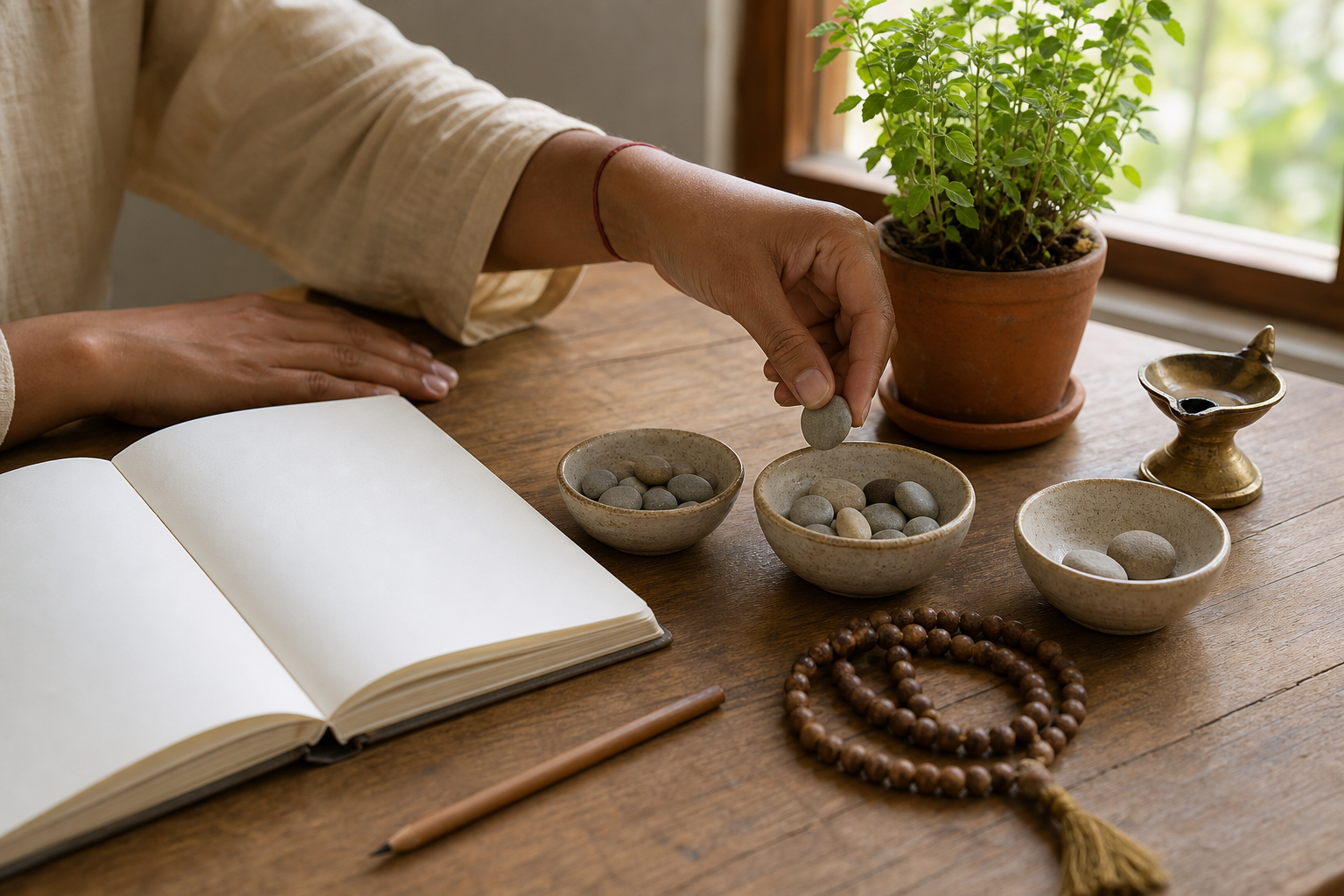
Choose three resolutions for 90 days: the daily sadhana, one ethical sankalpa, and one weekly household or seva commitment. More commitments can be added later. At the beginning, extra vows mostly make it harder to see which practice is working and which one needs correction.
Define each commitment so that a calendar mark has a clear meaning. Practised Ahimsa is too vague to track. Took three breaths before responding to criticism is visible. Studied scripture is vague. Read for 10–15 minutes and recorded one insight is clear. The tracker measures the action, not whether you felt peaceful, devout, or inspired while doing it.
At the weekly review, ask:
- Which cue reliably started the practice?
- Where did the practice fail: schedule, setting, unclear action, or resistance at the moment of choice?
- Was the vow small enough to repeat without becoming trivial?
- Did meditation alter speech and conduct, or remain isolated from the rest of the day?
- What single adjustment will make the next week more workable?
If a commitment is repeatedly missed, reduce friction before questioning your sincerity. Put the mala beside the text, move the phone out of the room, shorten the minimum return, clarify who is responsible for the family observance, or place the seva appointment on the shared calendar. If the action is being completed but has no ethical effect, deepen the reflection instead of merely increasing its duration.
At the end of 90 days, keep the commitments that have become stable, adjust those whose design was poor, and replace any vow that encouraged display, rigidity, or self-harm. Measurement serves Dharma only when it supports honest course correction. It is not a system for manufacturing guilt.
Before the New Year day closes, prepare your sacred place, put the chosen text within reach, write one behavioural sankalpa, and schedule the first weekly seva or household observance. At your next waking cue, begin with three breaths. The decisive practice is not the intensity of the first morning; it is the honesty of your next return.
References
