
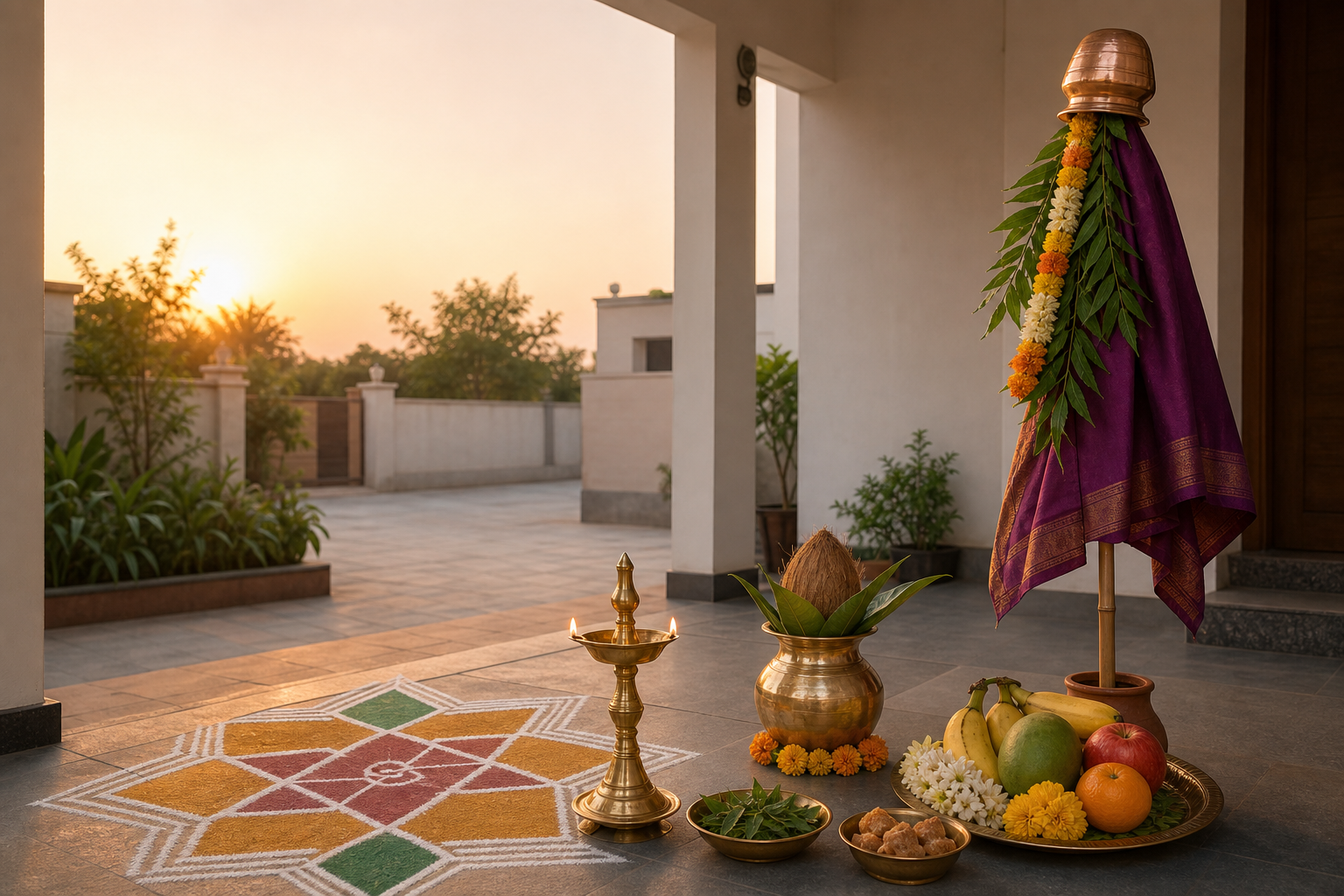
You are planning Ugadi or Gudi Padwa for 2026, but two details may be creating doubt. The Hindu New Year appears in March even though several other Bharatiya New Year observances fall in April, and its name, Parabhava, can sound ominous when translated without context. For communities beginning the year on Chaitra Shukla Pratipada, the date to mark in most of India is Thursday, 19 March 2026.
That date is your starting point, not a substitute for a local panchanga. Hindu calendrical observance follows a tithi at the relevant local sunrise, not a midnight-to-midnight date copied from Indian Standard Time. Once you understand that rule, you can settle the date, use the correct year-name in your sankalpa, and receive Parabhava as a call to disciplined renewal rather than a prediction of defeat.
The date to mark, and the one check you should still make
Parabhava Nama Samvatsara succeeds Vishwavasu, which concludes on 18 March 2026. The new year begins when Chaitra Shukla Pratipada, the first tithi of Chaitra’s bright fortnight, governs the New Year observance. For most Indian locations, that condition places Ugadi, Yugadi, and Gudi Padwa on 19 March.
The operational rule is more precise than simply saying that the festival falls on a particular Gregorian date: the panchanga determines whether Pratipada prevails at local sunrise. Longitude, time zone, sunrise, the exact tithi boundary, and a regional almanac’s computational convention can therefore matter. A family in India and relatives in North America should not automatically celebrate on the same local civil date merely by converting the clock from IST.
- If you are observing in India: use 19 March 2026 unless your established regional panchanga or temple gives a different local instruction.
- If you are observing outside India: consult a panchanga calculated for your city. Do not use an Indian timetable with only a time-zone conversion.
- If you are sending invitations: verify the local date before printing or booking. A festival date copied from a national calendar may not settle a boundary case for another country.
- If your family follows more than one regional tradition: identify which calendrical rule belongs to each observance instead of forcing every New Year onto one date.
Parabhava is expected to remain the applicable Samvatsara name until the following Chaitra Shukla Pratipada, anticipated around 8 March 2027 in IST, subject to local calculation. That span matters when you hear or recite the year-name in puja sankalpas after New Year’s Day.
The March date does not invalidate the spring New Years observed through solar reckoning. Puthandu, Vishu, and Vaisakhi generally belong to the mid-April cluster, while Cheti Chand and Navreh follow their own inherited community conventions near the spring turn. The useful distinction is not which festival is the real Hindu New Year. It is which calendrical doorway your sampradaya, region, and family use to enter the year.
Parabhava is a year-name, not a sentence passed on the year
Parabhava belongs to the traditional cycle of 60 named Samvatsaras. It follows Vishwavasu and precedes Plavanga; in the contemporary South Indian ordering, it is the 40th name. The cycle gives families, temples, inscriptions, ritual records, and panchangas a recurring vocabulary for locating a year within sacred time.
A familiar conceptual explanation relates the 60-year structure to the approximately 12-year period associated with Brihaspati and the 30-year period associated with Shani: 60 is the lowest common multiple of 12 and 30. That cosmological association helps explain why the system is often described as a Jovian cycle, but the practical function of Parabhava remains straightforward. It identifies a position in an inherited sequence.
The Sanskrit word parabhava can carry senses such as defeat, decline, humiliation, or being overcome. Those meanings deserve reflection, but they do not justify declaring that every person, family, or nation must suffer during 2026–2027. A Samvatsara name by itself is not a deterministic forecast. Annual panchanga interpretations use additional calendrical and astrological factors, while an individual assessment requires still more specific information.
Parabhava becomes spiritually useful when you turn the disturbing edge of the word inward. Where has pride made correction difficult? Which neglected duty is weakening the household? What belief are you repeating without examining it? Those questions transform an alarming translation into a practical New Year discipline.
parābhavas tāvad abodha-jāto yāvan na jijñāsata ātma-tattvam
Śrīmad-Bhāgavatam 5.5.5
The verse links parabhava with the absence of inquiry into atma-tattva. Its relevance here is ethical and contemplative: decline persists while the deeper truth of the self goes unquestioned. It does not say that a calendar year bearing this name guarantees calamity. For your New Year sankalpa, choose one area in which honest inquiry must replace habit, evasion, or borrowed certainty.
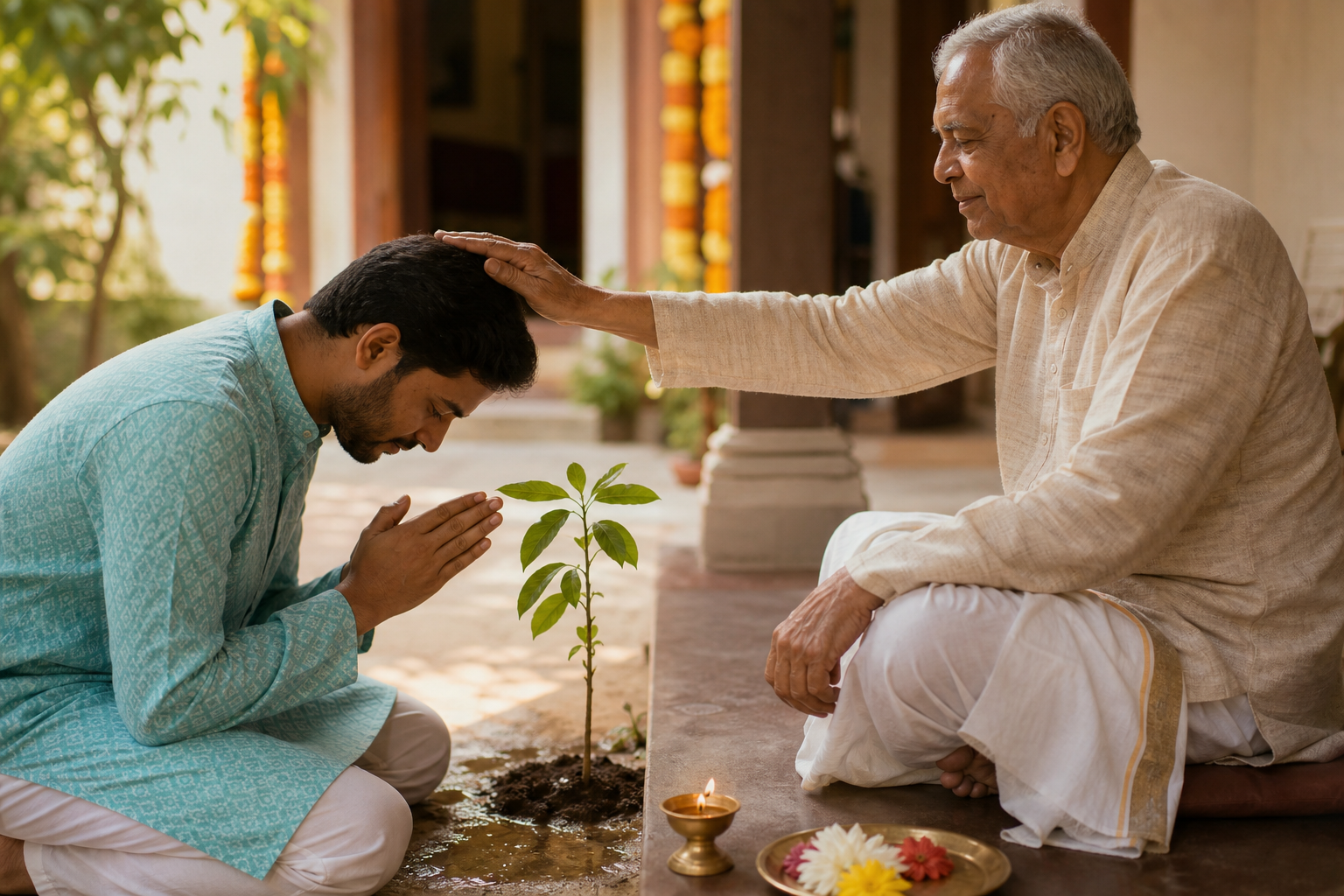
A practical home observance for 19 March
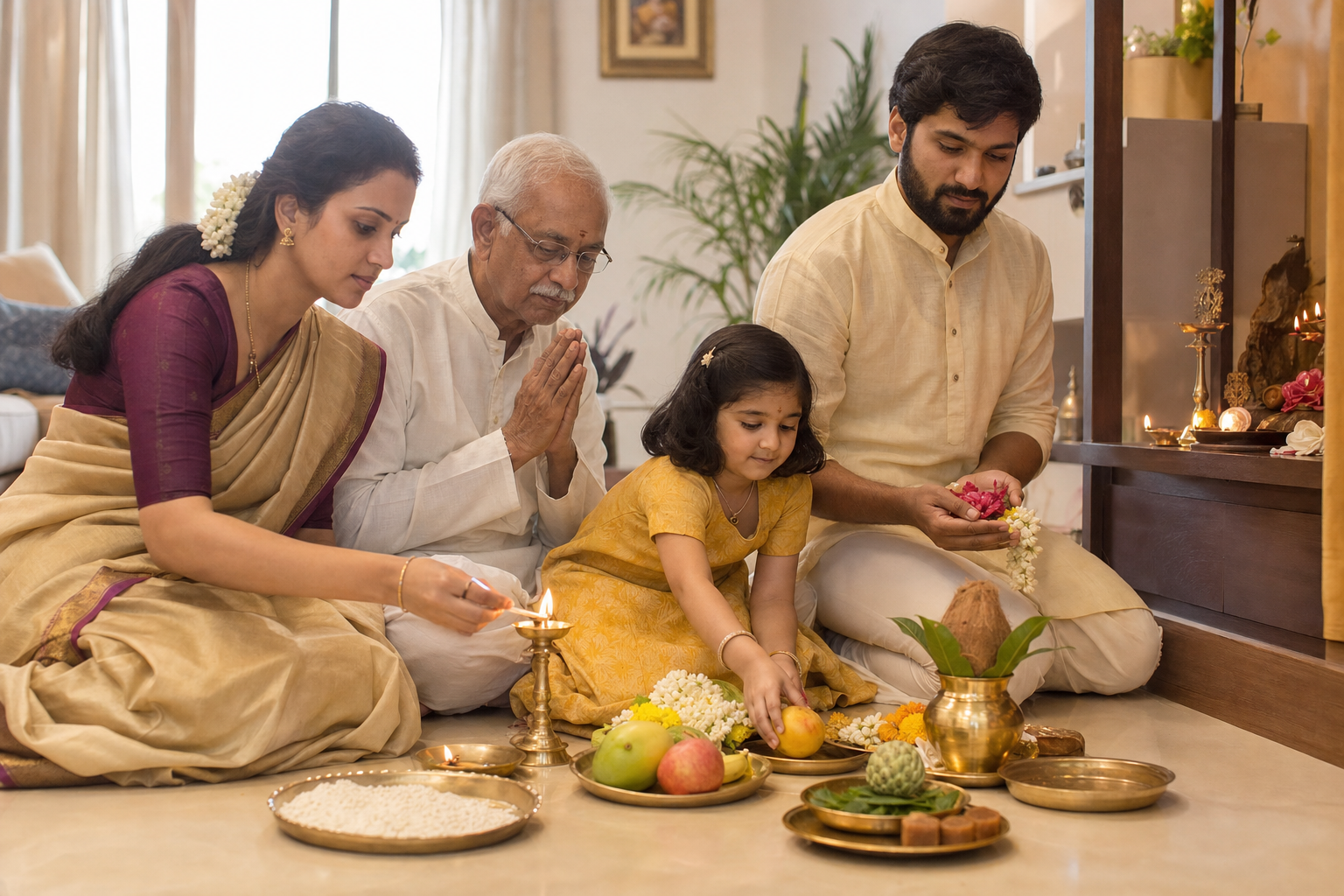
You do not need to combine every regional custom into a single ceremony. Follow the tradition your household has received, and understand what each action is doing. A focused observance can be organized in six steps.
- Confirm the local panchanga. Record the New Year date, the locally recommended worship period, and the day’s tithi, vara, nakshatra, yoga, and karana. If your temple publishes timings for your city, use those rather than a generic online graphic.
- Prepare the household before worship. Clean the puja space and entrance, bathe, wear clean clothes, and make the customary rangoli or kolam. The point is not decoration alone; physical order creates a deliberate break between the completed year and the conduct you intend to begin.
- Use the correct Samvatsara name in the sankalpa. The annual phrase is Parabhava-nama-samvatsare. The remaining details—including ayana, ritu, masa, paksha, tithi, nakshatra, yoga, and karana—must come from the panchanga for that place and time. Do not copy the entire formula from an old recording merely because the opening sounds familiar.
- Keep the regional symbol intact. Telugu and Kannada households may prepare Ugadi Pachadi or bevu-bella, using contrasting tastes to remember that life does not offer sweetness alone. Marathi and Konkani households may raise the gudi as an emblem of auspiciousness, renewal, and the victory of dharma. These customs can share a date without becoming interchangeable.
- Hear the Panchanga Shravanam attentively. Listen for the five limbs of the day and for the broader annual indicators used in your regional tradition. Note which statements concern the community or region and which, if any, are intended for personal application.
- Name one correction that can be observed. Replace a vague resolution such as becoming more spiritual with a defined practice: a fixed weekly period for svadhyaya, a monthly act of seva, a regular family puja, or a scheduled review of duties you have been postponing.
If your family contains both Ugadi and Gudi Padwa traditions, you need not choose one identity at the expense of the other. Keep each practice recognizably itself: prepare the customary food from one tradition, raise the gudi where that inheritance is present, and share the same sankalpa and panchanga hearing where appropriate. Unity is strongest when it preserves memory rather than flattening it.
How to use the panchanga without surrendering judgment
Panchanga literally points to five limbs: tithi, vara, nakshatra, yoga, and karana. Panchanga Shravanam places those calendrical coordinates alongside annual phala traditions. Depending on the region, you may hear measures such as Aaya–Vyaya, concerning income and expenditure, and Rajapujya, concerning honor or favor.
Treat these readings at the scale at which they are given. An Aaya–Vyaya reading for 2026–2027 may be a collective, regional, or traditional annual index; it is not your household budget, an investment guarantee, or proof of an unavoidable personal event. Record the reading as a prompt for preparedness, then make actual decisions through dharma, evidence, prudent planning, and advice appropriate to the decision.
The same limit applies to muhurta. The fact that 19 March is New Year’s Day does not make every hour on that date equally suitable for every samskara. Weddings, griha pravesha, and other consequential rites require their own examination of vara, tithi, nakshatra, and supporting combinations. Use the Samvatsara for annual orientation; use a location-specific muhurta for the particular rite.
Three separate calendar questions prevent most confusion:
- When does this community begin its year? Chaitra Shukla Pratipada is the answer for Ugadi and Gudi Padwa, while several other traditions use a solar transition or another inherited starting point.
- What is the year called? In the 60-name cycle beginning here on 19 March 2026, the answer is Parabhava.
- Which era number is being used? Ugadi 2026 begins Shaka Samvat 1948 and, among communities starting Vikram Samvat in Chaitra, Vikram Samvat 2083. These numbers and the Samvatsara name describe different coordinates; they do not compete with one another.
Amanta and Purnimanta month conventions can also label and close lunar months differently. Solar and lunisolar calendars answer different ritual needs. Jain commercial reckoning from Deepavali and the mid-April New Year patterns found among Tamil, Malayali, and Sikh communities add further layers. The dharmic achievement is not a single compulsory calendar but a shared capacity to hold lunar tithis, solar transitions, seasonal renewal, ritual memory, and community identity within one civilizational grammar.
Key takeaways
- For most of India, Parabhava Samvatsara begins on Thursday, 19 March 2026, with Chaitra Shukla Pratipada.
- If you live outside India or near a tithi boundary, verify the observance with a panchanga calculated for your location and local sunrise.
- Parabhava follows Vishwavasu, precedes Plavanga, and is the 40th name in the contemporary South Indian ordering of the 60-year cycle.
- The name can evoke defeat or decline, but it does not predetermine your personal or collective future. Use it as a prompt for humility, inquiry, and correction.
- In the sankalpa, use Parabhava-nama-samvatsare, then obtain the day-specific calendrical details locally.
- Receive Aaya–Vyaya and other annual readings as traditional interpretive guidance, not as substitutes for personal judgment, proper budgeting, or a rite-specific muhurta.
Before you print an invitation or forward a festival message, open the panchanga for the city where the observance will occur and write down its sunrise rule, ritual timing, and sankalpa details. Then choose one neglected duty to correct during Parabhava. A year whose name warns against being overcome is best entered by refusing to remain unconscious of what must change.
References
- HinduPad — Parabhava Nama Year 2026–2027: Ugadi/Gudi Padwa Dates, Meaning, and Panchanga Essentials
- DharmaRenaissance Blog — Parābhava Samvatsara 2026–2027: Exact Ugadi/Gudi Padwa Date, Meaning, and Traditions
