
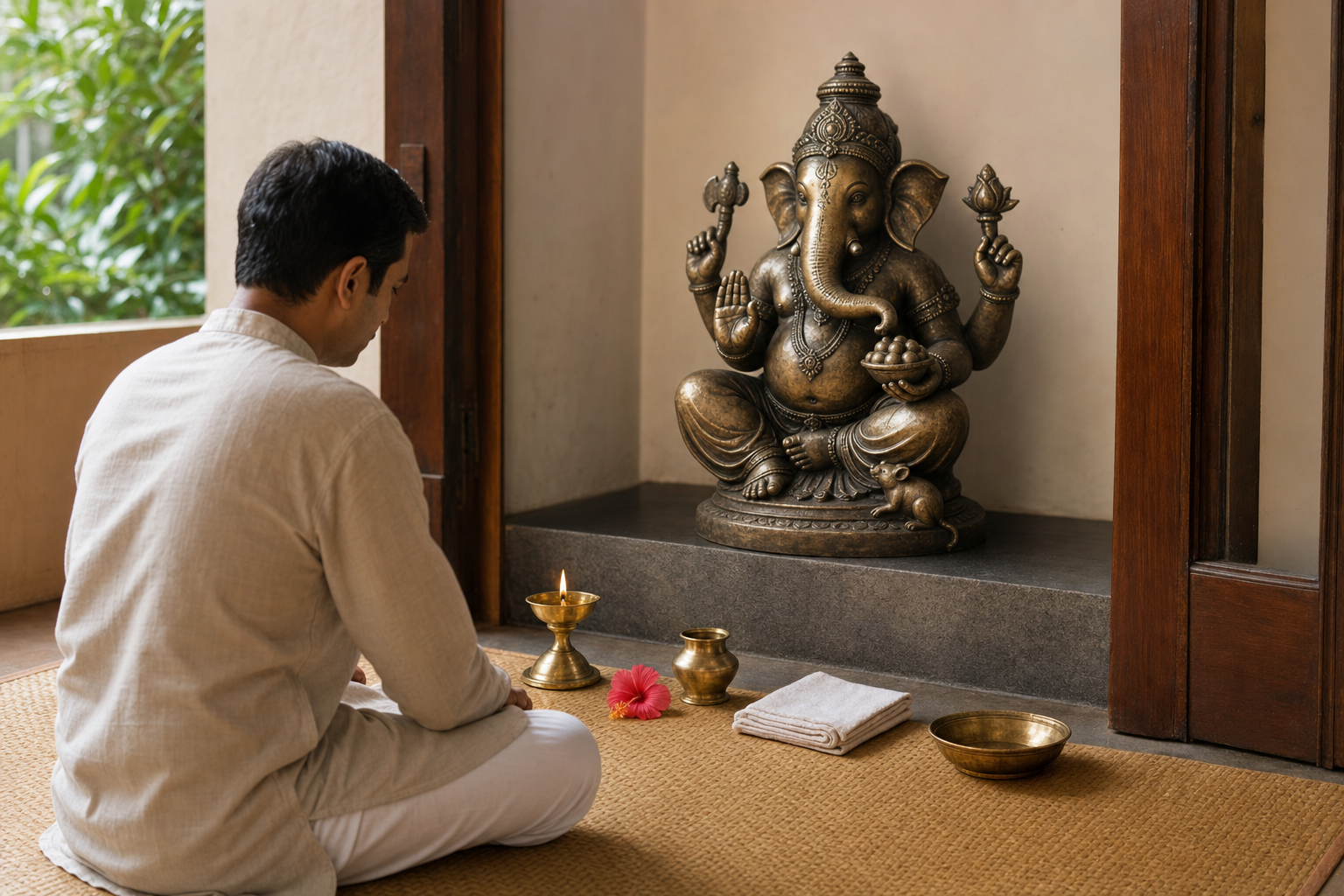
You are standing before a beautiful murti and wondering whether it belongs in your home. The bow, trunk, posture, direction of gaze, or accompanying animal may look like an artistic detail. In a traditional sacred image, however, such details can identify a particular manifestation of the deity and the discipline associated with it.
Your decision should therefore begin with two questions: what form is this, and what kind of worship can you honestly sustain? When iconography, installation, and daily practice fit one another, a home shrine supports devotion. When they don’t, the shrine can become a source of confusion, guilt, or superstition.
Key takeaways before choosing a murti
- Identify the exact form from its full set of attributes, not from one striking feature or a seller’s label.
- Ask whether the object will remain devotional art, receive ordinary household worship, or undergo formal consecration. Those choices do not create the same obligations.
- Treat claims about a form’s special potency as teachings within a lineage, not as biomedical facts or universal rules followed identically by every Hindu tradition.
- Choose according to the minimum practice you can maintain on an ordinary working day, not the elaborate puja you can perform on a festival.
- For an exacting or unfamiliar form, obtain its daily and contingency protocols from a qualified priest, guru, or teacher within the relevant sampradaya before installation.
- If you already possess such a murti, don’t panic, discard it, or blame normal hardships on the deity. Keep it respectfully and seek form-specific guidance.
Read the icon as a discipline, not a decoration
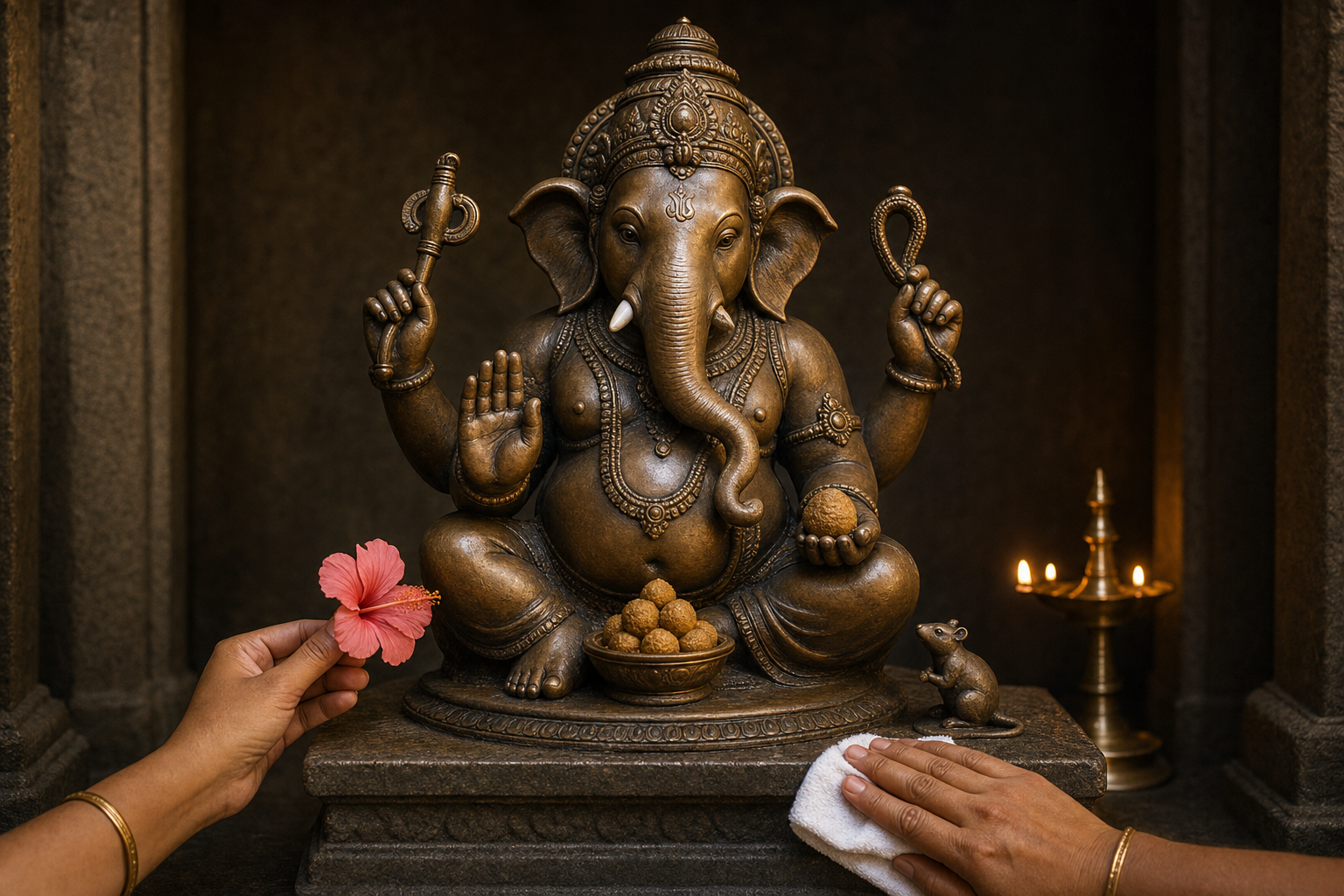
Iconography is a visual grammar. An attribute identifies what the deity does; a posture reveals the quality of that action; attendants and animals place it within a narrative; the complete composition tells you what kind of attention the form asks from the viewer. A bow may indicate focused action, but its meaning changes according to who carries it, what surrounds the figure, and which episode is being represented.
Begin by recording what is actually present. Note the number and position of the hands, held objects, posture, head covering, ornaments, companions, animals, and objects beneath the feet. Then seek identification from a temple or lineage familiar with that form. Regional sculptors may change clothing, facial hair, ornaments, or composition, so one missing secondary feature doesn’t necessarily settle the question.
Kiratamurti: focus tested by an unexpected form
Kiratamurti depicts Shiva as a forest or mountain hunter rather than in an immediately recognisable courtly or ascetic guise. The visual markers can include a bow, quiver, hunting blade, practical forest clothing, wrapped headcloth, and rustic ornaments. Kirati, the huntress form of Parvati, may accompany him. In narrative panels, Arjuna, a fallen boar, a dog, or other attendants can make the identity clearer. Regional workshops sometimes add a moustache or beard, while others preserve more familiar Shaiva markers.
The scene comes from Arjuna’s tapas for the Pashupatastra. Shiva appears as Kirata, contests Arjuna after both strike the boar-form of Muka, tests his resolve, and grants the weapon after recognition. The form cannot be reduced to martial strength. Arjuna’s skill is real, but it becomes spiritually fruitful only when joined to steadiness, humility, and recognition of an agency greater than his own.
Use the icon accordingly. First notice the diagonal force of bow, arrow, limbs, and quiver. Then find the still point: the hunter’s composed presence amid conflict. Before a difficult action of your own, name the legitimate aim, identify the impulse that could distort it, and act without turning competence into vanity. In this contemplative reading, the bow is disciplined capacity, the arrow is one-pointed attention, and the target is not permission for aggression but a demand for discrimination.
Right-coiled Ganesha: an iconographic choice with ritual consequences
Trunk direction is not treated as a negligible detail in several Ganesha traditions. A left-coiled trunk is commonly connected with Ida, the cooling or receptive current; a right-coiled trunk with Pingala, the solar and activating current; and a straight trunk with Sushumna, balance and transcendence. This is a yogic and ritual symbolism. It should not be presented as an anatomical or medical claim.
Within this symbolic scheme, a right-coiled or dakshinavarti Ganesha represents concentrated tejas and tapas. Traditional guidance often places this form in temples or in households capable of maintaining demanding niyamas. Daily worship may include cleanliness, a lamp, mantra practice, bathing or other offerings, and fresh naivedya according to the applicable tradition.
That does not make the form evil, unlucky, or eager to punish a missed ritual. The point is suitability. A temple has trained archakas and an established cycle of daily and occasional rites. A household dealing with employment, caregiving, illness, and travel may not possess that support. For many homes, a left-coiled or straight-trunk Ganesha allows sincere devotion within a more sustainable domestic rhythm.
Don’t turn this distinction into a universal decree. Agamic customs, regional interpretations, family traditions, and sampradayas do not all prescribe an identical ritual package. The responsible question is not, “Is this murti dangerous?” It is, “Which tradition identifies this form, and what does that tradition require after installation?”
Match the sacred form to your actual capacity
A demanding icon may attract you precisely because it represents intensity, accomplishment, or protection. Attraction alone is not readiness. The relevant measure is your ordinary life: the morning when work begins early, the week when a child is ill, and the period when travel interrupts your normal routine.
Use this decision process before making a formal commitment:
- Confirm the identity. Obtain the form’s exact name and ask which features establish that identification. A confident retail description is not a substitute for iconographic knowledge.
- Define the intended status. Decide whether you are acquiring sacred art for respectful display, an image for ordinary remembrance, or a murti intended for formal installation and worship. Do not arrange consecration merely because it sounds more spiritually impressive.
- Request the minimum rule. Ask what must be done every day, what belongs only to festivals or special occasions, and which acts require a trained priest. Get concrete answers about lamp, water, bathing, mantra, naivedya, cleanliness, and timing rather than accepting the vague instruction to “worship properly.”
- Ask about interruptions. Find out what the tradition provides for travel, sickness, menstruation if relevant to that lineage, bereavement, caregiving emergencies, and days when another household member must serve. A workable discipline needs a lawful response to foreseeable disruption.
- Rehearse before formal installation. Follow the proposed domestic schedule through a busy weekday, a weekend, and a predictable interruption. If it repeatedly fails before consecration, reduce the complexity or choose a more suitable form.
- Decide without status anxiety. Selecting a gentler household form is not lesser devotion. It can be the more truthful act because it aligns reverence with the life you can actually offer.
The distinction between an elaborate form and a simple form is not a ranking of deities. The Divine is not made greater by the number of vessels on your altar. Iconographic suitability concerns the relationship between a manifestation, a ritual framework, and the devotee’s capacity for service.
Build a daily rule that can survive ordinary life
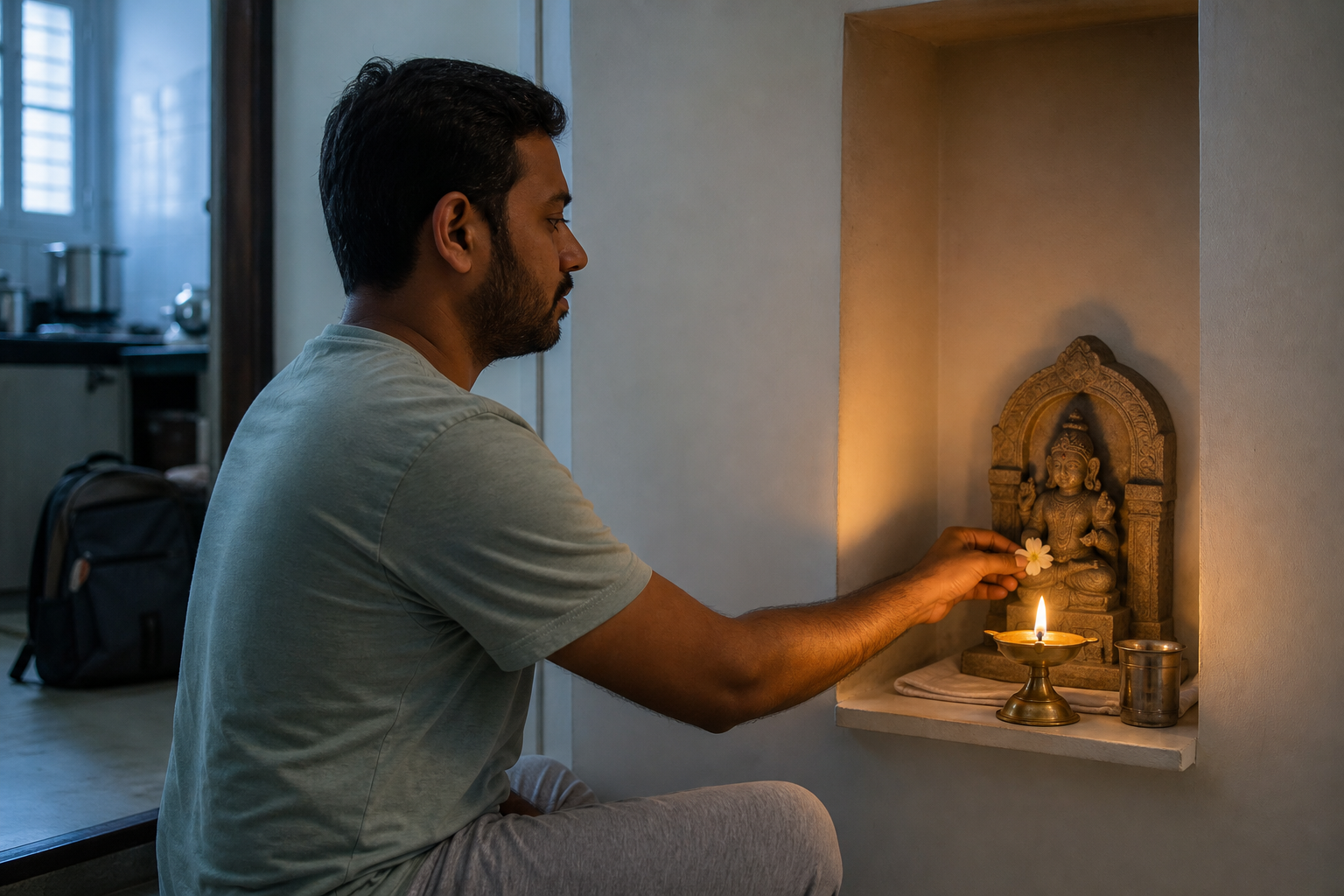
Once you have form-specific guidance, write down a short daily rule. Memory tends to enlarge the ritual on inspired days and shrink it on hurried ones. A written minimum keeps the practice intelligible. It also helps other members of the household know what service has actually been accepted.
A basic household sequence, where consistent with your family or lineage, can be organised around five functions:
- Prepare. Attend to personal cleanliness, clear the shrine area, and remove stale offerings in the manner your tradition permits.
- Establish attention. Approach without multitasking. Light the prescribed lamp, offer water, or perform the opening act taught to you.
- Recite. Use a mantra, name, stotra, or prayer appropriate to the deity and received tradition. Keep a fixed count only when a teacher or family custom has given one; don’t invent large counts to make the practice feel powerful.
- Offer. Present the permitted naivedya or other simple offering. Choose something you can provide cleanly and consistently rather than promising festival-level abundance every day.
- Close. Complete the prescribed salutation, distribute or handle offerings properly, and leave the shrine ready for the next observance.
The exact items are less important than obeying the form-specific protocol you have accepted. One tradition may require an action that another omits. Avoid assembling a hybrid rite from unrelated videos, short-form clips, and forwarded messages. If you add a practice, ask whether it belongs with this deity, this form, and this mode of installation.
Keep special worship special. A longer vrata, abhishekam, festival puja, or fixed mantra discipline should deepen the daily foundation, not compensate for abandoning it. A modest observance that continues through normal life is more coherent than bursts of complexity followed by avoidable neglect.
Discipline also extends beyond the shrine. A satvika regimen traditionally associated with exacting worship includes cleanliness, sobriety, non-violence, restraint, and responsible food habits. Kiratamurti adds a related demand: strength must remain governed by discrimination and humility. Ritual correctness without ethical restraint misses what the icon is teaching.
This principle resonates across the Dharmic family without making every path ritually identical. Buddhist cultivation disciplines attention and conduct; Jain practice gives rigorous place to self-restraint and ahimsa; Sikh life joins remembrance of the Divine Name with upright action and seva. Shared seriousness about conduct does not erase the distinct theology or practice of any tradition.
Know when the temple is the better home
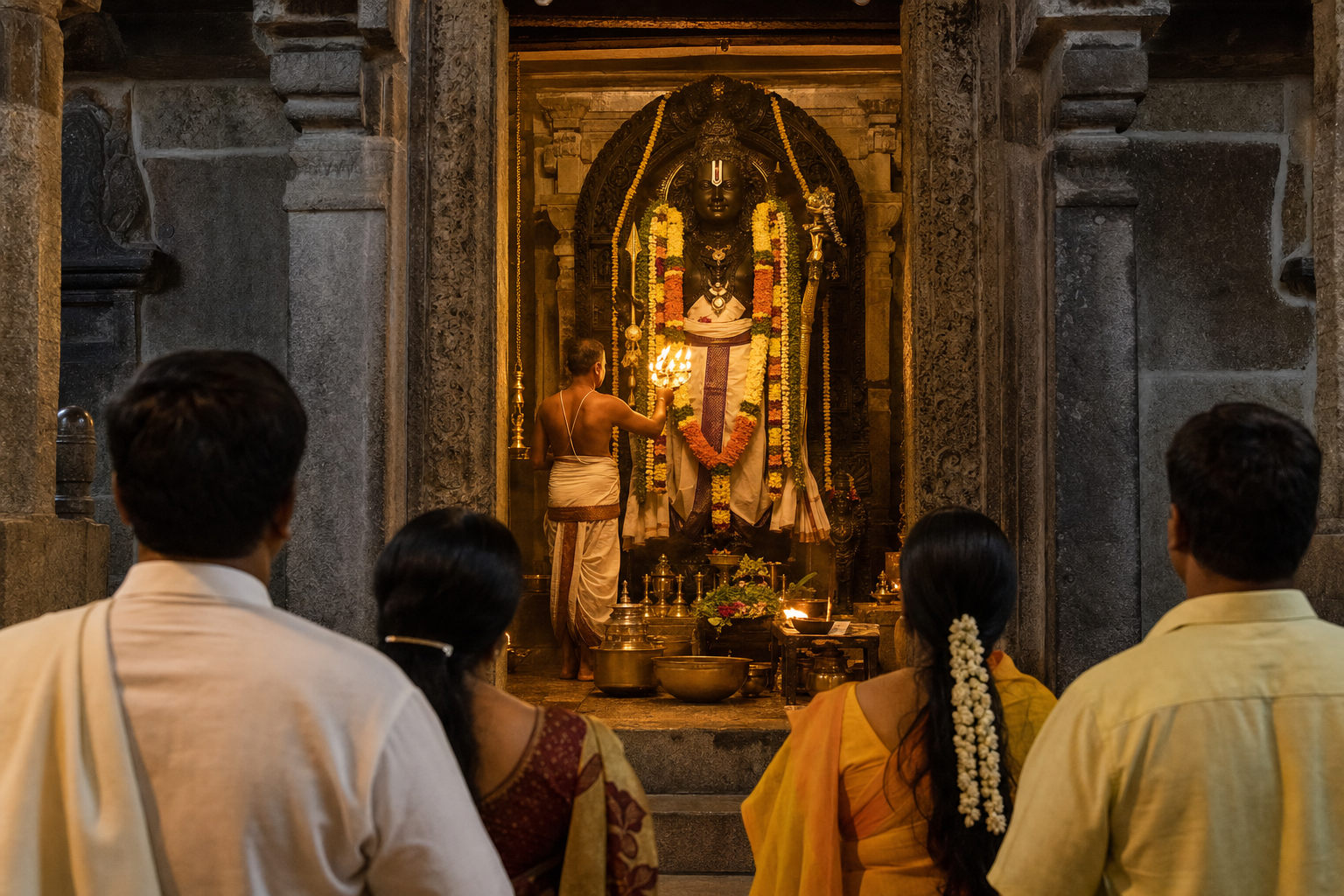
A temple is not merely a larger household shrine. It has an installed ritual order, trained service, inherited procedures, and continuity beyond one person’s schedule. That makes it the appropriate setting for many forms whose worship depends on precise daily and occasional rites.
Prefer temple darshan over home installation when the form is traditionally treated as ritually exacting, when you cannot identify its sampradaya, when its minimum daily service remains unclear, or when no one in the household can maintain the accepted routine. You can still form a deep relationship with the deity through temple worship, prayer, study, pilgrimage, dana, and ethical practice. Possession is not the measure of devotion.
If a right-coiled Ganesha or another demanding murti is already in your home and your worship has been irregular, don’t make a frightened correction. Do not throw it away, abandon it outdoors, or perform an improvised immersion. Keep the shrine clean, offer simple respect without pretending to know a missing protocol, and consult a priest or teacher who can inspect the exact form and ask how it was installed. The answer may be to regularise the worship, conduct a prescribed transition, or clarify that the object was never formally consecrated.
Also resist reading every illness, expense, argument, or delay as evidence that the deity is displeased. That habit turns devotion into fear and makes ordinary life impossible to assess clearly. Ritual responsibility means learning and keeping an appropriate discipline; it does not mean inventing supernatural explanations for every setback.
Before your next purchase, take a clear image of the proposed murti to the temple or teacher whose practice you trust. Ask for its exact identity, intended setting, minimum daily service, and interruption protocol. If those four answers fit your real household, proceed deliberately. If they don’t, choose the form you can welcome with steadiness.
References
- DharmaRenaissance Blog — Kiratamurti Unveiled: Shiva the Divine Hunter, Iconography, Symbolism, and Temple Legacy
- DharmaRenaissance Blog — Siddhidata Ganesha’s Right-Coiled Trunk: Sacred Discipline, Temple Protocols, and Home Guidance
