
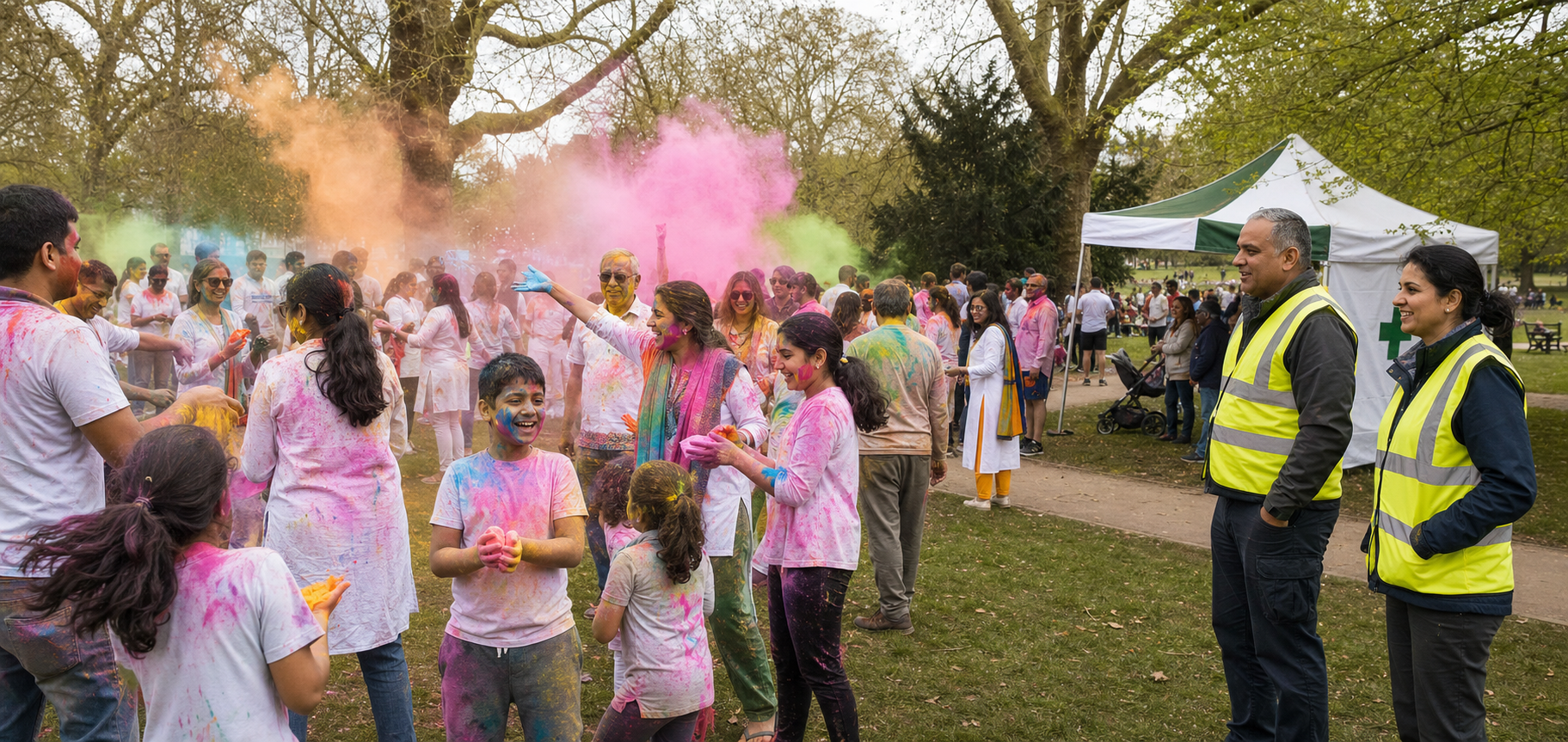
If you help organise a Holi celebration in Britain, the practical question is not whether the festival should become quieter, smaller, or less visible. It is how you keep an open, joyful, multigenerational gathering safe without turning it into a fortress.
The Harrow disturbance creates pressure in two unhelpful directions: minimise what frightened families experienced, or treat an unverified claim about several individuals as a verdict on an entire community. You should reject both. Hindu festivals deserve firm protection, and credible protection begins with accurate evidence, proportionate safeguards, and people who know exactly what to do when the atmosphere changes.
Read the Harrow incident carefully before drawing conclusions
On 13 March 2026, a public Holi celebration in Harrow, northwest London, reportedly experienced a brief disturbance involving a small group of youths. Attendees described parents moving children away from the colour-play area while volunteer stewards created a soft corridor and restored order. Those initial accounts remain subject to verification by the Metropolitan Police.
Some attendees identified the youths as Muslim based on appearance or statements. That attribution has not been independently established. Appearance is not reliable evidence of religion, and even an individual’s declared identity would not transfer responsibility to a wider community. Investigators must determine separately what each person did, whether an offence occurred, whether religious hostility was present, and whether the available evidence supports any charge.
This distinction does not require organisers to play down intimidation. It requires them to describe it precisely. Observable conduct, exact words, injuries, damage, witness perceptions, and preserved recordings are evidence. Assumptions about identity or motive are not substitutes for evidence.
The legal principle is equally important. Articles 9 and 11 of the European Convention on Human Rights, incorporated in Britain through the Human Rights Act 1998, protect religious manifestation and peaceful assembly. The state may address disorder and crime through lawful restrictions and police powers, including those governed by the Public Order Act 1986 and the Police, Crime, Sentencing and Courts Act 2022. Protective measures should therefore respond to behaviour and credible risk, not presumed ethnicity or religion.
Key takeaways
- Treat the Harrow episode as an alleged disturbance requiring investigation, not as proof of a communal conspiracy.
- Record conduct, motive, and identity as separate questions. Do not let an assumption about one answer determine the others.
- Design Holi security around its real features: open access, colour play, music, food stalls, families, spontaneous movement, and high footfall.
- Give stewards written roles and escalation triggers before the event. A volunteer should never have to invent policy in the middle of a crowd.
- Use one authorised information channel after an incident. Fast speculation makes witness accounts less clear and community tensions harder to contain.
Build safeguards around the way Holi actually works
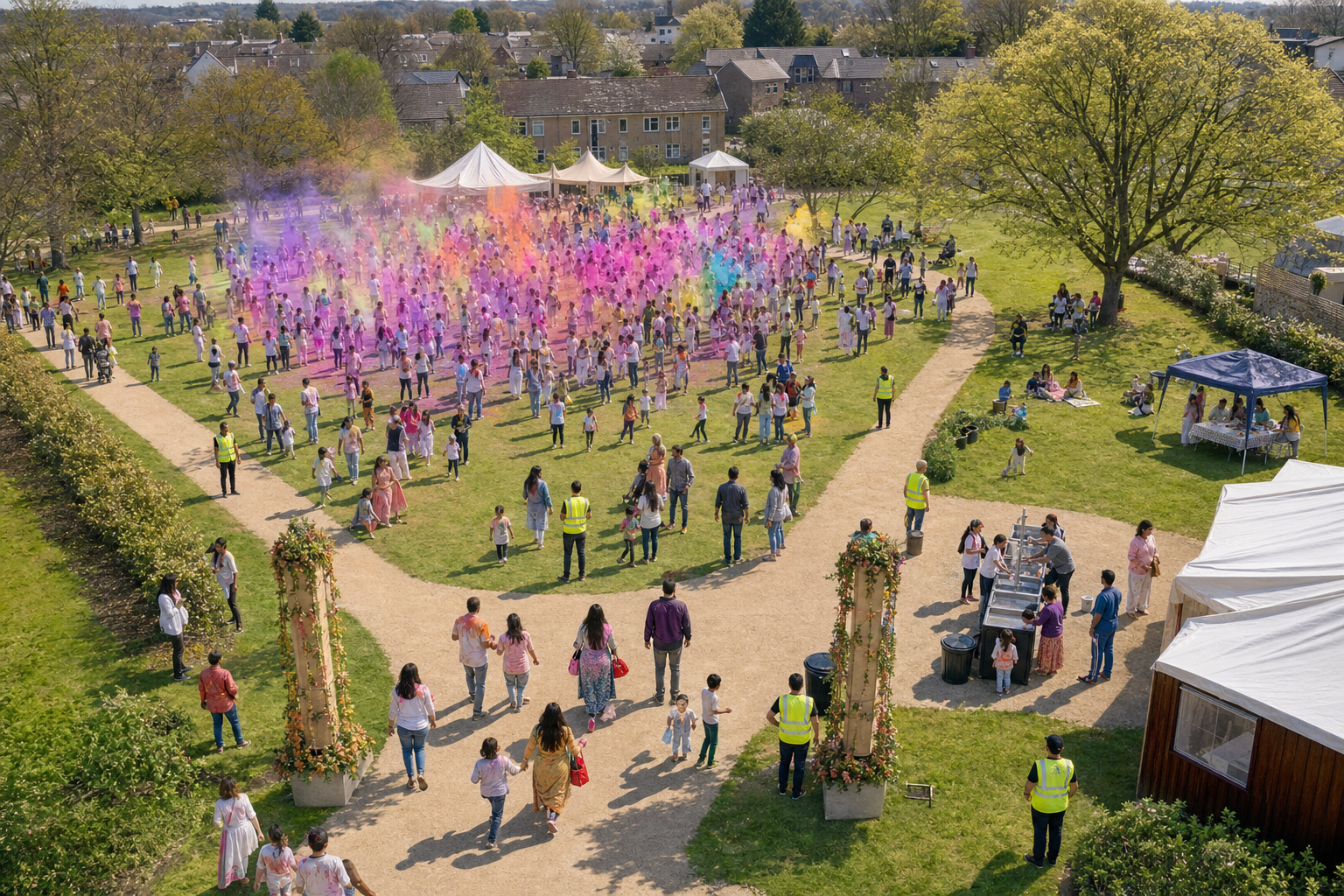
A conventional seated-event plan is not enough for Holi. Participants move unpredictably, colour can reduce visibility, music can make verbal instructions difficult to hear, and families may cluster around the busiest play area. Food queues and temporary barriers can narrow circulation at exactly the moment people want to leave. Your risk assessment should reflect those conditions rather than relying on a generic festival template.
Use a layered plan. No single camera, barrier, police presence, or steward team can carry the entire burden. The layers should help you notice concerning behaviour early, create space around it, communicate clearly, protect routes, summon the right help, and preserve an accurate record afterward.
- Engage the council early. Ask whether the local Safety Advisory Group should review the event. A SAG can bring together the council, emergency services, highways, environmental health, and other relevant specialists. Give them a site plan and operating plan rather than approaching them with only a festival date.
- Write scenarios into the risk assessment. Include harassment near an entrance, unwanted entry, pushing in the colour-play zone, an obstructed exit, a medical emergency, a separated child, a confrontation near a stage, and a false online claim spreading during the event. Assign an owner, first response, escalation point, and communication method to each scenario.
- Map the site by function. Mark entrances, exits, colour-play areas, stage frontage, queues, food stalls, medical provision, steward posts, CCTV coverage, family rendezvous points, and routes emergency responders can use. Check the map from a child’s height and from the position of an older person who cannot move quickly. A route that exists on paper may disappear once queues form.
- Set entry rules before the gates open. Publish prohibited items and behavioural conditions, brief every entrance team on the same rules, and apply them consistently to people in equivalent circumstances. Screening should be proportionate to the assessed risk. Profiling attendees by perceived religion is neither a reliable control nor a defensible substitute for conduct-based decisions.
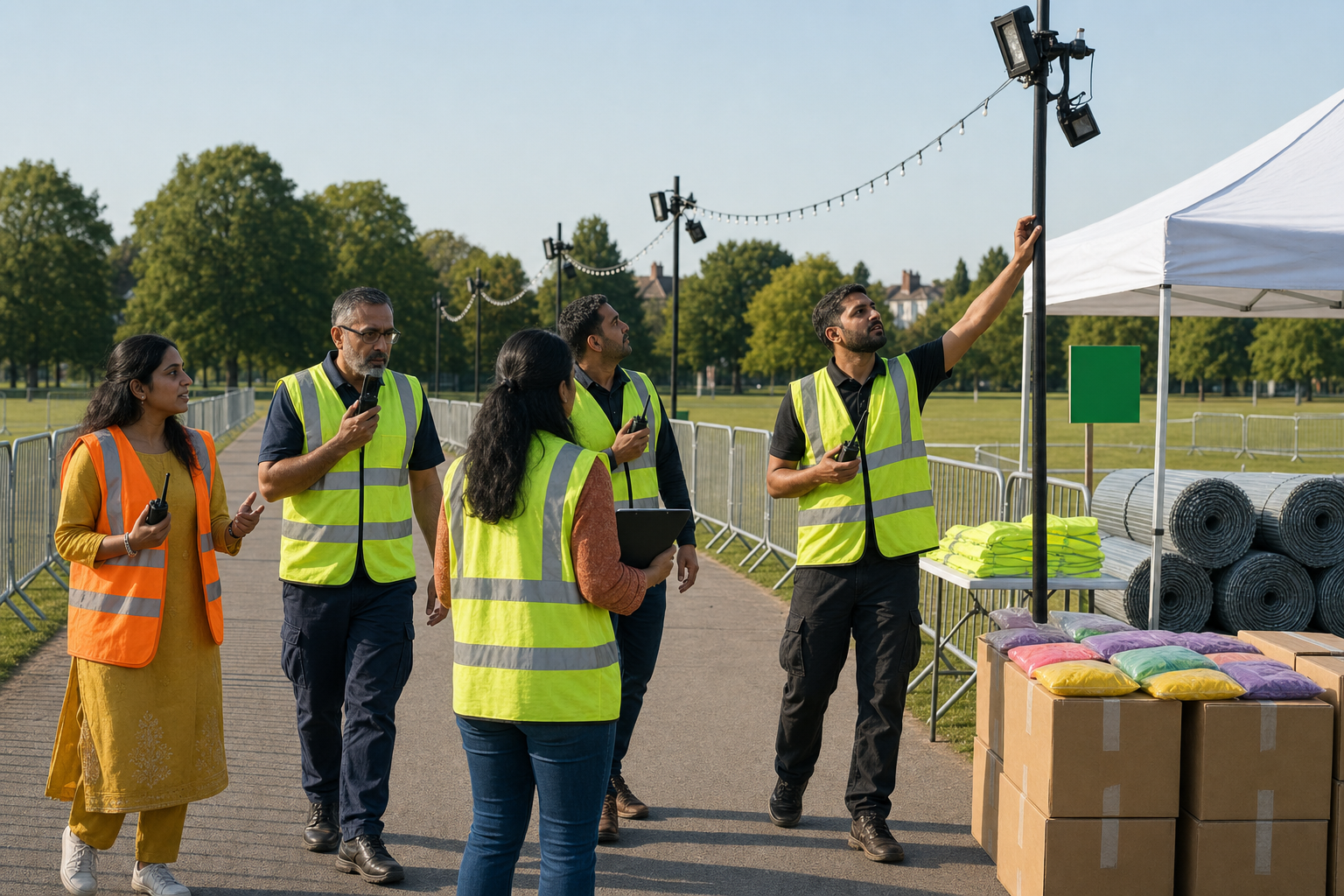
- Recruit stewards for defined posts and functions. Name an event-control lead, entrance supervisors, roaming teams, stage liaison, medical liaison, evidence lead, and communications lead. Mark who may ask someone to leave, who contacts police, and who can pause or end the programme. Volunteers should guide, observe, report, and de-escalate; physical intervention should be left to people trained and authorised for that role.
- Test the system in the actual venue. Run a walk-through while music is playing. Test radios and the public-address system from the noisiest and most crowded points. Confirm that control can see entrances, the busiest play zone, and exit routes. Where police support uses Silver and Bronze command roles, record which event-control role can reach them and through which channel.
Established UK event-safety material can turn this planning into a competent operating document. The Health and Safety Executive framework and the Events Industry Forum’s Purple Guide cover matters such as crowd movement, temporary structures, fire, power, and contingencies. ACT Awareness training from the National Counter Terrorism Security Office and crowded-place guidance from the National Protective Security Authority can strengthen steward awareness. These resources do not replace local advice or competent specialists, but they give organisers a common operational language.
Pay particular attention to barriers. A barrier can protect a stage or guide a queue, but poorly placed barriers can also create a pressure point or block a natural escape path. Do not improvise their layout on the morning of the event. Plot expected movement, test the route with stalls and equipment in position, and keep the final arrangement under the control of the event manager.
Give stewards a calm sequence for the first five minutes

A short disturbance becomes more dangerous when several well-meaning people issue conflicting instructions. Your plan should establish a simple sequence that stewards can remember under pressure.
- Verify the behaviour. The nearest steward should report what is happening, where it is happening, how many people appear directly involved, and whether anyone is injured or carrying a weapon. Labels such as suspicious, extremist, or hostile are too vague to guide a response.
- Create space. Move children, elders, and bystanders away from the immediate confrontation without causing a rush toward one exit. A soft corridor of visible stewards can preserve movement and lines of sight while allowing the rest of the gathering to remain calm.
- Use one speaker. A designated steward should give a short conduct-based instruction, such as identifying the pushing or harassment that must stop and directing the person toward a quieter location. Several volunteers surrounding and arguing with someone can turn a manageable incident into a crowd spectacle.
- Escalate according to conduct. Contact event control and police through the agreed channel when behaviour crosses the written trigger. Do not delay because the programme is popular or because organisers fear reputational damage. Equally, do not escalate solely because someone appears not to belong to the expected audience.
- Keep exits and emergency routes clear. Stewards not directly handling the incident should manage crowd flow, watch for secondary confrontations, and stop spectators from forming a ring around the scene.
- Log decisions as they happen. Record the time, location, instruction given, response, escalation, and name or call sign of the responsible steward. The log should distinguish what a steward personally saw from what another person reported.
- Make a deliberate restart decision. Event control should decide whether to resume, pause, relocate an activity, or close the event. Do not let the programme drift back into operation while the team is still uncertain about the risk.
A pre-written public announcement will prevent improvisation. It need only tell people that the programme is paused, ask them to keep routes clear, direct them to follow steward instructions, and promise a further update through the official channel. It should not announce a suspected motive, religion, or criminal classification.
If you are attending rather than organising, move yourself and dependants toward a stewarded space, keep exits open, and report direct observations to the event team. Recording may help only when it is safe and does not obstruct responders. Do not approach a confrontation for a better video, and do not add an identity or motive to a clip before investigators have established either.
Separate hate reporting from premature criminal claims

People often use hate incident and hate crime as if they mean the same thing. They do not. A hate-related incident can be recorded when a victim or witness perceives hostility connected to a protected characteristic. A hate crime requires an underlying criminal offence and sufficient evidence for the relevant criminal threshold. Recording a victim’s perception is therefore legitimate, but it does not predetermine a charge or conviction.
This is why a good incident form needs separate fields. If one box mixes behaviour, identity, motive, and legal conclusion, the resulting record will be harder to investigate and easier to dispute.
- Write down observable acts: blocking, pushing, threatening gestures, thrown objects, damage, attempts to enter a restricted area, or refusal to follow a lawful event instruction.
- Record exact words as accurately as possible. Put paraphrases and exact recollections in different fields so they cannot be confused later.
- Note the time, precise location, direction of movement, and where each witness was standing.
- Describe individuals using relevant observable features. Do not convert clothing, skin colour, language, or appearance into an assumed religious identity.
- Record injuries, property damage, missing property, medical assistance, steward actions, and police contact.
- Record separately whether the victim or witness perceived anti-Hindu or other protected-characteristic hostility, and why.
- Obtain witness contact details with consent and note whether photographs, recordings, or nearby CCTV may exist.
Preserve the original evidence. Export relevant CCTV before routine retention processes erase it. Keep untouched originals of videos and photographs, note their file names and time information, and record who received each copy. Do not crop, caption, enhance, or repeatedly re-encode the only version. If a short extract is needed for communication, make it from a copy and retain the original separately.
A viral upload is not an evidence strategy. Public circulation can expose children and uninvolved attendees, encourage online identification of the wrong person, and attract inflammatory commentary before police have collected statements. Give investigators access through established reporting routes, including the national police True Vision portal where a hate-related report is appropriate, and request victim support when someone has been threatened, injured, or seriously distressed.
Post-incident communication should be brief and factual. Confirm that an incident occurred, say whether anyone required assistance, explain that evidence is being preserved or supplied, identify the next formal step, and state when another update will appear. One multilingual event channel, coordinated with police communications where appropriate, is safer than several committee members posting different interpretations.
Turn demands for stronger protection into measurable action
OFBJP UK has called for an inquiry and stronger security following Harrow. That demand should become a specific, time-bound review rather than a general promise to be more vigilant. The Metropolitan Police, the council’s Safety Advisory Group, organisers, and suitably independent community observers can each contribute without displacing the police investigation.
Ask the review to answer concrete questions:
- Did the risk assessment include deliberate disruption, harassment, and crowd reaction, or only accidents and medical emergencies?
- Were entrances, exits, barriers, colour-play zones, and steward posts positioned as shown in the approved plan?
- Could stewards reach event control and police quickly, and did they know the threshold for doing so?
- Did CCTV and direct observation cover the relevant area, and was footage preserved promptly?
- Were incident logs contemporaneous, factual, and consistent enough to support investigation?
- Did public communication correct misinformation without prejudging identity, motive, or guilt?
- Which corrective action belongs to the organiser, venue, council, contractor, or police liaison, and by what agreed completion date?
The corrective plan should survive beyond the next news cycle. Track near misses as well as completed offences. Run response drills. Review whether stewards stayed in their assigned positions. Ask families whether they knew where to seek help and whether they felt able to report hostility. A falling number of reports does not automatically prove that risk has fallen; it may also mean people no longer believe reporting will lead to action.
Community liaison is another protective layer, but it must have a purpose. Before Holi, Ram Navami, Vaisakhi, or Diwali, invite representatives from temples, gurdwaras, Jain and Buddhist centres, schools, youth clubs, mosques, and neighbourhood groups to walk the site and understand the safety plan. Reciprocal volunteering can enlarge the steward pool and make it harder for outsiders to portray a local festival as a communal boundary. Participation should be invited, trained, and role-based; no neighbour should be treated as responsible for controlling every person who may claim the same faith.
You do not have to choose between resisting intimidation and rejecting collective blame. A clear pro-Hindu position demands equal protection for Hindu worship and celebration, prompt investigation of suspected hostility, care for affected families, and consequences supported by evidence. It also refuses to turn an allegation against individuals into suspicion of an entire religious population. That combination is not weakness. It is how a community protects both its rights and the credibility of its demand for justice.
Before your next public festival, choose the incident lead, approach the council about SAG engagement, walk every crowd route, test the radios and announcements, and give each steward a written escalation card. Hindu festivals remain genuinely open when their organisers prepare for disruption, defend participants lawfully, and make evidence stronger than rumour.
References
