

If you are planning a pilgrimage to Tirupati or Tirumala in March 2026 because you want to attend an Asthanam, one distinction will prevent most of the confusion: the Ugadi observance at Sri Govindaraja Swamy Temple in Tirupati has a clear date of 19 March, while Tirumala’s Ugadi, Sri Ramanavami, and Sri Rama Pattabhisheka observances follow a tithi-based sequence whose final timings and access arrangements depend on TTD.
Plan this as a pilgrimage through two temples and four related observances, not as one interchangeable festival program. Once you know which Asthanam answers your devotional purpose, you can choose the right day, allow for altered darshan operations, and understand what is happening when the Lord’s court assembles.
Put the four observances in the right order
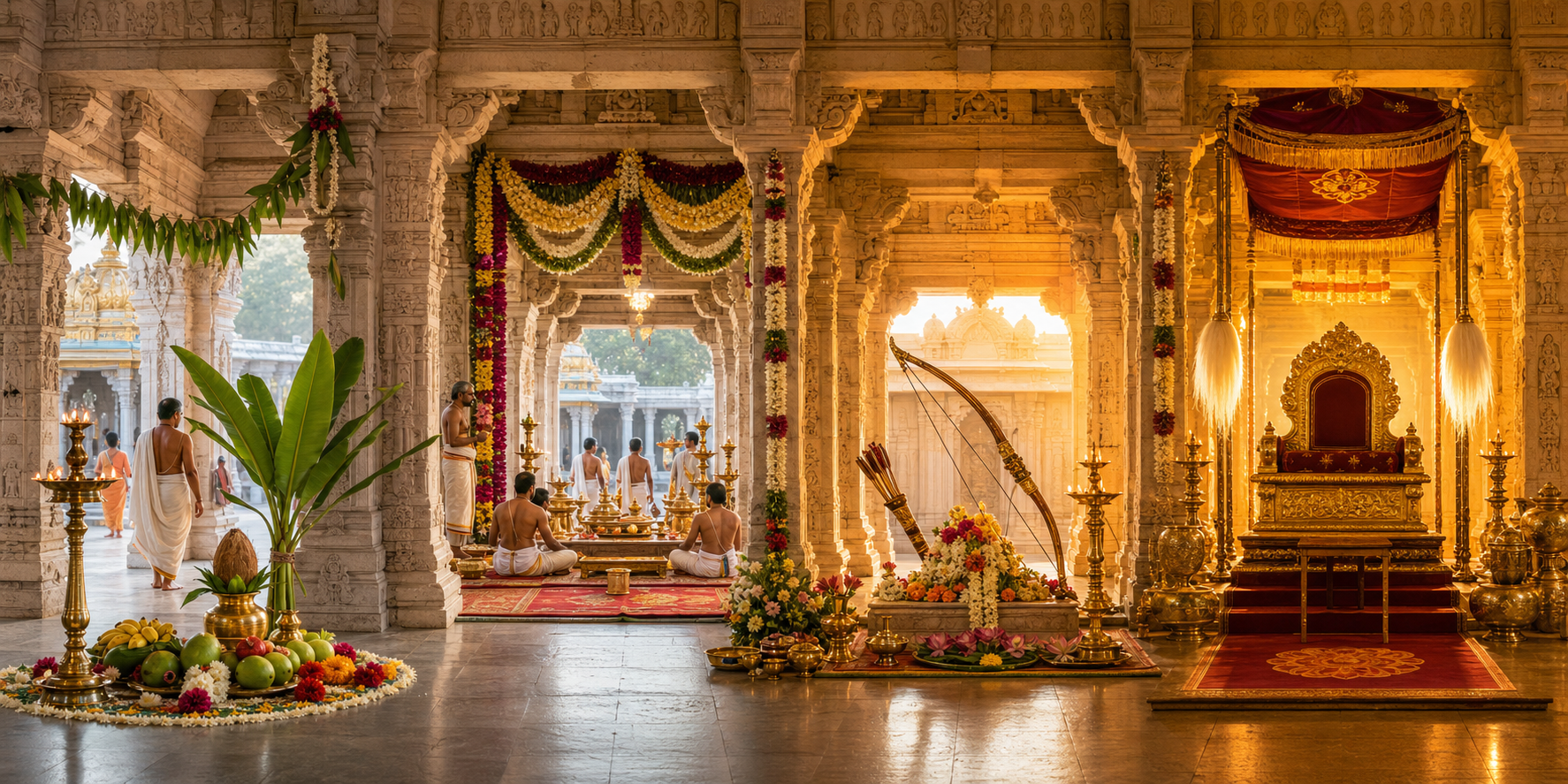
The firm Gregorian anchor is the Ugadi Asthanam at Sri Govindaraja Swamy Temple on 19 March 2026. At Tirumala, the liturgical order is Ugadi on Chaitra Shukla Pratipada, Sri Ramanavami on Chaitra Shukla Navami, and Sri Rama Pattabhisheka ordinarily on the following Dasami. Treat those tithis as the religious anchors and the final TTD notice as the operational authority for Gregorian dates, session times, entry instructions, and seva changes.
| Shrine | Observance | Calendar anchor | What to plan around |
|---|---|---|---|
| Sri Govindaraja Swamy Temple, Tirupati | Ugadi Asthanam | 19 March 2026 | Morning worship and Panchanga Sravanam, followed by the evening Panchanga Sravanam and Asthanam |
| Sri Venkateswara Swamy Temple, Tirumala | Ugadi Asthanam | Chaitra Shukla Pratipada | The new samvatsara, Panchanga Sravanam, and the Lord’s ceremonial court |
| Sri Venkateswara Swamy Temple, Tirumala | Sri Ramanavami Asthanam | Chaitra Shukla Navami | Sri Rama’s birth-tithi and the contemplation of dharma in action |
| Sri Venkateswara Swamy Temple, Tirumala | Sri Rama Pattabhisheka Asthanam | Typically Chaitra Shukla Dasami | The coronation of Sri Rama and the responsibilities of righteous rule |
This distinction matters when you are making travel commitments. If 19 March is your only available date, Sri Govindaraja Swamy Temple gives you the clearest event around which to plan. If Sri Ramanavami or Pattabhisheka is your priority, keep the Tirumala portion of the trip flexible until TTD confirms the schedule. A third-party calendar may identify a tithi, but it cannot tell you how TTD will integrate the Asthanam with the temple’s daily and weekly seva matrix.
If you want to attend more than one observance, do not assume that a single darshan arrangement covers the complete ritual program. Temple-court ceremonies, ordinary darshan movement, and any ticketed or restricted sevas are separate planning questions. Confirm each one in the final TTD instructions before making non-refundable arrangements.
Choose the Asthanam by the question you are bringing
The four observances share a Vaishnava courtly form, but they do not say the same thing. Ugadi concerns the responsible reception of a new cycle of time. Ramanavami places dharma before you in the life of Sri Rama. Pattabhisheka asks what legitimate authority looks like after victory has been won. Choosing by devotional purpose will give you more than choosing by whichever date happens to be convenient.
Ugadi: begin the year with worship and accountability
Ugadi 2026 inaugurates Parabhava Nama Samvatsaram. At Sri Govindaraja Swamy Temple, the morning sequence comprises Suprabhatam, Thomala Seva, Koluvu, Panchanga Sravanam, and Archana. In the evening, Panchanga Sravanam is heard again before the Ugadi Asthanam.
That progression is worth following as a single argument. Suprabhatam awakens the sacred day. Thomala Seva adorns the deity with garlands. Koluvu convenes the Lord’s court. Panchanga Sravanam places the coming year before that court. Archana then directs attention through the Lord’s names and the disciplined offering of flowers. What can appear to be a series of independent sevas is really a movement from awakening to order, and from order to personal sankalpa.
Koluvu also carries a practical ethical lesson. The traditional aaya-vyaya, or income-and-expenditure, account is presented before the deity. For a devotee, this makes Ugadi an appropriate time to review more than aspirations. Look honestly at how you used money, time, authority, and trust during the previous cycle. Then make one commitment for Parabhava Samvatsaram that can actually be examined next Ugadi.
During Panchanga Sravanam, listen for the five limbs of the panchanga: tithi, vara, nakshatra, yoga, and karana. The recitation may also address planetary transits, eclipses, and regional muhurtas. You do not need to record every prediction. Note the samvatsara name, any guidance that affects your household or community, and the dates that require interpretation by a trusted elder or panchanga scholar. This keeps the almanac connected to dharmic time stewardship instead of reducing it to private fortune-telling.
Sri Ramanavami: measure conduct against Maryada Purushottama
The Sri Ramanavami Asthanam turns from calendrical renewal to Sri Rama as Maryada Purushottama. The focus is the birth-tithi of the avatara whose life holds duty, restraint, justice, compassion, and fidelity together even when those obligations become difficult.
If this is the Asthanam you plan to attend, prepare with a small and definite act of Ramayana remembrance. Read or hear a manageable passage before the visit; Sundara Kanda is one traditional avenue noted for this season. Then carry one question into the temple: where has convenience begun to displace maryada in your own duties? A precise question will help you receive Ramanavami as instruction rather than as festival atmosphere alone.
Pattabhisheka: see coronation as a demand upon power
Sri Rama Pattabhisheka Asthanam ordinarily follows Ramanavami and recalls Rama’s coronation. Its central idea is not triumphal power. It is rightful sovereignty governed by satya, restraint, service, and concern for the welfare of others.
You do not need to hold public office for that teaching to apply. A parent, employer, teacher, volunteer, elder sibling, or trustee exercises authority over some part of another person’s life. Before attending, identify one such responsibility and one standard by which you will make it answerable to dharma. That turns the language of Rama Rajya from a political slogan into a discipline of conduct.
Read the Asthanam as the Lord’s court
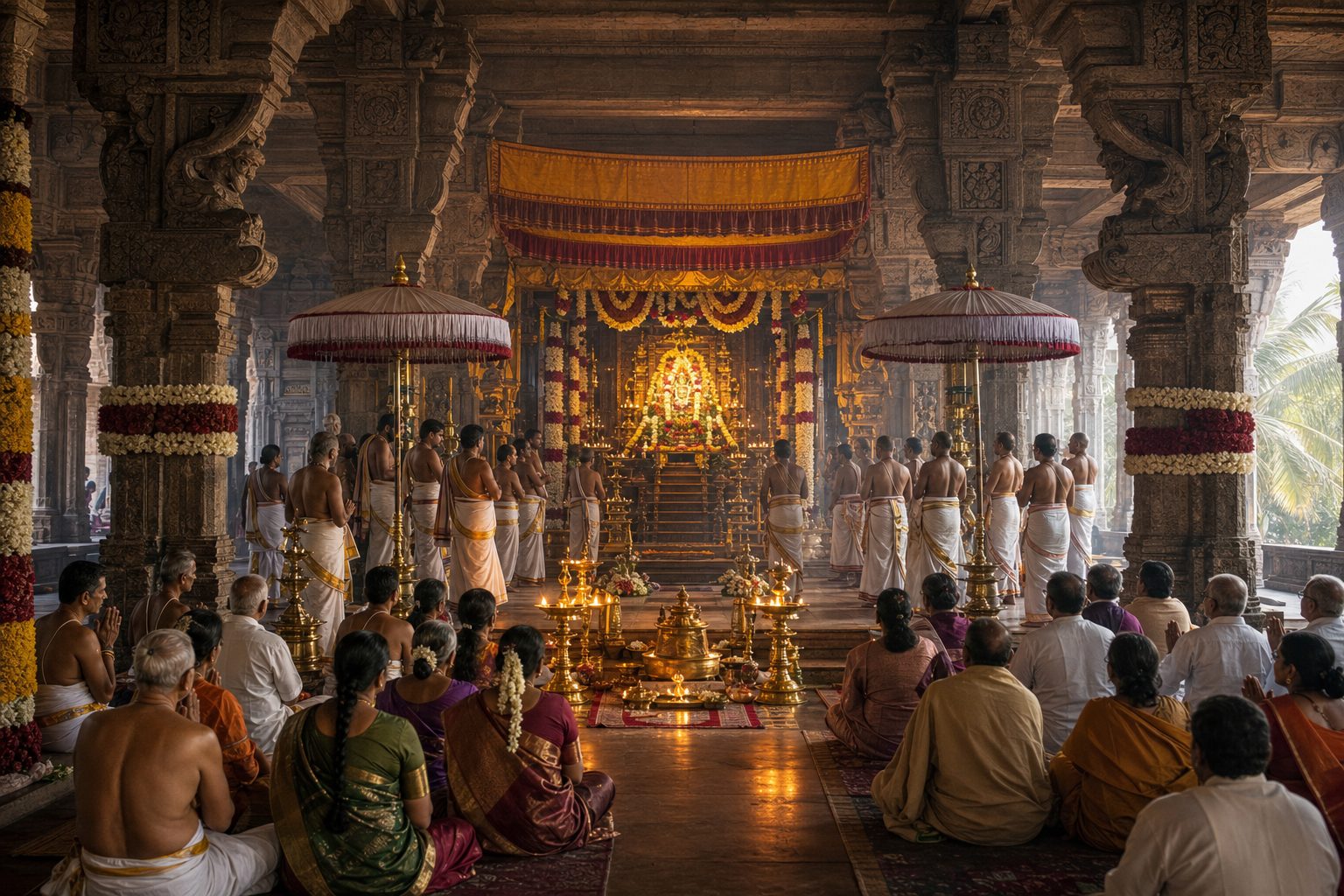
Asthanam means a formal temple-court sitting. At Tirumala, Malayappa Swamy with Sridevi and Bhudevi is ceremonially enthroned before the Garudalwar Sannidhi. The Lord is received as sovereign, the temple becomes His court, and devotees stand within an ordered relationship of seva and saranagati.
This is why the enthronement is the ritual center. Vedic recitation, the sound of the conch, temple music, special naivedyam, ceremonial honor, and deepa-harati support the courtly encounter. Regalia such as the chatra and chamara are not decorative additions. They make visible the claim that sovereignty ultimately belongs to the divine and that human authority must remain answerable to dharma.
Garuda’s position sharpens that meaning. As Vishnu’s vahana and exemplary servant, Garuda places steadfast seva directly before the enthroned Lord. The spatial relationship asks you to see devotion not as passive admiration but as loyal, disciplined service.
Both Tirumala and Sri Govindaraja Swamy Temple follow Vaikhanasa Agama, but you should not transfer every ritual detail from one shrine to the other. Tirumala’s court centers on its Utsava Murthis and the Garudalwar Sannidhi. The Tirupati observance unfolds through Sri Govindaraja Swamy Temple’s own sequence of daily worship, Koluvu, Panchanga Sravanam, Archana, and evening Asthanam.
It is also useful to distinguish an Asthanam from an abhishekam. Tirumanjanam has its own important places in temple practice, but the defining action here is ceremonial enthronement and courtly honor. If you arrive expecting a bathing ritual, you may miss the actual theological center unfolding in front of you.
Plan around festival operations, not an ordinary darshan day
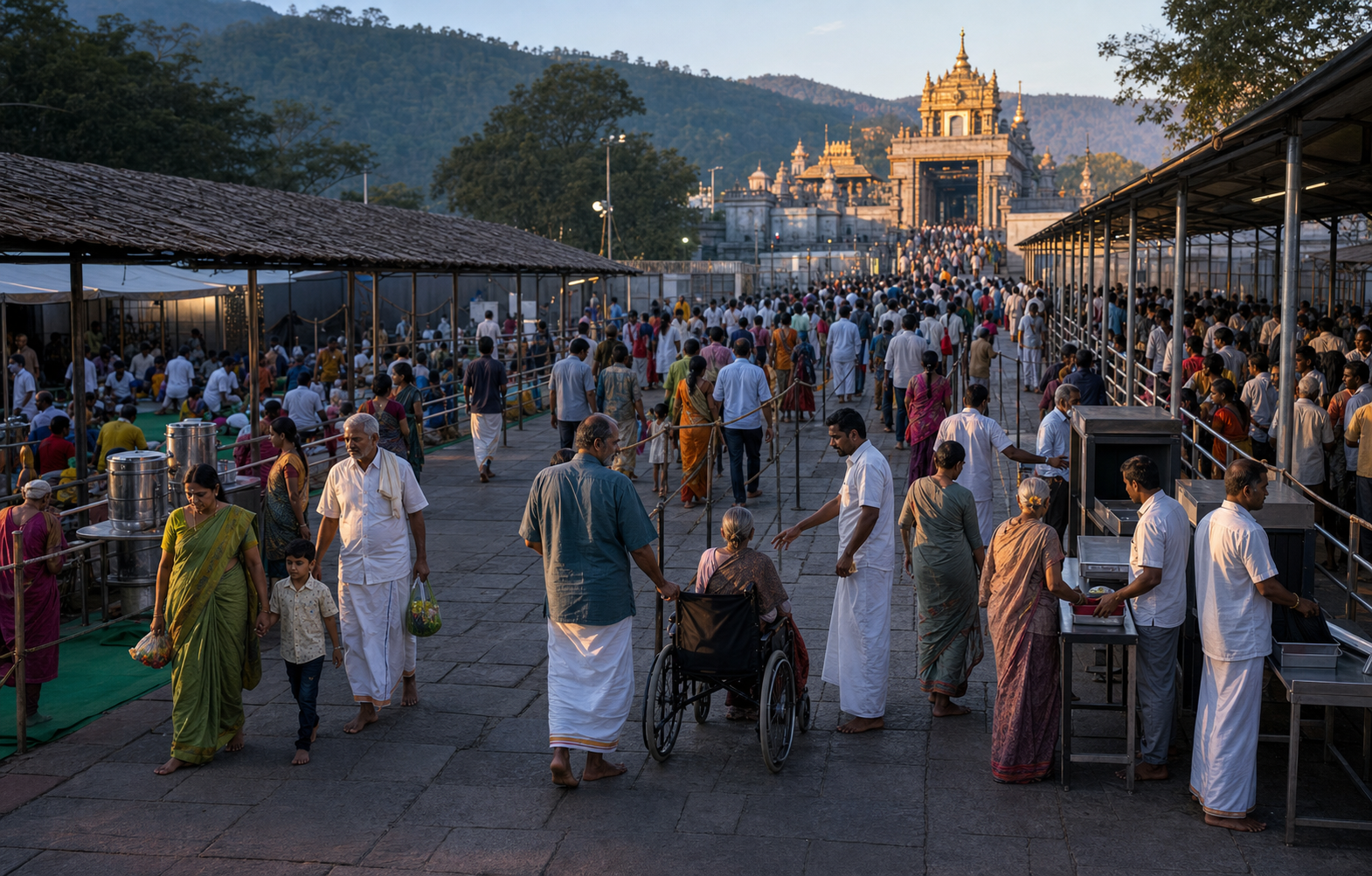
Asthanam days sit inside a functioning temple calendar. At Tirumala, darshan patterns may be adjusted and some sevas may be curtailed, advanced, or rescheduled. Queue diversions and other crowd controls can also change how you move through the complex. Sri Govindaraja Swamy Temple can receive substantial Ugadi footfall as well.
- Select the observance first. Choose Ugadi for the new year and Panchanga Sravanam, Ramanavami for Rama’s birth-tithi and ethical example, or Pattabhisheka for the dharma of authority.
- Separate the Tirupati and Tirumala plans. Record the shrine name beside every event. Similar terminology does not mean the ceremony occurs at the same location or follows an identical sequence.
- Use TTD’s final notice for operations. Recheck the date, time, venue within the temple, entry advisory, and affected sevas close to the event. Do this again before departure if your travel arrangements cannot be changed.
- Build time around the ritual, not just the darshan slot. Arrive early enough to follow on-site directions without rushing. Do not promise yourself an uninterrupted view until TTD has clarified how devotees will be admitted or routed.
- Prepare for the people travelling with you. If elders or children are accompanying you, allow additional buffer for queues and diversions. Arrive hydrated, wear clothing consistent with current temple requirements, and carry only items permitted under the applicable rules.
- Protect the atmosphere of worship. Follow queue instructions, keep conversation restrained during recitation, and let the prescribed liturgy set the pace. An Asthanam is a court in which you participate through attention and seva, not a performance whose value depends on obtaining the closest position.
If your main goal is ordinary darshan rather than the festival court, be candid about that when choosing a day. Core Asthanam hours can bring altered seva patterns and concentrated footfall. If the court itself is your reason for travelling, accept a slower darshan day and leave margin around it. Trying to maximize both speed and ritual proximity usually creates the wrong expectations.
For a one-day visit on 19 March, Sri Govindaraja Swamy Temple offers a coherent Ugadi arc from the morning services to the evening Asthanam. Do not assume, however, that every component will be equally accessible from one position or under one entry arrangement. Follow TTD’s on-site announcements if the sequence or crowd routing changes.
Key takeaways for your March pilgrimage
- The fixed Tirupati date is 19 March 2026 for Ugadi Asthanam at Sri Govindaraja Swamy Temple.
- Tirumala’s order is Ugadi, Sri Ramanavami, and then Sri Rama Pattabhisheka; use the relevant tithi for religious orientation and TTD’s final notice for practical scheduling.
- Ugadi asks you to begin Parabhava Nama Samvatsaram with both sankalpa and accountability, especially through Koluvu and Panchanga Sravanam.
- Ramanavami directs attention to Sri Rama’s disciplined performance of dharma; Pattabhisheka applies that discipline to authority and governance.
- The defining action of an Asthanam is the Lord’s ceremonial court and enthronement, not an abhishekam.
- Festival rituals can alter darshan and seva operations, so confirm the shrine, time, entry conditions, and schedule changes before committing to a rigid itinerary.
Choose the court you most need to stand in, then prepare one concrete sankalpa before you go. When March arrives, let TTD’s final instructions settle the logistics and let the Asthanam settle the harder question: how you will carry the Lord’s order into the part of life entrusted to you.
References
- DharmaRenaissance Blog – Ugadi Asthanam 2026 at Sri Govindaraja Swamy Temple, Tirupati: Rituals, Panchanga, Devotee Guide
- DharmaRenaissance Blog – Tirumala’s Sacred March 2026 Asthanams: Ugadi, Sri Ramanavami & Pattabhisheka – A Complete Guide
