
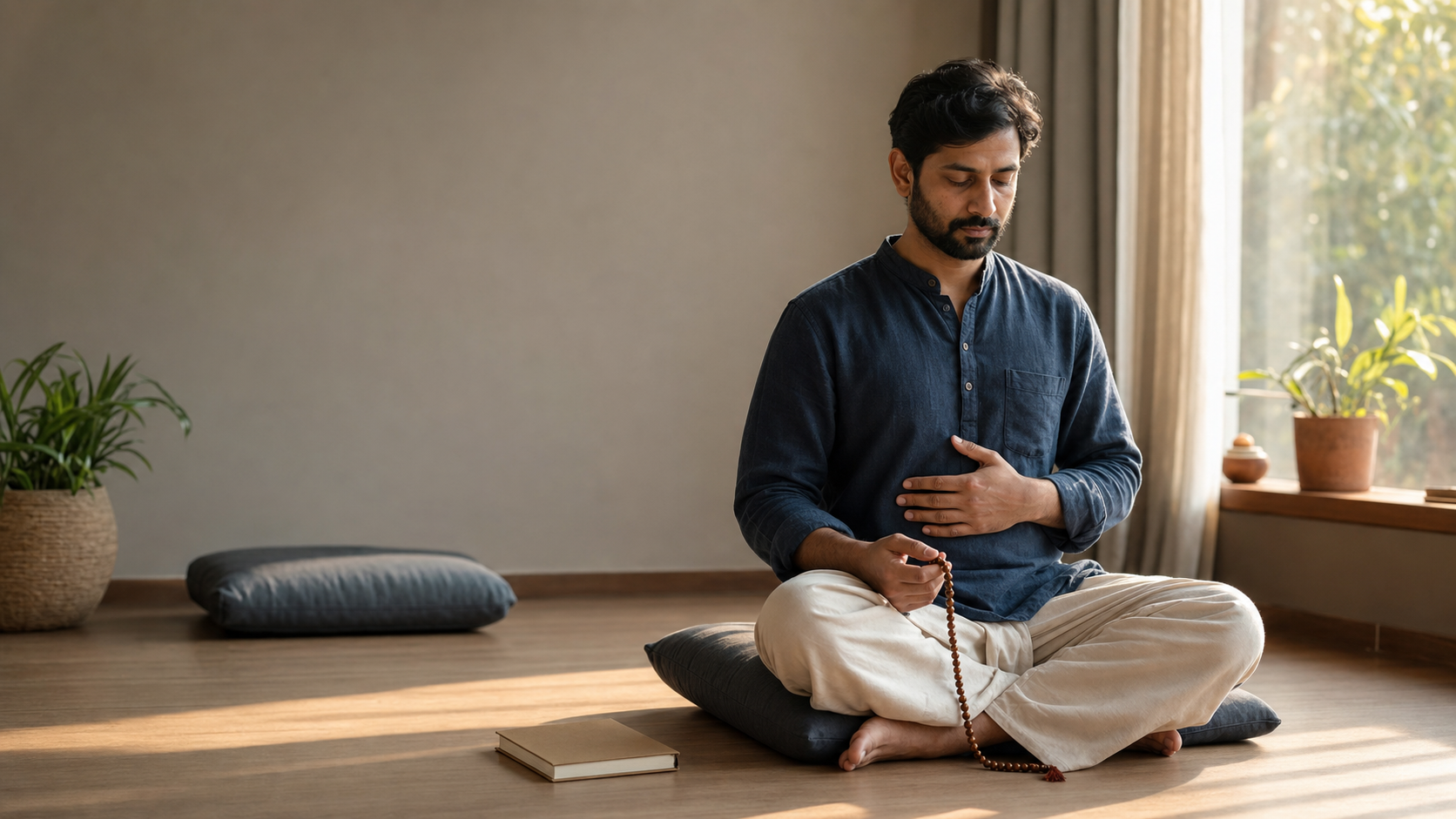
If stress has made your breath shallow, your attention scattered, or your sleep unreliable, you probably don’t need another demanding self-improvement project. You need a practice simple enough to use on a difficult day and deep enough to change the habits that keep recreating the strain.
A Dharmic approach can give you that structure. Begin with a repeatable core of slow breathing and steady attention, then bring ethical reflection, mantra, meditation, community, and seva into the places where stress actually enters your life. The aim isn’t to suppress every uncomfortable feeling. It is to recover enough steadiness to see clearly, choose well, and act without being driven by every surge of rajas or collapse into tamas.
First, distinguish activation from the habits that renew it

Stress is not merely a thought in your head. When perceived demands exceed your regulatory capacity, the response can involve sympathetic arousal, the hypothalamic-pituitary-adrenal axis, inflammatory signalling, muscle tension, and disrupted breathing. If that activation becomes chronic, it can burden sleep, mood, executive function, and the brain’s threat-detection systems.
Yoga adds a second level of diagnosis without denying the external problem. Citta-vritti describes the movements that keep the mind churning. The kleshas name recurring distortions such as avidya, asmita, raga, dvesha, and abhinivesha: misperception, egoic fixation, grasping, aversion, and fear-driven clinging. Samskaras make familiar reactions easier to repeat. Rajas accelerates the cycle; tamas obscures or immobilizes; sattva supports clarity and proportion.
These concepts should not become a way of blaming yourself for illness, injustice, grief, overwork, or a genuinely unsafe environment. An external demand may need a boundary, a repair, or practical help. Inner practice addresses the additional suffering created when the nervous system remains mobilized after the immediate demand has passed, or when an old reaction begins directing a new situation.
Before choosing a technique, take one quiet minute to notice where the cycle is strongest:
- Body: Are your jaw, throat, shoulders, abdomen, or hands braced even though no immediate physical action is required?
- Breath: Is it high in the chest, irregular, repeatedly held, or difficult to release without force?
- Attention: Are you repeatedly rehearsing the same threat, argument, or future scenario without discovering anything new?
- Conduct: Is the strain being renewed by an unspoken truth, an avoidable commitment, compulsive consumption, or a repair you know you need to make?
Choose the most obvious entry point. A restless body may need movement before stillness. A looping mind may need mantra rather than more analysis. Overstimulation calls for pratyahara. Stress rooted in conduct will not be resolved by breathing alone.
Build a repeatable 20-minute core practice
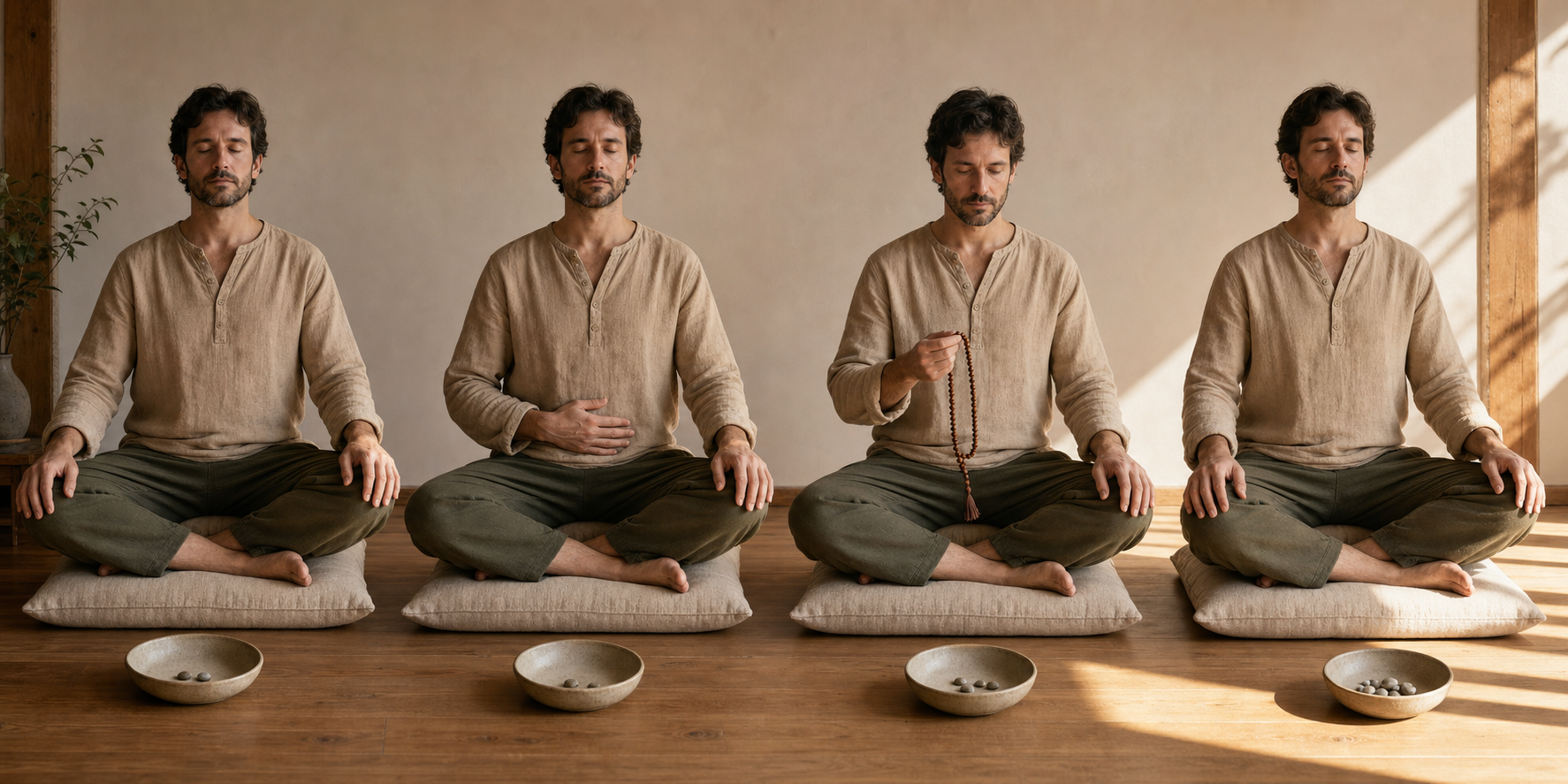
The most useful routine is not the most elaborate one. It is the one you can repeat without bargaining with yourself. Start with a 20-minute core: ten minutes of comfortable diaphragmatic breathing followed by ten minutes of dharana, or deliberate placement of attention.
- Reduce avoidable input. Put the phone out of reach, choose a stable seat, and soften unnecessary effort in the face, hands, and abdomen. If closing your eyes makes you less settled, keep them open with a relaxed gaze.
- If the body is too agitated to sit, begin with slow, mindful asana. Gentle spinal flexion and extension, supported forward folds, and other comfortable movements can help restore proprioceptive and interoceptive awareness. Do not push into pain or treat flexibility as the purpose.
- Breathe diaphragmatically for ten minutes. Move gradually toward approximately five to six breaths per minute only if that rate remains easy, with the exhalation slightly longer than the inhalation. Keep the breath quiet and unforced. If you become dizzy, air-hungry, panicked, or more agitated, return to ordinary breathing and stop the exercise.
- Continue with ten minutes of dharana. Use one anchor: the natural breath, a mantra or divine name from your tradition, an Ishta, or simple formless awareness if that is your established path. When attention wanders, notice it and return without an argument. The return is the repetition that trains you.
- Before rising, choose one expression of the practice in conduct: truthful but non-harming speech, restraint from an unnecessary purchase, gratitude, an overdue apology, study, prayer, or a concrete act of service.
Slow breathing at a comfortable pace can strengthen respiratory sinus arrhythmia and baroreflex regulation, supporting a more balanced relationship between sympathetic and parasympathetic activity. Vagal pathways also connect breathing with brain systems involved in arousal and attention. This is why a few minutes of breath regulation can change the conditions under which meditation occurs; you are not merely telling an activated mind to become calm.
Meditation then trains a different capacity. Instead of trying to eliminate every thought, you strengthen the ability to recognize distraction and return deliberately. With regular practice, contemplative training is associated with better attentional regulation, less rumination, and more accurate awareness of bodily signals. Randomized trials and meta-analyses have reported small-to-moderate improvements in perceived stress, anxiety symptoms, sleep quality, and resilience. That is a meaningful but modest claim: these practices can complement appropriate care, not replace it.
Do not turn heart-rate variability, breath rate, or the absence of thoughts into a spiritual grade. A physiological measure can help you observe regulation, but it cannot measure devotion, wisdom, or liberation. The practical test is whether you recover more readily after a trigger and behave with greater clarity once you do.
Match the Dharmic doorway to the form of stress

Hindu, Buddhist, Jain, and Sikh disciplines share important structures, but they are not interchangeable wellness products. Hindu japa and dhyana, Buddhist satipatthana and shamatha-vipassana, Jain samayik and pratikraman, and Sikh simran and seva retain distinct lineages, teachings, and sacred meanings. Their practical convergence lies in training attention, reducing harmful reactivity, clarifying conduct, and turning inner steadiness toward compassionate action.
| What you notice | Useful doorway | What to do differently |
|---|---|---|
| Your body is restless and sitting feels like confinement | Mindful asana before pranayama | Let movement discharge unnecessary bracing, then sit. Do not answer agitation with forceful breathwork. |
| Your mind keeps replaying one verbal loop | Japa, Naam Simran, or dharana on one phrase | Choose one lineage-consistent mantra or sacred name and keep it unchanged for the session. Repetition reduces the number of decisions competing for attention. |
| Your attention is fragmented by constant inputs | Pratyahara | Create a quiet transition before practice and reduce late-evening screens. Reclaiming attention begins before you sit down. |
| You feel isolated, emotionally constricted, or unable to sustain practice alone | Kirtan or another appropriate form of communal recitation | Join a participatory gathering where meaning, pronunciation, and context are respected. Shared rhythm and vocalization can support affiliation as well as attention. |
| The stress comes from conflict between your conduct and your values | Yama, niyama, pratikraman, sila, or seva | Name one specific contradiction and make one repair. Physiological calming without ethical correction leaves the generator of stress in place. |
Kirtan is especially useful when solitary regulation has become another burden. Call-and-response chanting coordinates voice, breathing, rhythm, and attention while allowing participation without musical expertise. Group singing and synchronized clapping can foster interpersonal synchrony and affiliation, while repetition reduces cognitive load. In a Dharmic setting, however, those mechanisms do not exhaust its meaning. Kirtan is also remembrance, devotion, shared sacred language, and the cultivation of community.
If you want to start a small local circle, use a clear structure. A 60-to-90-minute gathering can include arrival silence, breath settling, two or three mantras at comfortable tempos, progressive chanting, and a short closing meditation. Provide transliteration and meaning, rotate leadership, and value sincere participation over performance polish. Make seating accessible, leave a quiet area for sensory-sensitive participants, and explain the context when including prayers from another Dharmic tradition.
Protect the voice as carefully as the intention. Use clear but unforced pronunciation, open vowels, gentle resonance, and a pitch that ordinary participants can sustain. Alternate full-voice singing with softer participation, hydrate, and rest when the throat tightens. Louder is not necessarily more devotional, and strain does not deepen concentration.
Progress for eight weeks without making practice another pressure
Abhyasa means steadiness over time, not a dramatic beginning. An eight-week progression gives the body and attention time to adapt while showing you which elements are actually sustainable. Keep the sequence modest, and do not compensate for a missed day by doubling the next session.
Weeks 1-2: Establish the floor
- Practice ten to fifteen minutes of comfortable diaphragmatic breathing.
- Sit for ten minutes with the breath, a mantra, an Ishta, or another established contemplative anchor.
- Record one daily yama or niyama observation. Ahimsa in speech and santosha through specific gratitude are practical starting points.
- Reduce late-evening screen exposure so pratyahara becomes part of the routine rather than an idea added after meditation fails.
During these first weeks, do not keep changing techniques. You are learning how your system responds to repetition, not shopping for the strongest sensation.
Weeks 3-4: Add breath and concentration skills
- If it is comfortable and appropriate for you, introduce three to eight minutes of gentle Nadi Shodhana without breath retention.
- Add three to five minutes of easy Bhramari, using a soft humming exhalation rather than throat pressure.
- Extend dharana to twelve to fifteen minutes.
- Include two restorative asana sessions each week.
Nadi Shodhana and Bhramari are refinements, not tests of endurance. Do not force the nostrils, prolong an exhalation into distress, or add retentions merely because a more intense version sounds advanced. If you have a relevant health condition, remain with ordinary comfortable breathing until a qualified clinician and an appropriately trained teacher have advised you.
Weeks 5-6: Consolidate meditation and seva
- Practice twenty minutes of meditation daily if the earlier duration is stable and beneficial.
- Choose one weekly act of seva that is specific enough to complete.
- Include metta or karuna cultivation so regulation does not become self-enclosure.
Seva matters because stress can narrow the field of concern until every event is interpreted through personal threat. Appropriate service restores relationship and agency. It should not become self-erasure, compulsive rescuing, or an excuse to remain in an exploitative situation. Ahimsa applies to the practitioner as well as to the recipient.
Weeks 7-8: Personalize without losing the structure
- Select the devotional form, sacred phrase, or formless focus that you can practice with integrity.
- Refine the time and setting so the routine fits your actual obligations.
- Use three calming breaths before a difficult call, a 60-second gentle Bhramari pause between tasks, or compassionate reframing during conflict.
- Keep the full daily practice as the foundation. Micro-practices are bridges, not replacements for sustained training.
By the eighth week, the important question is not whether every session felt peaceful. Ask whether you notice activation sooner, return more deliberately, sleep or concentrate more reliably, and carry less avoidable harm into speech and action. Those changes are closer to Dharmic resilience than a temporary altered state.
Key takeaways and the safety limits that matter

- Begin with ten minutes of comfortable diaphragmatic breathing and ten minutes of one-pointed attention; consistency matters more than intensity.
- Match the method to the pattern: movement for bodily agitation, mantra for verbal rumination, pratyahara for overstimulation, kirtan for supported communal practice, and ethical repair when conduct is sustaining the stress.
- Use approximately five to six breaths per minute only as a comfortable direction, never as a quota. Normal breathing is the safe fallback when strain appears.
- Treat mantra, meditation, and kirtan as sacred disciplines within their lineages, not merely as techniques for manipulating the nervous system.
- Use Dharmic mind-body practice alongside appropriate medical or psychological care, never as a reason to delay it or discontinue it.
Modify early when intensity is the problem
If you have a severe trauma history, stillness, closed eyes, or intense inward attention may increase distress. Trauma-informed pacing can include eyes-open practice, orienting to the room, shorter periods, and movement before seated meditation. Stop when a method leaves you more flooded, detached, or unable to function; forcing your way through is not tapas.
People with bipolar-spectrum or psychotic disorders should coordinate with a qualified clinician before intensive contemplative or breath practices. Strong stimulatory techniques and breath retentions are often unsuitable. Pregnancy, glaucoma, uncontrolled hypertension, certain arrhythmias, and other cardiovascular vulnerabilities can also require modification. The governing principle is ahimsa: adapt the practice to the person rather than forcing the person into the practice.
Seek clinical assessment when symptoms are severe, worsening, or persistently disrupting sleep, work, relationships, or basic functioning. Do not stop prescribed medication or therapy because a contemplative routine feels helpful. Dharmic practice can strengthen your participation in care; it is not a substitute for diagnosis or treatment.
Track function, not spiritual performance
If you want a structured view of change, assess yourself at baseline, week four, and week eight. The Perceived Stress Scale, Hospital Anxiety and Depression Scale, and Pittsburgh Sleep Quality Index are established instruments for tracking relevant domains, though they do not provide a self-diagnosis. Optional heart-rate-variability readings from a validated wearable can add a physiological trend, but no single reading should govern your interpretation.
Keep the daily log brief: technique, minutes practiced, your state before and after, sleep quality, and any adverse response. Look for patterns. If one practice repeatedly increases agitation while another supports steadier functioning, that is a reason to modify the routine, not evidence that you have failed spiritually.
Choose your anchor tonight and prepare the place where you will sit. Tomorrow, practice ten minutes of easy breathing and ten minutes of return to that anchor. Keep the core unchanged for two weeks. Once it is safe and repeatable, let abhyasa deepen it into clearer conduct, steadier remembrance, and service.
References
- DharmaRenaissance Blog — On the Banks of Mother Ganga: Immersive Kirtan, Mantra Science, and Dharmic Unity in Rishikesh
- DharmaRenaissance Blog — Yoga and Psychological Stress Relief: Evidence-Based Pathways to Calm, Clarity, and Resilience
