

If you are deciding when to perform puja, begin a course of study, undertake important work, or keep a Sashti observance, the date alone is not enough. Monday, March 23, 2026 has two distinct ritual windows: Shukla Paksha Panchami continues until 21:18 IST, followed by Shukla Paksha Sashti.
That 21:18 boundary gives you the basic plan, but it does not give every city the same ready-made muhurat. Sunrise, sunset, solar noon, Rahu Kalam, Choghadiya, Nakshatra, Yoga, and Karana must still be checked for your location. Here is how to use the day without confusing an India-wide tithi time with a city-specific auspicious interval.
The date has two different ritual windows
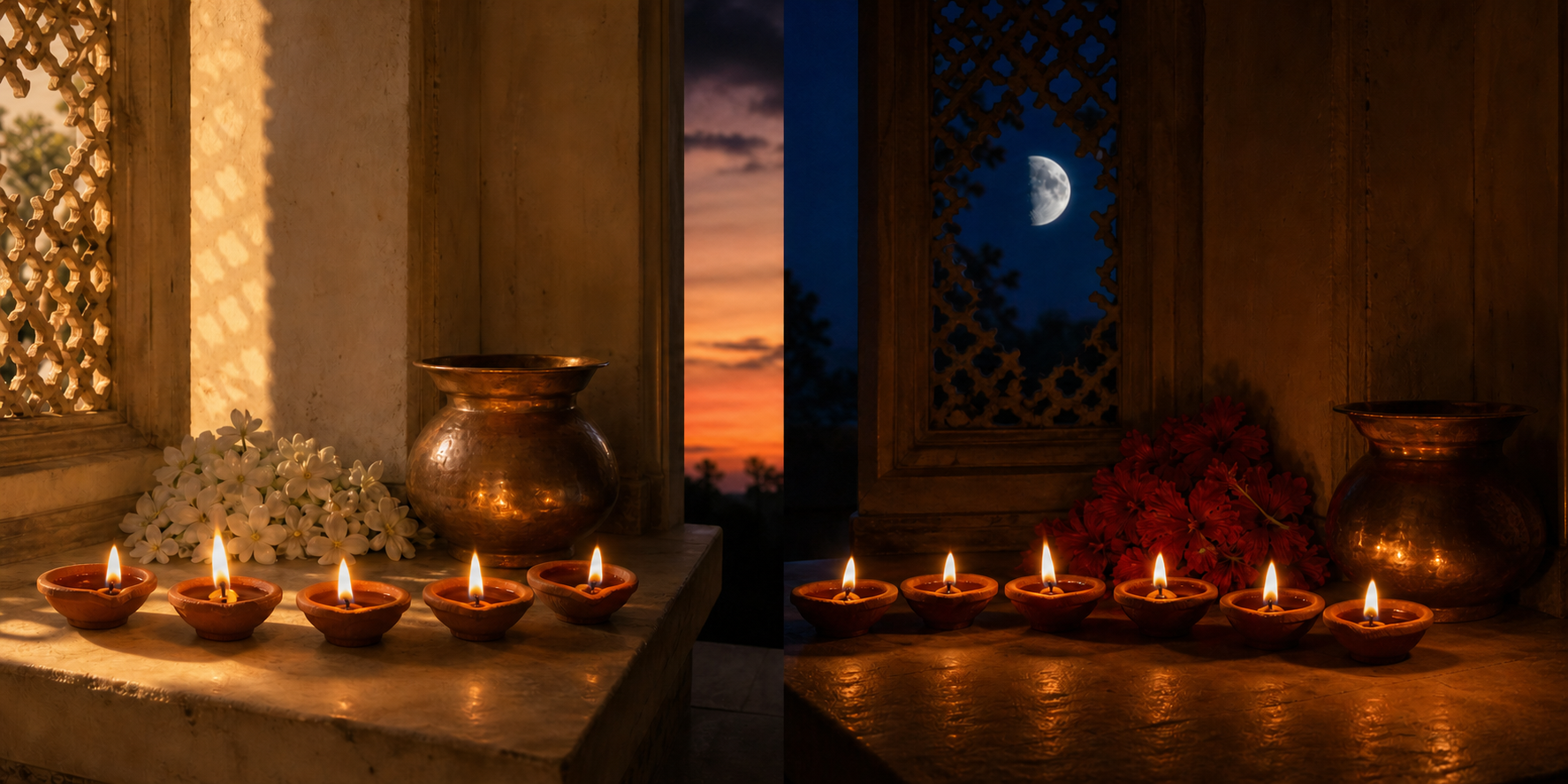
A tithi is an astronomical division, not a civil date running from midnight to midnight. Each tithi corresponds to another 12-degree step in the angular separation of the Sun and Moon. Thirty such divisions make a synodic lunar month. This is why Panchami can end at 21:18 rather than at sunrise, sunset, or midnight.
The stated boundary is appropriate for general planning in most regions of India. A local almanac can differ by a few minutes because its calculations account for location. If a temple rite, vrata, sankalpa, or family ceremony depends on the exact boundary, use the time published for the city where the observance will actually occur.
Key takeaways
- Shukla Paksha Panchami prevails through most of Monday, March 23, ending at 21:18 IST.
- Shukla Paksha Sashti begins at 21:18 IST, so Sashti-oriented worship may begin after that transition.
- Panchami is the practical daytime framework for study, recitation, japa, household worship, charity, and moderate beginnings.
- A Sashti vrata governed by the sunrise tithi will generally be observed on the following civil day, subject to local sampradaya rules.
- Rahu Kalam, Gulika Kalam, Yamaganda, Abhijit Muhurat, and Choghadiya must be calculated from local sunrise and sunset rather than copied from another city.
Plan the day around the 21:18 tithi change
The simplest useful plan is to match the work to the tithi that is actually operating when you begin it. Do not treat the whole civil date as Panchami merely because Panchami prevails at sunrise, and do not treat the whole evening as Sashti before its astronomical start.
| Period | Prevailing tithi | Best practical use | What still needs checking |
|---|---|---|---|
| From sunrise until 21:18 IST | Shukla Paksha Panchami | Study, recitation, japa, household worship, charity, and moderate undertakings | Local Rahu Kalam, Gulika Kalam, Yamaganda, Nakshatra, Yoga, Karana, and any personal considerations |
| After 21:18 IST | Shukla Paksha Sashti | Subrahmanya or Kartikeya upasana, disciplined spiritual practice, and preparation for a Sashti vrata | Whether the observance follows the tithi-start, sunrise, or another rule used by your sampradaya |
Panchami is especially well suited to work that grows through attention rather than spectacle. If you have postponed a scripture-reading discipline, language lesson, memorisation practice, family recitation, or ordinary home puja, choose a defined period before 21:18 and complete the first session within it. A small undertaking with a clear beginning fits the character of the day better than a vague intention to start sometime.
For an activity lasting across the boundary, distinguish its formal beginning from its later continuation. If the opening sankalpa or initiation must occur under Panchami, do not schedule it a few minutes before 21:18. Allow enough margin for the essential opening act to be completed before the tithi changes, using the locally verified end time rather than relying on the general IST figure.
After 21:18, the emphasis can shift toward Sashti and Kartikeya worship. That does not automatically make the late evening the principal fasting day. The start of a tithi and the civil date selected for a vrata are related questions, but they are not always the same question.
Build a muhurat from your city’s sunrise
A useful daily Panchang combines five limbs: Tithi, Vara, Nakshatra, Yoga, and Karana. Monday supplies the Vara and 21:18 IST supplies the general Panchami-to-Sashti boundary, but neither one produces a complete muhurat by itself. Use the following sequence so that a convenient clock time is not mistaken for an auspicious one.
- Record the exact city and obtain its local sunrise and sunset for March 23. If you are outside India, use your own location and time zone rather than reading 21:18 as local clock time.
- Find Rahu Kalam, Gulika Kalam, and Yamaganda from a location-specific Panchang. These periods are based on eight equal divisions of the daylight interval, so their clock times move when sunrise and sunset move.
- Locate local solar noon if you need Abhijit Muhurat. Its commonly used span is approximately 24 minutes on either side of solar noon, not automatically 24 minutes on either side of 12:00 on the civil clock.
- If your tradition uses Choghadiya, identify a daytime or nighttime Shubh, Laabh, or Amrit interval and then remove any portion overlapping the inauspicious filters.
- Confirm Nakshatra, Chandra Rashi, Yoga, and Karana for the proposed start time. These can change during the civil day and cannot be inferred from the tithi alone.
- Apply the rules of the intended rite. A general daily muhurat should not replace the more exact requirements of a marriage, samskara, vrata, or temple ceremony.
Why the familiar Monday Rahu Kalam may be wrong for you
With an illustrative sunrise of 06:00 and sunset of 18:00, the daylight period is twelve hours and each eighth lasts ninety minutes. In that simplified example, Monday Rahu Kalam is commonly shown as approximately 07:30 to 09:00. Those numbers are valid only for that assumed twelve-hour day. If your local sunrise or sunset differs, the segment shifts as well.
The same caution applies to Gulika Kalam and Yamaganda. Copying a schedule prepared for Delhi, Mumbai, Chennai, Toronto, or another city may move your chosen beginning into a period you meant to avoid. Start with the local daylight interval; do not start with a memorised clock time.
Use Abhijit as a fallback, not a universal override
Abhijit Muhurat can be useful when an urgent or essential action cannot be placed in a more tailored auspicious window. First find local solar noon, then check the approximate 48-minute interval centred on it against the day’s other restrictions. Many traditions do not use Abhijit as a shortcut for marriage or certain samskaras, so a midday label should not overrule the requirements of the rite.
Refine the candidate time with the remaining Panchang limbs
Nakshatra and Chandra Rashi depend on the Moon’s precise position. If the undertaking is personal or consequential, compare the day’s lunar placement with your Janma Nakshatra and Chandra Rashi instead of treating a generally favourable interval as equally suitable for everyone.
Yoga is derived from the combined longitudes of the Sun and Moon, while Karana divides a tithi into halves. Many traditions favour Yogas such as Siddha, Subha, or Dhriti and avoid Vyatipata or Vaidhriti for sensitive beginnings. Bava, Balava, Kaulava, and Taitila Karanas are commonly preferred over Vishti, also known as Bhadra. Read the actual Yoga and Karana from a trusted local Panchang because their transition times cannot be recovered from the 21:18 tithi boundary alone.
Your final interval should therefore survive several filters at once: it should suit the purpose, fall under the intended tithi, avoid the restricted periods used by your tradition, and agree with the local Nakshatra, Yoga, and Karana. If no interval satisfies every preference, ask which rule your family, guru, or temple treats as decisive rather than combining incompatible conventions on your own.
Let the ritual rule choose the civil date
The most common mistake on a transition day is to assume that a tithi beginning at night must make that same civil date the vrata day. Hindu observances use several decision rules. The correct one depends on the vrata and the sampradaya, not merely on when the tithi first appears on a clock.
- For daily puja, study, recitation, or a moderate beginning: use Panchami until its locally confirmed end near 21:18 IST.
- For Sashti-oriented prayer after the tithi begins: the late evening after 21:18 can be used for Kartikeya or Subrahmanya upasana and preparation.
- For a vrata governed by the sunrise tithi: Panchami, not Sashti, prevails at sunrise on March 23. The principal Sashti observance will therefore generally fall on the following civil day.
- For a vrata using a vyapini rule: follow the date on which the required tithi has the effective or prescribed prevalence. The precise application belongs to the observance’s own tradition.
- For a temple or inherited family practice: follow that established calendar even when a general-purpose Panchang app displays a different civil-date label.
This distinction lets you honour both parts of the day without creating a false choice. You can use Panchami constructively during Monday, acknowledge the start of Sashti after 21:18, and still keep the main sunrise-based vrata on the date recognised by your community.
Do not let the lunar month name create a second dispute
Regional calendars may give the date different month labels. Purnimanta calendars, common in North India, reckon lunar months from one Purnima to the next. Amanta calendars, common in South India, reckon them from one Amavasya to the next. March 23 may consequently appear as late Phalguna or early Chaitra depending on the convention, while the underlying Panchami-to-Sashti progression remains the same.
When relatives or community members use different calendars, compare the tithi, transition time, location, and observance rule before deciding that one calendar is wrong. A different month name may reflect a different reckoning system rather than a different astronomical day.
Before fixing your schedule, write down four things: your location, local sunrise and sunset, the locally verified Panchami end time, and the rule governing your intended rite. Then choose the interval. That short check will do more for accuracy than copying a complete-looking timetable made for somewhere else.
References
