
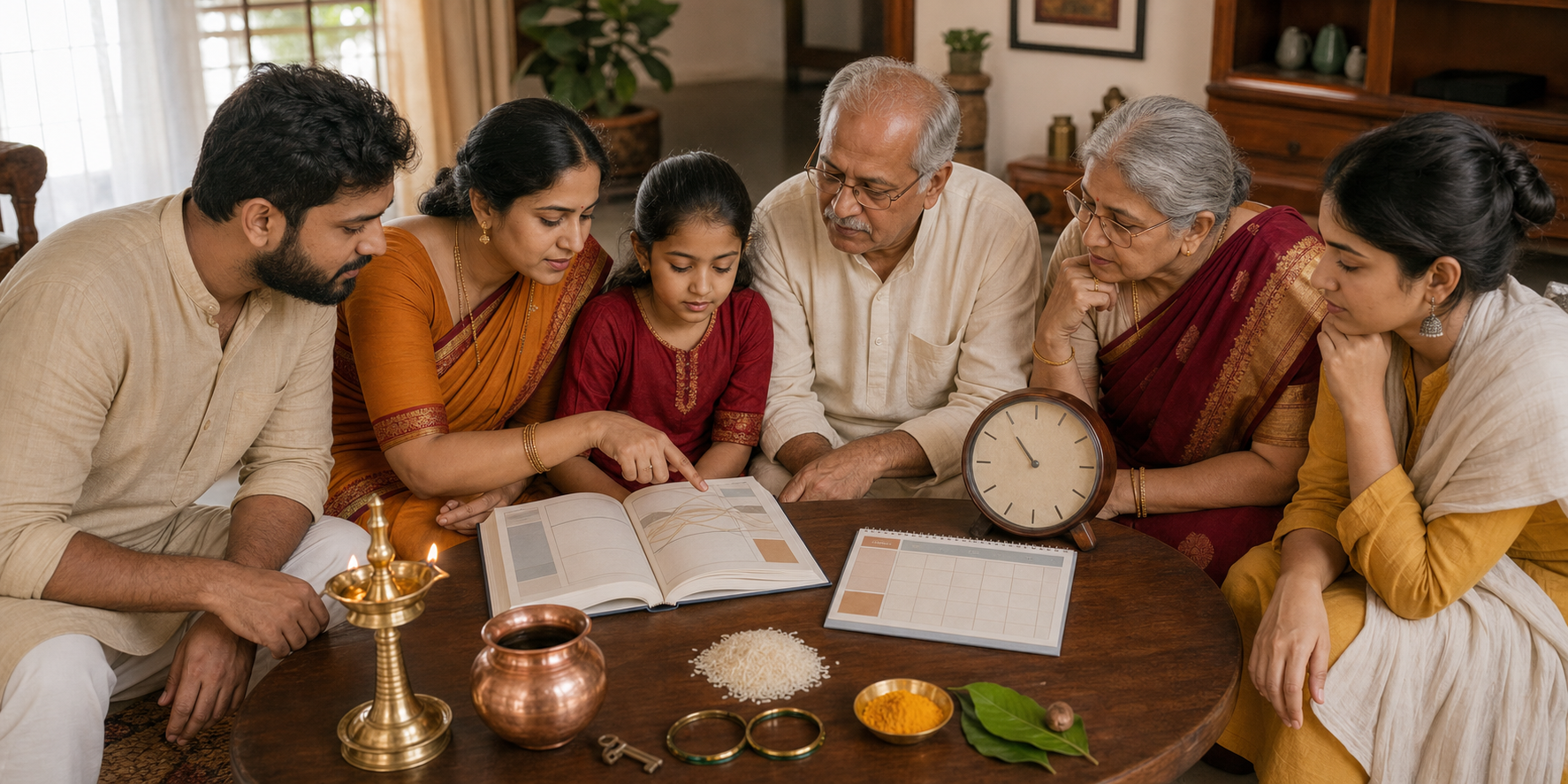
You may already have a wedding month, a nearly finished home, or relatives asking for a ceremony date. Then someone opens a Marathi Panchang, points to a promising day, and another person rejects it because the Tithi ends early, Bhadra is present, or the listed time belongs to a different city.
The way through that confusion is to stop treating a shubh date as an all-day approval. You need an event-specific interval, calculated for the place where the rite will occur and checked against your family’s parampara. Here is how to build a practical shortlist without pretending that a general Panchang can settle every personal question.
Before looking at dates, fix four inputs
A Panchang cannot answer an underspecified question. Asking for a good day in May is not enough. The rules used for Vivah, Griha Pravesh, Upanayan, Mundan, Ekadashi parana, and a festival puja are not interchangeable.
- Name the exact rite. A house may require Vastu Shanti, the first formal entry, or both. Confirm with the officiating purohit which action must occur inside the muhurta.
- Name the exact place. Record the town or city where the ceremony will happen, not the family’s ancestral village or the city where the person consulting the calendar lives. Sunrise, sunset, moonrise, and daylight-based intervals depend on location.
- Name the governing tradition. Gotra, shakha, sampradaya, family custom, and the practice followed by the chosen purohit can change which combinations are accepted. Write these down before comparing dates.
- Separate fixed constraints from preferences. School holidays, venue availability, travel, construction completion, and the presence of elders are logistical constraints. They help rank acceptable muhurta options; they do not turn an unsuitable interval into a suitable one.
This first pass also prevents a common and expensive mistake: paying a non-refundable venue or vendor deposit before the family-specific check is complete. Shortlist from the Panchang, obtain ritual confirmation, and only then convert the shortlist into a commitment. If an early booking is unavoidable, seek a refundable hold covering more than one candidate date.
Think of the general Panchang as a community-level filter. It can identify promising windows and obvious exclusions. A family priest or astrologer, where your tradition requires one, then considers the personal and lineage-specific factors that a general calendar cannot encode.
Read the five limbs as changing intervals, not labels

The word Panchang points to five working elements: Tithi, Vara, Nakshatra, Yoga, and Karana. You should read them together with local sunrise and sunset. A promising Nakshatra does not rescue an unsuitable Tithi, and a favorable civil date does not mean the required combination lasts throughout the day.
| Element | What it identifies | What you should record |
|---|---|---|
| Tithi | The lunar day | Its start and end times, and whether the relevant Tithi is present at the sunrise or ritual moment required for the observance |
| Vara | The weekday | The weekday at the ceremony location and whether your event rules treat it as supportive |
| Nakshatra | The lunar mansion | The exact interval during which the desired Nakshatra operates |
| Yoga | A division derived from the combined angular positions of the Sun and Moon | Whether the Yoga remains acceptable for the full ritual action |
| Karana | Half of a Tithi | The Karana at the operative moment, with special attention to Vishti or Bhadra where your rite avoids it |
Copy the boundary times onto your planning sheet. Do not merely write Panchami or a Nakshatra name. Write, for example, that the required element ends at the listed local time. The useful unit is an interval, because the main ritual action must fit inside the overlap of acceptable conditions.
The Marathi system uses Amanta month reckoning, from one Amavasya to the next. Purnimanta calendars used in parts of northern Bharat label their lunar months differently, even though major observances generally converge on the same underlying Tithi. If two relatives use different regional calendars, compare the Tithi and its timing before concluding that the festival itself differs.
For the 2026-2027 cycle, the Maharashtra calendar should identify Parabhava Nama Samvatsara and Shalivahana Shaka 1948. Its ceremonial year opens with Chaitra Shukla Pratipada and Gudi Padwa on March 19, 2026; the next year begins on April 6, 2027. These details help you confirm that you have opened the correct annual edition rather than a page from an adjacent year.
Turn Panchang data into an event-specific shortlist

Use a sequence of filters. First apply the broad rules for the rite. Then find the overlap of acceptable Tithi, Nakshatra, Yoga, and Karana. After that, remove any cautionary intervals your tradition observes, including Rahu Kalam, Yamaganda, Gulika Kala, or Vishti/Bhadra. Finally, apply location and personal considerations.
Do not reverse this order. Finding a convenient venue date and then searching for one favorable label on that day is confirmation bias, not muhurta selection. Likewise, Rahu Kalam alone is not a complete muhurta method. How strictly Rahu Kalam, Yamaganda, Gulika, Choghadiya, Tarabalam, or Chandrabalam is applied belongs to the relevant community and family practice.
Vivah: shortlist first, personalize second
Commonly considered Tithis for marriage include Dwitiya, Tritiya, Panchami, Saptami, Dashami, Ekadashi, and Dwadashi when they occur with a conducive Nakshatra and the other required conditions. That list is a starting filter, not permission to choose any occurrence of those Tithis.
Many Maharashtrian communities also avoid Chaturmasya and particular dosha-bearing combinations. Because those rules vary, ask the family priest to approve the date and the actual marriage interval, not merely the civil day. Give the venue the wider schedule, but tell the officiants and immediate family which central rite must occur within the approved window.
Griha Pravesh: distinguish readiness from consecration
First decide whether you are selecting a time for Vastu Shanti, for the household’s first formal entry, or for both in sequence. Vaishakh, Jyeshtha, and Magha are regarded as agreeable months in many Maharashtrian lineages, but the final choice still depends on the day-level and intra-day combination.
Do not let the builder’s handover date silently become the ritual date. Confirm that the home will be safe, accessible, and sufficiently complete before choosing the muhurta. Construction work, moving vehicles, and puja preparation should be scheduled around the sacred action rather than forced into its narrow interval. Where Vishti or Bhadra is avoided, verify the Karana at the time of entry and consecration.
Upanayan and Mundan: let lineage rules lead
Many traditions favor an Uttarayana period for Upanayan and spring to early summer for Mundan or Chudakarana. These are broad seasonal preferences. Gotra, shakha, family custom, and the guru’s direction decide how they are refined.
Ask the officiant to state the acceptable season, Tithi, Nakshatra, and any personal requirements before you present candidate dates. That produces a useful conversation. Asking only whether one already-booked Sunday is good puts logistics in command of the samskara.
Protect the observance from boundary and location errors
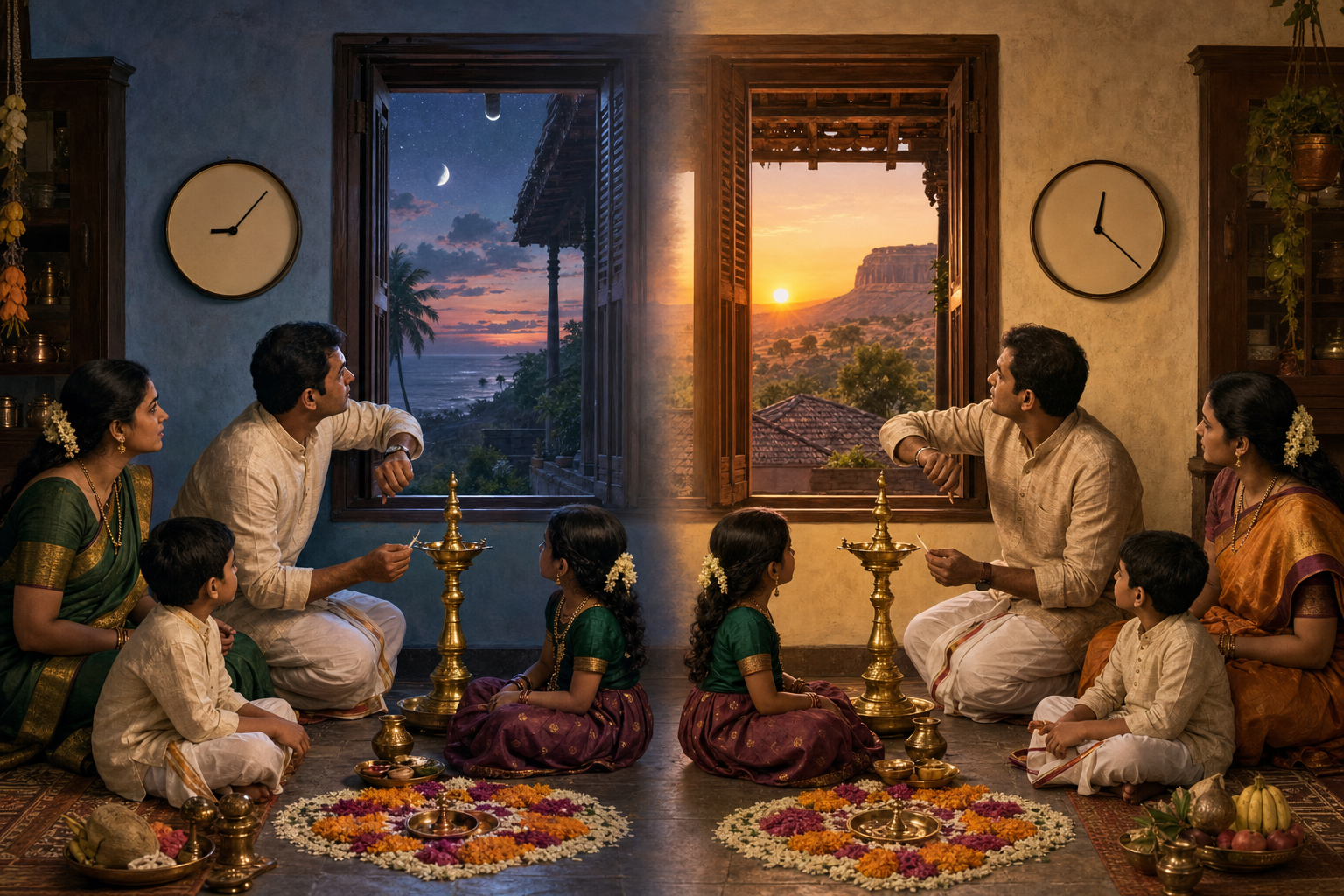
Most avoidable errors occur at a boundary: a Tithi ends before the expected ritual moment, a Nakshatra changes during the ceremony, moonrise belongs to another city, or the family mistakes the published start of a window for the time guests should arrive.
- Put the main act inside the core of the window. When the schedule permits, place it near the middle rather than against the opening or closing minute. This preserves room for ordinary delays and small computational differences.
- Keep setup outside the operative interval. Guest arrival, decoration, sound checks, cooking, photography, travel, and preliminary coordination can begin earlier. Identify the sacred action that actually needs the muhurta.
- Use times calculated for the ceremony city. A Maharashtra Panchang aligned to Indian Standard Time and regional sunrise conditions should not be copied unchanged for a ceremony in Toronto, London, Singapore, or another location. Keep the Marathi parampara, but use locally computed astronomical timings.
- Do not average conflicting publications. Small differences can arise from computational traditions and coordinate assumptions. Choose the Panchang and interpretive method accepted by the officiant, then use it consistently.
- Include the time zone in every family message. This is essential when relatives, planners, or priests are coordinating from different countries.
Vratas and festivals need their own trigger rules. Ekadashi observance depends on the Tithi around sunrise, while parana belongs to the appropriate interval on Dwadashi. Sankashti Chaturthi depends on locally relevant moonrise as well as the Tithi. A festival printed under one civil date cannot safely be moved to the nearest weekend merely because the family celebration is more convenient then; distinguish the prescribed observance from a separate social gathering.
The same discipline matters for Gudi Padwa, Ram Navami, Hanuman Jayanti, Akshaya Tritiya, Guru Purnima, Ganesh Chaturthi, Navaratri, Vijayadashami, Deepavali, Makar Sankranti, Maha Shivaratri, and Holi. First determine which Tithi or transition governs the observance. Then check how it relates to local sunrise, sunset, or moonrise. The civil date is the result of that rule, not its replacement.
This lunisolar grammar also reaches beyond one Hindu regional calendar. Vaishakh Purnima is important to Buddhist Vesak observance, Kartika Purnima aligns with Guru Nanak Jayanti in Sikh practice, and Bhadrapada timings shape Jain observances including Paryushan and Anant Chaturdashi. Shared astronomical markers do not erase the differences among traditions; they reveal a common civilizational rhythm expressed through distinct disciplines.
A repeatable planning method for your household
You do not need to perform the underlying astronomy yourself. You do need a clean handoff between the Panchang, the officiant, and the people managing the event.
- Create a one-page brief. Record the rite, city, time zone, family tradition, officiating priest, preferred date range, and immovable constraints.
- Take candidate dates from one regionally appropriate Panchang. For Maharashtra, confirm the Amanta calendar, correct Samvatsara, correct Shaka year, and local timing basis.
- Copy complete intervals. Record Tithi, Nakshatra, Yoga, Karana, sunrise, sunset, and every cautionary period your family applies. A screenshot of a single shubh label is not enough.
- Send several candidates for family-specific review. Include the exact place and ask which ritual action must occur within each approved interval.
- Rank only the approved options by logistics. Compare travel, elders’ needs, priest availability, venue availability, and the realistic duration of the rite.
- Choose the core rather than the edge. Build the event schedule backward from the central sacred action, leaving preparation and guest movement outside the critical interval.
- Issue one final timing note. State the civil date, city, time zone, muhurta interval, arrival time, puja start, and the action that must be completed within the window. Ask everyone to discard earlier drafts.
Key takeaways
- A shubh date is not automatically a shubh day from midnight to midnight.
- The useful muhurta is the overlap of event-appropriate Tithi, Vara, Nakshatra, Yoga, Karana, and locally calculated time conditions.
- A general Marathi Panchang creates the shortlist; family parampara and personal considerations refine it.
- Vratas and festivals may depend on sunrise, moonrise, or parana rules rather than the date printed most prominently.
- For a ceremony outside Maharashtra, retain the tradition but recalculate the timings for the actual location.
- Confirm the muhurta before making an irreversible booking, then schedule the principal rite near the center of the accepted window.
Open your Panchang with one real event in mind. Write down its place, governing tradition, and candidate range, then carry complete intervals to the person who will conduct the rite. That small change turns the almanac from a collection of auspicious labels into a reliable household practice of sacred time.
References
