

If you see India condemn the 7 October attacks, support later calls for humanitarian ceasefires, deepen cooperation with Israel, protect its Gulf partnerships and keep a route open to Iran, the policy can look contradictory. That impression usually comes from forcing every decision into a single question: Whose side is India on?
A better question is: Which Indian interest, legal principle or human obligation is this particular decision addressing? Once you separate counterterrorism, civilian protection, energy, diaspora welfare, trade, connectivity and domestic cohesion, the apparent contradictions form a recognisable strategy. This framework will help you judge that strategy without mistaking balance for indecision or moral clarity for alliance politics.
Begin with India’s constraint map, not a camp label
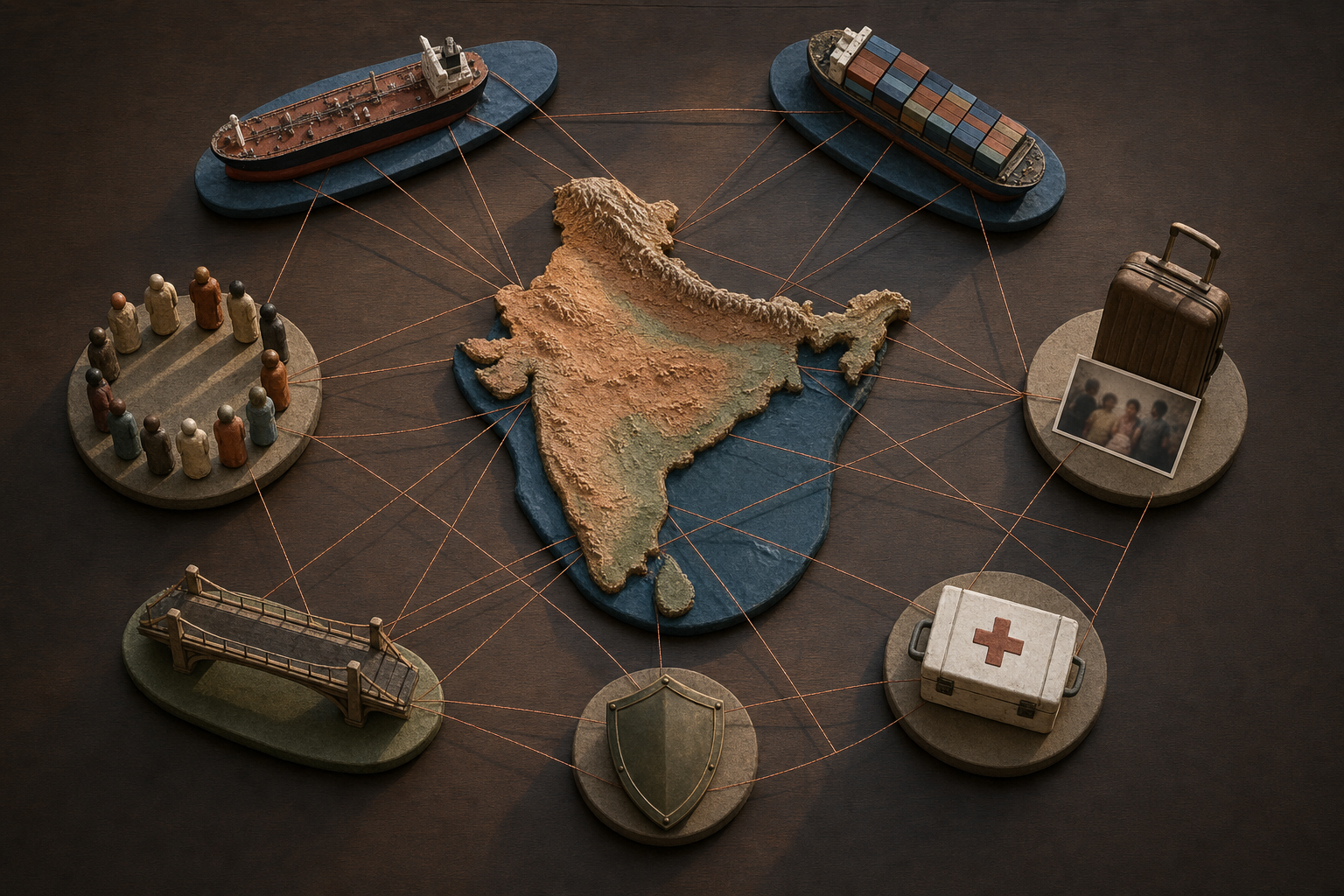
India does not approach the Middle East from a safe distance. A regional war can reach an Indian household through the fuel bill, a delayed shipment, a relative working abroad or a lost export order. That exposure places practical limits on theatrical diplomacy.
- Energy: India imports most of the crude oil it consumes, and roughly half of its crude imports have historically come from the Gulf, even as the supply basket diversified during 2023–2025. Qatar also provides a long-term liquefied natural gas pillar under an arrangement renewed until 2048. A disruption is therefore not an abstract diplomatic cost; global price movements can feed into domestic costs.
- People: Approximately nine million Indians live and work in the Gulf. Their safety, employment and remittances turn de-escalation into a direct national responsibility. A policy that sounds forceful in Delhi can become dangerous for an Indian nurse, technician, driver or construction worker in the region.
- Trade: The India–UAE Comprehensive Economic Partnership Agreement helped take bilateral commerce into the roughly $85 billion range in recent years. India–Saudi Arabia trade has remained above $50 billion, while India–Israel exchanges have hovered around $10 billion. These are different relationships serving different parts of India’s economy.
- Sea lanes: Attacks on merchant shipping in the Red Sea and Arabian Sea raise insurance costs, lengthen journeys and unsettle energy and container flows. Naval deployments associated with Operation Sankalp show why maritime security belongs at the centre of the policy, not at its margins.
- Continental access: Iran gives India a route toward Central Asia and Russia through Chabahar Port and the International North–South Transport Corridor. The ten-year Chabahar operating framework must be advanced while India manages sanctions exposure and the concerns of the United States and Gulf partners.
This map gives you a quick test for sweeping demands that India should simply cut off one country or join another bloc. Ask what would replace the affected energy, jobs, trade, technology, sea-lane access or continental route, and on what timetable. If an argument cannot answer that question, it is a slogan rather than a policy.
Key takeaways
- India’s balancing posture is structural: it follows from energy, people, commerce, shipping and connectivity.
- Israel, the Arab Gulf states and Iran do not perform interchangeable roles for India.
- Condemning terrorism and protecting civilians are compatible duties, not competing loyalties.
- Judge each Indian action by the problem it is designed to address, not by a single friend-or-enemy label.
Read India’s actions in the order of duties they perform

Foreign-policy confusion often begins when unlike actions are compared as though they were votes on the same proposition. A UN resolution, a relief shipment, a naval patrol, an evacuation and a bilateral technology agreement use different instruments for different purposes.
The sequence since October 2023 is instructive. India condemned the 7 October attacks as terrorism. It abstained on an early UN General Assembly resolution that did not explicitly denounce those attacks, then supported later resolutions calling for humanitarian ceasefires and aid access. It also sent medical and relief supplies to Gaza through Egypt while arranging evacuation and assistance for Indian nationals in Israel and the wider region.
That is more coherent when read as a sequence of duties:
- Name terrorism clearly. Political grievance does not convert attacks on civilians into legitimate resistance. If diplomatic language obscures that distinction, it weakens the norm India wants applied to terrorism directed at Indians as well.
- Separate perpetrators from civilian populations. Condemnation of a terrorist attack does not make every civilian on the other side responsible for it. This distinction is the foundation of credible humanitarian concern.
- Protect Indian nationals. Evacuation and consular assistance are not side issues. With millions of Indians tied to the region, citizen protection is one of the first tests of state capacity.
- Limit escalation and preserve essential flows. War that spreads across borders can endanger diaspora communities, energy supplies and merchant shipping even where India is not a combatant.
- Keep a political horizon open. India’s support for a negotiated two-state solution recognises that military action alone cannot settle the Israeli–Palestinian conflict.
You should therefore compare like with like. Compare a UN vote with other votes and the wording placed before India. Compare humanitarian assistance with actual civilian needs. Compare a naval deployment with the threat to shipping. Do not treat every diplomatic instrument as a secret referendum on whether India prefers Israel or Palestine.
This distinction also prevents two common errors. Support for lawful self-defence is not a blank cheque for harm to civilians. Support for a humanitarian ceasefire does not require silence about terrorism. A serious policy must be able to hold both lines at once.
Multi-alignment is not neutrality or equal approval
India’s Middle East relationships form a network, not a single alliance. Multi-alignment means working with several powers on specific interests while reserving the ability to disagree with each of them. It does not mean pretending that every actor, tactic or political demand is morally equivalent.
The Gulf states matter for energy, Indian livelihoods, investment, trade and regional stability. Israel matters for defence, agriculture, water technology and electronics; cooperation includes air-defence and unmanned-platform programmes. Iran matters for Chabahar and continental connectivity. None of these relationships can simply substitute for another.
That functional diversity is why a warm engagement with one partner does not automatically constitute hostility toward another. It is also why symbolic alignment with a regional camp could impose costs far beyond the immediate dispute. India gains room to protect its citizens, move aid, secure shipping and communicate across rival power centres by keeping several channels open.
Still, strategic autonomy should not become a phrase that excuses anything. You can test whether multi-alignment remains credible by looking for four disciplines:
- Consistent red lines: Terrorism should not become acceptable when committed by a convenient actor, and civilian suffering should not become invisible when caused by a useful partner.
- Visible national value: Each partnership should serve a defined purpose such as energy security, technology, diaspora welfare, trade or connectivity. A relationship without a clear Indian interest is harder to defend.
- Manageable dependence: Diversification matters because a partner can use excessive dependence as leverage. India needs alternatives even while it deepens valuable ties.
- Room for diplomacy: Access is strategically useful only if India can use it to protect citizens, lower escalation, sustain commerce or support a workable settlement.
By this standard, balance is not measured by distributing praise and criticism in equal quantities. It is measured by whether India applies its red lines consistently while extracting legitimate value from relationships that serve different national needs.
Apply Dharmic ethics without turning policy into sentiment

A Dharmic reading should sharpen distinctions, not dissolve them. Ahimsa, karuṇā, aparigraha and sewa offer useful disciplines, but none removes the state’s responsibility to confront terrorism, protect citizens or think through consequences.
- Ahimsa, or non-violence, asks whether avoidable violence is being reduced. It does not demand passivity toward organised attacks. It does demand restraint, discrimination between combatants and civilians, and a credible path away from endless retaliation.
- Karuṇā, or compassion, refuses to rank innocent lives by religion or nationality. Grief for Israeli victims of terrorism and concern for Palestinian civilians can coexist without one cancelling the other.
- Aparigraha, or restraint in possession and appetite, warns against political maximalism. A policy driven by vengeance, prestige or the desire for total domination can impose suffering long after its stated security objective has been lost.
- Sewa, or service, makes compassion operational. Medical supplies, aid access, evacuation, reconstruction and the protection of seafarers matter more than emotionally satisfying declarations that help no one in immediate danger.
These values also matter inside Bharat. A foreign conflict should not be imported as collective suspicion of Indian Muslims, Jews, Hindus, Christians or any other community. India’s plural society gives the government an additional reason to use precise language: identify terrorist organisations and state decisions accurately, protect civilians universally, and refuse claims of inherited guilt.
You can apply the same standard to your own speech. If a message treats every Palestinian as a terrorist, every Israeli as personally responsible for state policy, or an entire religious community as an enemy, it has abandoned both analytical precision and Dharmic restraint. Forwarding it does not strengthen India. It carries an external conflict into India’s social fabric.
Compassion without security awareness becomes naive. Security policy without compassion becomes indiscriminate. The difficult but necessary position is to oppose terrorism, insist on civilian protection, support humanitarian access and retain space for negotiation at the same time.
Use six questions before accepting a claim about India’s stance
Short videos and partisan headlines compress multi-vector diplomacy into a punchline. Humor can make the policy easier to remember, but a viral satire cannot carry every fact about sanctions, proxy actors, UN wording or the laws of armed conflict. Before you decide that India has betrayed, appeased or secretly joined one side, run the claim through six questions.
- What exactly did India do? Find the instrument: a vote, statement, shipment, evacuation, military deployment, contract or private diplomatic engagement. Do not infer policy from a clipped phrase alone.
- What problem was that instrument meant to solve? A naval patrol protects shipping; it does not by itself endorse every policy of the coastal states. Relief for civilians is a humanitarian action; it does not legitimise the armed group controlling territory.
- Does the claim distinguish terrorism, lawful security action and harm to civilians? Any analysis that merges these categories will produce a misleading moral conclusion.
- Which Indian exposure is involved? Check energy, diaspora safety, trade, shipping and connectivity. If none is considered, the analysis is probably missing the mechanism that shaped the decision.
- Is the principle applied consistently? Look for the same opposition to attacks on civilians, the same concern for humanitarian access and the same expectation of restraint regardless of the actor involved.
- What is the proposed off-ramp? A credible position should point toward de-escalation, aid delivery, reconstruction or a negotiated settlement. Permanent outrage is not a strategic end state.
The next moves worth watching are concrete. India needs to keep the Arabian Sea and Red Sea routes secure, continue diversifying its energy basket, deepen reliable Gulf supplies, make Chabahar and the International North–South Transport Corridor operational, support civilian aid and preserve working ties with Israel, Iran and the Arab states. Each task reduces a different vulnerability.
The next time a headline announces that India has “chosen a side,” pause before repeating it. Identify the instrument, the duty and the Indian exposure involved. If the action isolates terrorism, protects civilians and Indian nationals, keeps essential flows moving and preserves a political exit from war, it is likely part of a coherent balance. If it sacrifices one of those duties without a credible gain, that is where your scrutiny should begin.
References
