
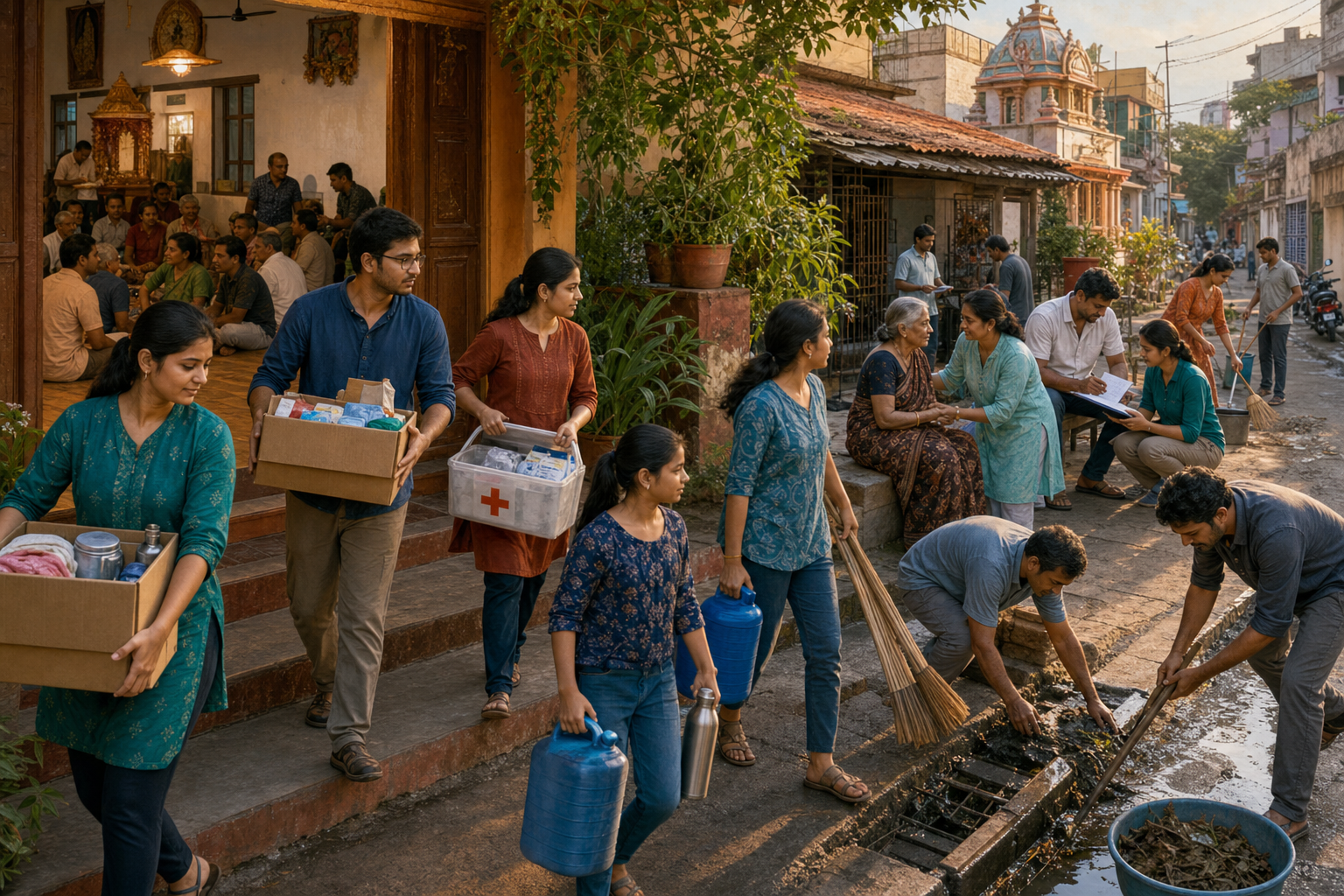
A full hall can disappear by Monday. If you help run an HJS chapter, temple network, campus circle or neighbourhood initiative, the real question is not whether people care. It is whether that concern has somewhere disciplined to go after the applause ends.
Community resilience is what remains when no event is happening: neighbours who can complete a seva project, help someone reach the right authority, respond to harassment without vigilantism, verify a viral claim before forwarding it and keep serving when the original organiser is unavailable. You build that capacity by converting dharmic conviction into roles, routines, safeguards and measurable public benefit.
Measure what remains after the gathering
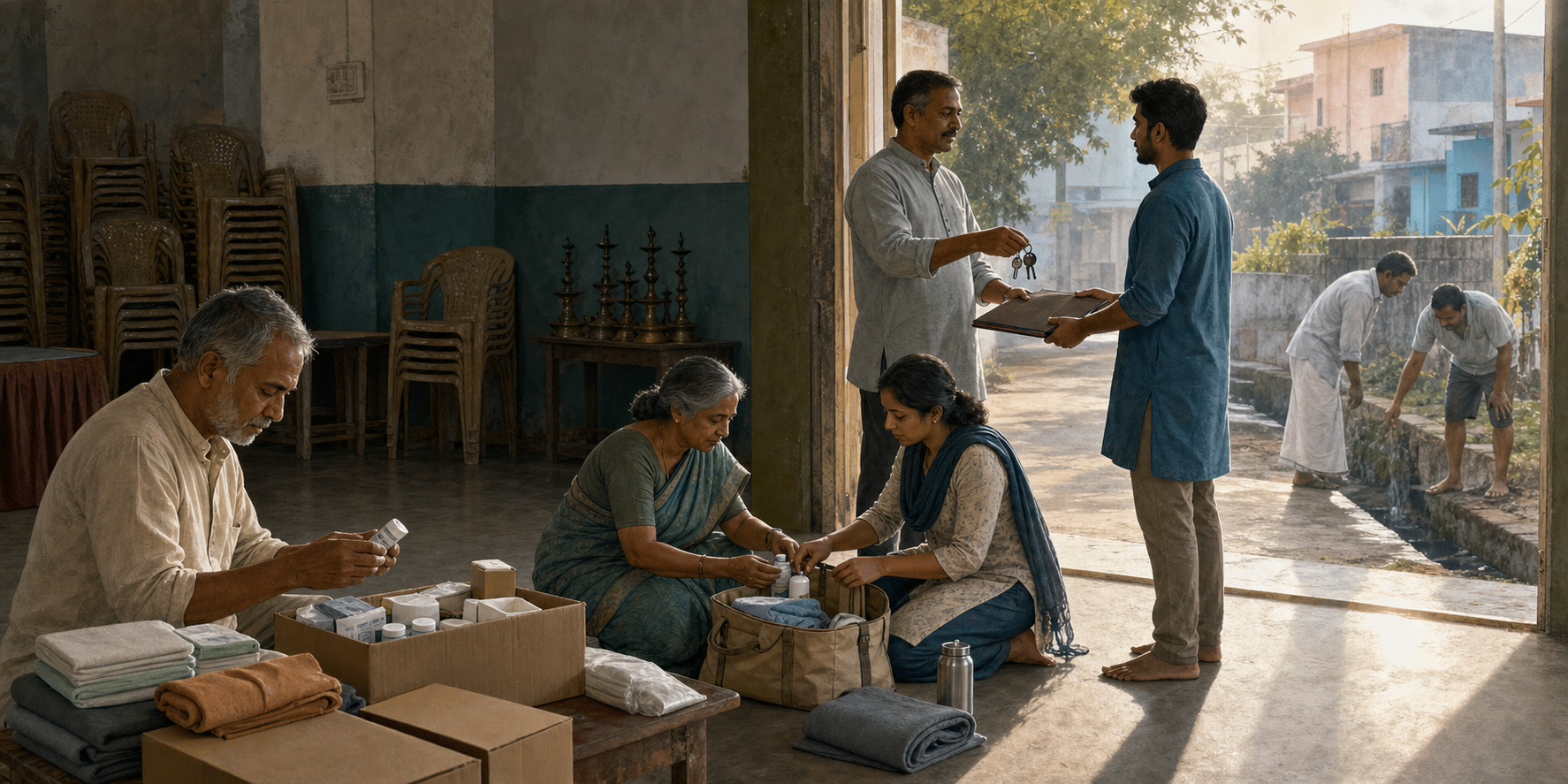
The Solapur Hindu Rashtra-Jagruti Sabha brought more than 10,000 people into a peaceful public pledge. That scale demonstrates mobilisation. It does not, by itself, tell you whether a vulnerable family will receive help, a heritage record will be preserved or a volunteer team will still function months later.
Turnout measures reach. Resilience measures conversion: a participant becomes a contact, a contact accepts a bounded role, the role produces completed work, and somebody else learns enough to carry that work forward. If your team records only attendance and photographs, it cannot see where that chain breaks.
Plan the first act of follow-through before announcing the main event. Give each participant a clear choice among practical lanes such as community safety, yoga and well-being, local seva, heritage work or truthful public communication. Ask only for the contact details and availability needed for that choice, explain how the information will be used, and obtain consent before adding anyone to a messaging group.
Replace the vague invitation to get involved with a specific next action. A useful invitation names the task, place, expected effort, responsible coordinator, required preparation and finish condition. People can decide whether they can honour a duty when they can see its boundaries. An open-ended appeal often attracts initial enthusiasm but leaves dependable volunteers carrying an undefined burden.
Key takeaways
- Design the follow-through before the stage programme, not after the crowd has dispersed.
- Offer bounded roles with a named owner, safety process and visible finish condition.
- Build resilience through complementary work: personal steadiness, mutual protection, public service, cultural continuity and truthful communication.
- Measure completed work, repeat participation, trained backups and beneficiary outcomes rather than attendance alone.
- Treat ahimsa, constitutional conduct, inclusion and financial transparency as operating requirements.
Give the local team a minimum civic operating system

A committed group can still become fragile when every decision, password, contact and relationship sits with one energetic person. The test is simple: if that person becomes unavailable, can the next activity proceed safely? If not, you have enthusiasm but not yet an institution.
Every local team needs responsibility for coordination, participant safety, records, communication, inclusion and financial accountability. These do not have to become grand titles. They do have to become explicit functions. Name a primary volunteer and a backup for each function, and record where the information needed for handover is kept.
Give every activity a one-page brief containing:
- Purpose: the local need being addressed and the people meant to benefit.
- Scope: what the team will do, what it will not do and which requests must be referred elsewhere.
- Ownership: the coordinator, backup, partner institution and decision route.
- Safeguards: permissions, consent, first aid, accessibility, privacy and professional supervision where required.
- Completion: the observable result that allows the task to be closed rather than continued indefinitely.
- Evidence: an attendance record, service log, expense record, beneficiary confirmation or other proportionate proof.
- Handover: the review point, next responsible person and material another team would need to repeat the activity.
This brief prevents two common errors. The first is mistaking good intent for permission: volunteers may care deeply but still lack authority to enter a campus, handle sensitive personal information, advise on law or conduct physical training. The second is mistaking perpetual activity for impact. A project without a finish condition can consume attention long after it has stopped solving the original problem.
Use a stable rhythm of preparation, delivery, review and refresher training. Safety skills in particular need rehearsal; the campus-safety model recommends quarterly refreshers rather than assuming a single demonstration creates lasting capability. End each review by deciding what to retain, what to change and who will own the next cycle.
Choose programmes that make people more capable
A resilient community does more than react to a crisis. It develops people who can stay steady, recognise risk, help without escalating danger and complete ordinary civic work. HJS initiatives already provide several programme forms that local teams can adapt without pretending that every locality needs the same intervention.
Teach protection without producing vigilantism
A credible safety programme begins with avoidance, awareness, boundaries, bystander support and exit planning. Physical response is a last-resort means of breaking contact and reaching safety, not an invitation to punish, pursue or prove courage.
The Chembur campus workshop used a practical 120-minute structure: 20 minutes for awareness, 20 for verbal skills, 40 for physical fundamentals, 20 for bystander methods, 15 for legal and reporting pathways, and 5 for questions. That sequence matters. It places judgement, communication and help-seeking around the physical drills instead of presenting fighting techniques as the whole answer.
Keep the awareness segment calm. Participants should learn to notice unusual proximity, path-blocking, boundary testing and changing exit conditions without being told to live in permanent alarm. Scenario walk-throughs can cover campus corridors, public transport, rideshares and crowded events. Each scenario should end with an exit, a call for help or a safe handoff, because escape is the operational objective.
Teach the bystander 5Ds as a menu rather than a hierarchy: Direct, Distract, Delegate, Document and Delay. A volunteer who cannot intervene directly may still interrupt the situation, call an authorised person, preserve useful information or check on the affected person afterward. Documentation must never take priority over immediate safety, and it must not become an excuse to circulate a victim’s identity or distress online.
Physical drills require a qualified trainer, progressive intensity, safe surfaces, a structured warm-up, first-aid readiness and an explicit right to opt out without explanation. Provide seated or alternative-position variations when needed. Consent must be checked before partner contact, not inferred from attendance. Do not improvise weapon instruction or encourage people to carry prohibited items.
Have a qualified professional verify every legal reference, helpline and reporting route against the law and institutional rules in force when the session is delivered. A photocopied legal handout can become dangerously stale. The same caution applies to campus procedures: name the actual reporting body and contact route available to those participants, not merely the procedure that ought to exist.
Use yoga to build steadiness, not performance culture
Volunteers who cannot regulate strain eventually become less reliable, more reactive or both. Yoga can support the physical mobility, breath awareness and reflective pause that steadier service requires. Its civic value lies in disciplined continuity, not an impressive posture or an intense one-day spectacle.
The Faridabad workshop brought 19 participants into a structured practice of foundational asanas, pranayama and relaxation. A small room is not a failed mobilisation. It can be the right size for alignment checks, individual modifications and the relationships needed to sustain a practice circle.
Ask the instructor to use three self-checks throughout the session: motion remains pain-free, breathing remains sustainable and attention remains stable. Props and reduced ranges should be normal options, not marks of weakness. Beginners do not need forceful breathing or long breath retention. Participants with hypertension, dizziness, respiratory concerns or anxiety sensitivity need individual guidance, and a community class must not be presented as a substitute for medical care.
Connect the practice to daily conduct. A short pause before replying to provocation, awareness of rising muscular tension and the ability to return to steady breathing are not abstract wellness goals. They improve the chance that a volunteer will make a measured decision under pressure. This is where yoga’s dharmic roots in self-regulation meet the practical demands of civic service.
Select seva by local need, not photographic value
Annadanam, public-space cleanliness, tutoring, support for seniors and people with disabilities, blood-donation camps, festival waste audits and heritage conservation can all express Dharma through public benefit. The right choice is the task your locality actually needs and your team can complete safely.
Listen before selecting the project. Ask the intended beneficiaries or responsible institution what creates difficulty, what help is already available and what would merely duplicate existing work. Then define a modest finish condition. A cleanliness drive needs permission, a plan for collected waste and responsibility for the area after the photographs. Tutoring needs an agreed learning aim and continuity. A blood-donation camp needs an accredited medical partner. Heritage conservation needs competent guidance before anybody cleans, moves or repairs an object.
Do not force every volunteer into the most visible task. Someone who cannot attend field work may be able to confirm permissions, prepare accessible materials, maintain accounts, call beneficiaries, translate instructions or document the handover. Resilience increases when contribution is designed around real capabilities rather than a single image of service.
Treat truthful communication as civic infrastructure
A network that forwards false or decontextualised material becomes easy to discredit, even when its underlying concern is legitimate. Before publishing an image, clip or allegation, check provenance, date, location and context. Seek corroboration where the claim could damage a person or inflame a community. If the team cannot verify it, do not convert uncertainty into certainty with a confident caption.
Create a correction habit. Record what was changed, remove inaccurate material where possible and publish a clear correction through the channel that carried the claim. This may feel less dramatic than rebuttal, but it protects the moral authority on which cultural advocacy depends.
Move each concern through a repeatable civic-action cycle
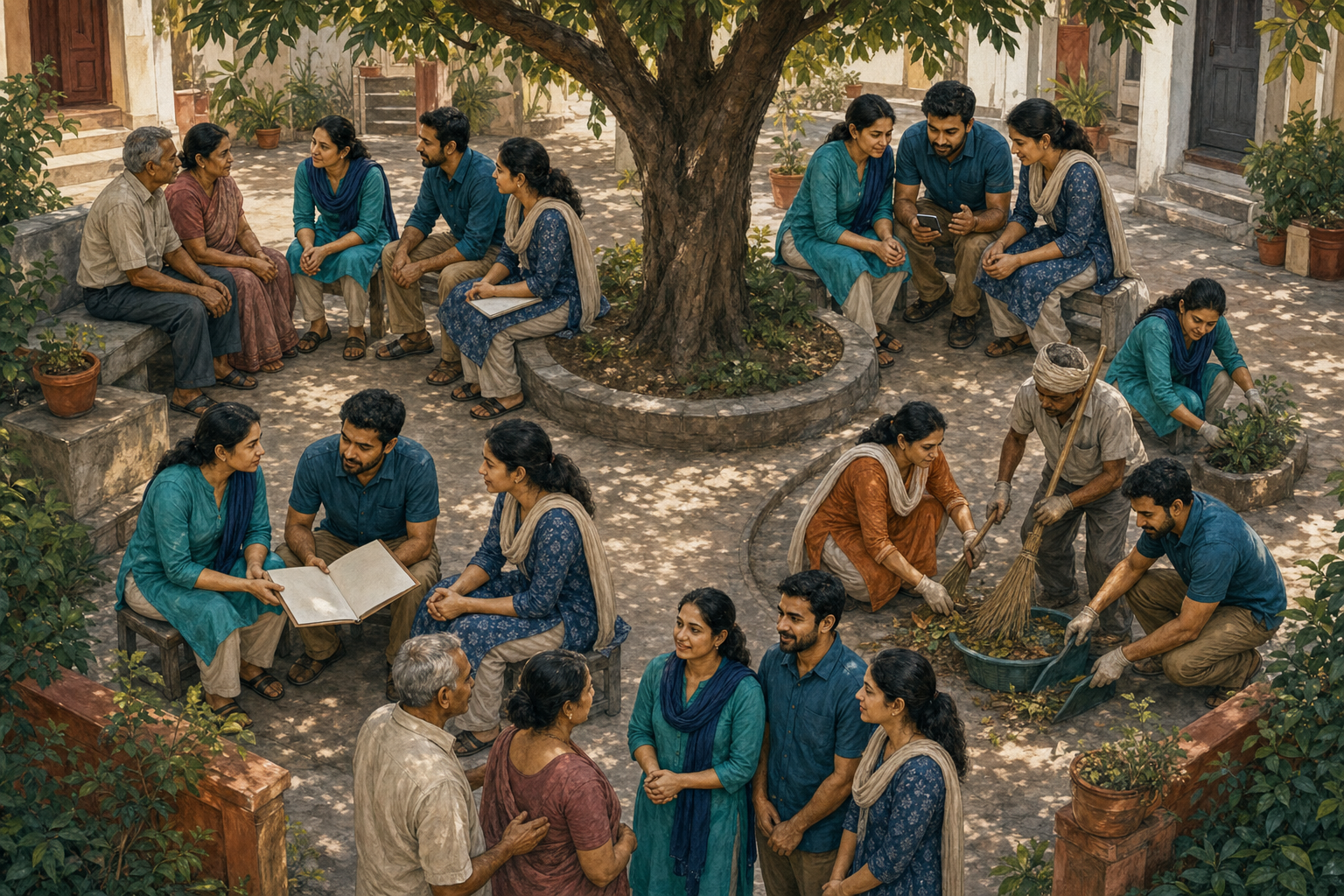
When a new concern arrives, resist the pressure to announce an event immediately. Move it through the same decision cycle each time. Repetition makes judgement less dependent on mood and gives newer volunteers a method they can learn.
- Listen and map. Identify who is affected, who has formal responsibility, what has already been attempted and whether the request is for service, advocacy, emergency help or professional intervention.
- Define the outcome. Write a sentence describing the observable improvement. Protecting Dharma is a governing intention; restoring a documented local practice, completing a public-space cleanup or training a campus cohort is an operational outcome.
- Choose the smallest competent format. Use a workshop when people need a skill, a service day when they need coordinated labour, a practice circle when continuity matters, and a public assembly when deliberation or visible commitment is genuinely the objective.
- Name the owner and backup. Assign authority for decisions, not merely responsibility for errands. Give the backup access to the contacts, documents and permissions needed for a real handover.
- Check risk and referral limits. Identify medical, legal, safeguarding, privacy, crowd-management and accessibility needs. Bring in qualified partners where volunteers lack competence. A sincere amateur is still an amateur when the consequences are serious.
- Deliver and record. Keep only the records needed to establish attendance, service, expenses, incidents and outcomes. Protect sensitive personal information and do not turn a beneficiary’s hardship into promotional material without informed permission.
- Review, close and retain. Ask what changed, what failed, what must be referred onward and whether the activity should be repeated. Thank participants with a concrete next option, then archive the brief so another team can reproduce the work.
The choice of format is especially important. A large sabha can create sankalpa and public visibility, but it cannot replace supervised skill training. A yoga workshop can strengthen personal discipline, but it cannot replace a reporting mechanism. A social-media campaign can attract attention, but it cannot clean a neglected site or accompany a distressed person to competent help. Match the instrument to the need.
Partnership is often the point at which intent becomes competent action. Colleges can provide campus reporting pathways; established social organisations can clarify beneficiary needs; medical institutions can conduct donation camps; qualified trainers can protect participants during physical practice; and local authorities can grant permissions for public work. Record who is responsible for what so collaboration does not dissolve into assumption.
Protect trust with guardrails and a public scorecard

A dharmic civic network should become more disciplined when challenged, not more reckless. Ahimsa does not mean passivity, and courage does not mean escalation. The practical standard is proportionate, lawful action directed toward protection, truth and public welfare.
Peaceful cultural advocacy is strongest when it respects constitutional boundaries, rejects hate speech and coercion, and leaves law enforcement, adjudication, medical treatment and legal advice to those authorised and qualified to provide them. These are not concessions to public relations. They are the conditions that keep civic energy from turning into private punishment or avoidable harm.
Inclusion must also be operational. Welcome participation across sampradayas, caste and regional backgrounds without demanding doctrinal sameness. Make room for women and younger volunteers in decision-making, not only execution. Adapt venues and activities for different mobility and sensory needs. A group that speaks of unity while making ordinary participation unnecessarily difficult has found a problem it can fix immediately.
Publish a compact community scorecard at regular review points. Use aggregate information where personal details are unnecessary. Useful measures include:
- Volunteer hours committed and the proportion of planned tasks actually completed.
- People served, alongside the concrete outcome relevant to that service.
- Repeat participation, trained backups and activities successfully handed to new coordinators.
- Safety incidents, complaints, referrals and corrective actions.
- Participation across age, gender, ability and socio-economic background, recorded without exposing individuals.
- Money received, approved expenditure and supporting records.
- For heritage or cleanliness work, the condition documented before and after intervention.
- For public communication, disputed claims reviewed and corrections issued.
Interpret each number alongside the purpose. A high attendance count cannot compensate for an unsafe workshop. A large volume of distributed food says little unless it reached an identified need under suitable hygiene and accountability. A clean site on the day of an event is not a durable result if nobody has arranged lawful disposal or follow-up. Metrics should expose unfinished work, not decorate it.
At your next HJS planning meeting, begin with one local need rather than the next large event. Write the outcome, owner, backup, safeguards, evidence and handover on a single page. If the team cannot name those elements, the initiative is still a slogan. Once it can, sankalpa has started becoming social infrastructure.
References
- Hindu Janajagruti Samiti – Chembur College hosts empowering, practical women’s safety and self-defence by HJS
- Hindu Janajagruti Samiti – Faridabad Yoga Workshop by HJS & Jeev Kalyan Sansthan Boosts Holistic Health and Focus
- Hindu Janajagruti Samiti – 10,000 Unite in Solapur: A Peaceful Dharma Pledge for Dharmic Unity and Civic Renewal
