
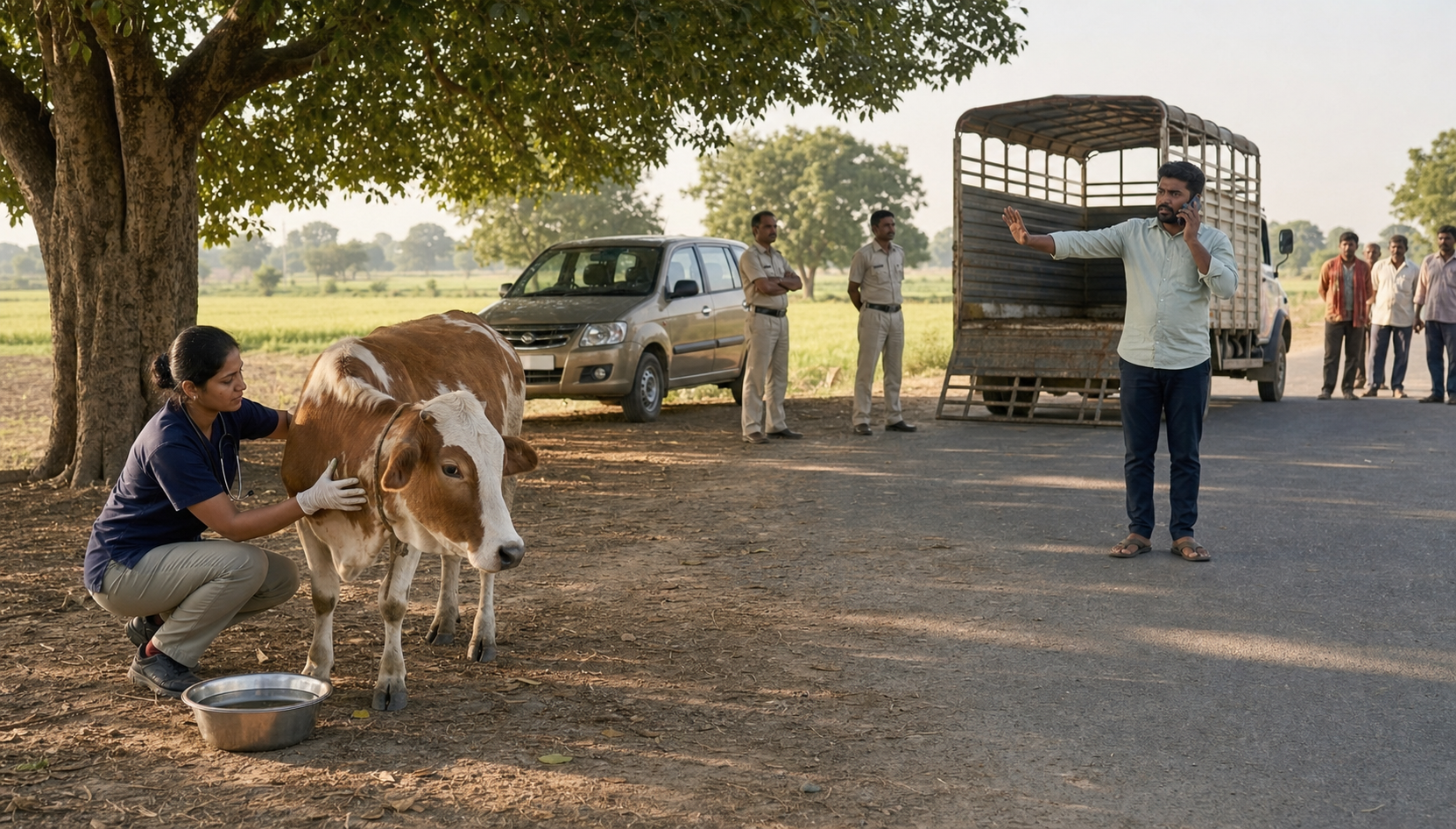
You see a vehicle carrying distressed cattle, or a violent Gau Raksha clip appears in your family group. You want to act, but you do not want anger, rumour, or communal tension to turn a legitimate concern into another wrong. The right response is neither silence nor vigilantism. It is prompt, documented, non-violent action through lawful authorities.
Cow protection should pass three tests: Does it reduce suffering? Does it respect due process? Does it protect innocent people from fear and collective blame? If an action fails any of these tests, calling it gau seva does not make it dharmic.
Reverence does not create private police power
For many Hindus, the cow represents nourishment, restraint, gratitude, and the duty to protect vulnerable life. Gau seva gives that reverence a practical form: feeding, sheltering, treating, and responsibly caring for cattle. It is strongest when the animal’s welfare, rather than the activist’s display of anger, remains at the centre.
This ethical direction is not confined to one dharmic vocabulary. Jain ahimsa demands care in thought, speech, and action. Buddhist karuna directs compassion toward suffering beings. Sikh sarbat da bhala places the welfare of all within the moral horizon. These traditions are distinct, but none turns compassion for one life into permission to assault another.
Ahimsa does not mean indifference to cruelty or illegal slaughter. It governs how you resist them. You may investigate, document, complain, organize, litigate, donate, educate, and demand competent enforcement. You may not convert suspicion into guilt or religious conviction into a private licence to threaten, detain, search, punish, or injure.
The constitutional structure reflects the same distinction. Article 48 directs state policy toward modern agriculture and animal husbandry and toward prohibiting the slaughter of cows and calves. It guides legislation and administration; it does not deputize a roadside crowd. State cattle laws can prohibit slaughter and regulate transport, with different rules and penalties in different jurisdictions. Police, veterinary officers, courts, and designated regulators determine whether those laws have been violated.
Article 19(1)(a) protects forceful advocacy, including advocacy for stricter enforcement and better cattle welfare. Article 19(2) also permits reasonable restrictions connected with matters such as public order, decency, and morality. Threats, criminal intimidation, deliberate provocation, and attempts to promote communal enmity do not acquire moral immunity because they are presented as religious activism.
Supreme Court decisions including Mohd. Hanif Quareshi and Mirzapur Moti Kureshi have affirmed substantial state authority to restrict cow slaughter. The Court has also directed states to prevent mob vigilantism through measures such as nodal officers, preventive protocols, and expedited proceedings. The two positions are compatible: the state may enforce strong cattle-protection laws, while citizens remain bound by due process.
Exact offences, procedures, and cattle-transport requirements depend on the current law of the state and the facts of the incident. Do not rely on section numbers copied from an old social-media message. If you are filing litigation, organizing vehicle checks, handling seized cattle, or making public accusations, obtain advice from a lawyer familiar with the applicable state law.
If you suspect a cattle offence, follow this protocol
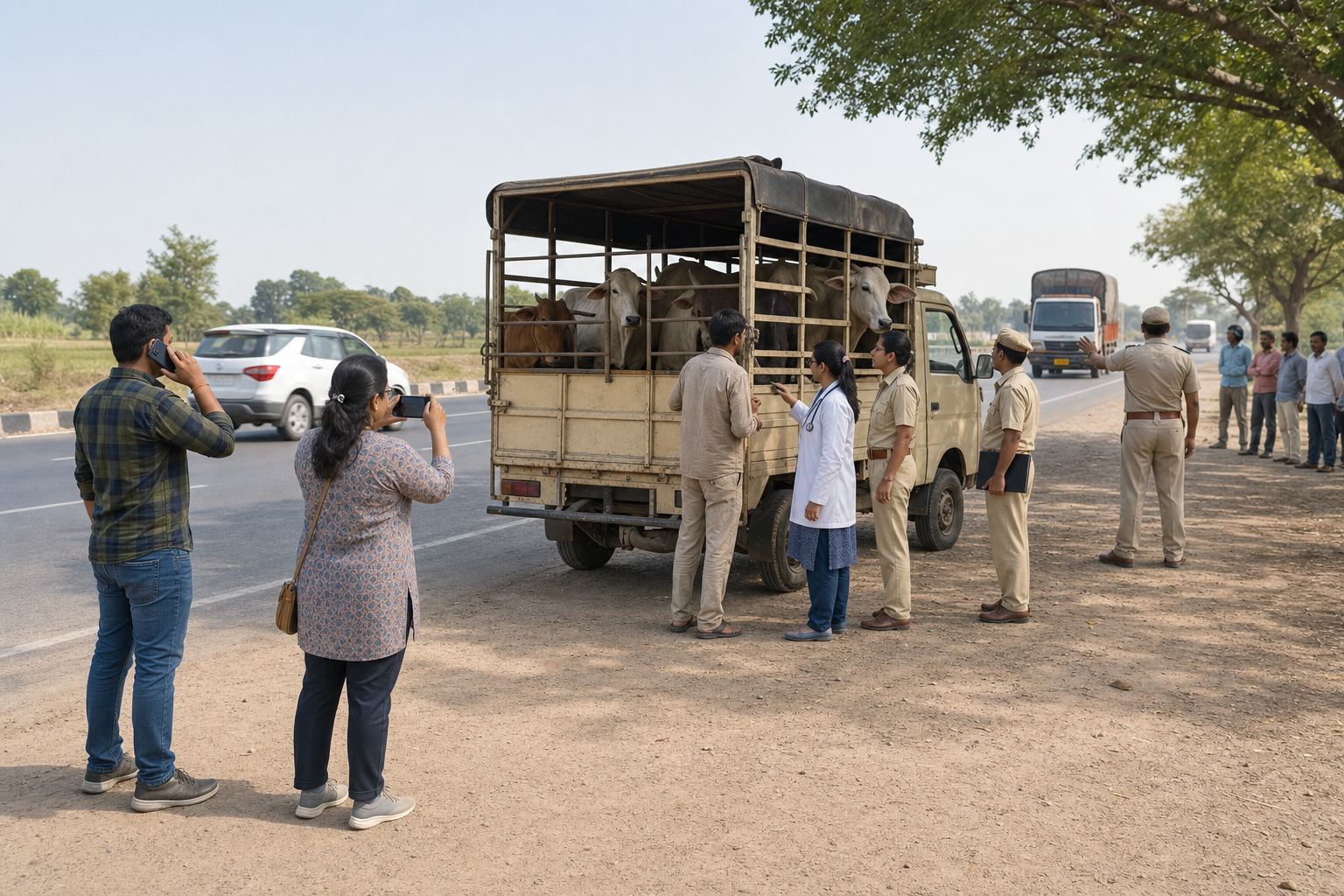
The first minutes matter because a crowd can form faster than facts can be verified. Your objective is to get reliable information to the competent authority without creating a second emergency.
- Protect life before collecting evidence. Keep a safe distance and contact the local police or district control room. If an animal or person appears to face immediate injury, say that clearly. Do not stand in front of a moving vehicle, reach inside it, chase it, or place yourself between agitated people.
- Record observations, not conclusions. Note the location, time, direction of travel, vehicle description and registration if safely visible, number and apparent condition of the animals, and the conduct you personally observed. Say suspected illegal transport until an authorized investigation establishes what occurred.
- Do not assemble a crowd. Forwarding a location into an activist group can produce a confrontation before police arrive. Contact a small number of responsible office-bearers only if they have a defined role, such as coordinating with authorities or arranging lawful veterinary care.
- Preserve the original evidence. Keep the unedited photograph or video, along with its original timestamp and location information where available. Do not add music, captions, communal labels, or allegations. Editing may remove context and weaken the value of the material.
- Ask for official verification. Request police examination of the relevant documents and, where animal welfare is at issue, inspection by a qualified veterinary or designated authority. Citizens at the scene are rarely equipped to determine from appearance alone whether transport documents, ownership, destination, or animal condition satisfy the applicable law.
- Create a follow-up trail. Ask for a complaint number, diary entry, acknowledgement, or other locally available record. Keep the name of the office contacted, the time of contact, and any evidence submitted. If no response follows, escalate through the police hierarchy, district administration, designated cattle-welfare authority, or legal counsel rather than through threats.
What a useful complaint contains
- The exact place, approximate time, and direction of movement.
- Identifiers that were safely visible, without guessing at missing characters.
- A factual description of crowding, injury, handling, or other observable conditions.
- A clear distinction between what you witnessed and what another person told you.
- The original files rather than screenshots of forwarded media.
- A request for lawful inspection, veterinary assessment, and preservation of official records.
- Your contact details if you are willing to give a statement or provide the original evidence.
A complaint becomes less credible when it assigns a religious identity, criminal motive, or destination that the witness could not actually know. Describe the act. Let investigators establish identity, intent, ownership, and legality. This protects the innocent and makes a genuine case harder to dismiss as communal agitation.
Never seize keys, enter a vehicle, search belongings, demand identity documents, force a confession, or decide punishment yourself. Even where a cattle offence may have occurred, coercion can endanger people, compromise evidence, expose you to legal consequences, and allow the original allegation to disappear beneath a case about mob conduct.
If a crowd is already gathering, tell the police about the risk of violence and withdraw to a safe position. Ask others not to touch the occupants, animals, or vehicle. Attempt verbal de-escalation only when it is safe to do so. Ahimsa includes the frightened driver, the bystander, the police officer, and the accused person as surely as it includes the cattle.
Do not let a viral clip recruit you into someone else’s anger

A short video can be authentic yet still be misleading. The words may be real while the date, location, sequence, target, or surrounding exchange is misrepresented. A combative fragment also travels farther than a correction because outrage rewards immediate sharing. Verification must therefore come before condemnation and before defence.
Use four checks before you forward a Gau Raksha clip:
- Provenance: Can you identify the earliest available upload or the person who recorded it? A chain of forwarded copies is not provenance.
- Continuity: Is the recording continuous, or does it begin and end around the most inflammatory sentence? Look for the longer version before interpreting intent.
- Time and place: Is there independent information establishing when and where it occurred? Captions added by an unknown account are claims, not verification.
- Consequence: Does sharing help an authority investigate, or does it merely spread a threat, expose an unverified identity, or invite people to gather?
If you possess potentially relevant footage, preserve it privately and provide it to competent authorities. Public circulation is not the same as reporting. Posting a face, address, vehicle number, or accusation before verification can expose an innocent person to harassment and can make communal retaliation more likely.
You also do not have to choose between endorsing violent rhetoric and saying nothing. A responsible public statement can be direct: we support strict enforcement of cattle-protection law, reject threats and collective blame, and ask citizens to submit evidence to police and veterinary authorities. That wording protects conviction without converting followers into a crowd.
Leaders carry an additional duty because their audience can act on implication as well as instruction. If a statement is clipped or misinterpreted, a correction should be prompt, unambiguous, and visible to the same audience. If the statement was accurately captured, disavowing extra-legal violence is not weakness. It is the minimum discipline required of anyone asking others to act in the name of Dharma.
Build cow protection around care, records, and institutions
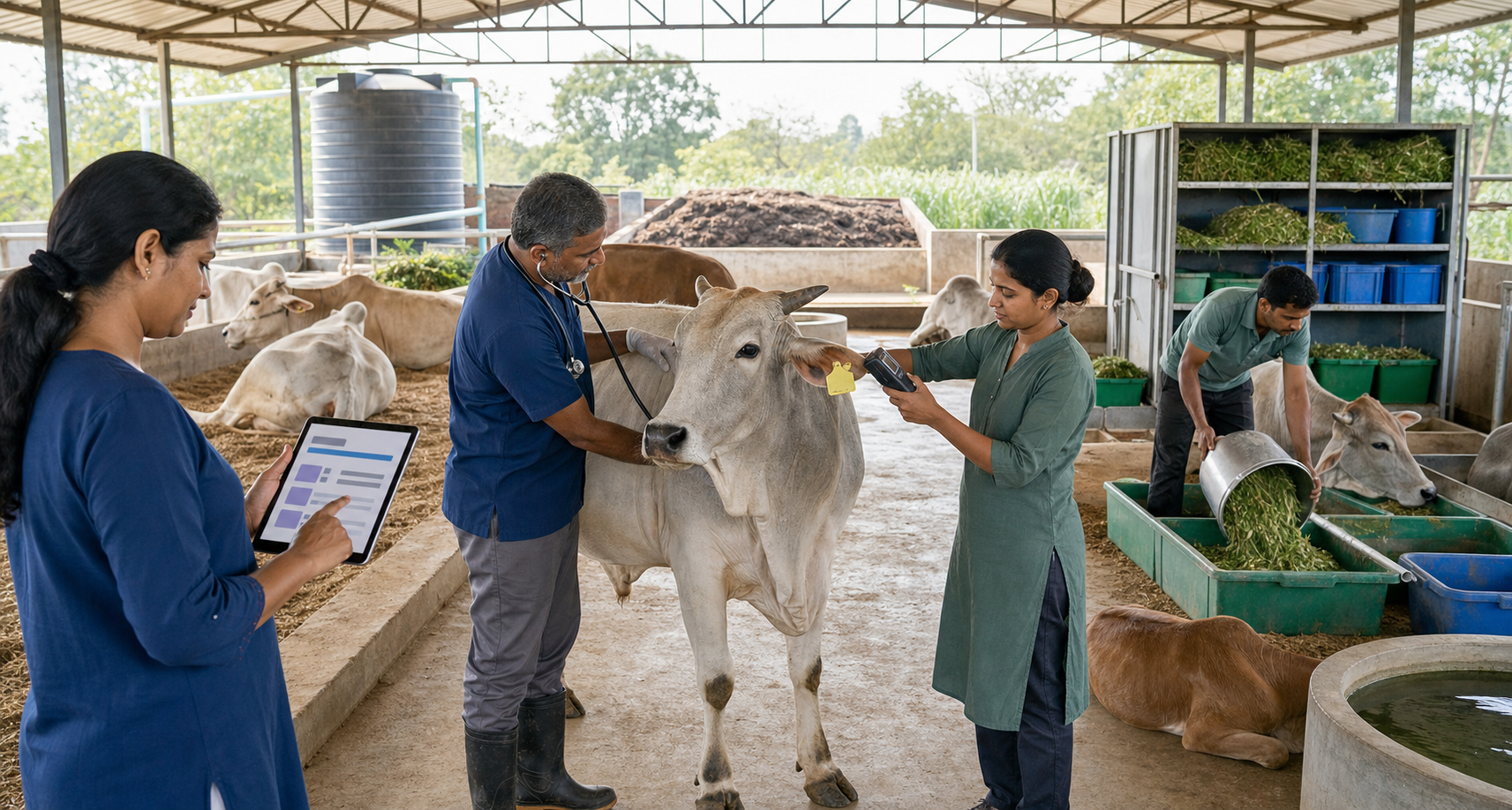
Roadside confrontation treats the suspected offence as the whole problem. Durable cow protection begins much earlier: with fodder, veterinary access, responsible ownership, transport traceability, financially stable shelters, and a workable plan for cattle that no longer produce an economic return. A movement that rescues an animal today but cannot feed it next month has shifted the suffering rather than ended it.
Support gaushalas that can demonstrate lifetime care
Before donating money, fodder, or cattle, ask operational questions. A sincere name or devotional image does not establish that a shelter has the capacity to accept another animal.
- Who provides veterinary care, and how are sick or injured cattle isolated and treated?
- How many animals can the available land, water, fodder, staff, and shelter support without overcrowding?
- Are intake, treatment, transfer, death, and expenditure records maintained?
- What is the funding plan for non-lactating, disabled, or elderly cattle?
- Does the shelter coordinate lawful handovers with police and district authorities rather than accepting animals through informal seizure?
- Can donors see clear accounts and animal-welfare outcomes instead of only rescue videos?
These questions are not hostile. They protect the shelter from unsustainable intake and protect the cow from becoming a symbol at the moment of rescue and a neglected expense afterward.
Make cooperation routine before a crisis
A district-level network should know who calls whom before a rumour spreads. Police, veterinary officers, administrators, responsible animal-welfare groups, gaushala managers, transport representatives, and respected community figures can establish a simple written procedure for complaints, inspection, temporary custody, evidence preservation, and public communication.
- Identify the designated police and veterinary points of contact.
- Agree that only authorized personnel will stop, search, inspect, or seize.
- Create a process for placing rescued cattle only where capacity has been confirmed.
- Maintain a peace committee that can issue a joint factual advisory when communal rumours appear.
- Train volunteers to document safely, manage rumours, and withdraw when a situation becomes volatile.
- Publish basic outcomes: complaints acknowledged, inspections completed, verified violations, veterinary actions, lawful handovers, and false claims corrected.
Traceability also matters. Reliable ownership, transport, health, and destination records make it easier to identify illegal networks without treating every carrier as a criminal. Better records move enforcement away from identity and suspicion and toward evidence.
The best measure of Gau Raksha is not how many confrontational videos it produces. It is whether fewer cattle are abandoned, injured, trafficked, or slaughtered unlawfully; whether complaints lead to competent investigation; whether shelters remain humane; and whether no innocent person is terrorized in the process.
Key takeaways
- Article 48 supports state action for cattle protection, but it does not confer enforcement powers on private citizens.
- Report suspected offences with exact observations, original evidence, and a request for official and veterinary verification.
- Do not stop, search, detain, threaten, expose, or punish anyone on suspicion.
- Verify the provenance, continuity, time, place, and likely consequence of a viral clip before sharing it.
- Direct most of your effort toward veterinary care, fodder, sustainable gaushalas, traceability, legal follow-up, and local coordination.
- Rejecting vigilantism does not dilute Gau Raksha. It gives cow protection legal durability and dharmic credibility.
The next time outrage asks you to react immediately, pause long enough to protect both truth and life. Record what you can safely observe, contact the proper authority, refuse collective blame, and follow the case through lawful channels. Then put sustained time or money into the unglamorous work of feeding, treating, sheltering, and responsibly protecting cattle. That is how reverence becomes seva, and how seva remains aligned with ahimsa.
References
