
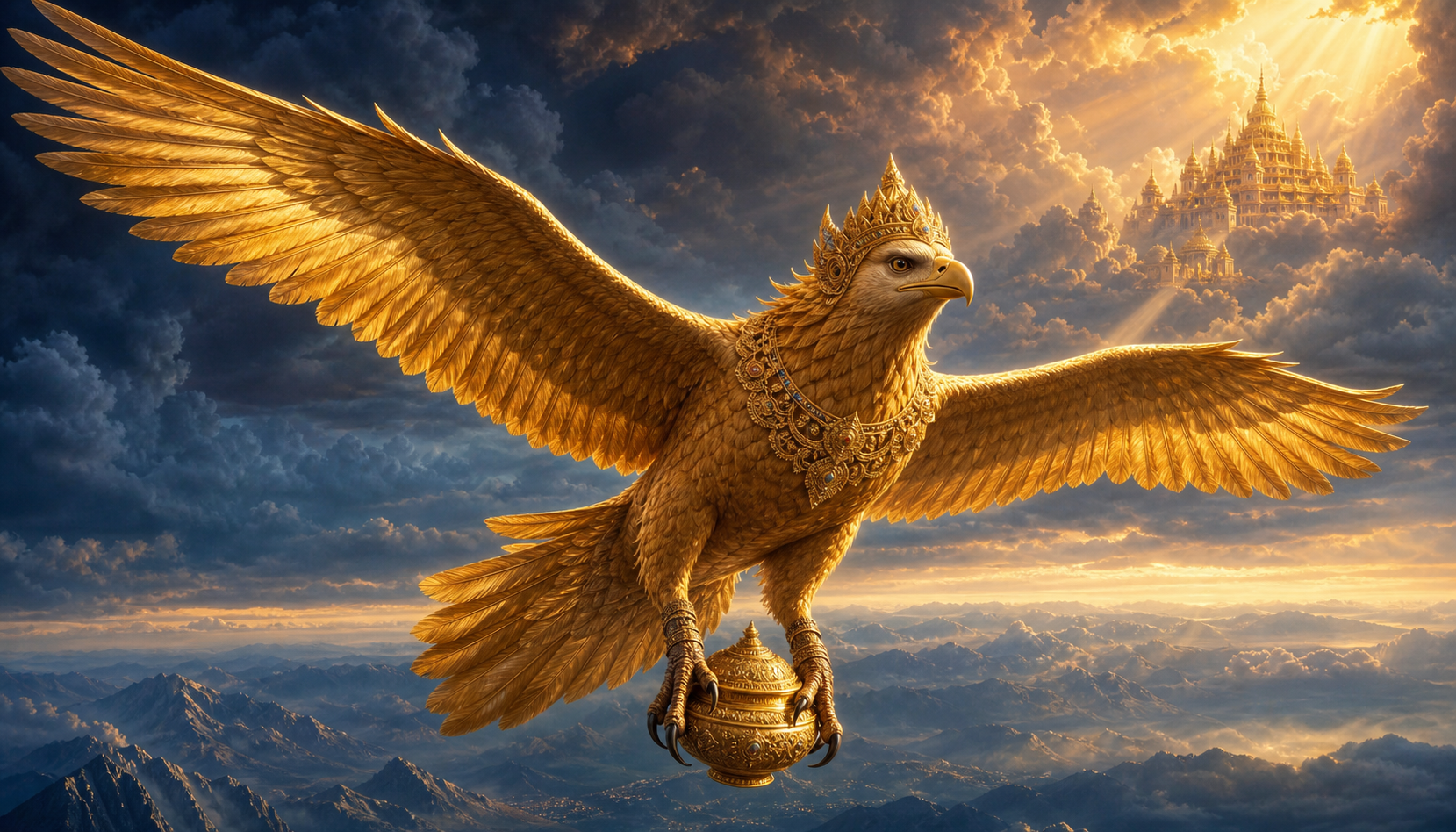
If you know Garuda mainly as Vishnu’s vahana, his flight for amrit can sound like a simple tale of a mighty bird storming heaven. That misses the question that makes the episode matter: what does a powerful being do when an unjust demand is the only available way to free his mother?
You understand Garuda best by watching what he refuses to do. He does not abandon Vinata, spend his strength carelessly, disregard innocent life, despise the sacrifice embodied by an adversary, or drink the nectar he has won. The plot concerns immortality, but its moral center is disciplined power.
Key takeaways
- Garuda seeks amrit as the ransom for Vinata’s freedom, not because he wants immortality for himself.
- His changing size matters as much as his gigantic strength: each obstacle requires a different measure of force, precision, or restraint.
- His protection of the Valakhilya sages shows that an urgent duty does not erase responsibility toward bystanders.
- He honors the sacrifice behind Indra’s vajra even while refusing to surrender his mission.
- Garuda’s decisive victory is not possession of amrit. It is keeping his vow without becoming ruled by the prize.
Why Garuda agrees to an impossible ransom
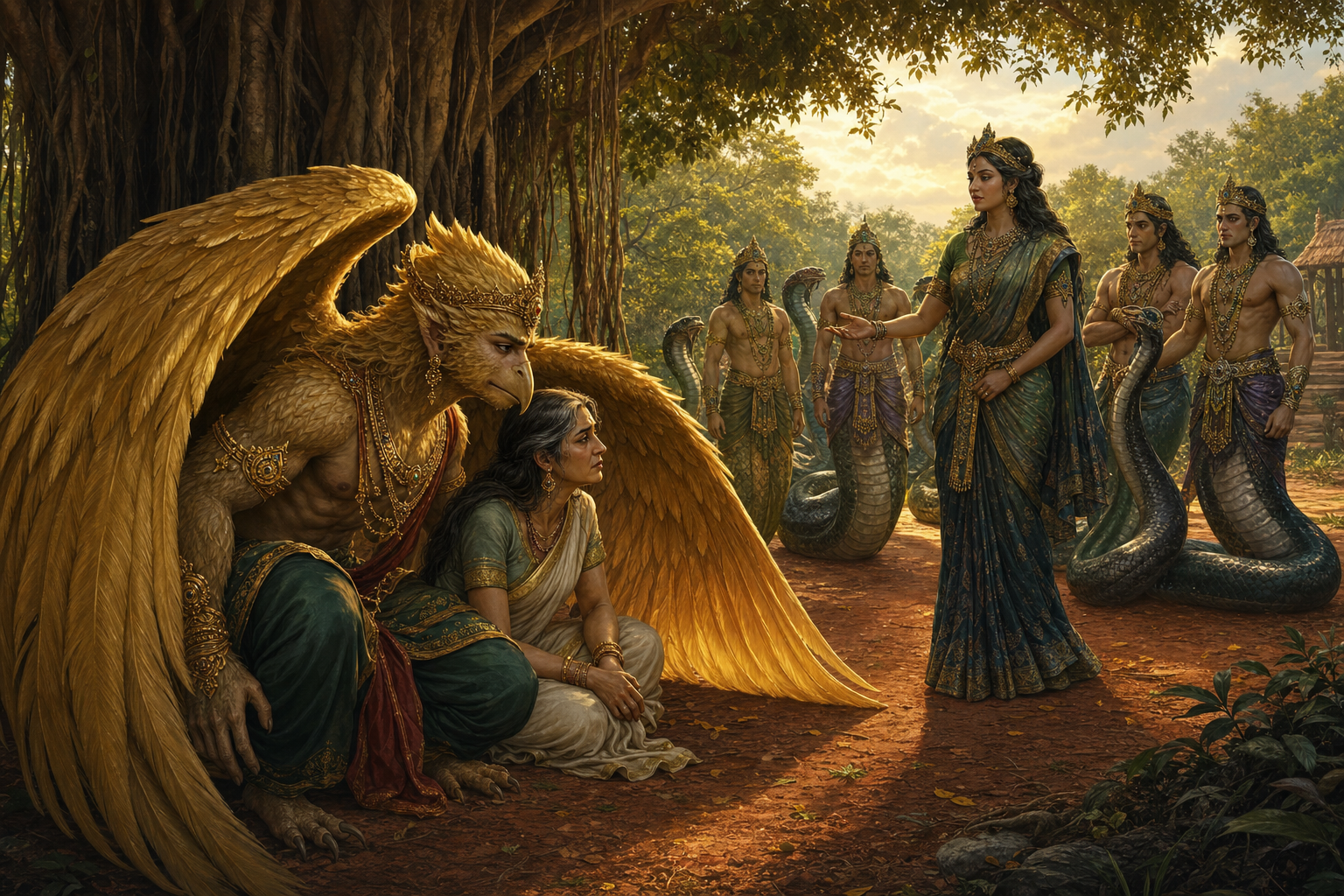
The quest begins inside a family divided by deception. Vinata, Garuda’s mother and a consort of the sage Kashyapa, wagers with her sister Kadru over the color of the divine horse Ucchaiḥśravas. Deceit corrupts the result, and Vinata becomes enslaved to Kadru. Kadru’s sons, the Nāgas, will release her only if Garuda brings them amrit, the nectar guarded by the devas.
That motive changes the meaning of everything that follows. Garuda undertakes the ascent to liberate his mother; he is not hunting invulnerability, rank, or dominion. Amrit is the demanded payment. It is never his private ambition.
This distinction is the first thing to notice when you read the episode. A spectacular battle can hide a modest moral objective. Garuda does not set out to overthrow heaven or prove that he is stronger than the devas. He has a defined obligation: end Vinata’s bondage. That clear stopping point keeps his immense power from turning into conquest for its own sake.
The demand is also morally crooked. The Nāgas benefit from the deceit that enslaved Vinata, then place a nearly impossible price on her release. Garuda nevertheless refuses the easier paths of resignation and uncontrolled vengeance. He accepts the burden of obtaining what they demand while retaining judgment about how he will obtain, carry, and finally relinquish it.
That is subtler than blind obedience. Garuda does not treat the Nāgas’ desire as righteous merely because he fulfills their condition. He distinguishes the person he must free, the promise he must keep, and the prize he need not desire. When your duties become tangled with another person’s manipulation, that distinction is worth making explicitly: identify whom you are protecting, what you actually promised, and which consequences you are not morally required to celebrate.
The ascent tests how Garuda uses power
Garuda’s scale is cosmic. His wings can darken the horizon, yet he can contract himself until he can pass through an opening of almost impossible narrowness. Read literally, this makes him a formidable divine being. Read ethically, it establishes the governing rule of the quest: having maximum power does not mean applying maximum force to every problem.
The branch he refuses to sacrifice
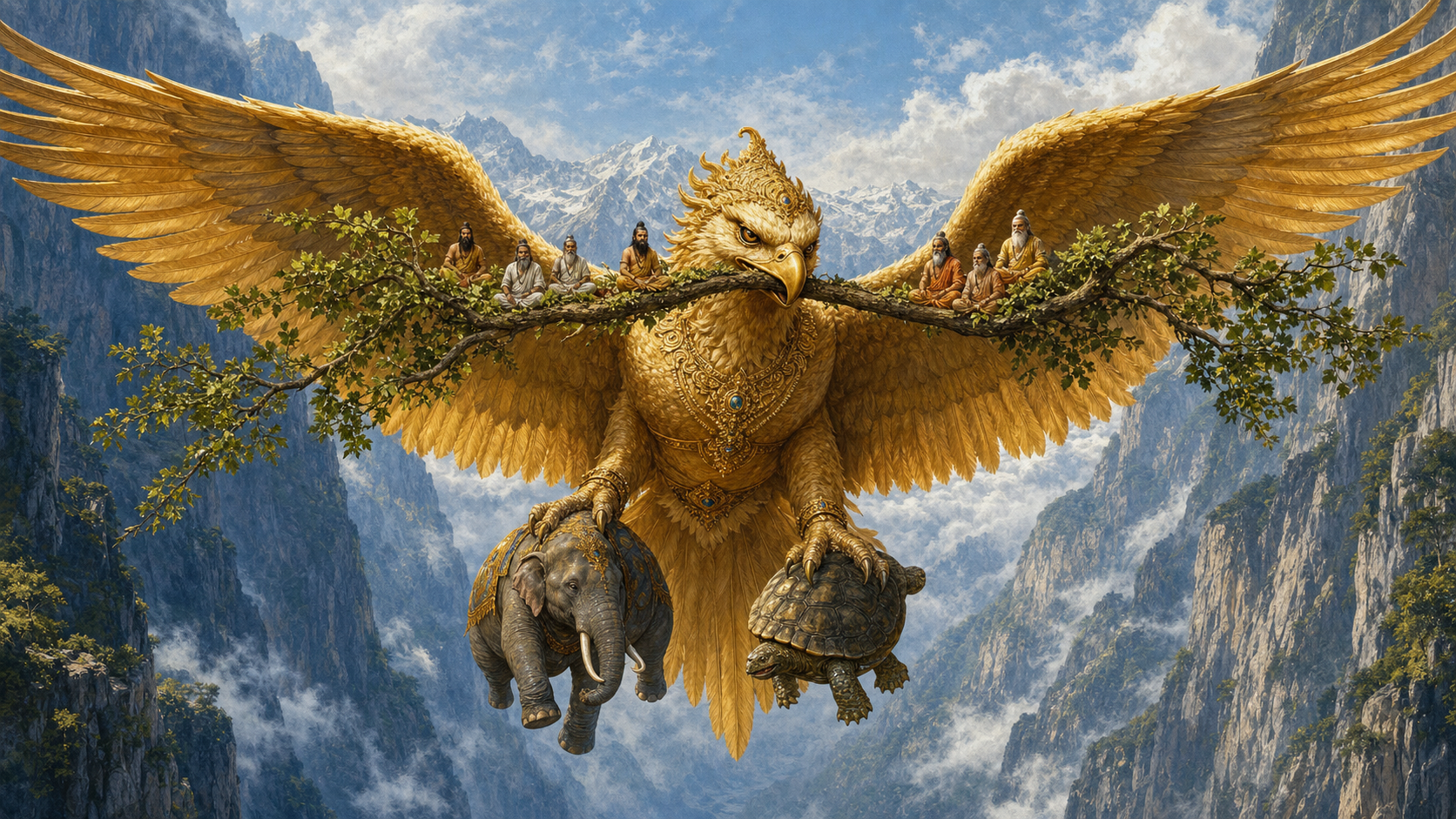
During his journey, Garuda carries away a colossal elephant and tortoise locked in ceaseless combat. The burden dislodges a branch from which the tiny Valakhilya ascetics are suspended. Garuda could treat them as negligible beside his mission. Instead, he notices the danger, carries the branch without letting the sages fall, and relocates it safely before taking his meal.
This interruption is not decorative. The sages did not create Vinata’s bondage, impose the ransom, or guard the nectar. They are innocent beings accidentally placed in the path of a larger struggle. Garuda’s duty to his mother therefore does not give him permission to disregard them.
The practical test is straightforward. Before you call harm an unavoidable cost of an urgent task, ask whether the affected person is actually part of the conflict. If not, protecting that person belongs inside the mission rather than outside it. Garuda does not wait until after victory to regret collateral damage. He changes his movement while the danger is in his grasp.
Each heavenly defense requires a different answer
The way to amrit is protected by several distinct defenses. Garuda succeeds because he does not mistake them for one problem.
- The flames require an opposing element. Garuda counters the surrounding conflagration with clouds and water rather than trying to endure it through pride alone.
- The bladed wheels require timing and contraction. Their revolving spokes cannot be defeated simply by growing larger. Garuda makes himself small enough to pass through the lethal interval.
- The serpentine sentinels require decisive action. Once through the mechanism, he overcomes the guardians that directly prevent him from reaching the vessel.
- The devas require bounded combat. Garuda fights those who stand between him and the ransom, but his purpose remains the recovery of one object rather than the destruction of a cosmic order.
The pattern is easy to miss if you remember only his size. Fire is quenched, machinery is navigated, sentinels are overcome, and divine opposition is resisted. Strength helps in every stage, but discernment determines its form. The tale gives you a useful diagnostic for difficult work: first decide whether the obstacle calls for endurance, adaptation, precision, negotiation, or confrontation. Treating every obstacle as an enemy to crush is not courage. It is a failure to see what is actually in front of you.
The vajra does not erase respect
Indra’s vajra carries the ascetic sacrifice of the sage Dadhīci, whose bones were used to forge the weapon. Garuda accepts its strike out of respect for the sacrifice embodied in it, yet the blow does not break his resolve.
This is not submission to Indra, and it is not contempt for him. Garuda separates the immediate opposition from the righteous sacrifice that gives the vajra its dignity. He can honor what is worthy in an adversary without surrendering a rightful purpose.
That distinction is central to dharma-yuddha, combat bounded by moral limits. Opposition does not make every quality of the opponent contemptible. Respect does not require agreement. If you cannot preserve those two truths at once, a dispute soon becomes hatred, and the original duty disappears beneath the desire to humiliate someone.
Why winning the nectar does not make Garuda its owner
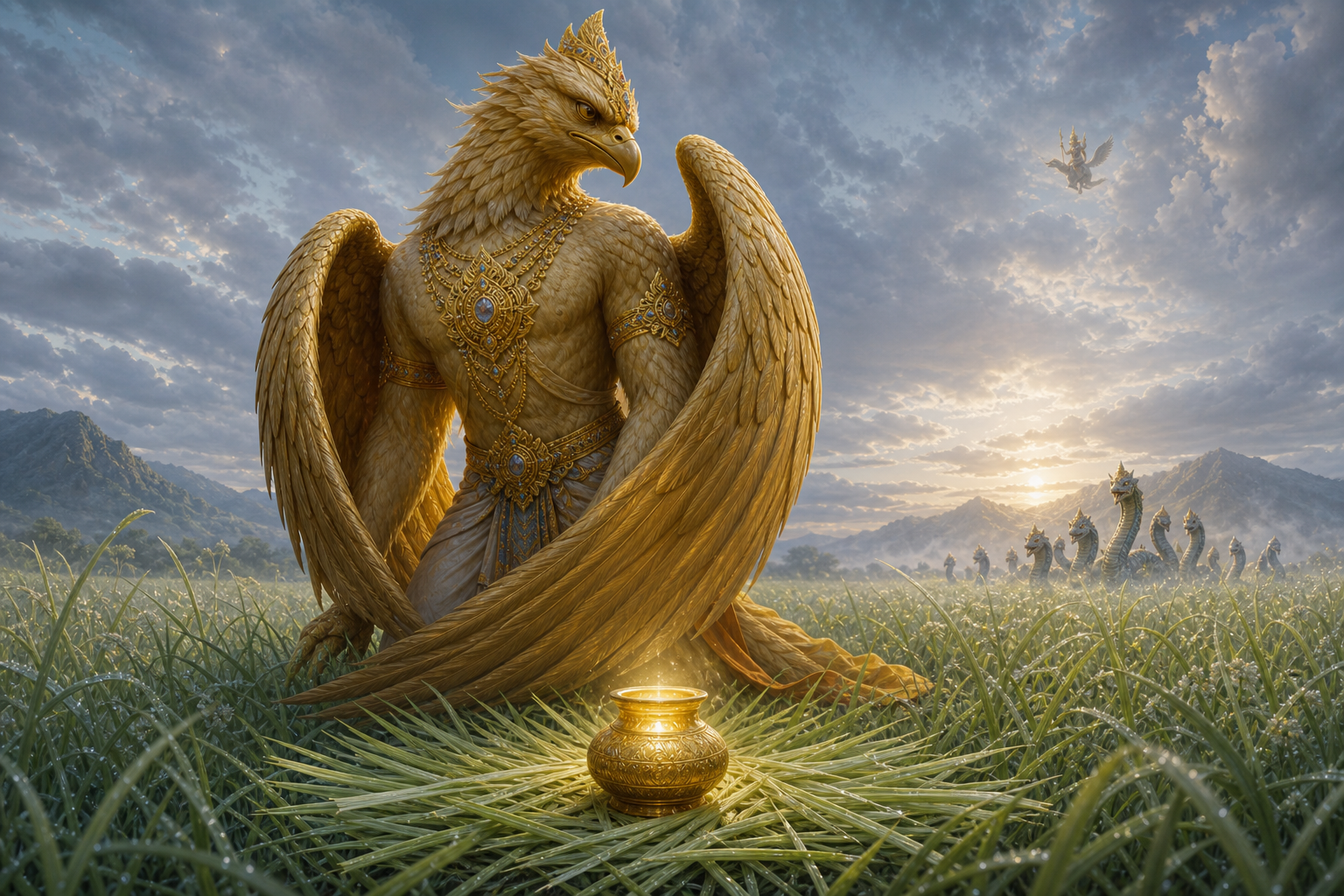
Garuda reaches the vessel and carries it away, but he does not drink. This is the hinge of the whole episode. If personal immortality had been his real goal, the defenses of heaven would merely have delayed his consumption. Instead, the nectar remains what it was at the beginning: a means of releasing Vinata.
Vishnu recognizes the quality revealed by that restraint. Garuda receives immortality without needing the nectar, freedom from fatigue, and the lasting honor of serving as Vishnu’s vahana. The relationship is not built on Garuda being conquered or bribed into obedience. His power becomes service because he has already shown that power does not own him.
This is why renunciation in the tale should not be mistaken for weakness. Garuda does not renounce effort, danger, skill, or responsibility. He renounces personal consumption of the reward. He can hold the vessel without allowing its promise to rewrite his purpose.
He then returns to the Nāgas and makes Vinata’s release the condition of delivery. The amrit is placed on kuśa grass while the Nāgas turn to ritual ablutions. With Garuda’s foreknowledge and tacit assent, Indra retrieves the nectar before they can drink it. When the Nāgas lick the grass in search of the lost drops, the blades split their tongues. Within the sacred narrative, this becomes the explanation for the serpent’s forked tongue and a fitting consequence for a freedom bargain rooted in deceit.
Garuda has still fulfilled the decisive part of his undertaking: he brought the demanded vessel, presented it, and secured his mother’s freedom. He neither substituted a false object nor seized immortality for himself. At the same time, he does not wage another war to guarantee that those who profited from Vinata’s enslavement become immortal.
The settlement restores relationships rather than leaving the universe in permanent rebellion. Indra affirms Garuda’s eminence among birds, and the enmity between Garuda and serpents becomes part of the natural order. Vinata is free. The nectar returns to divine custody. Garuda enters service to Vishnu. Victory is measured by the balance restored after conflict, not by how much spoils the victor can retain.
How to read the story and put its dharma to work
Do not merge two different amrit narratives
Garuda’s quest is sometimes blurred with the Samudra Manthana because both narratives involve amrit. Keep their plots distinct. Garuda’s journey begins with Vinata’s bondage and the Nāgas’ ransom. The churning of the ocean concerns devas and asuras, with Mohini determining the nectar’s distribution. The monumental Samudra Manthana imagery at Angkor Wat belongs to that wider churning tradition, not to the specific sequence in which Garuda penetrates the heavenly defenses.
The textual layers also deserve care. The central quest appears in the Ādi Parva of the Mahabharata. Later Puranic traditions, including the Garuda Purana and Padma Purana, develop further theological and iconographic nuances. Garuda also has Vedic precursors in Suparṇa and Garutmān of the Ṛgveda. If two retellings arrange an event or symbol differently, ask which textual layer each one represents before trying to force them into a single seamless version.
Use the yogic reading as a lens, not a replacement
A yogic interpretation can turn the ascent inward. It is best treated as a disciplined lens rather than a rigid code in which every character has only one meaning.
| Narrative element | Possible yogic reading |
|---|---|
| Amrit | Liberating knowledge rather than bodily reward |
| Indra | The sovereign mind guarding its established order |
| Devas and revolving wheels | Vigilant senses and the mechanisms that obstruct passage |
| Nāgas | Latent compulsions that bind awareness |
| Garuda | Awakened prāṇa carrying awareness beyond obstruction |
On this reading, the deepest achievement is not acquiring an elixir. It is gaining sufficient mastery over energy and attention to cross the obstacles, then refusing to become attached to what has been attained. Garuda’s ability to expand and contract becomes especially important: awakened force must know when to become vast and when to become almost imperceptibly precise.
Yet the symbolic reading should not erase Vinata. The story begins with a concrete relationship, a wrong, and a vow. Spiritual interpretations become evasive when they turn every injured person into a metaphor and leave the actual ethical demand behind. Garuda’s inner mastery matters because it equips him to perform an outward duty.
Apply Garuda’s standard before a difficult action
You do not need a celestial weapon or a pot of amrit to use the story. Before entering a high-conflict obligation, answer these questions in writing:
- What exactly am I trying to free, protect, or restore? State the objective in one sentence. If the objective silently changes from protection to domination, stop and reassess.
- Who are the Valakhilyas in this situation? Name the bystanders who did not cause the dispute but could be harmed by the way you pursue it.
- What kind of obstacle is each one? Separate the fire that must be quenched from the wheel that must be navigated and the guardian that must be confronted.
- What remains worthy of respect in the opposition? Identify the equivalent of Dadhīci’s sacrifice without pretending that respect removes the disagreement.
- What is the amrit I must carry but not consume? It may be status, leverage, vindication, or control gained while completing the task. Decide beforehand what you will not appropriate for yourself.
- Where does the struggle end? Define the restored condition that allows you to stop. Garuda stops when Vinata is free and balance is recovered; he does not turn a rescue into an endless campaign.
Garuda’s presence in Hindu worship, Buddhist traditions, Southeast Asian art, temple iconography, and classical performance reflects the reach of this ideal: courage becomes dharmic when joined to compassion, precision, and service. Those values can resonate across dharmic paths without pretending that every tradition tells the same narrative in the same way.
When your next hard duty arrives, begin with three lines: name the person or principle you must protect, list the bystanders you must shield, and define the point at which the task is complete. Then use the strength the situation requires, and no more. That is how Garuda’s ascent becomes more than a story of reaching amrit; it becomes a way to carry power without being carried away by it.
References
