

If your family wants to observe Navreh properly in March 2026, writing “19 March” on the calendar is only the first step. Write “check the tithi at local sunrise” beside it. Hindu sacred time follows the relationship between Surya and Chandra, so a festival date cannot always be carried unchanged across time zones.
The central observance is Navreh at dawn, but the month also offers a useful lesson in living by the Panchang. Six days later, 25 March moves from Shukla Saptami to Ashtami during the civil day. Planning both dates correctly will help you distinguish a festival day from a clock date, prepare the Navreh thaal without haste, and choose practices that fit the prevailing tithi.
The sacred day turns when the tithi meets your sunrise

A tithi is not a fixed 24-hour unit. It is produced by the changing angular distance between the Moon and the Sun, with each tithi occupying a 12-degree interval. Because the Moon’s apparent motion is not uniform, a tithi may begin or end at almost any civil-clock time. Midnight therefore has no automatic ritual authority.
For festivals governed by a day’s identity, the usual practical rule is to use the tithi present at local sunrise. For a rite tied to a particular moment, use the tithi prevailing when that rite begins. That distinction explains why a vrata, puja or sankalpa may belong to one tithi in the morning and another later in the same civil day.
In India, Chaitra Shukla Pratipada prevails at sunrise on 19 March 2026, making that the date for Navreh. It is also the first day of Chaitra Navratri. If you live outside India, do not convert an Indian clock time and assume the answer. Check a Panchang calculated for your own city, because sunrise and tithi can meet differently on either side of a time-zone boundary.
- Set the Panchang location to the city where you will perform the dawn observance, not to Kashmir or an Indian city by default.
- Look for Chaitra Shukla Pratipada and confirm whether it is present at local sunrise.
- If your local result differs from the Indian date, follow your family, temple or community convention consistently. Diaspora households that retain 19 March should still perform the thaal darshan at their own local sunrise.
- Record the decision before inviting relatives. A clear shared convention prevents the calendar question from overtaking the observance itself.
You may also encounter more than one year name. Navreh begins Laukika, or Saptarishi, year 5102 for 2026–2027. Some regional Panchangs will also identify the incoming Jovian-cycle year as Parabhava, following Vishwavasu in 2025–2026. These labels belong to different but coexisting systems. One does not invalidate the other, and Laukika 5102 remains the relevant Kashmiri Hindu year count.
Put these March 2026 anchors on the family calendar
| Date and period | Panchang identity | What to plan |
|---|---|---|
| 19 March at local dawn | Chaitra Shukla Pratipada; Navreh; first day of Chaitra Navratri | Thaal darshan, Panchang reading, household puja and the beginning of Laukika 5102 |
| 25 March from sunrise until the local Saptami ending time | Shukla Saptami on Budhavara | Surya arghya, solar prayer, study, accounts and carefully organised work |
| 25 March after the local transition | Shukla Ashtami | Devi upasana, japa, reflective study and disciplined follow-through |
The 25 March timing needs a local check even within an India-oriented schedule. The available Panchang calculation places Saptami until 4:29 PM in most regions, followed by Ashtami. Treat 4:29 PM as a planning reference, not a universal worldwide boundary.
Navreh also sits within a broader civilizational rhythm. Ugadi and Gudi Padwa use the same Chaitra Shukla Pratipada threshold while expressing it through different regional forms. This is unity without uniformity: Kashmir does not need to surrender its Laukika reckoning, sacred geography or thaal tradition in order to participate in the larger Hindu new-year season.
Prepare the Navreh thaal as a household sankalpa
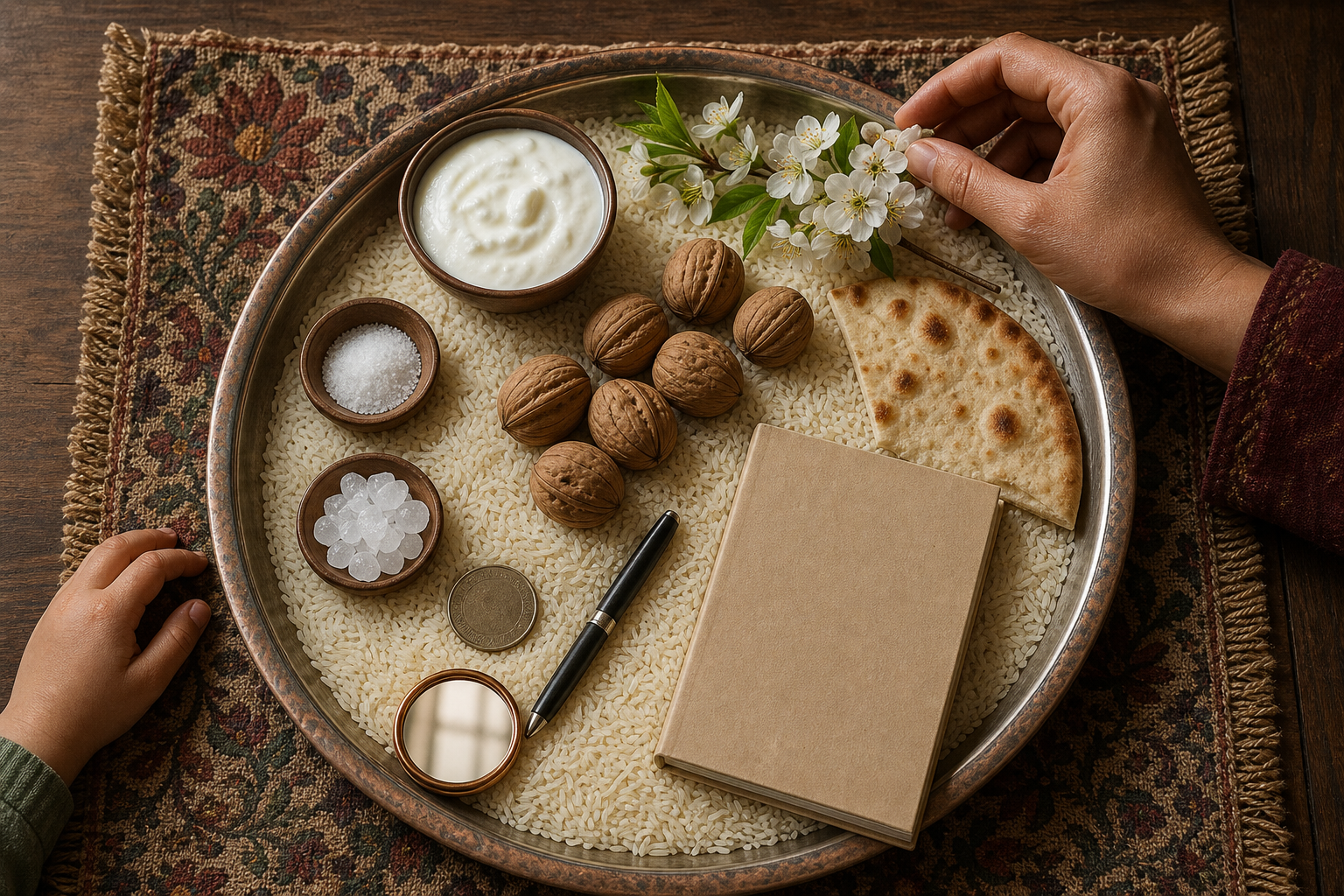
The Navreh thaal is meant to be the year’s first considered sight. Its power does not come from turning every possible object into a compulsory checklist. Contents differ among families. The important discipline is to assemble a coherent image of the life you intend to cultivate, then meet that image at dawn with an attentive mind.
A customary arrangement begins with uncooked rice and may include a mirror, flowers, walnuts or other nuts, salt, coins, a notebook and pen, curd or milk, and the new Panchang. In this ritual grammar, rice and dairy suggest nourishment, flowers vitality, salt sufficiency and integrity, coins material responsibility, writing materials learning, and the almanac an ordered relationship with sacred time. The mirror brings the arrangement back to the observer: the year you are asking for must also be lived by the person looking into it.
- Prepare without hurry. Clean the chosen place and assemble the thaal the previous evening if that will protect the morning from distraction. Use your inherited household arrangement where one exists.
- Keep the first sight intentional. At local dawn, approach the thaal after personal cleanliness and before letting messages, news or routine work occupy your attention.
- Look before you list demands. Notice the mirror and each object. Frame the moment as self-examination and gratitude, not as a transaction in which ritual objects guarantee results.
- Read the Panchang selectively. Note the sunrise tithi, nakshatra, yoga and karana, then mark the vratas your household will actually keep. Traditional Aaya Vyaya 2026–2027 indications are best treated as prompts for prudence and reflection, not deterministic financial predictions.
- Continue with your family’s devata practice. A brief prayer to Devi or Shiva, a lamp, incense and prasad may follow. Devotees connected to Kashmir’s sacred geography may turn especially toward Sharika Devi at Hari Parbat, whether through a visit or remembrance from afar.
- Make abundance outward-facing. Add dana, hospitality or a simple act of service. This keeps prosperity from becoming merely decorative symbolism on the thaal.
If your family begins Chaitra Navratri on the same morning, decide in advance what you can sustain for all nine days. A modest daily lamp, mantra or reading kept consistently is more coherent than an elaborate opening followed by neglect. Let the Navreh notebook hold that commitment, along with one practical household resolution involving learning, spending, service or sadhana.
The meal can remain seasonal and satvik rather than ostentatious. Kashmiri choices may include haakh, modur pulao, nadru yakhni and simple sweets. Choose the dishes that belong naturally to your household and circumstances; cultural continuity is carried by memory, method and shared attention, not by an unnecessarily large menu.
Use 25 March to practise reading a changing tithi
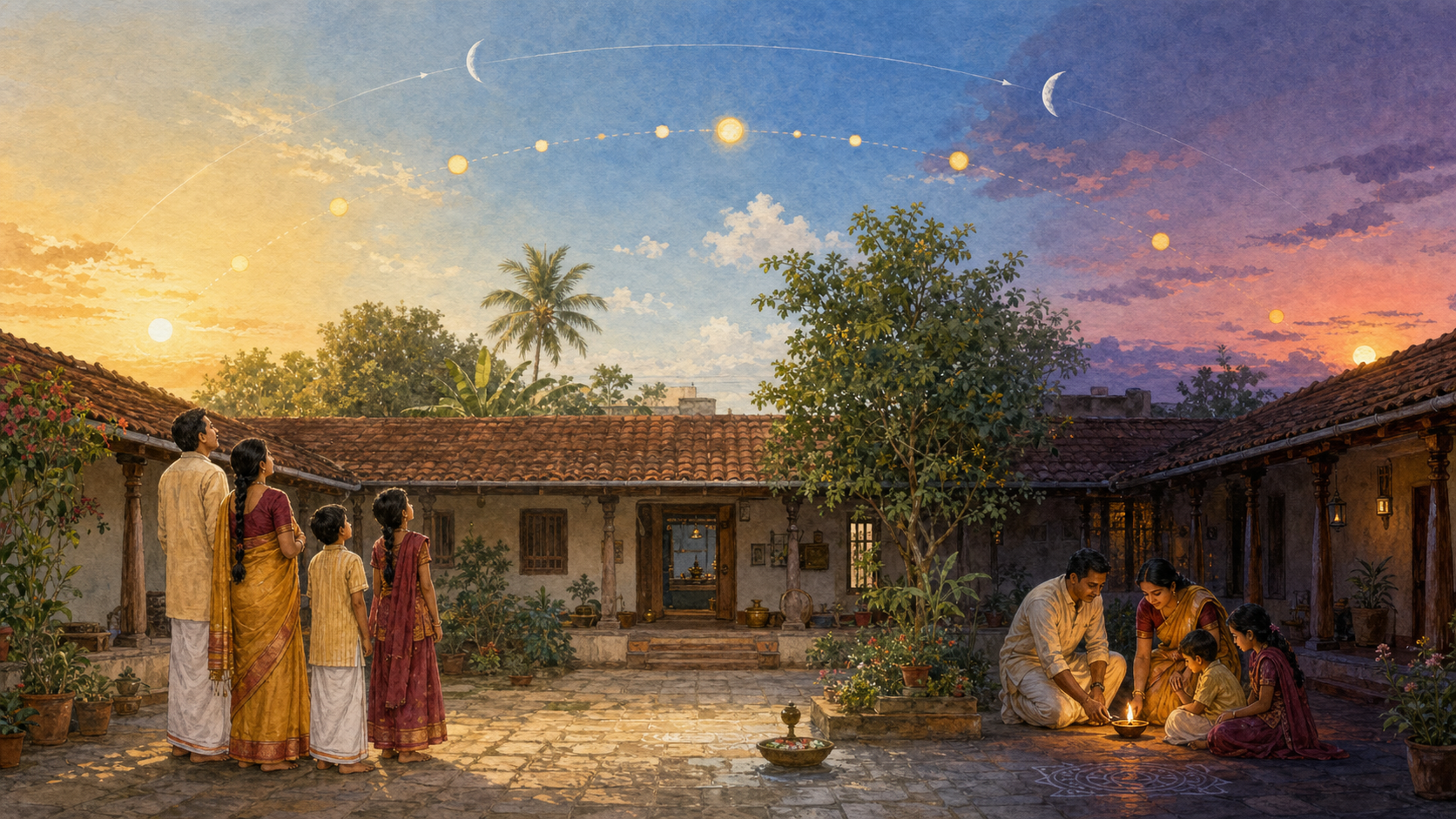
Wednesday, 25 March is a particularly clear Panchang lesson because Shukla Saptami is present first and Shukla Ashtami begins during the afternoon. You do not have to assign the entire civil date a single spiritual tone.
Use the Saptami portion for Surya-oriented practice. At sunrise, offer arghya if that belongs to your practice, recite Aditya Hridayam or perform Surya Namaskar. Complete any sankalpa that specifically requires Saptami before the locally confirmed boundary. Because the weekday is Budhavara, this portion of the day also suits focused study, writing, communication, accounts and practical organisation.
After Ashtami begins, turn toward Devi upasana, japa or contemplative reading centred on Shakti. The transition is not a reason to abandon ordinary responsibilities. It is an invitation to change the quality of attention: from outward clarity and solar order toward purification, boundaries and disciplined inner work.
If you need a general auspicious period, Brahma Muhurta is placed approximately 96 minutes before local sunrise and is classically a 48-minute span. It is suited to meditation and study. Abhijit Muhurat is centred on local solar noon, roughly 24 minutes on either side, and can serve urgent undertakings when a more specific muhurta is unavailable. Godhuli, the softer twilight period, can be reserved for prayer or a reconciliatory conversation. All three depend on local solar timing rather than a clock table copied from another city.
Wednesday’s avoided intervals can also be calculated without guessing fixed clock times. Take the interval from local sunrise to local sunset and divide it into eight equal segments. On Wednesday, Yamaganda occupies the second segment, Gulika the fourth and Rahu Kalam the fifth. Avoid initiating a major journey, agreement or milestone during those windows when your tradition observes them. Existing work does not have to stop merely because an avoided interval has begun.
Do not infer nakshatra or Moon rashi from the Saptami-to-Ashtami time. Tithi measures the Moon–Sun relationship, while nakshatra and rashi depend on the Moon’s position in their own divisions. A day may cross a nakshatra boundary independently of its tithi change. For a samskara, griha-pravesha, temple commitment or another consequential muhurta, use the locally calculated nakshatra and rashi at the actual starting time.
Key takeaways for your March observance
- In India, keep Navreh on 19 March 2026; outside India, first confirm that Chaitra Shukla Pratipada prevails at your local sunrise.
- Navreh opens Laukika 5102 and coincides with the first day of Chaitra Navratri.
- Prepare the thaal as a deliberate household sankalpa, using inherited family practice before generic checklists.
- Read annual Panchang indications as aids to reflection and planning, not as guarantees or fatalistic verdicts.
- On 25 March, use the Saptami period for Surya practice and the Ashtami period for Devi-centred sadhana; verify the local transition rather than assuming 4:29 PM applies everywhere.
- Calculate Brahma Muhurta, Abhijit Muhurat and Wednesday’s avoided daylight segments from local sunrise and sunset.
Before March begins, make one concrete family decision: settle the local Navreh date, assign the thaal preparation, and write a sustainable nine-day practice in the notebook that will sit on it. Then the calendar will do what it is meant to do—not merely label sacred time, but help you enter it consciously.
References
- DharmaRenaissance Blog — March 25, 2026 Panchang: Shukla Paksha Saptami to Ashtami, Auspicious Times, Nakshatra, Rashi
- DharmaRenaissance Blog — Navreh 2026 (Laukika 5102): Sacred Kashmiri New Year Date, Rituals, Meaning, and Unity
