

You hear a priest pause during a yajña, another voice answers with a short oṃ, and the rite moves on. If you are wondering whether you should answer too, the apparent simplicity is misleading. A correct syllable spoken by the wrong person, or at the wrong cue, is not the same ritual act.
Pratigara gives that moment its grammar. It is a designated reply that confirms readiness and allows a particular part of the rite to proceed. Once you learn to notice the cue, the respondent, and the action that follows, a Vedic yajña stops looking like an uninterrupted stream of Sanskrit and begins to reveal its carefully coordinated structure.
Key takeaways: follow the cue, assent, and act
- Pratigara names a ritual function: a formally placed response or assent. It is not necessarily one fixed word in every tradition.
- The basic pattern is cue → designated response → recitation or action.
- Oṃ or astu may serve as the response at specified points, but neither word is automatically a pratigara wherever it is spoken.
- The identity of the speaker, the timing, the vocal manner, and the ritual school all matter.
- If you have not been assigned a response, attentive silence is usually more appropriate than copying the priests.
The most useful definition is therefore operational: pratigara is the authorized reply within a ritual exchange. It receives a cue, confirms that the relevant participant is ready, and closes the gap between an instruction and its execution.
A schematic oblation sequence makes the pattern easier to see. The adhvaryu may give an injunction such as yaja. A designated member of the hotṛ group supplies a concise assent, which in some traditions may be oṃ or astu. The yājyā recitation then reaches the vaṣaṭ call, and the offering proceeds with svāhā. This is a map of the relationship among the speech acts, not a universal script to be imposed on every yajña.
That qualification matters. Forms and cue-points vary by śākhā and rite. The invariant is not a single vocabulary item but the ordered relationship: someone calls, the proper person responds, and the sanctioned act follows.
Pratigara coordinates the four priestly functions
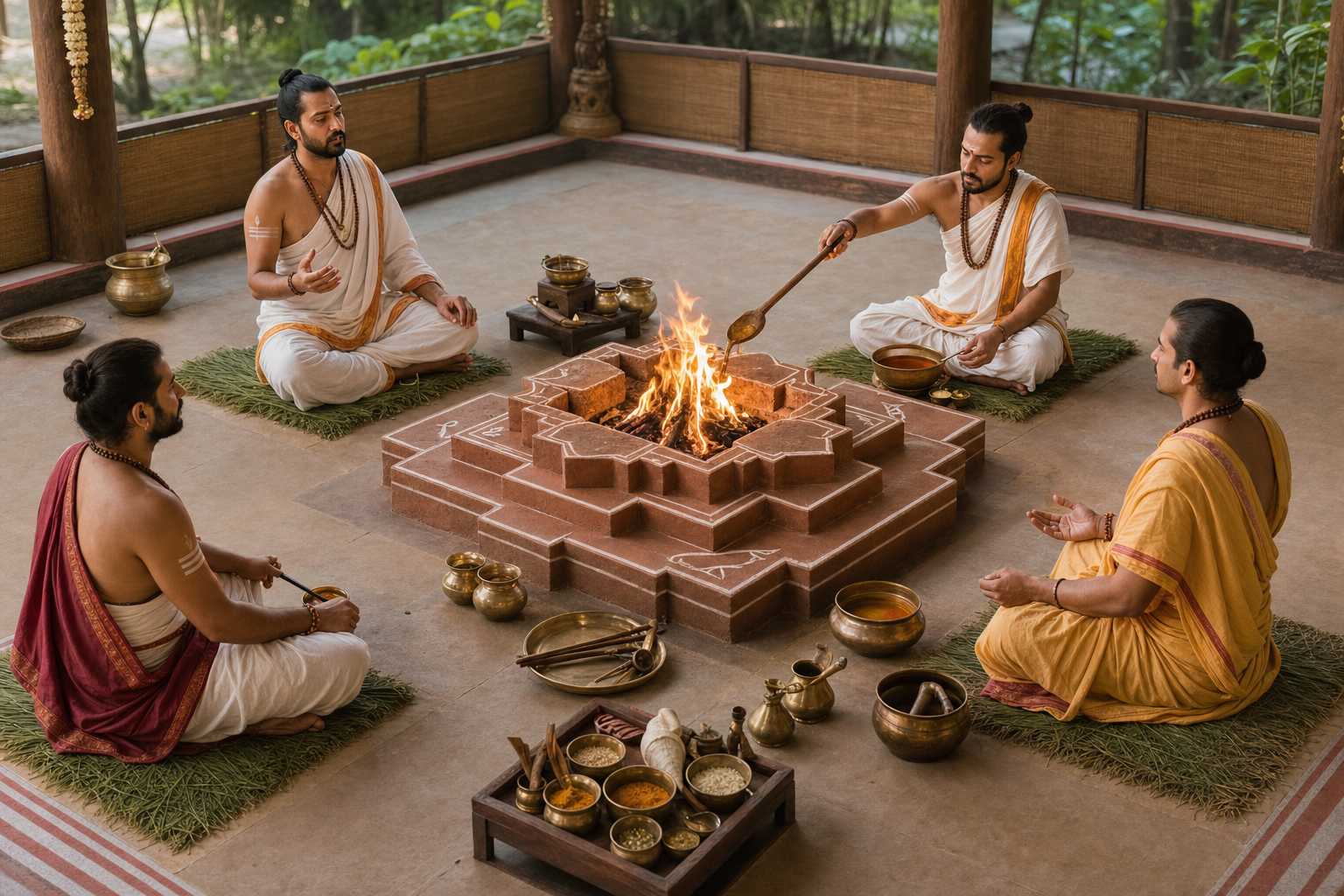
A formal Vedic yajña distributes responsibility rather than placing every mantra and action in one pair of hands. The four principal priestly functions divide recitation, physical execution, chant, and oversight:
- Hotṛ: recites the Ṛgvedic verses assigned to the rite.
- Adhvaryu: performs the physical operations and voices the relevant Yajurvedic directions and formulae.
- Udgātṛ: leads the Sāmavedic chants.
- Brāhmaṇ: watches the performance as a whole and oversees its correctness.
Pratigara is not a fifth priestly office. It is one of the synchronizing speech acts that connect these specialized roles. A cue announces that one part of the ritual system is ready. The response confirms that the next responsible participant has heard and accepted it. The following recitation, chant, or offering can then begin without ambiguity.
You can think of it as a ritual handshake, provided the analogy is not taken too casually. A handshake in a technical protocol prevents one operation from racing ahead of another. Pratigara similarly prevents a complex rite from becoming several simultaneous but disconnected performances. Its brevity is a strength: the response carries only what the moment requires—recognition, readiness, and assent.
This also explains why pratigara is more than congregational enthusiasm. The respondent is not merely showing approval of a religious sentiment. The utterance belongs to an assigned relationship among priestly acts. Its authority comes from its position in that relationship.
Why speaker, timing, voice, and accent all matter
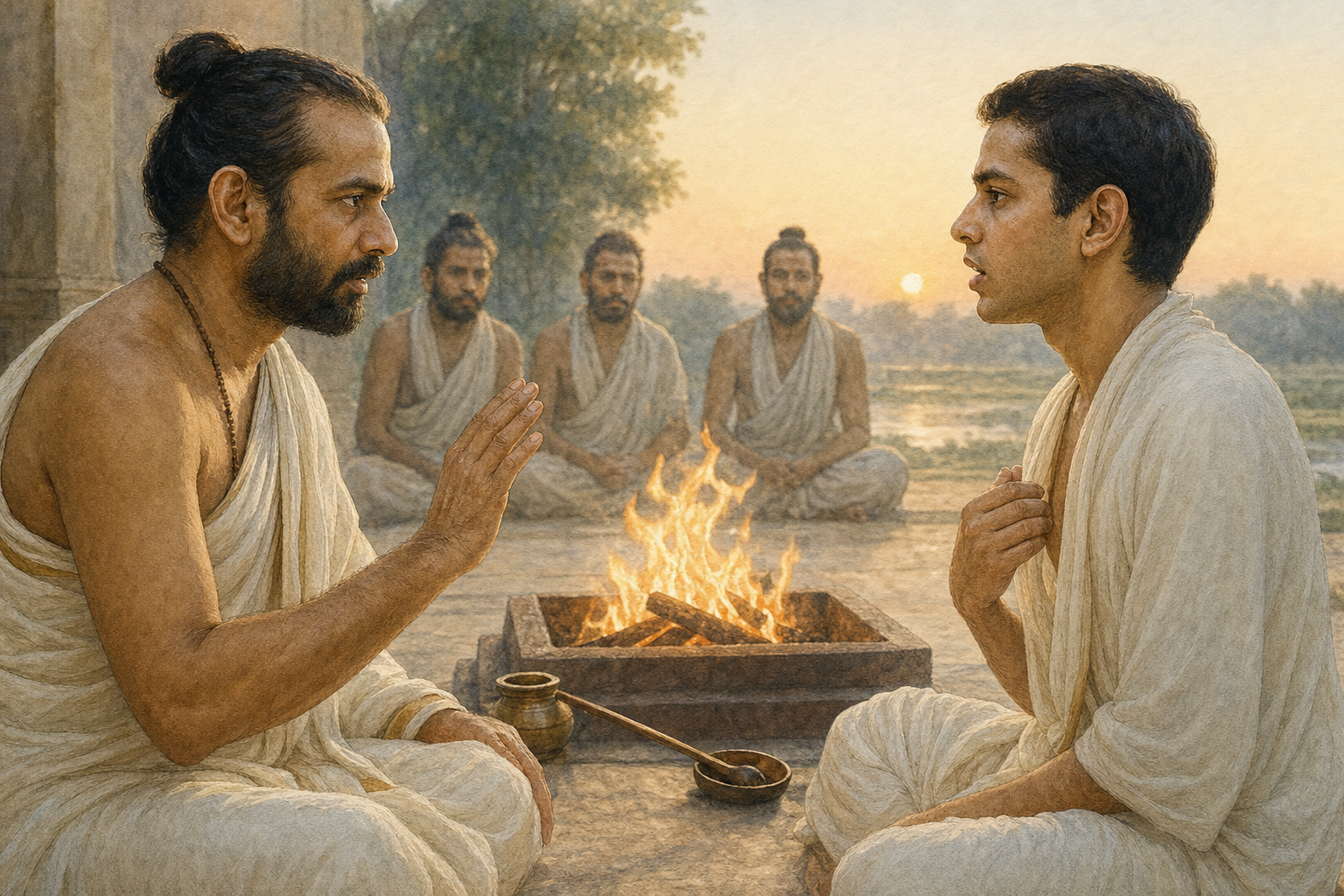
In ordinary conversation, a delayed “yes” may still count as agreement. In yajña, timing is part of the meaning. A response given before its cue anticipates an act that has not yet been ritually opened; one given too late fails to join the action at its prescribed point.
Volume matters as well. Vedic performance distinguishes audible recitation from quieter modes such as nigada, used for murmured formulae, and upāṃśu, a sub-vocal manner of recitation. An audible pratigara can mark acknowledged assent, but you should not infer that every sacred formula is meant to be projected to the assembly. The mode of delivery is assigned along with the words.
Pronunciation alone is therefore not enough. Training also covers svara, cadence, the exact entry point, and the relationship of the response to the next action. If you are learning a priestly role, make a five-column note for every pratigara you encounter:
- Cue: What exact word, verse ending, gesture, or action opens the response?
- Respondent: Which priest or priestly group is authorized to answer?
- Formula: What syllable or expression does this śākhā prescribe?
- Vocal mode: Is it audible, murmured, or sub-vocal, and what accent is required?
- Consequence: What recitation, chant, offering, or movement follows immediately?
This grid is more reliable than memorizing an isolated translation such as “assent.” It teaches you the complete speech-act rather than only its dictionary meaning.
The brāhmaṇ priest’s oversight provides another safeguard. When a cue or response is misplaced, the rite does not invite spontaneous repair from everyone present. A prescribed correction may be required. If you make an error as a participant, stop and follow the officiant’s direction; adding an improvised mantra can compound the sequencing problem the correction is meant to resolve.
Formal study must remain specific to the ritual school and its oral discipline. Textual anchors include the Śatapatha Brāhmaṇa, Taittirīya Saṃhitā, Kātyāyana Śrauta Sūtra, Āpastamba Śrauta Sūtra, allied Brāhmaṇas, and the Gṛhya Sūtras. They do not supply one interchangeable transcript for all settings. A śākhā-specific paddhati and a competent teacher are necessary when you move from recognizing the structure to performing it.
How to participate without mistiming the response
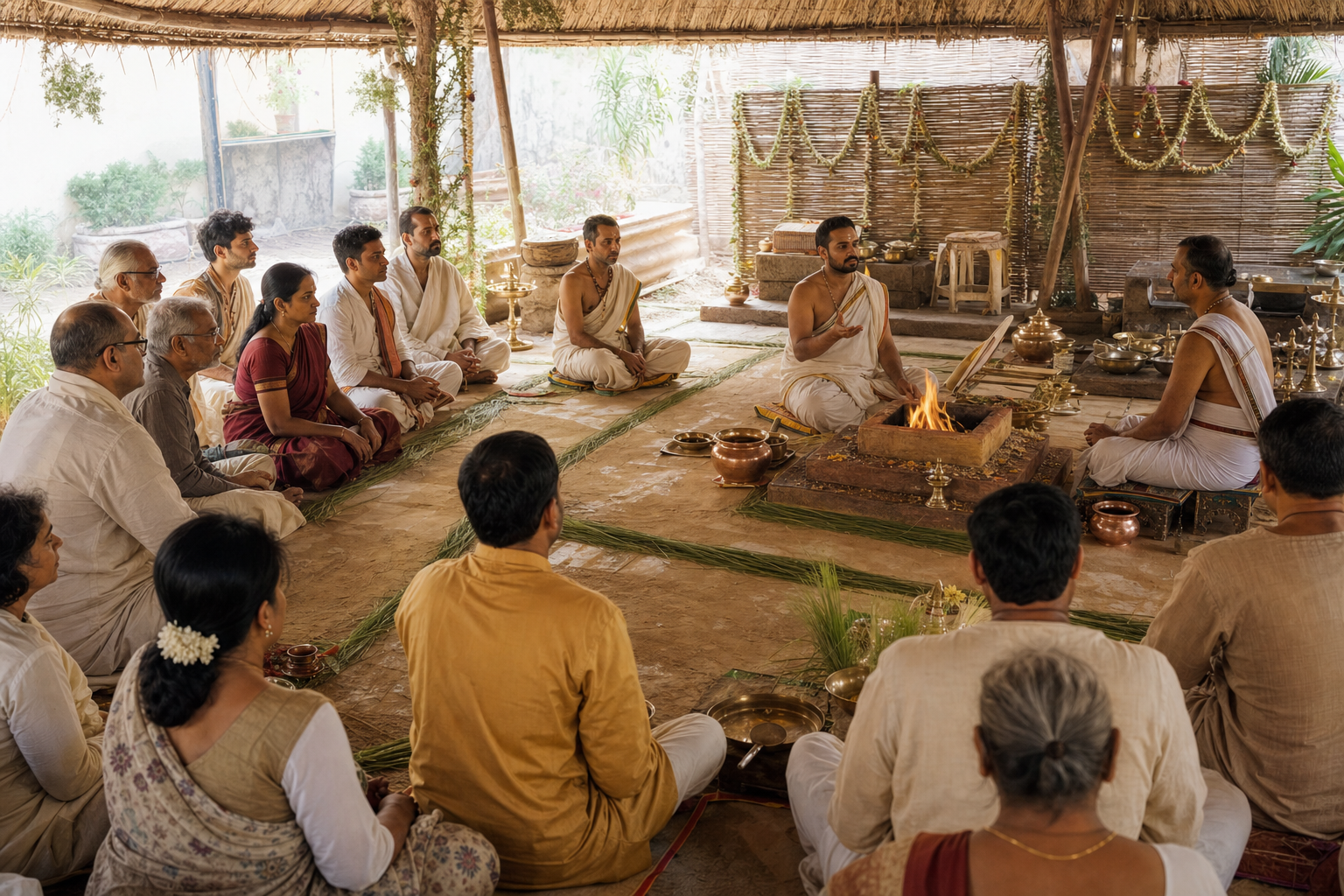
A domestic homa, a temple havan, and a full Śrauta performance do not assign speech in exactly the same way. The logic of call and response may remain recognizable, but the congregation’s role can range from repeated communal utterances to complete silence. Use this sequence whenever you attend or help organize a rite:
- Ask before the fire is kindled. Find out whether participants are expected to say oṃ, svāhā, tathāstu, or nothing. Ask for the cue as well as the word.
- Identify the leader you will follow. In a group setting, one clearly designated priest or caller prevents participants from responding to different pauses.
- Repeat only the assigned formula. Do not import a response remembered from another family, temple, recording, or ritual school.
- Enter after the cue, not while it is being spoken. A response is meaningful partly because it receives something already uttered.
- Stop when your assigned part ends. Oṃ, vaṣaṭ, and svāhā may stand close together in the wider sequence, but that does not make them interchangeable invitations for the whole gathering.
If you are organizing a public havan, a brief spoken rehearsal is more useful than printing a long transliteration without stage directions. Give participants three pieces of information: the exact cue they will hear, the exact response they should make, and the action that follows. One trial exchange before the formal rite can prevent a roomful of premature replies.
If you are attending only as an observer, listen for the pattern rather than trying to catch every syllable. Notice who initiates the exchange, who answers, and whether a chant, gesture, or offering follows. That method lets you recognize pratigara even when you do not yet know the full mantra sequence.
What pratigara is not, and what its “yes” accomplishes
Several similar-looking Sanskrit terms belong to different ritual categories. Keeping them separate prevents basic errors:
- Pratigara is the designated responsive assent within a liturgical exchange.
- Pratigraha means acceptance or receipt, especially the acceptance of a gift. It is not the name of this priestly reply.
- Pratihāra can designate a reprise or section within Sāmavedic strophic performance. It should not be substituted for pratigara when describing assent.
- Vaṣaṭ and svāhā belong to the movement toward and performance of the offering. Their presence near a response does not turn them into synonyms for pratigara.
- Oṃ has many sacred uses. It functions as pratigara only when its assigned place in the rite makes it the responsive authorization.
The last distinction is especially useful. You identify pratigara by function, not by sound alone. An oṃ that opens contemplation, begins a recitation, or bears an Upaniṣadic meaning is not automatically a ritual response. The same syllable becomes pratigara when it answers the appropriate cue and authorizes the next step.
This precision points to a larger Vedic understanding of vāc. Speech in yajña does not merely describe an intention formed elsewhere. Properly assigned speech helps enact it. Saṃkalpa, injunction, response, and offering form a continuous movement toward ṛta and satya. Pratigara is the point at which inward willingness becomes audible and coordinated with the deed.
You can notice a family resemblance in other Dharmic settings: the affirming sādhu heard in Buddhist and Jain assemblies, the Sikh call “Jo bole so nihāl” and answer “Sat Sri Akal,” and the responses of Hindu kīrtan. These practices are not technically the same rite, and resemblance alone does not prove an identical historical origin. What they share is a civilizational appreciation for voiced participation: sacred understanding is received, affirmed, and embodied together rather than left as private thought.
At the next yajña you attend, track three things: who gives the cue, who has authority to answer, and what happens immediately afterward. Do that before you join the words. You will not only avoid an untimely response; you will begin to hear the ritual as the disciplined conversation it is.
References
