
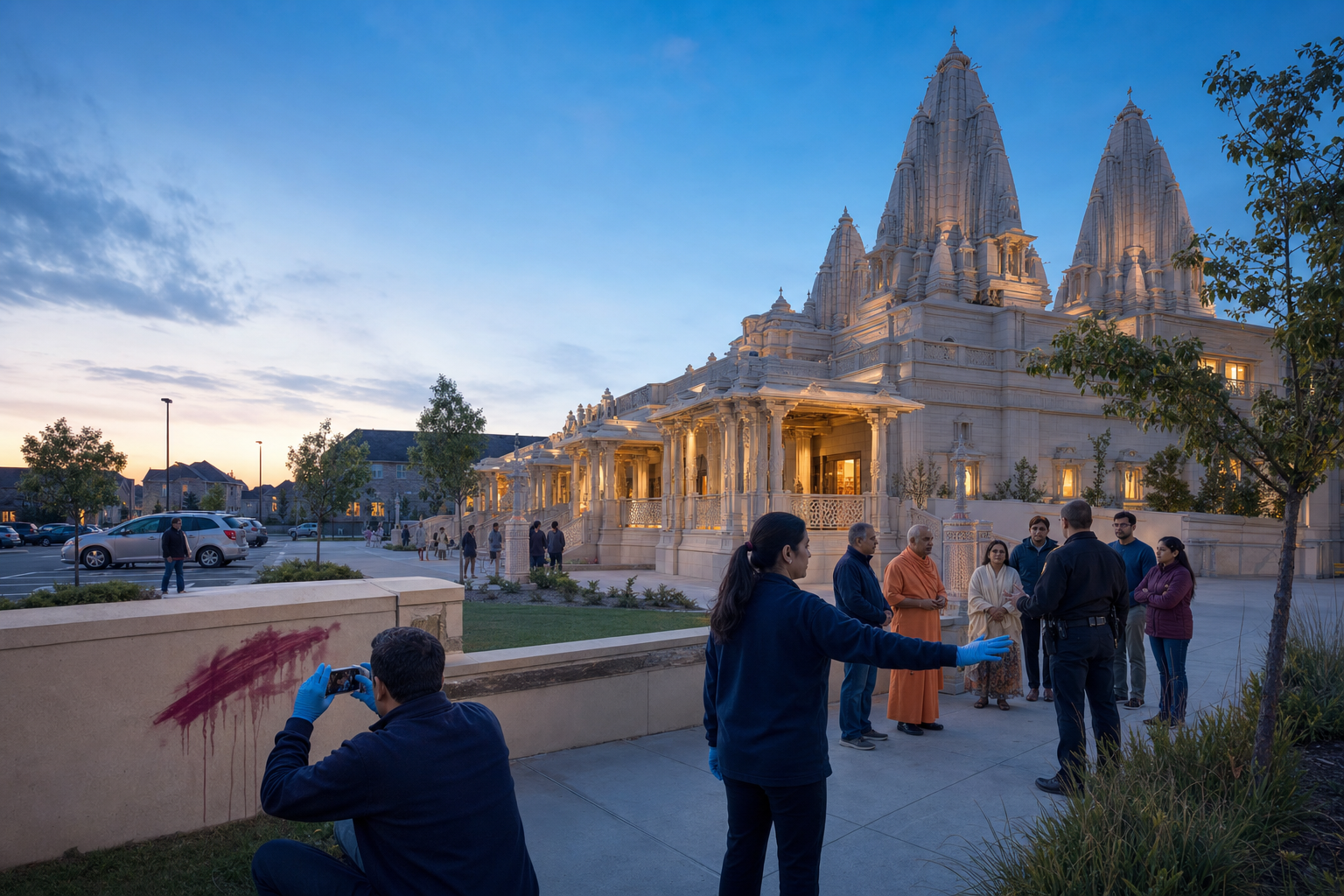
If your mandir is facing hostile zoning comments, an online threat, or fresh graffiti, the first decision is not what to post on social media. It is what kind of problem you are looking at. A parking question, anti-Hindu abuse, and criminal damage may appear in the same controversy, but they require different evidence, messengers, and remedies.
Your aim is to protect worshippers, preserve the temple’s legal position, and keep reasonable neighbors from being absorbed into a conflict created by its loudest participants. This is a practical framework, not advice for an individual legal matter. Land-use rules and criminal laws vary by jurisdiction, so involve a qualified U.S. attorney when a permit deadline, binding condition, threatened lawsuit, or criminal investigation is at stake. If anyone faces immediate danger or a specific threat, contact emergency services and follow law-enforcement instructions.
Key takeaways for temple leaders and volunteers
- Classify the issue before answering it: ordinary land-use concern, discriminatory rhetoric, or possible crime and safety threat.
- Keep a land-use file and a security-incident file. Mixing them makes both harder to use.
- For zoning, insist on the same measurable standards applied to comparable religious and secular assemblies.
- After vandalism or a threat, protect people first and preserve physical and digital evidence before cleaning, repairing, or replying online.
- Answer neighbors with site plans, schedules, and named points of contact. Do not let a hostile hashtag become the public record.
- Build police, dharmic, and interfaith relationships before a crisis. A contact tree assembled during an incident is already late.
Separate civic objections, Hinduphobia, and criminal conduct
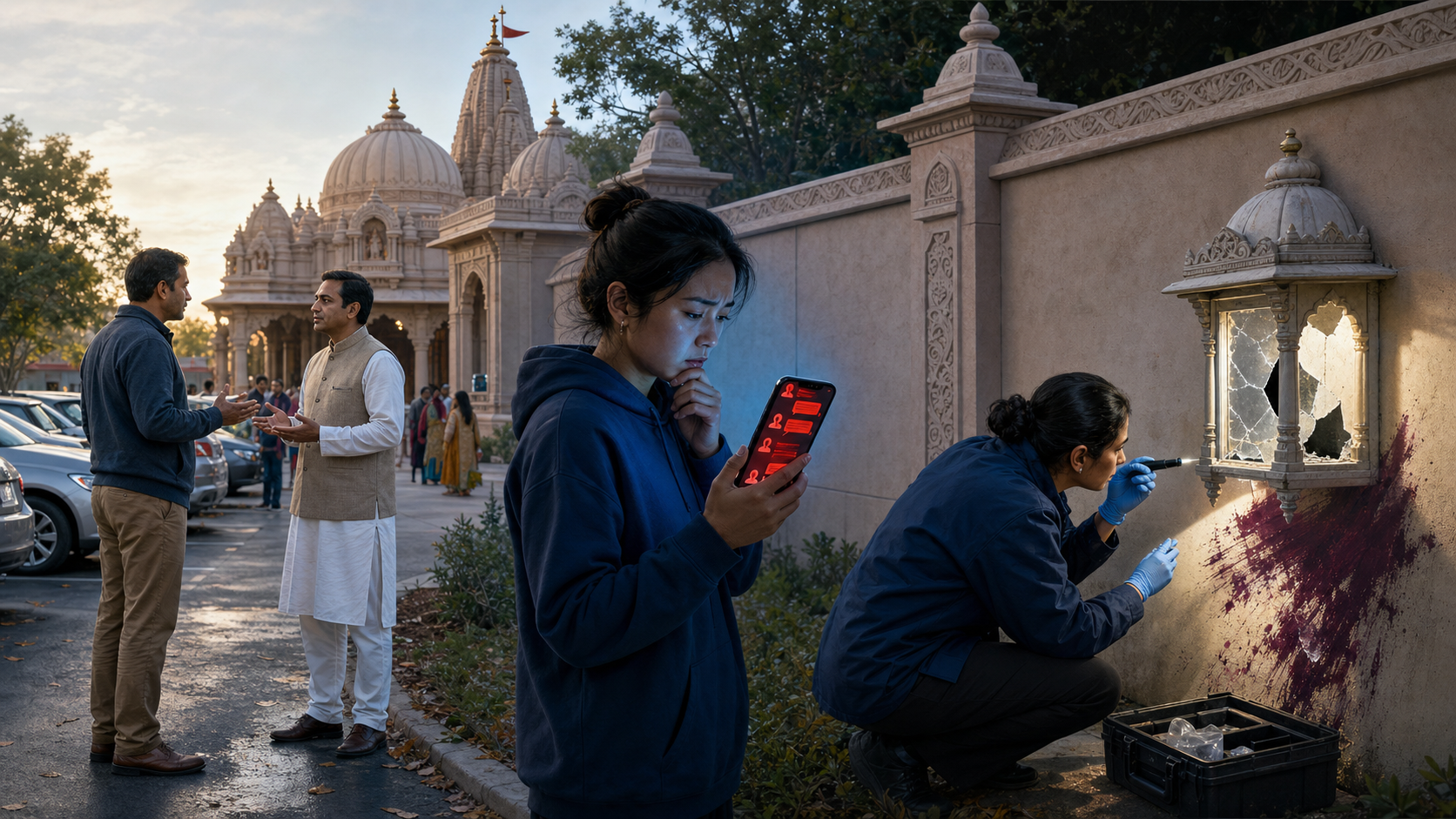
A recent Ganesha temple controversy in the Dallas–Fort Worth area showed how quickly questions about development can turn into claims that a Hindu institution is erasing the surrounding culture. The distinction matters. A neighbor asking how festival traffic will be managed has raised a question that can be answered. A commenter treating Hindu worship itself as foreign, corrosive, or politically suspect has moved from impact analysis to prejudice.
| What you are seeing | What distinguishes it | Your first response |
|---|---|---|
| Ordinary land-use concern | The question concerns parking, traffic, storm water, emergency access, occupancy, hours, or sound and would also make sense for a church, community hall, or another comparable assembly. | Answer with plans, operating schedules, professional analysis, and the same neutral standards used for comparable properties. |
| Discriminatory rhetoric | The objection singles out Hindu identity, murtis, rituals, ethnicity, immigration, or demographic change rather than a documented site impact. | Archive the statement, correct material falsehoods, and calmly restate that religious identity is not a land-use impact. |
| Possible crime or safety threat | There is vandalism, damaged sacred property, trespass, stalking, targeted intimidation, a threat, or conduct that obstructs worship. | Secure people and the scene, preserve evidence, notify law enforcement, obtain a report number, and involve counsel or insurance as appropriate. |
Do not call every skeptical question Hinduphobia. That can alienate residents whose practical concerns are answerable and weaken the force of the term when actual hostility appears. But do not translate an identity-based objection into a harmless traffic concern merely to avoid discomfort. A demand that the temple reduce congestion can be tested. A claim that Hindu presence displaces legitimate local culture is not traffic evidence.
The legal boundary is also important. The First Amendment can protect speech that is ignorant, insulting, or hostile. It does not immunize violence, vandalism, or true threats; those acts may activate federal and state protections for religious property and worshippers. Temple volunteers should document conduct accurately rather than trying to decide by themselves whether a prosecutor can prove a hate crime.
Build a zoning record that tests equal treatment
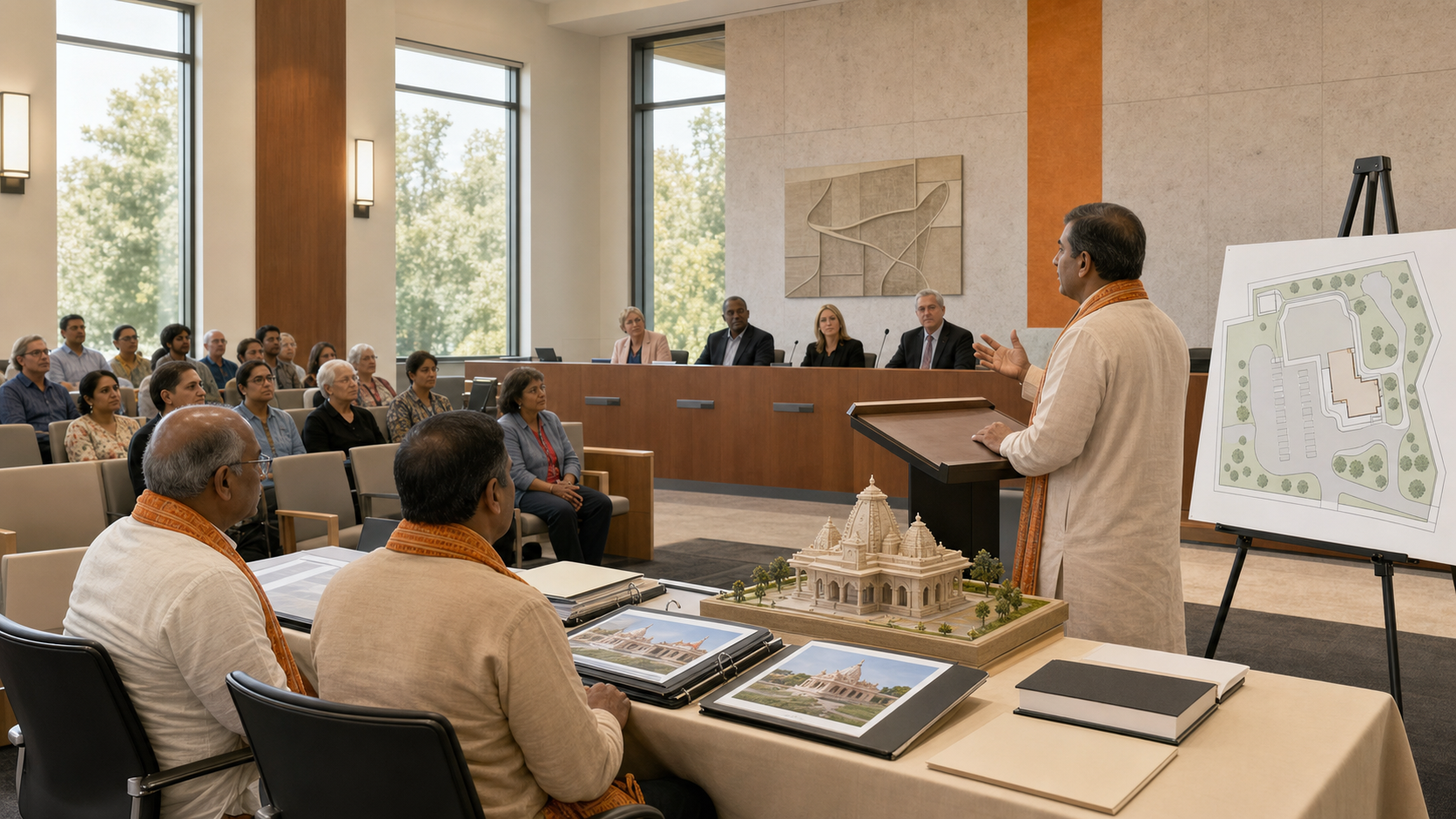
A temple does not gain stronger rights by denying every possible impact. It gains credibility by addressing real impacts while refusing unequal treatment. The First Amendment protects religious exercise, and the Religious Land Use and Institutionalized Persons Act of 2000, usually called RLUIPA, supplies additional land-use safeguards. Among other protections, RLUIPA addresses substantial burdens on religious exercise, unequal treatment of religious assemblies, religious discrimination, and unreasonable exclusion. A permit denial is not automatically unlawful, but a municipality cannot make Hindu worship carry burdens that comparable assemblies do not.
The strongest permit file is created before the public hearing. Build it in this order:
- Meet planning staff before filing. Ask which standards apply, which professional studies are expected, how major-event attendance should be represented, and which departments must review the plan. Confirm important answers in writing.
- Identify honest comparators. Look for churches, synagogues, mosques, gurdwaras, meeting halls, schools, recreation facilities, or community centers with similar capacity, schedules, parking needs, and surrounding roads. A comparator is useful because its operational profile is similar, not merely because it is nearby.
- Commission the studies the site actually needs. Traffic circulation, parking, storm-water management, emergency access, occupancy, and acoustic design should be addressed by qualified professionals where required. A generic claim that temples are quiet does not answer a site-specific question.
- Separate normal operations from peak festivals. Show ordinary hours, expected high-attendance occasions, overflow parking, pedestrian routes, accessible access, emergency lanes, volunteer traffic control, rideshare arrangements, and any staggered scheduling the temple can reliably maintain.
- Ask that every proposed condition be tied to a documented impact. A narrowly framed parking or landscaping condition is different from an open-ended restriction based on generalized fear. Have counsel review any binding condition before accepting it.
- Preserve the complete record. Keep applications, plan revisions, staff comments, hearing notices, correspondence, meeting minutes, comparator approvals, public statements, and dated screenshots. Record observable facts; do not assign motives that the evidence cannot establish.
A useful equal-treatment question is simple: would the city demand this study, setback, parking ratio, operating restriction, or hearing from a secular assembly of comparable size and use? The answer still depends on local facts, but the question exposes whether officials are measuring impacts or reacting to religious identity.
Temple representatives should also avoid making promises that operations cannot sustain. If volunteers cannot guarantee off-site parking every weekend, do not place that assurance in a binding plan. Offer controls that are measurable, funded, and realistic. A credible commitment survives a change of board members.
Respond to threats or vandalism without losing evidence
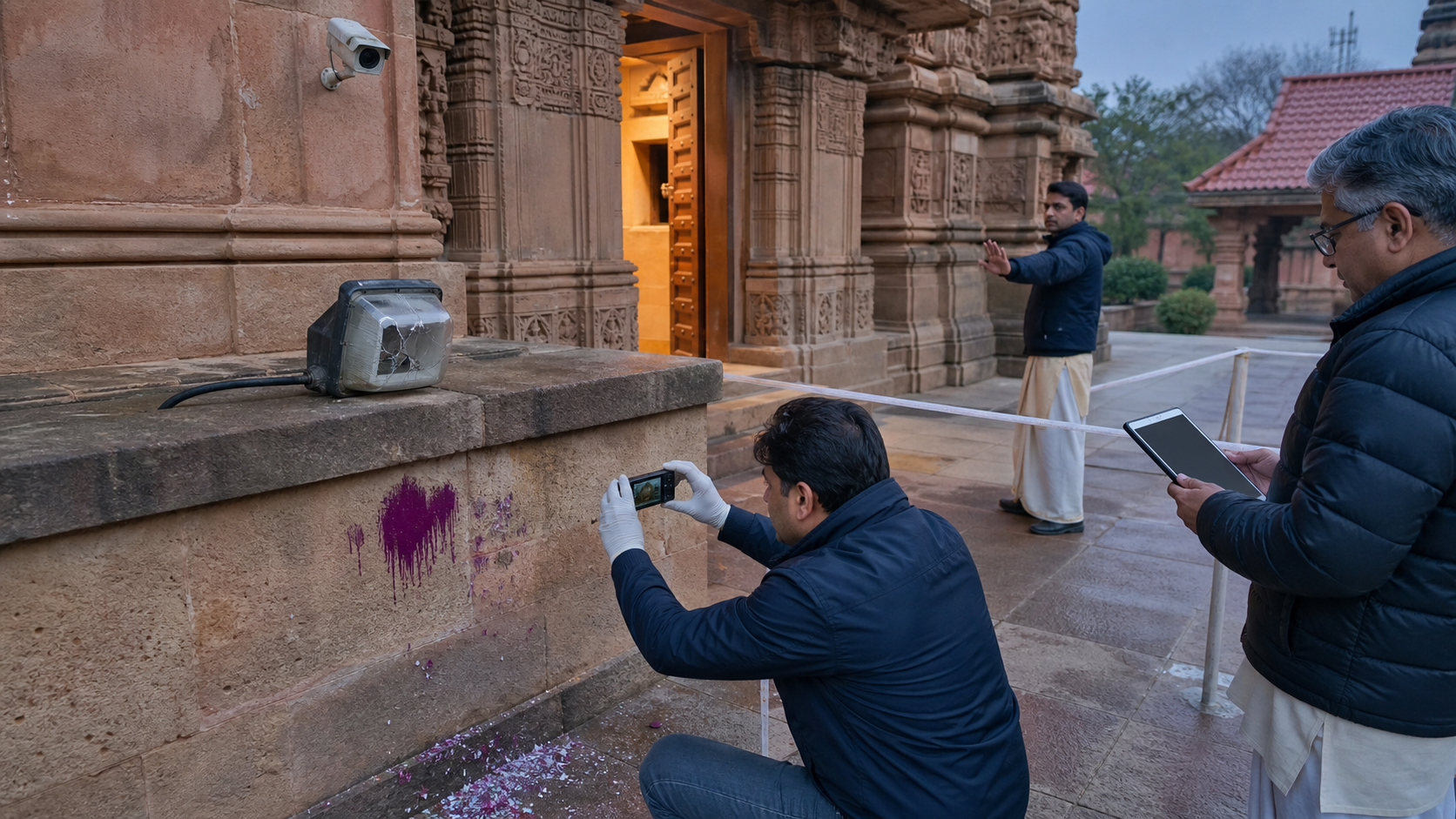
When a murti, sign, wall, vehicle, or entrance has been defaced, the natural impulse is to clean it quickly. Pause long enough to preserve evidence unless leaving the material in place creates an immediate danger. Repair matters, but an erased camera file, discarded object, or scrubbed inscription may not be recoverable.
- Protect people. Move congregants away from danger, do not confront a suspected offender, and contact emergency services if the threat is immediate. Preserve access for police and emergency personnel.
- Preserve the scene. Take wide and close photographs without unnecessarily handling damaged items. Note who discovered the incident, when it was found, what had changed, and the exact location of damage. Do not rely on memory formed after a stressful event.
- Export digital evidence. Save relevant camera footage before the system overwrites it. Preserve the original files as well as working copies. Capture threatening posts, usernames, profile links, message headers, dates, and the surrounding conversation; a cropped screenshot can omit context investigators need.
- Make a police report. Give investigators the observable facts and any apparent bias indicators, such as anti-Hindu words, targeted sacred symbols, repeated contact, or links to earlier threats. Ask for the incident or report number and the appropriate follow-up contact.
- Ask about the correct investigative path. Intentional damage to religious property or force and threats obstructing religious exercise may raise 18 U.S.C. § 247, while state hate-crime provisions differ. Local investigators, prosecutors, federal authorities, and counsel must determine which law fits the evidence.
- Notify the insurer before non-emergency repairs when the policy requires it. Retain photographs, invoices, repair estimates, security expenses, and records of interrupted events. Emergency measures needed to keep people safe should not wait for a communications strategy.
- Use one incident liaison. That person should maintain the chronology, coordinate with police, counsel, insurers, and temple leadership, and prevent volunteers from publishing sensitive evidence or unverified accusations.
Recorded anti-Hindu events make up a relatively small portion of religion-based hate-crime statistics, but a small national count does not make a local threat harmless. Underreporting and inconsistent categorization remain practical concerns, especially for smaller congregations without trained reporting contacts. Reporting creates a record that can connect repeat incidents across locations; it should be accurate even when the motive is not yet known.
Prevention should be layered and proportionate. A security audit can examine lighting, cameras, doors, key control, alarm procedures, festival entry, emergency communications, and the protection of children and seniors. Volunteer greeters should know whom to call and what not to touch after an incident. The Department of Homeland Security’s Nonprofit Security Grant Program can support eligible security measures such as cameras, access controls, and training, but temple leaders should verify the current application rules for the relevant funding cycle.
Indian consular contacts may help with liaison and community reassurance when diaspora safety is implicated, but consular involvement does not replace an emergency call, a local police report, insurance notice, or legal counsel. Put each contact in the plan for the job it can actually perform.
Control the public record and make the temple harder to isolate
Online backlash often grows in an information vacuum. A partial site plan or decontextualized image circulates, a slogan compresses several grievances into one accusation, and repetition makes a fringe view look representative. The answer is not an endless argument with anonymous accounts. It is a reliable public record that residents, journalists, officials, and partners can inspect.
Publish a project page with the current rendering, site plan, permit status, ordinary schedule, major-event calendar, parking and traffic arrangements, sound controls, emergency access, and a dedicated contact address. Date every update. When a plan changes, retain the earlier version or explain the change so an old screenshot cannot be presented as a concealed proposal.
A short public response can hold the right boundary: Questions about traffic, parking, sound, and safety will receive factual answers through the temple’s project page and community contact. Abuse directed at Hindu identity will not determine the permit record, and threats or vandalism will be preserved and reported to the appropriate authorities.
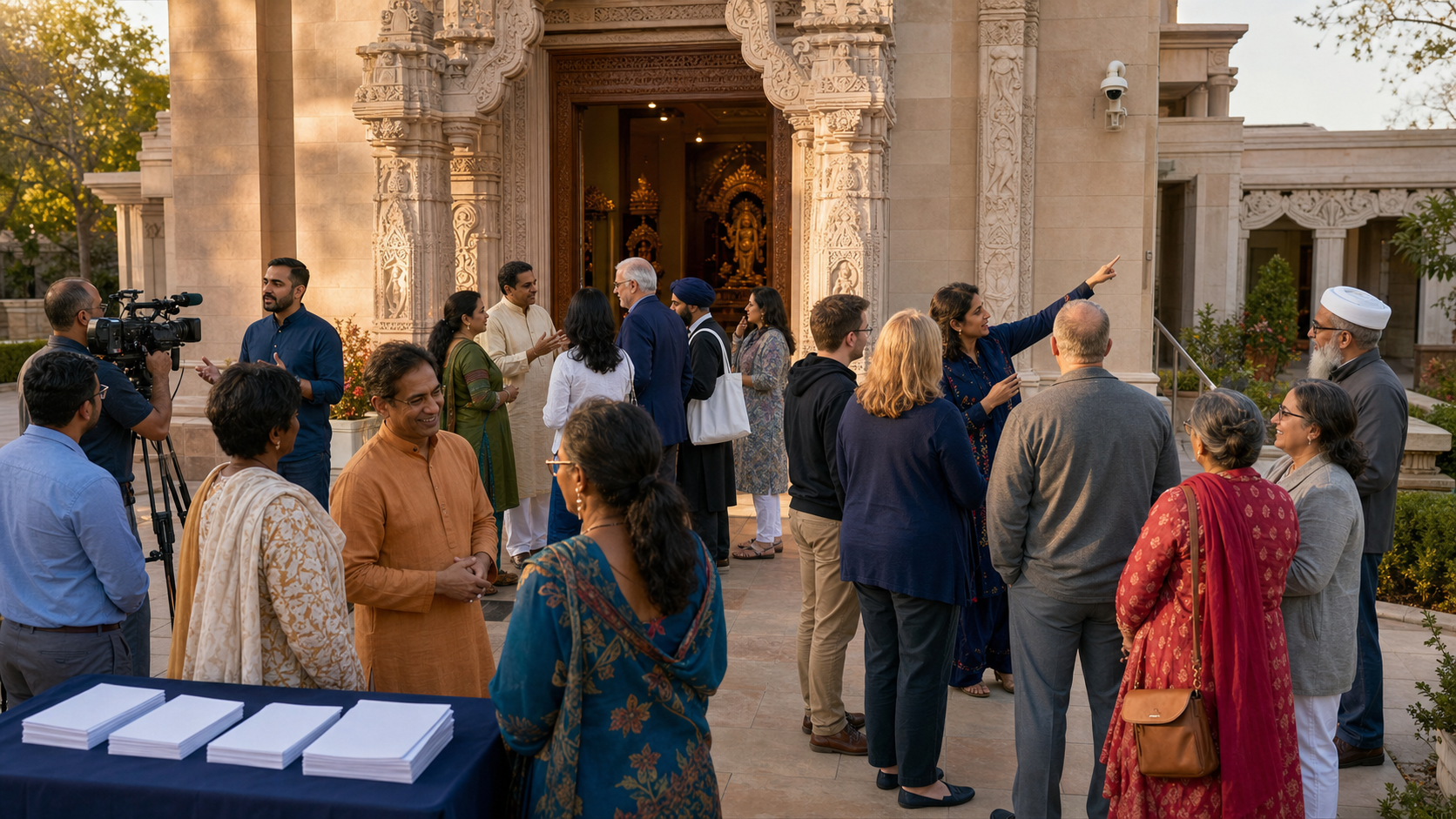
Invite nearby residents to a site walk-through before the most consequential hearing. Show entrances, parking flow, landscaped buffers, and festival arrangements on the ground. Record each practical question and publish the answer. Do not require a neighbor to understand Hindu theology before receiving a clear answer about a driveway.
At the same time, do not act as if a mandir must earn constitutional protection through good works. Religious freedom is a right, not a reward for charity. Seva still matters because visible service creates durable civic relationships. Food drives, blood-donation camps, tutoring, youth mentorship, health initiatives, and cultural education allow neighbors to know the congregation through shared work rather than hostile commentary.
Make solidarity operational. Hindu temples, Sikh gurdwaras, Jain derasars, and Buddhist viharas can share security training, vetted repair contacts, grant-writing knowledge, evidence-preservation templates, and backup worship space. Christian, Jewish, Muslim, and other congregations may already know how to manage expansion hearings, overflow parking, vandalism recovery, and police liaison. Ask for named contacts and specific cooperation, not just a general endorsement.
A dharmic response should be firm without turning collective blame against another faith or ethnicity. Ahimsa is not passivity, and pluralism is not silence. Protect the worshipper, the sacred space, the evidence, and the legal record while refusing the same stereotyping being directed at the temple.
At the next board meeting, put three living documents on the agenda: a land-use response sheet, an incident protocol, and a partner contact tree. Give each one an owner and a backup. The temple is least vulnerable when its rights, evidence, and relationships are ready before the next hearing, festival, or hostile message.
References
- Struggle for Hindu Existence — Culture Erased: New Hindu Temple in Texas Sparks Online Backlash Amid Rising Tensions
- Struggle for Hindu Existence — India Rebuts USCIRF’s Selective Claims, Urges Action on Hindu Temple Attacks in the U.S.
