
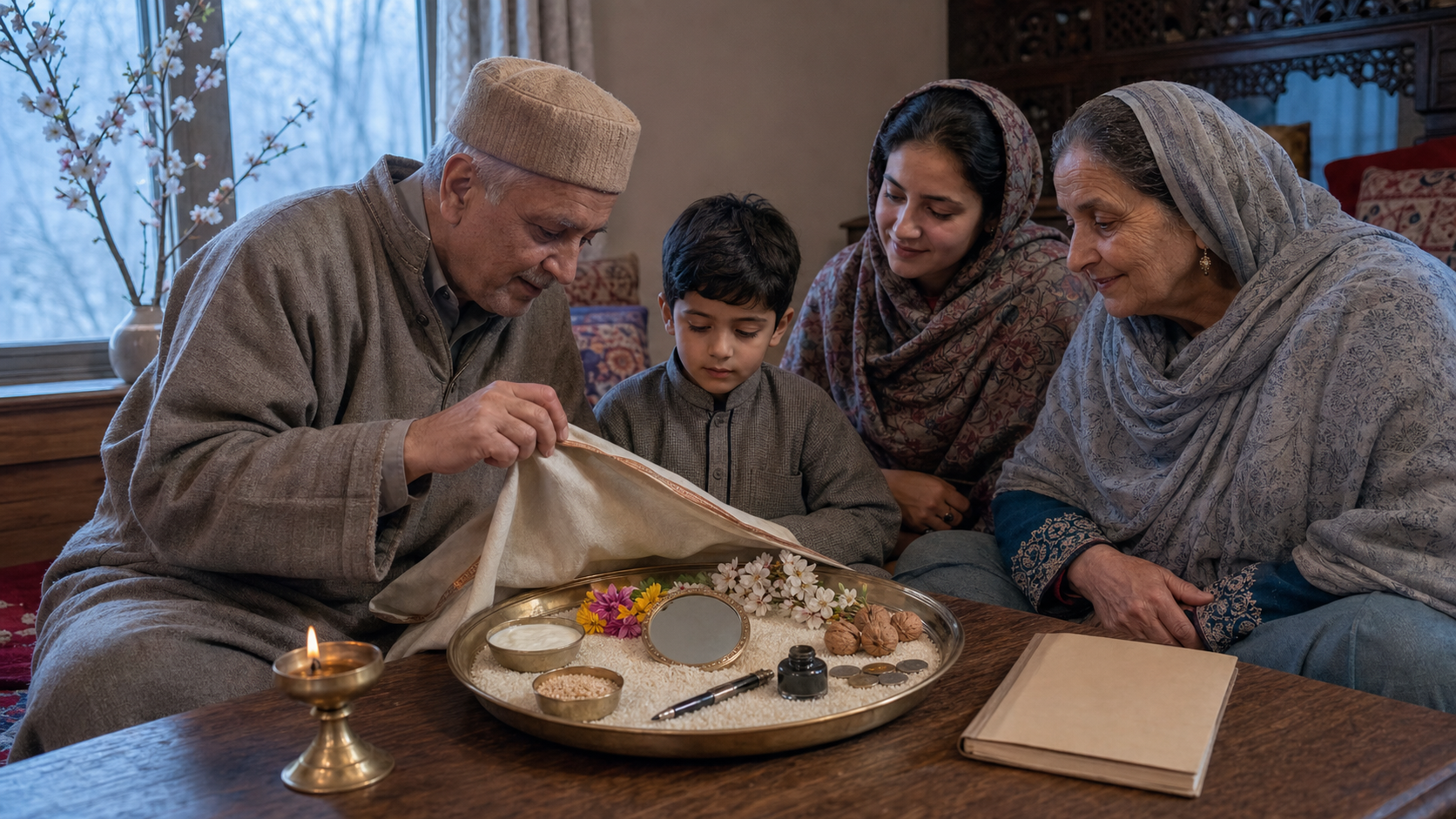
If your family calendar marks Chaitra Navratri from March 19 to March 27, but an almanac shows Ashtami ending after midday on March 26, there is no contradiction. The civil date tells you which page of the calendar you are on; the tithi tells you when a particular observance belongs. For a Kashmiri Pandit household, there is another essential layer: the opening day is Navreh, the Kashmiri New Year.
You can plan the festival without turning it into a calendrical puzzle. Fix the dates, use one location-based panchang for exact timings, preserve the Navreh thaal and family customs, and let the nine days form one continuous discipline rather than nine unrelated ceremonies.
The 2026 calendar: what to put on your family schedule
Most North Indian panchang calculations place Chaitra Navratri 2026 from Thursday, March 19 through Friday, March 27. March 19 is Chaitra Shukla Pratipada and Navreh. March 27 carries the principal Sri Rama Navami observance in most regions, subject to Navami prevailing during the local Madhyahna period.
| Civil date | Navratri focus | Useful household cue |
|---|---|---|
| March 19 | Navreh and Shailaputri | View the Navreh thaal at daybreak, establish the altar where customary, and make the family’s sankalpa. |
| March 20 | Brahmacharini | Begin the chosen vrata and settle on a manageable daily recitation. |
| March 21 | Chandraghanta | Join serenity to courage; do not let festival preparation create agitation at home. |
| March 22 | Kushmanda | Keep the worship space bright, clean, and uncluttered. |
| March 23 | Skandamata | Bring children and younger relatives into the practice through explanation, not merely instruction. |
| March 24 | Katyayani | Connect worship with a concrete act of righteous conduct or generosity. |
| March 25 | Kalaratri | Use prayer to face fear and difficulty without surrendering discipline. |
| March 26 | Mahagauri and the Ashtami-to-Navami transition | Follow the household or temple decision for Kanya Pujan; prepare for Sri Rama Navami. |
| March 27 | Siddhidatri and Sri Rama Navami | Complete the Devi observance and turn toward Rama bhakti during the appropriate local worship period. |
This is a planning calendar, not a universal clock-time schedule. A tithi is determined by the changing angular separation of the Moon and Sun, not by midnight. Each tithi covers 12 degrees of separation. Ashtami occupies the interval above 84 degrees through 96 degrees; Navami begins after that separation passes 96 degrees. That is why one civil day can contain parts of two tithis.
Key takeaways
- Reserve March 19 for Navreh and the opening of Chaitra Navratri.
- Treat March 26 as a transition day: Ashtami prevails first, followed by Navami.
- Expect the principal Sri Rama Navami observance on March 27 in most regions, but verify that Navami covers Madhyahna in your location.
- Choose the day for Kanya Pujan through family parampara and the calendar followed by your community or temple.
- Use one trusted, location-based panchang throughout the festival instead of switching between calendars when their clock times differ.
Navreh begins with a thaal, but its purpose is renewal
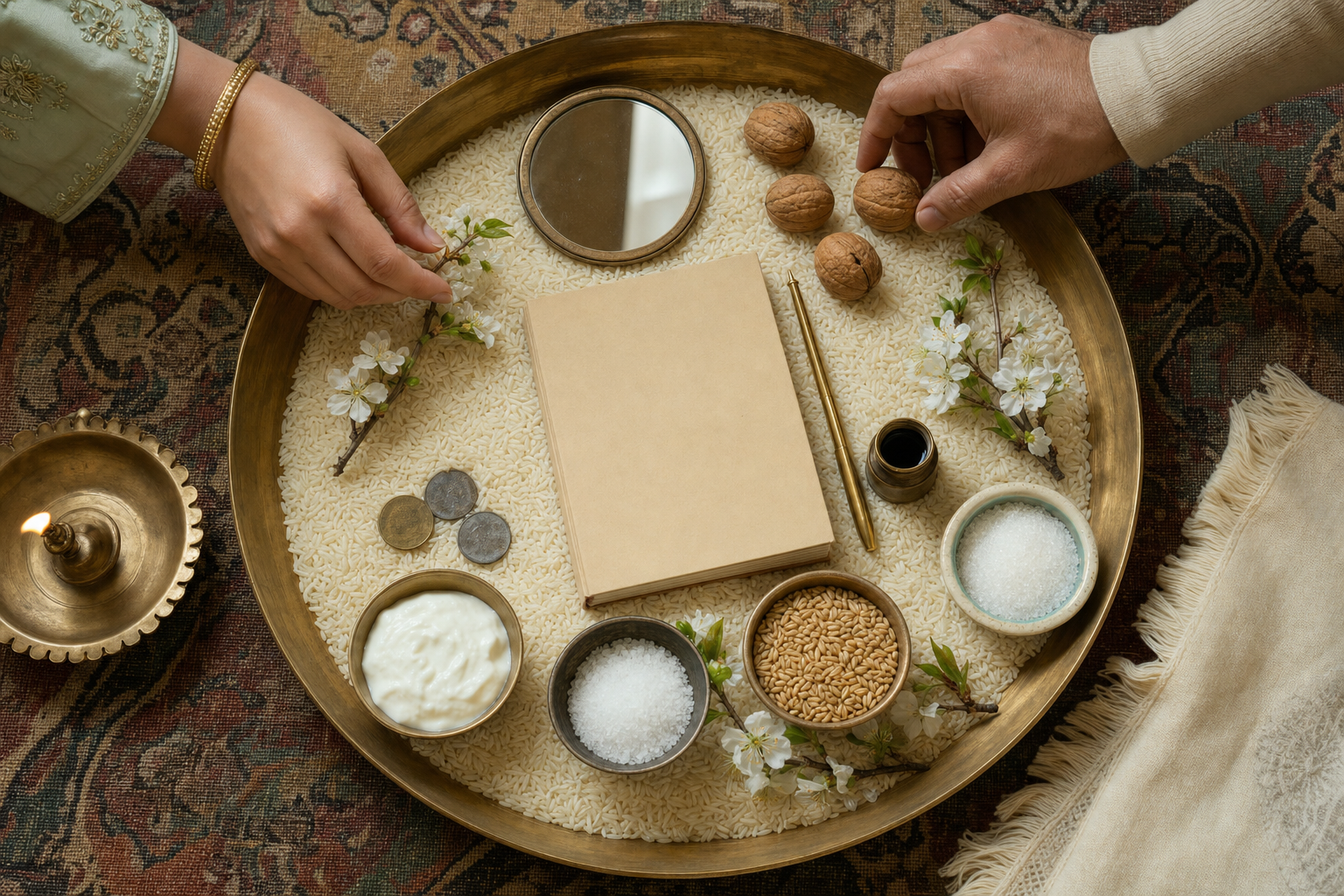
Navreh is more than a regional name attached to the first day of Navratri. It is the Kashmiri New Year, a springtime threshold, and an occasion for a family to renew its relationship with dharma, learning, ancestry, and ordered time. The customary Navreh thaal viewed at daybreak gives those ideas a visible form.
- Have the thaal ready before daybreak. If your family preserves a particular arrangement, use it rather than replacing it with a generic decorative display.
- Place rice for abundance; a coin or gold ornament for prosperity; a pen and inkpot for learning; a mirror for self-examination; a calendar or panchang for disciplined timekeeping; and seasonal flowers for freshness and renewal.
- Let the thaal be the first deliberate sight of the morning. Keep the moment unhurried enough for younger family members to understand what they are seeing.
- Ask an elder to explain at least one object and the family memory attached to it. This turns a photographed ritual into transmitted knowledge.
- Make the year’s sankalpa concrete. A commitment to regular study, dana, truthful conduct, or steadier family worship gives the symbols somewhere to land.
The mirror deserves particular attention. It is not there to encourage vanity; it makes self-scrutiny part of the new year. The panchang likewise does more than supply festival dates. It places personal intention inside a larger rhythm of tithi, season, worship, and community life.
For families in or near Srinagar, worship of Sharika Bhagwati at Hari Parbat remains a central expression of Navreh devotion. Teher, the familiar turmeric-yellow rice, may be presented as naivedya. Confirm the shrine’s darshan arrangements and accepted offerings locally rather than assuming that a household schedule or an earlier year’s routine still applies.
If you live outside Kashmir, do not measure the authenticity of Navreh by how elaborately you can reproduce a shrine visit. Prepare the thaal faithfully, perform home worship, speak with relatives, and preserve the meanings your family actually inherited. Continuity depends more on understanding and repetition than on spectacle.
Make the nine days one sustainable sadhana
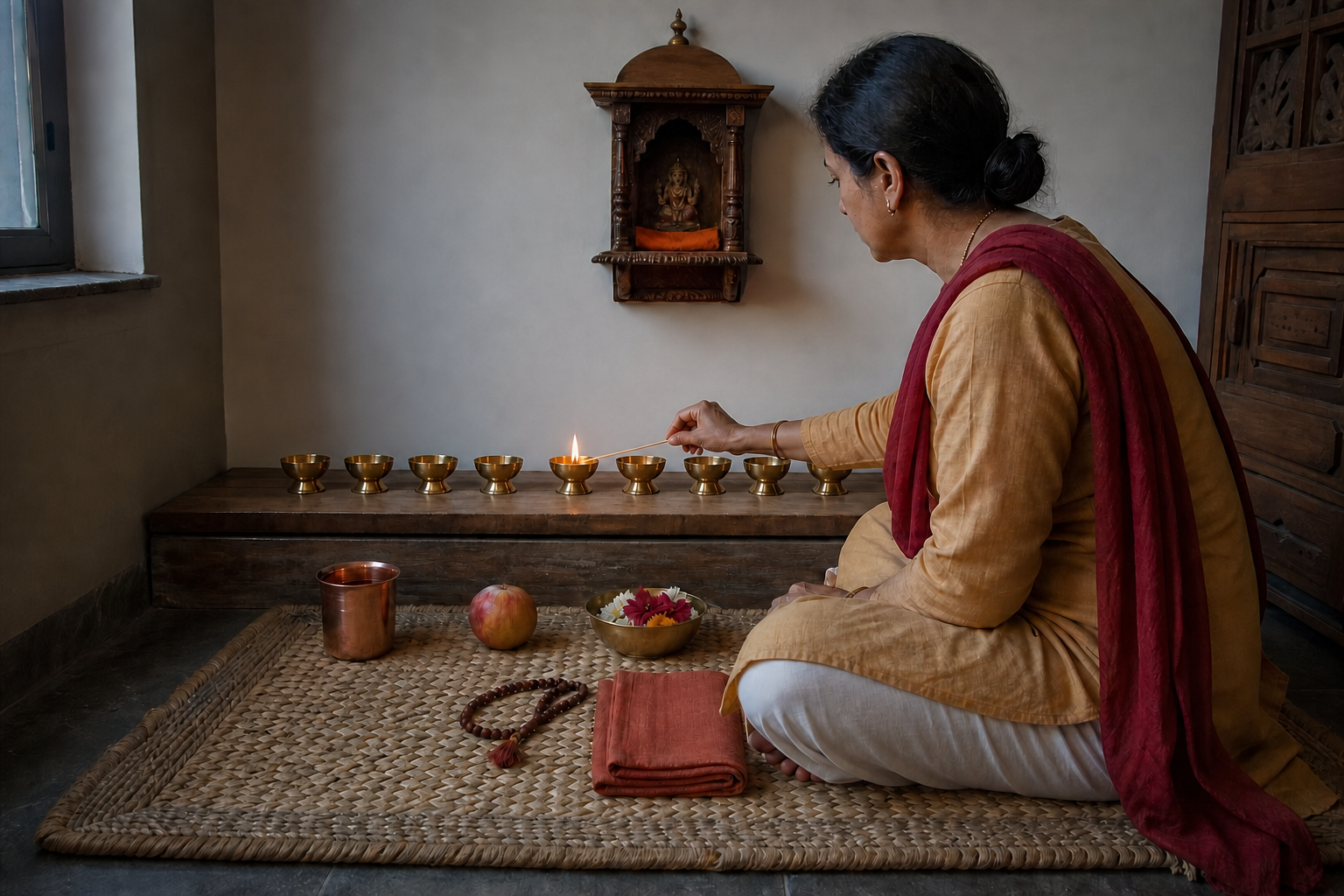
The sequence from Shailaputri to Siddhidatri can guide an inward progression: grounded strength, disciplined study, calm valor, radiance, nurturing wisdom, righteous courage, protection from fear, purity, and fulfillment. You do not need a different elaborate ceremony every day. You need a daily form that the household can keep without resentment or haste.
A workable daily rhythm
- Begin with a clean altar and the customary morning upasana. Perform ghat sthapana if it belongs to your household practice and can be maintained properly.
- Choose a stable recitation. This may be a portion of the Durga Saptashati, Lalita Sahasranama, familiar Devi hymns, or the prayers followed in your family. A modest portion completed attentively is more useful than an ambitious plan abandoned halfway.
- Close the day with aarti, a short reflection on the day’s Devi, and preparation for the next morning. A brief homa can be included where the family has the practice and knowledge to conduct it.
The ethical vrata belongs beside the ritual one. Satya, ahimsa, and dana prevent Navratri from shrinking into altar management. Choose an act you can verify in your own conduct: repair an avoidable untruth, restrain needless harshness, share food, assist a relative, or support someone facing difficulty. The point is not to advertise virtue but to align action with worship.
Keep the food discipline clear and proportionate
Kashmiri Pandit vrat food during Chaitra Navratri generally follows the wider North Indian pattern. Common choices include fruit, milk, sabudana, kuttu or buckwheat, singhada flour, and sendha namak. Grains, onions, and garlic are commonly left aside during the fast. Follow the form established in your household, since families may differ in the number of fasting days and the foods they accept.
The purpose of restraint is to quieten the senses and make worship more attentive. It is not a competition in deprivation. If a full vrata is not appropriate for someone, a simpler sattvik discipline can preserve the devotional intention without turning the family table into a test of status.
Simple choices also fit the festival’s reverence for Prakriti. Use local and seasonal ingredients where possible, carry reusable vessels for offerings, avoid single-use plastic at shrines, and choose biodegradable decorations. A clean altar should not produce a bag of unnecessary waste outside it.
Handle Ashtami, Kanya Pujan, and Rama Navami by tithi
March 26 is the date most likely to create confusion. Shukla Ashtami prevails until approximately 2:11 PM, after which Shukla Navami begins. The exact local clock time can vary slightly with the panchang method and observer’s location, so 2:11 PM is a practical baseline rather than a substitute for your local calculation.
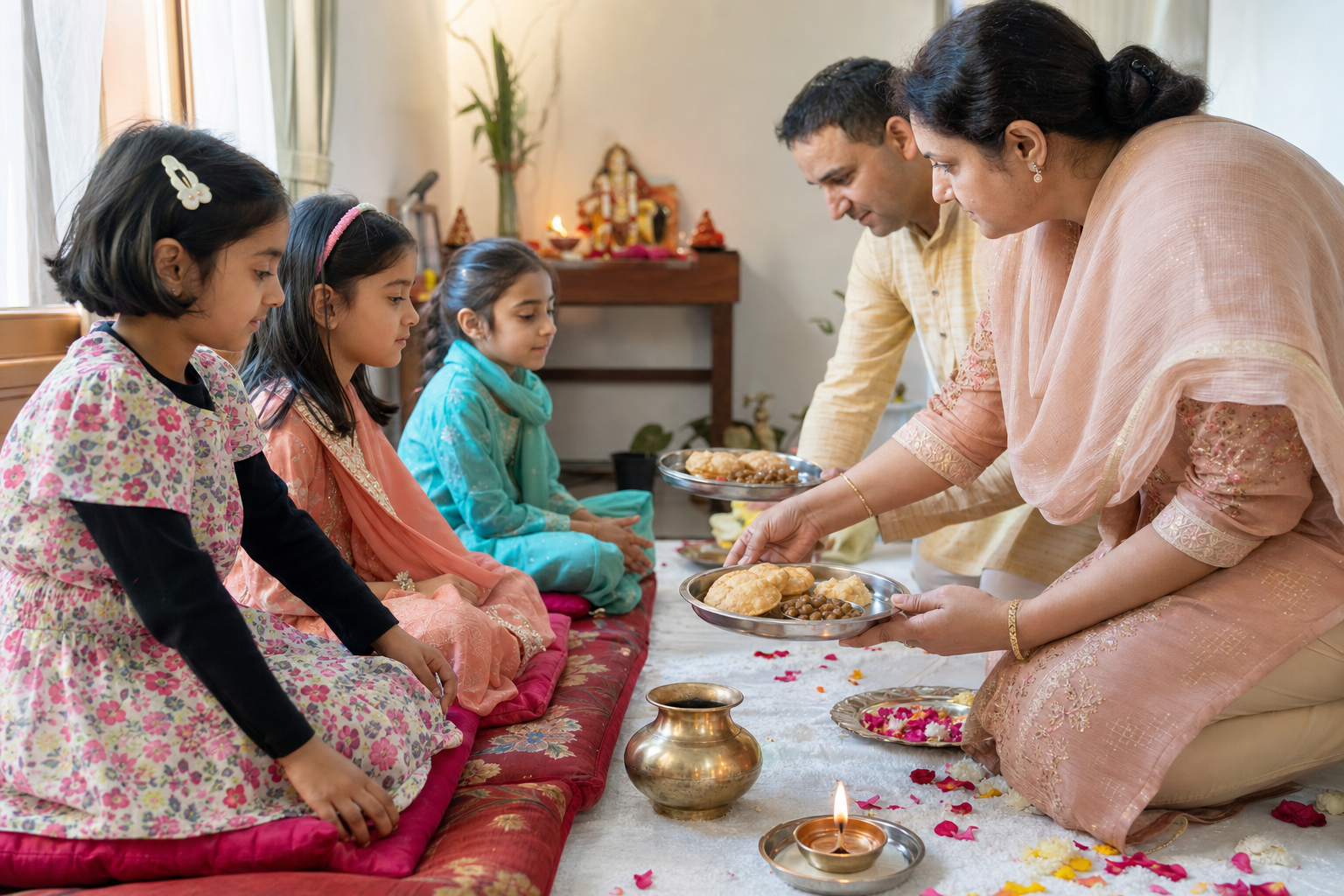
You do not have to interrupt worship at 2:11 PM as though a civil appointment has begun. The transition tells you how the tithi is moving and why different rites may be assigned to different days. Many households perform Kanya Pujan on Ashtami; others do it on Navami. Neither choice should be detached from the family custom and panchang rule that produced it.
- Set the observer’s location in the panchang. Use the city where the worship will occur, not the location of a relative who forwarded the calendar.
- Check which tithi prevails at local sunrise on March 26 and March 27.
- For Sri Rama Navami, verify whether Navami prevails during the local Madhyahna period. This is the decisive worship window, not merely the presence of Navami at some point during the civil date.
- If you are joining a public celebration, follow the temple’s announced schedule. A community rite cannot be coordinated from several private apps at once.
- Confirm the Kanya Pujan day before inviting children and families. The ritual expresses hospitality and reverence; uncertainty imposed on guests works against that purpose.
If you need a general worship window rather than a tithi-specific one, derive it from local sunrise and sunset. Brahma Muhurta begins roughly 1 hour 36 minutes before sunrise and lasts about 48 minutes. Abhijit Muhurta spans roughly 48 minutes around local solar noon. These definitions travel across locations more reliably than copied clock times.
For Thursday, March 26, divide the daylight period from sunrise to sunset into eight equal segments when calculating the weekday intervals. Yamaganda occupies the first segment, Gulikai the third, and Rahu Kalam the sixth. Avoid those periods for a discretionary new undertaking. Do not let fear of them cancel routine prayer or a remedial spiritual act already anchored to the tithi.
The movement from Devi worship to Sri Rama Navami is not an abrupt change of subject. Chaitra Navratri joins Shakti with the life of Maryada Purushottama Sri Rama: inner power is disciplined by dharma, compassion, and steadfast conduct. Let the evening of March 26 become preparation rather than festival fatigue. Set out the Rama text or bhajans your family will use, confirm the March 27 Madhyahna timing, and keep the final morning free from avoidable errands.
Preserve the Kashmiri character wherever the family lives
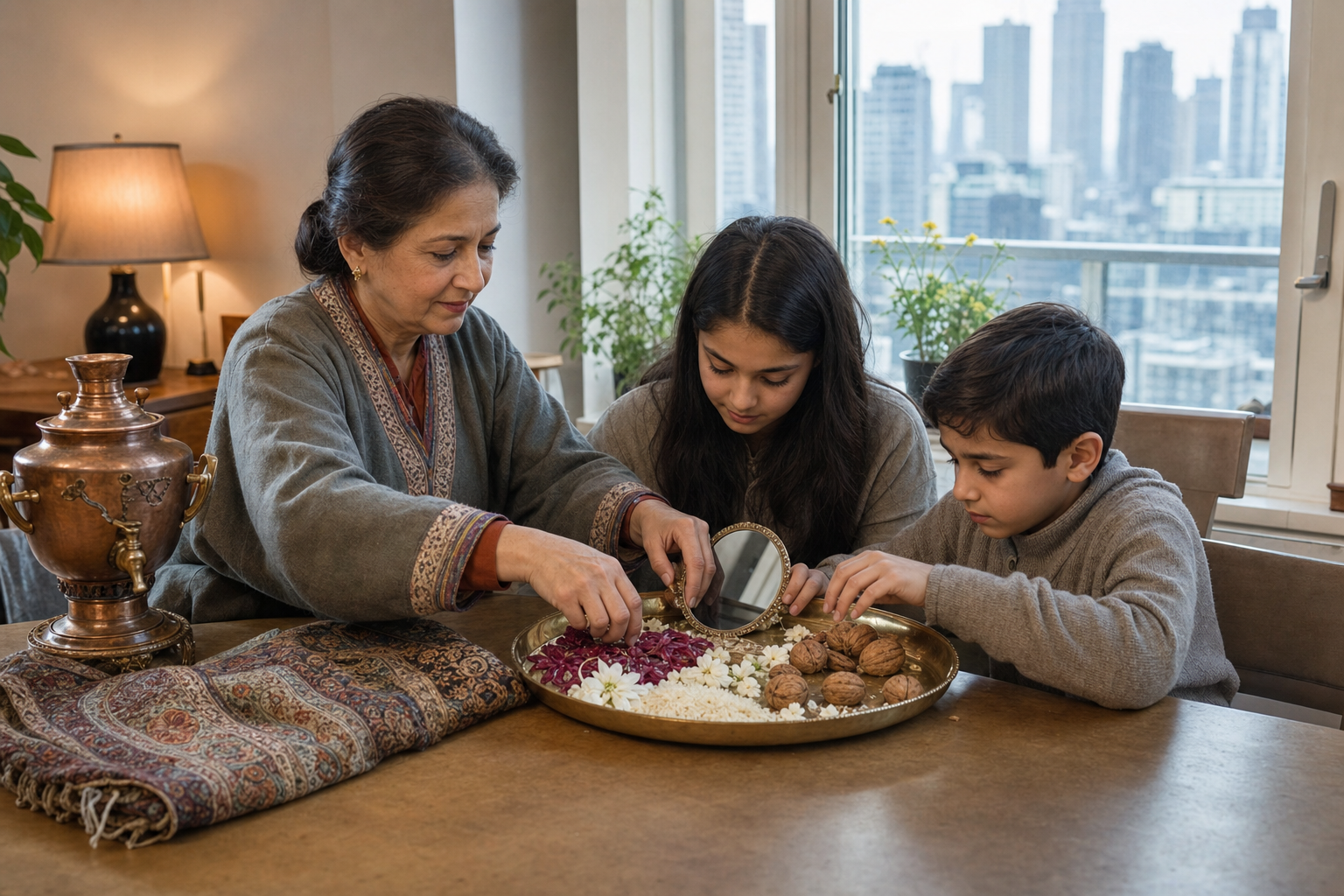
For a dispersed community, synchronization matters, but identical staging is not required. A family in Kashmir and relatives abroad may observe daybreak at different clock times while remaining united by the same tithi, Devi sequence, thaal, prayers, and memory. Use the festival to create a small piece of cultural infrastructure that will still exist next year.
- Name one person to circulate the location-specific dates and temple timings so conflicting messages do not govern the household.
- Record the Kashmiri names, pronunciations, songs, offerings, and altar customs used by your own family. Label people and places in old shrine photographs while elders can still identify them.
- If manuscripts or handwritten prayers survive in the household, store clear copies and note who preserved them. A file without family context is easier to lose than a remembered practice.
- Include younger relatives in a real role: arranging one thaal item, reading a short passage, preparing flowers, or asking an elder about Navreh.
- Where gestures toward married daughters and sons-in-law belong to the family’s custom, preserve them as acts of kinship rather than treating them as universal requirements.
If you are visiting Kashmir for the festival, dress modestly, ask about darshan and aarti timings, and seek local guidance before bringing an offering. Photography rules can vary. Obtain consent in temple precincts and do not treat a private family observance as a public display merely because it is visually striking.
Before March 19, make three decisions: which local panchang will govern the timings, who will prepare the Navreh thaal, and what daily practice the household can genuinely sustain through March 27. Once those are settled, the calendar stops being a source of confusion and becomes what it is meant to be: a shared rhythm for worship, memory, and dharmic renewal.
References
- DharmaRenaissance Blog – Comprehensive March 26, 2026 Panchang: Shukla Ashtami to Navami, Auspicious Timings, Nakshatra & Rashi
- DharmaRenaissance Blog – Chaitra Navratri 2026 in Kashmir: Sacred Navreh Traditions, Dates, and Time-Honored Rituals