

If you manage a shop, office, plant, or service team in Bhilai, do not begin your search for personality-development training with a trainer’s biography or a motivational theme. Begin with the moment at work that needs to change: a risk reported too late, an unclear handoff, defensive feedback, careless customer communication, or a commitment that quietly disappears.
Bhilai already has a relevant local example. Hindu Jagruti Samiti, the Chhattisgarh Chamber of Commerce and Industries, and Swavalambi Bharat Abhiyan jointly held a three-day Employee Personality Development Training Workshop to enhance employee potential. That collaboration shows that employee development can bring commercial, self-reliance, and cultural concerns into the same room. Your practical challenge is to turn that broad purpose into conduct that employees can practise and managers can observe.
Start with behaviour, not personality labels
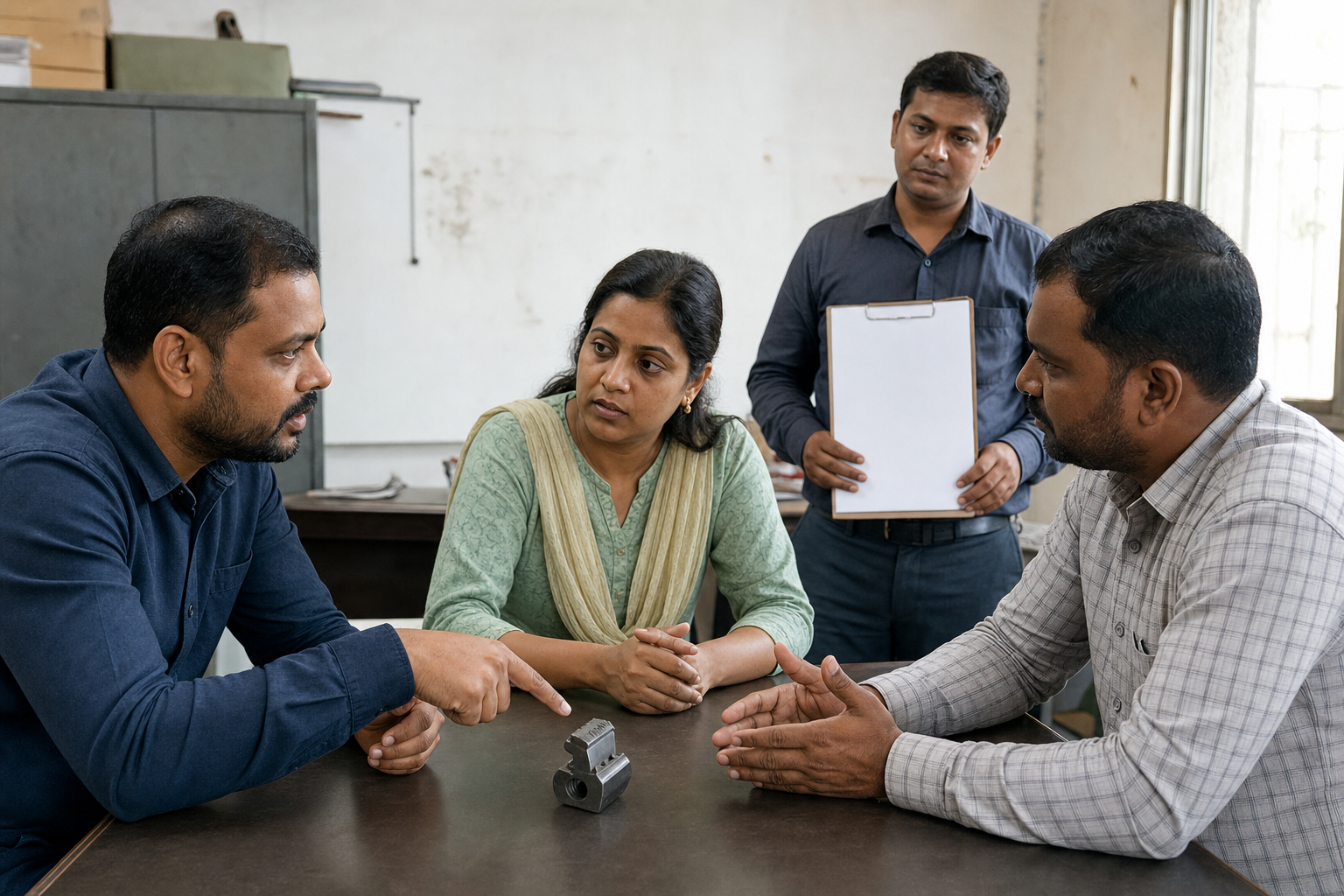
Personality development becomes vague when it is treated as an attempt to make everyone more extroverted, polished, or agreeable. Quiet employees can communicate precisely. Sociable employees can still fail to listen. Confidence without responsibility can make a team harder to manage. The workplace question is therefore not, “What kind of personality does this employee have?” It is, “What does this employee repeatedly do when the work becomes difficult?”
Translate every development goal into visible action. A useful workplace rubric can include:
- Communication: confirms instructions, asks when something is unclear, and reports a likely delay before the handoff fails.
- Accountability: names the commitment, owns the next action, and explains an obstacle without shifting blame.
- Adaptability: identifies what changed, separates the new constraint from the old plan, and proposes a workable response.
- Self-management: receives correction without turning the conversation into a personal contest and raises disagreement without humiliation or anger.
- Service: listens for the customer’s actual need, states what can be done, and checks whether the matter has been resolved.
Replace judgments with descriptions. “Improve your attitude” gives an employee nothing reliable to practise. “When you think a delivery may slip, tell the next person affected and propose a revised handoff” names the situation, the expected response, and the reason it matters.
Before arranging a workshop, collect real but anonymised workplace situations. Remove names and unnecessary personal details. For each situation, write what happened, what the employee did, what consequence followed, and what a better response would have looked like. These cases will reveal whether your problem is genuinely a development need or whether it is caused by unclear roles, conflicting instructions, missing tools, or an unrealistic workload. Training cannot repair a broken process by asking employees to display a better personality.
Use the three-day format as a sequence, not a long lecture

A three-day programme can create a useful progression, but duration alone proves nothing. For your own workplace, give each day a distinct job: recognise behaviour, rehearse a better response, and transfer that response into real work.
Day one: See the role and its consequences clearly
Begin with role clarity rather than inspirational language. Ask each participant to map the people who depend on their work: customers, colleagues, supervisors, suppliers, or the next shift. Then use an actual workplace incident to separate four things: the situation, the employee’s interpretation, the action taken, and the result.
This distinction matters because people often defend an intention while the team is dealing with the consequence. “We meant to complete it” does not tell the next team when the material will arrive. The exercise should help an employee notice the point at which a private assumption became somebody else’s operational problem.
Day two: Practise the difficult interaction
Move from discussion to rehearsal. Use scenarios your employees actually face: correcting an error, refusing an unsafe shortcut, informing a customer about a constraint, asking a supervisor to clarify competing priorities, or handing unfinished work to another person.
Give the participant a simple communication pattern: state the observable fact, explain its work impact, ask or propose the next action, and confirm who owns it. The trainer should pause the scenario when language becomes accusatory, evasive, or ambiguous. The employee then tries the same moment again with clearer words. Repetition is the training; merely agreeing with the trainer is not.
Day three: Carry one behaviour back to work
End with a live application, not a certificate as the only output. Each employee should identify a recurring situation, the old response, the replacement behaviour, and the person who will be affected by the change. A supervisor should know what to look for when that situation next occurs.
Keep the commitment narrow enough to observe. “Become a better communicator” is too broad. “Confirm the requested quantity and delivery date before closing a customer call” can be practised and checked. Once the behaviour becomes dependable, the employee can take on another.
Make dharmic values operational without making them coercive

A dharmic approach adds depth when it connects inner discipline with responsibility for the effect of one’s actions. It becomes empty when sacred vocabulary is placed over an ordinary motivational session. It becomes unjust when an employer uses it to test private belief or demand personal conformity.
Keep the application centred on work:
- Dharma and kartavya: define the duty attached to the role. Ask who relies on its proper fulfilment and what happens when it is neglected.
- Satya: make status reporting accurate. Do not hide a delay, exaggerate completion, or tell different people incompatible versions of the same situation.
- Ahimsa and maryada: correct errors without degrading the person. Firm standards and human dignity are compatible.
- Abhyasa: treat improvement as repeated practice. Insight during a workshop has little workplace value until it shapes conduct under pressure.
- Svavalamban: build the competence to take ownership. Self-reliance does not mean concealing difficulty or refusing help; it means recognising the problem, attempting a responsible response, and seeking the right support before failure spreads.
These values should be visible in the trainer’s own method. A session about dignity that publicly shames a hesitant employee contradicts itself. A session about truthfulness that discourages questions does the same. The method is part of the moral lesson.
Choose a workshop by what happens after it

Before selecting a programme, ask the organiser or trainer to explain the link between the agenda and your workplace. Useful questions include:
- Which observable employee behaviours is the programme designed to improve?
- How will participants practise those behaviours rather than only hear about them?
- Can anonymised cases from our workplace be used in exercises?
- What concrete commitment or work aid will each participant take back?
- What should supervisors observe when the relevant situation next occurs?
- How will the programme respect different communication styles while still maintaining clear performance standards?
- What part of the problem belongs to management, process design, or role clarity rather than to the employee?
Be cautious if the promised outcome is described only with words such as transformation, confidence, positivity, or leadership. Ask what an employee will do differently on an ordinary shift. If the answer cannot be expressed as conduct in a recognisable situation, the outcome is not yet defined.
Evaluation should follow the same logic. Before training, record examples of the behaviour that creates difficulty. During training, produce a script, checklist, or commitment tied to that behaviour. After training, observe what happens at the next genuine opportunity. Discuss the action and its consequence, not whether the employee has acquired a “good” or “bad” personality.
Participant satisfaction can tell you whether the session felt relevant and respectful. It cannot, by itself, tell you whether a handoff became clearer or a customer issue was handled better. Look for changed action in the real setting. If nothing changes, inspect the workshop design, the manager’s follow-through, and the surrounding process before blaming the employee.
Key takeaways
- Define personality development through observable workplace conduct, not labels such as confident, positive, or outgoing.
- Use real work situations to distinguish a training need from unclear roles, poor processes, or missing resources.
- Give a three-day programme a clear sequence: recognise the behaviour, rehearse the alternative, and transfer it into live work.
- Apply dharmic values through duty, truthfulness, dignity, practice, and responsible self-reliance rather than religious conformity.
- Judge the programme by what employees do at the next relevant workplace moment, not by attendance or enthusiasm alone.
If you are considering workplace personality development in Bhilai, write one sentence before contacting a trainer: “When this situation occurs, the employee should do this.” Ask the trainer how the programme will help the employee recognise, practise, and repeat that action. If the agenda cannot answer those questions, refine the brief before you book it.