
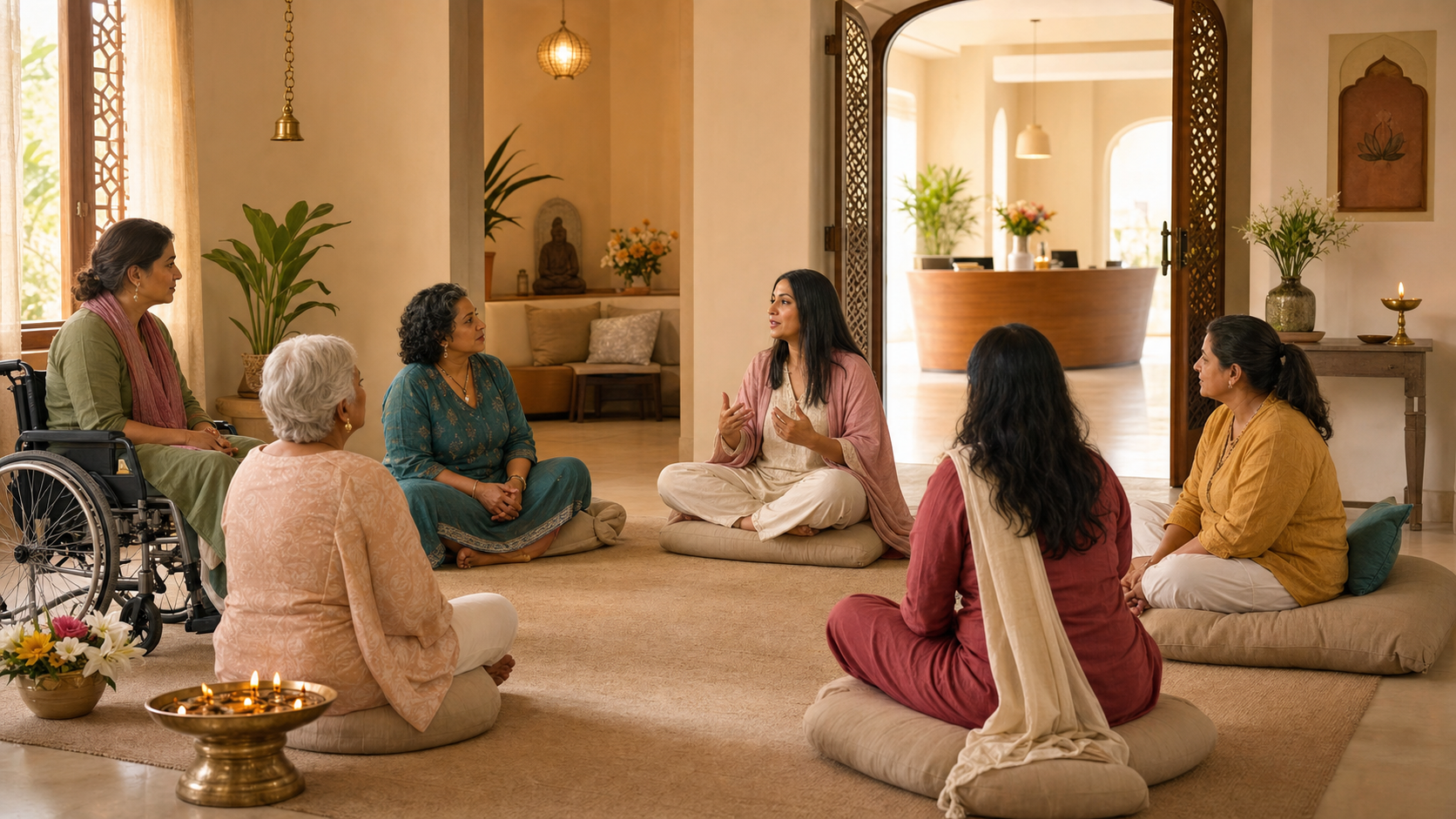
You may have been asked to organise a women’s wellbeing event at a temple, gurdwara, vihara, derasar, or community centre. The tempting response is to schedule yoga, kirtan, a talk, and refreshments. Those can all help, but they don’t yet make a trustworthy wellbeing programme.
Begin with the harder question: if a participant says she is frightened, overwhelmed, unwell, isolated, or under pressure, what happens next? A dharmic programme earns trust when spiritual practice sits inside a clear structure of dignity, informed choice, safeguarding, and competent referral. Here is how to build that structure.
Start with four promises, not a menu of activities
A useful design test is whether every part of the programme advances at least one of four promises: empowerment, connection, protection, and inspiration. A successful event needs all four. Inspiration without protection can leave vulnerable women exposed. Protection without empowerment can become paternalism. Connection without boundaries can turn a support circle into a place of gossip or unwanted advice.
- Empowerment: Give participants knowledge, practical choices, and room to speak in their own voice. Before adding an activity, ask whether it increases a woman’s ability to understand her options and make an informed decision.
- Connection: Create relationships that can continue beyond the event. Use facilitated small groups, opt-in contact arrangements, and a clearly identified community contact rather than assuming that people will somehow find support afterward.
- Protection: Establish boundaries, confidentiality rules, safeguarding responsibilities, and referral routes before inviting personal disclosure. Compassion needs a dependable container.
- Inspiration: Draw on spiritual teachings and sacred symbols to restore courage, meaning, and hope. Inspiration should help a woman act with greater agency; it should never pressure her to deny pain or accept preventable harm.
Run each proposed session through four questions. What will a participant learn? Who can she connect with? What protects her if a serious concern emerges? What dharmic practice or teaching helps her carry the benefit into daily life? If an activity answers none of these questions, it is probably decoration rather than care.
This also prevents a common planning error: treating the gathering as a self-contained celebration. A women’s day, festival programme, or Mother’s Day event may open the door, but wellbeing requires attention between public occasions. Build the route that continues after the hall has been cleared.
Use dharma to enlarge agency, not enforce a role

Hindu, Buddhist, Jain, and Sikh traditions are not interchangeable. Each has its own teachings, practices, and communities. Yet their ethical languages offer practical ways to examine whether a wellbeing programme is serving women with dignity: Shakti affirms sacred capacity, karuna directs attention toward suffering, ahimsa refuses avoidable harm, and seva turns concern into responsible service.
Within a Hindu setting, Durga, Lakshmi, and Saraswati can provide a particularly clear framework. Durga points to strength, protection, and the right to establish boundaries. Lakshmi points to the conditions that support flourishing, including time, care, nourishment, and material stability. Saraswati points to knowledge, discernment, and an audible voice. Present these qualities as capacities women can cultivate and communities must respect, not as ornamental praise offered while women carry every burden.
Karuna asks facilitators to listen without making another person’s distress serve a sermon. Ahimsa requires attention not only to overt injury but also to practices that silence, shame, intimidate, or expose someone unnecessarily. Seva asks what help is actually needed and whether it is being offered competently and with consent. In each case, the ethical test is visible in conduct.
Be alert when spiritual language starts shrinking a woman’s choices. Advice to preserve appearances, endure mistreatment, abandon qualified care, disclose private experiences publicly, or forgive on somebody else’s timetable is not made safe by a Sanskrit, Pali, Prakrit, or Punjabi term. Nor should ideas such as sacrifice and duty be applied only to the person already carrying the greatest burden.
Motherhood deserves honour, but it cannot be the programme’s definition of womanhood. Check whether the language and examples also welcome women who are unmarried, without children, widowed, caring for relatives, studying, working, ageing, or moving through another life transition. If adolescents attend, use safeguarding arrangements appropriate to minors rather than assuming that the rules for an adult sharing circle are sufficient.
Build the safeguarding pathway before the sharing circle

A circle can feel intimate within minutes. That does not mean it is automatically safe. Participants need to know who is listening, what will remain private, what cannot be kept confidential, and where serious concerns will go. Work out those answers before publicity begins.
- Define the scope. State plainly that facilitators offer spiritual, pastoral, or peer support within their competence. They are not acting as doctors, psychotherapists, investigators, or legal advisers unless they separately hold the relevant qualifications and are serving in that declared role.
- Name the safeguarding route. Identify the responsible safeguarding lead and a backup contact. Make their details available to participants and volunteers. Clarify who receives a concern when the named lead is involved in it.
- Explain confidentiality accurately. Say how personal information will be handled and what circumstances may require escalation under applicable law or safeguarding policy. Never promise absolute secrecy if the programme cannot lawfully or safely keep that promise.
- Prepare trusted referrals. Verify local health, mental-health, safeguarding, and other relevant care contacts. Record what each service does, who may use it, and how a person reaches it. A stale list of names is not a referral pathway.
- Train the first response. A volunteer receiving a disclosure should listen calmly, acknowledge what was shared, avoid interrogation, explain the available next steps, and involve the designated lead according to policy. The role is to support and connect, not to determine guilt or prescribe a solution.
- Plan aftercare. Decide who may follow up, how consent for contact will be recorded, and when the programme’s responsibility ends. Follow-up should be predictable without becoming intrusive.
Trauma-informed facilitation is practical rather than theatrical. Give participants choices. Explain the session flow. Do not require anyone to tell her story, close her eyes, accept touch, sing aloud, or remain in a discussion that has become distressing. Avoid surprise exercises that demand emotional exposure. A woman should be able to pass, pause, or leave without having to justify herself to the group.
Collect only the personal information needed for a defined care or safeguarding purpose. Store it according to the organisation’s policy, restrict access, and do not turn disclosures into informal committee conversation. Confidentiality is not merely courteous; it determines whether women can seek help without acquiring a second problem.
Yoga, breath practice, mantra, journaling, Ayurvedic routines, and pastoral conversation are not substitutes for medical or psychological treatment. A participant with severe or persistent symptoms should be encouraged to contact an appropriately qualified professional. If someone may be in immediate danger, use the applicable local emergency or safeguarding route rather than trying to contain the situation within a spiritual session.
Turn spiritual practices into a repeatable care rhythm

A strong programme does not need an overcrowded timetable. It needs a sequence participants can understand and facilitators can deliver safely. Use a consistent rhythm so that women know when they will practise, reflect, speak, receive information, and leave.
- Open with orientation. Introduce the facilitators, describe the purpose and limits of the gathering, explain participation choices, and point out the safeguarding contact.
- Settle the body and attention. Offer accessible movement, breath awareness, or quiet contemplation led by someone working within her competence. Make adaptations and opting out normal rather than exceptional.
- Teach one usable idea. Focus on a clear theme such as boundaries, compassionate self-observation, daily rhythm, mutual support, or seeking help. Avoid piling several complex teachings into a single session.
- Create private reflection. Journaling or silent contemplation allows a participant to notice what matters without immediately making it public.
- Offer bounded connection. Use pairs or small circles with a clear prompt, a time boundary, permission to pass, and a reminder that listening does not mean giving unsolicited advice.
- Close devotionally and practically. Kirtan, mantra, remembrance, prayer, or silent dedication can gather the session’s meaning. End by repeating the next programme date, community contact, and route to further support.
The practices should match the programme’s promise. Breath regulation and guided attention may help with stress reactivity, mantra-based practice may support attentional steadiness, and group singing can foster belonging. These are supportive possibilities, not guaranteed outcomes. Present them without medical claims and without implying that someone who remains distressed has practised incorrectly.
Ayurveda can contribute through accessible attention to daily rhythm, balanced nourishment, restorative rest, gentle movement, and seasonal routine. Keep this guidance non-prescriptive unless a properly qualified practitioner is providing individual care. A community talk should not label a participant’s constitution, recommend remedies for a medical condition, or encourage her to discontinue existing treatment.
Choice strengthens rather than dilutes spiritual practice. One participant may sing; another may listen. One may write; another may reflect silently. One may prefer seated movement; another may sit out. The shared discipline is attentive participation, not identical performance.
Before launch, test the plan with women from the community and across the life stages you expect to serve. Ask what would make attendance difficult, which words feel unclear, whether the venue offers sufficient privacy, and what support people would trust. Cultural fluency cannot be added after the programme is already fixed.
Train volunteers in active listening, non-directive support, inclusive language, consent, confidentiality, and the referral route. Spiritual sincerity does not automatically provide these skills. Volunteers serve participants better when they know both what to do and where their role stops.
Measure what changes, then fix the weakest part

Do not evaluate the programme only by attendance, applause, or whether the room felt warm. Those signals tell you something about reach and atmosphere, but not whether women understand their options, trust the care pathway, feel more connected, or can continue a useful practice.
- Reach: Review attendance patterns and relevant demographic reach, collecting the minimum information needed and doing so with clear consent.
- Immediate experience: Use brief, voluntary questions about perceived stress, belonging, safety, and the usefulness of the session. Keep claims proportionate; a short before-and-after check does not establish a clinical result.
- Care access: Track whether referrals are offered and, where privacy and consent permit, whether participants can use them. Do not compromise confidentiality merely to produce an impressive metric.
- Participant voice: Look for recurring themes in feedback while removing identifying detail. Ask what should stop, continue, or change rather than requesting praise.
- Continuity: Follow up, with consent, to learn whether women sustained a practice, maintained a helpful connection, or knew where to seek further support.
The combination of attendance, reach, referral information, brief stress or belonging measures, participant reflections, and follow-up gives a more honest picture than any single number. Interpret each result in context. A large gathering may have weak continuity; a smaller circle may create reliable connections but need a clearer referral route.
Use the findings to make one defined improvement before the next session. If participants cannot identify the safeguarding contact, make that information more visible and repeat it aloud. If women value the circle but do not return, examine timing, transport, care responsibilities, privacy, and follow-up. If volunteers give too much advice, retrain them in reflective listening and role boundaries.
Key takeaways
- Design every element around empowerment, connection, protection, or inspiration, and make sure the programme serves all four.
- Use Shakti, karuna, ahimsa, and seva to strengthen dignity and agency, never to demand silence, endurance, or a predetermined social role.
- Define scope, confidentiality, safeguarding responsibility, referrals, and aftercare before inviting personal disclosure.
- Offer yoga, contemplation, kirtan, journaling, and Ayurvedic routines as optional supports, not as replacements for qualified care.
- Measure safety, belonging, access to help, participant feedback, and continuity, then repair the weakest part of the programme.
For your next planning meeting, begin with a blank page and write the exact route a woman would follow after saying, “I need help.” Add the responsible contact, confidentiality limits, referral options, and follow-up process. Only then build the spiritual programme around it. That is how devotional warmth becomes dependable care.