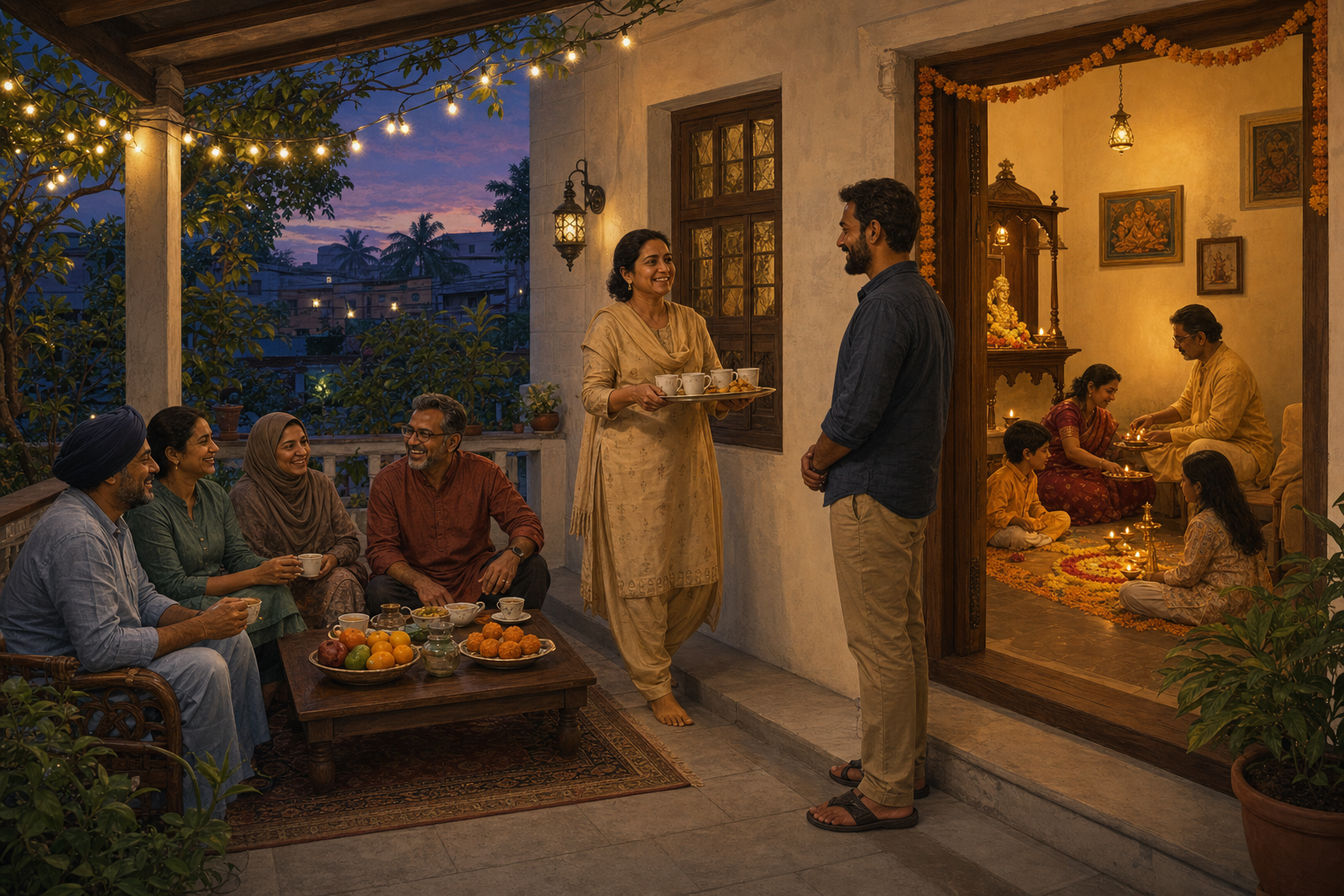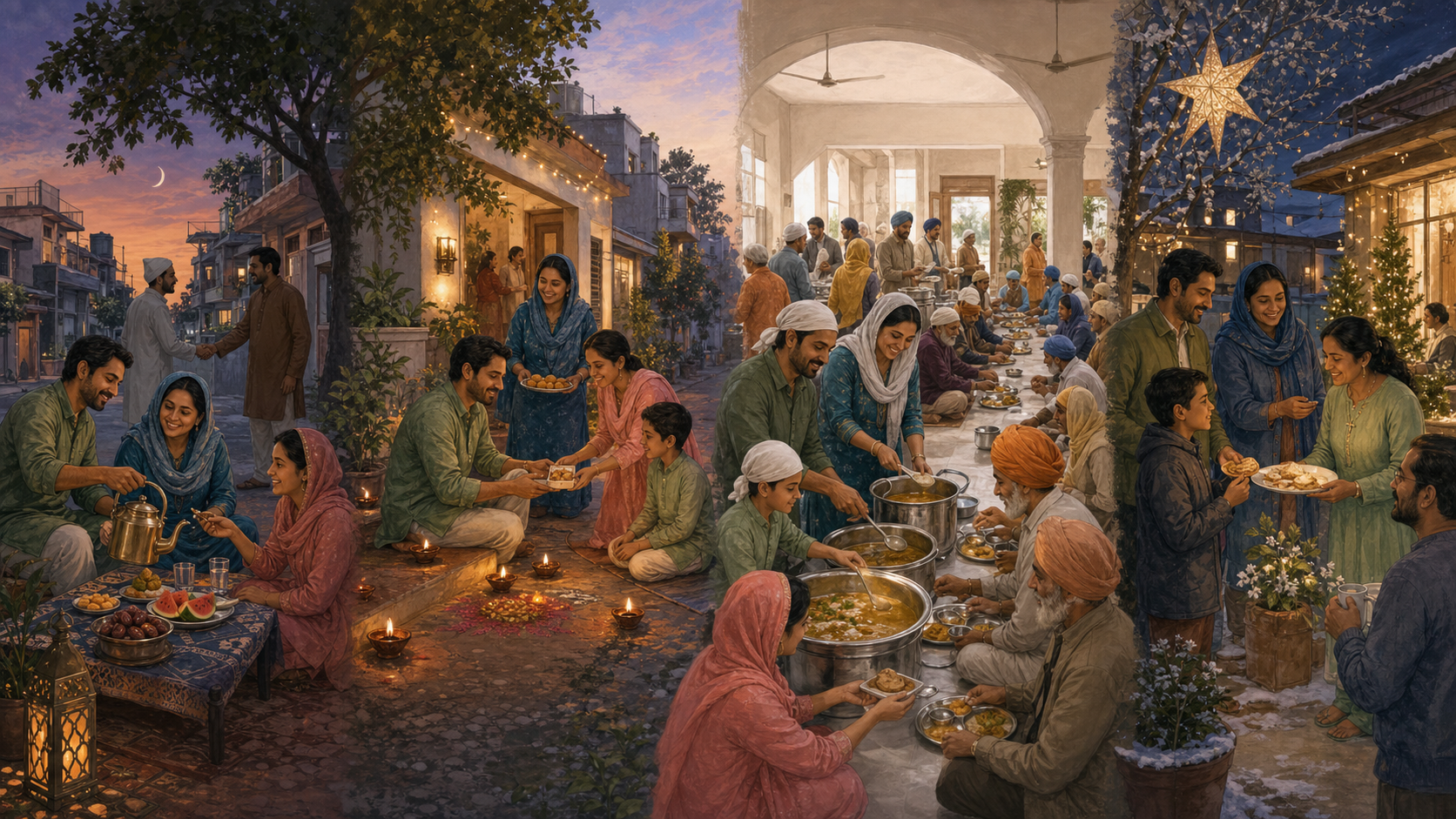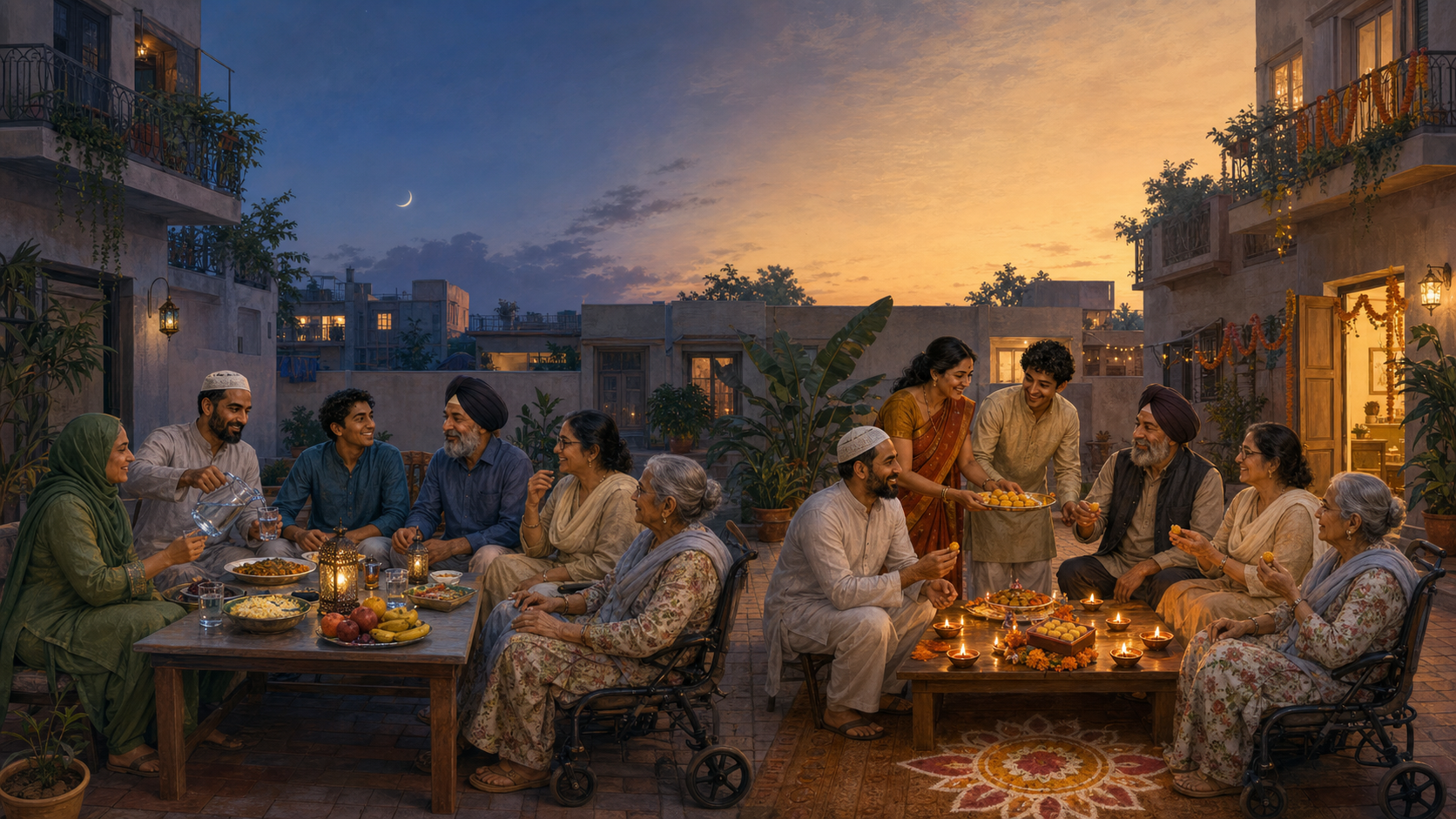
You accepted an Iftar invitation gladly. Now Diwali is approaching, and you are wondering whether the warmth will travel in both directions. Or perhaps you are planning a campus, workplace, or neighbourhood calendar where every community is welcomed, yet no faith is reduced to food, costumes, and photographs.
You do not need to choose between one-way accommodation and forced religious participation. A better standard is reciprocity: each community offers hospitality, each receives serious respect, sacred boundaries remain intact, and anyone may decline a ritual without being treated as hostile.
Reciprocity means equal regard, not identical participation
Festival reciprocity is sometimes mistaken for a ledger. You attended my celebration, so I must attend yours in exactly the same way. That approach fails because festivals do not have identical structures. A shared meal, congregational prayer, diya-lighting, aarti, langar seva, devotional dance, a forgiveness observance, and quiet meditation place different demands on a guest.
The fair comparison is not gesture for gesture. It is whether the relationship shows comparable intention, dignity, effort, and care over time. A guest who cannot perform a devotional act may still attend the public portion, listen to its meaning, help prepare the space, serve food, or contribute to a related seva. A host who welcomes outsiders should explain which forms of participation are open, optional, or reserved.
A playful caption, borrowed surname, or festival selfie is a low-cost social signal. It may express genuine friendship, but it does not by itself establish mutual respect. Trust grows through higher-commitment conduct: learning what an observance means, giving time to another community’s event, sharing organisational work, respecting sacred food, and showing up again when the camera is gone.
You can assess reciprocity through four layers:
- Recognition: people use the proper name of the observance, learn its basic meaning, and avoid careless stereotypes.
- Hospitality: guests receive a clear invitation, practical guidance, and a dignified place in the gathering.
- Contribution: people offer time, labour, resources, or attention instead of appearing only for photographs and refreshments.
- Return: the same seriousness appears when another community hosts an observance important to it.
Reciprocity breaks down at two opposite ends. Coercion occurs when a guest is pressured to affirm a belief or perform a rite against conscience. Asymmetry occurs when one community is repeatedly expected to display openness while another invokes difference as a reason never to acknowledge, attend, or support its neighbours’ festivals. Healthy pluralism avoids both.
This distinction matters particularly for Hindus. Attending an Iftar can be a sincere act of friendship, but it should not be treated as a public test of secular respectability. Muslim neighbours can reciprocate around Diwali, Navratri, or another Hindu observance without being asked to worship. The same principle applies among Hindu, Buddhist, Jain, Sikh, Muslim, and other communities: respectful presence is possible without theological surrender.
Separate open hospitality from sacred participation
Most avoidable friction begins before the event. The invitation says when and where, but not what guests will encounter. They arrive without knowing whether they may enter during prayer, receive sacred food, photograph the ceremony, join a chant, or quietly observe. Hosts then interpret hesitation as disrespect, while guests feel ambushed by expectations they were never given.
Do not classify an entire festival as open or closed. Identify the boundary around each part of the gathering. The host tradition, not an outside diversity committee, should define that boundary.
| Part of the gathering | What a guest can do | What the host should explain |
|---|---|---|
| Open social or civic portion | Share a meal, hear an introduction, join a public cultural activity, volunteer, or converse with hosts | Timing, food arrangements, clothing expectations, accessibility, and photography rules |
| Sacred observance open to witnesses | Stand or sit quietly, listen, follow spatial etiquette, and decline devotional gestures respectfully | Expected posture, periods of silence, treatment of sacred objects or food, and which actions are optional |
| Private or restricted observance | Accept the boundary without demanding access and join an open portion if one is offered | The restriction before arrival, stated plainly and without embarrassment |
A useful invitation can answer the main questions in a few lines:
- What does this observance mean to the host community?
- Which parts are open to guests, and which are reserved?
- May a guest observe instead of participating in a devotional action?
- What clothing, seating, silence, or food etiquette should guests know?
- When may photographs be taken, and whose consent is required before posting?
- Who can answer a private question without putting the guest on display?
Sacred food deserves more care than a generic refreshments label. Prasad is not merely a snack, and langar is not merely event catering. Tell guests what is being offered, how it should be received, and how someone may decline without contempt or embarrassment. Dietary labels should be clear enough for a guest to make an informed choice without having to announce a personal restriction to the room.
Apply the same discipline to clothing and identity. Wearing what a host requests can show courtesy; treating religious dress as a costume for a photograph does not. Identity-based humour, including playful name-swapping, requires consent from the people whose identity is being borrowed. Ask before writing the caption, not after it has circulated.
A refusal also needs etiquette. A guest may say, I would be glad to observe, but I do not perform that devotional act. A host can answer, You are welcome to remain quietly or join us afterward. Neither person needs to debate doctrine at the doorway.
Build reciprocity across the year, not around one viral moment
A single inclusive evening is easy to stage. A reciprocal culture needs a calendar, assigned responsibility, and memory. Without those, the same well-connected people keep representing entire faiths, planning effort falls unevenly, and each event begins again from zero.
A neighbourhood association, residence hall, company, school, library, or cultural centre can create a simple festival circle. It does not need to celebrate every observance or force every member to attend. It needs to honour the traditions actually present and make the terms of participation clear.
- Map the shared calendar. Ask participating families or groups which observances they want to open to neighbours. Possible entries include Iftar, Eid, Diwali, Navratri, Gurpurab, Vesak, and a Paryushan reflection. Do not select festivals merely because they produce attractive photographs.
- Name a tradition host and a cross-community co-host. The tradition host defines meaning, ritual boundaries, and correct language. The co-host helps with invitations, access, food labels, logistics, and follow-up. The co-host should not become an unofficial interpreter of someone else’s faith.
- Offer more than one doorway. Where appropriate, pair an open observance with a meal, orientation, service activity, or discussion. This gives guests a meaningful way to contribute even when they cannot join a rite.
- Use the same hospitality checklist each time. Include a short orientation, dietary information, a quiet area where feasible, a clear photo policy, and a real option to decline part of the programme.
- Rotate labour as well as visibility. Track who books the room, prepares food, welcomes guests, cleans up, and handles communication. Reciprocity is weak when one community supplies the sacred occasion while another controls all presentation, or when the same volunteers carry every event.
- Hold a short debrief. Ask what was unclear, what felt respectful, which boundary was missed, and what should change next time. Record the answers so the next host inherits learning rather than avoidable mistakes.
A balanced sequence might begin with an Iftar hosted by Muslim residents and supported by neighbours. Later, a Diwali gathering can include diya-lighting and a faithful explanation of its Hindu significance. A Gurpurab programme might invite neighbours into langar seva. A Navratri gathering can orient newcomers to the devotional context and conduct expected during garba. Vesak may include compassionate service, while a Jain event may open a conversation about ahimsa and forgiveness.
The service component must extend the religious occasion, not erase it. Institutions sometimes feel comfortable with food drives, lamps, music, and generic messages of kindness while becoming uneasy when practitioners name a deity, scripture, vow, guru, or doctrine. That is cultural display without full religious respect. Let each tradition explain itself in its own vocabulary, while making clear that guests are being invited to understand rather than assent.
Dharmic principles provide practical support for this kind of pluralism. Sarva-dharma-samabhava encourages regard across paths without pretending that all doctrines are interchangeable. Vasudhaiva Kutumbakam widens the circle of belonging. Jain ahimsa and Buddhist karuna place non-harm and compassion at the centre of conduct, while Sikh langar gives hospitality and equality a concrete form. These ideas should shape how people are received, not remain slogans on the welcome banner.
Audit the pattern and keep social media in its proper place
Do not judge success by attendance alone. A crowded room may still conceal tokenism, ritual flattening, unequal work, or pressure to perform harmony. You need a qualitative audit of the relationship that continues after the chairs are folded.
- Are the same one or two people repeatedly asked to represent an entire faith?
- Did the host tradition describe the observance in its own terms, or was its meaning rewritten into a safe secular slogan?
- Did guests have a dignified way to observe, participate selectively, or decline?
- Was planning work distributed, including the unglamorous work before and after the event?
- Does warmth travel across the calendar, including toward Hindu, Buddhist, Jain, and Sikh observances?
- Are people making fewer etiquette mistakes because previous lessons were retained?
- Can a community state a sacred boundary without being called exclusionary, and can a guest state a conscience boundary without being called intolerant?
You do not need a quota requiring equal turnout at every festival. Communities differ in size, schedules, resources, and the openness of particular rites. Look instead for a persistent direction of travel: broader participation, shared responsibility, better understanding, fewer careless assumptions, and visible willingness to reciprocate.
If the pattern remains one-sided, begin with a private and specific invitation rather than a public accusation. Say what you appreciated, name the forthcoming observance, and offer a role that does not cross conscience: We valued your invitation to Iftar. We are arranging Diwali next month. Would you help welcome guests, attend the explanation, or support the meal?
The answer will tell you more than a slogan. A person may decline one activity for a legitimate reason and still propose another form of support. But if a group repeatedly expects public participation in its own occasions while refusing every respectful avenue into its neighbours’ observances, stop describing the arrangement as reciprocity. Maintain civility, keep the door open, and do not manufacture an image of mutuality that the relationship has not earned.
Apply the same honesty online. Before publishing a festival photograph or reel:
- Confirm that hosts and identifiable guests consent to publication.
- Do not photograph prayer, sacred objects, or restricted areas merely because no one stopped you.
- Name the observance correctly and add enough context for readers to understand why it matters.
- Credit hosts and volunteers instead of presenting yourself as the centre of the gathering.
- Avoid captions that turn religious identity, dress, fasting, or ritual into a prop.
- Ask whether the same post would still feel respectful without the joke, trend, or borrowed identity label.
The best digital record points beyond itself. It helps another guest arrive prepared, acknowledges the people who did the work, and makes the next reciprocal invitation more likely.
Key takeaways
- Reciprocity is comparable respect and effort across time, not identical ritual behaviour.
- No guest should be pressured to worship, and no community should use conscience as a blanket excuse for permanent non-engagement.
- Hosts should distinguish open hospitality, observable sacred practice, and restricted observance before guests arrive.
- A year-round calendar, named co-hosts, rotating labour, and short debriefs turn goodwill into a durable practice.
- Religious traditions must be allowed to explain themselves faithfully instead of being flattened into food, entertainment, or generic moral language.
- Photographs and captions should document trust already built; they cannot substitute for it.
Before your next festival invitation, send one message that clarifies what is open, what is optional, and how a guest can contribute. Then place one observance hosted by another community on the shared calendar. That small pair of actions moves interfaith life from display to relationship while keeping Dharma, conscience, and hospitality intact.