

Your calendar shows Shukla Dashami until 10:06 AM on Saturday, March 28, 2026, followed by Shukla Ekadashi. The difficult part is deciding what that line permits you to do. Does the Ekadashi vrata begin at 10:06? Can you treat midday as automatically auspicious? Will the same clock time work outside India?
The clean answer is to separate three things: the astronomical tithi transition, the sunrise rule used for a formal vrata, and the location-based calculation of a muhurta. Once you keep those layers separate, the day becomes much easier to plan.
Key takeaways for March 28
- In the commonly published India-based schedule, Shukla Dashami lasts until 10:06 AM and Shukla Ekadashi begins afterward. Treat 10:06 AM as IST when no other location or time zone is specified.
- The 10:06 AM transition tells you which tithi is operating at that moment. It does not, by itself, determine the civil day on which a formal Ekadashi fast must be observed.
- The morning Dashami period is traditionally suited to continuing responsibilities, study, charity and work already underway. After the transition, you can give greater attention to japa, dhyana, scriptural reading, restraint and seva.
- Abhijit Muhurta, Choghadiya, Rahu Kalam, Yamaganda and Gulika Kala must be calculated from local sunrise and sunset. A fixed India clock table is unreliable for another city.
- The 10:06 AM line does not identify the day’s nakshatra, yoga, karana or Moon sign. Look them up rather than guessing them from the tithi.
What actually changes at 10:06 AM
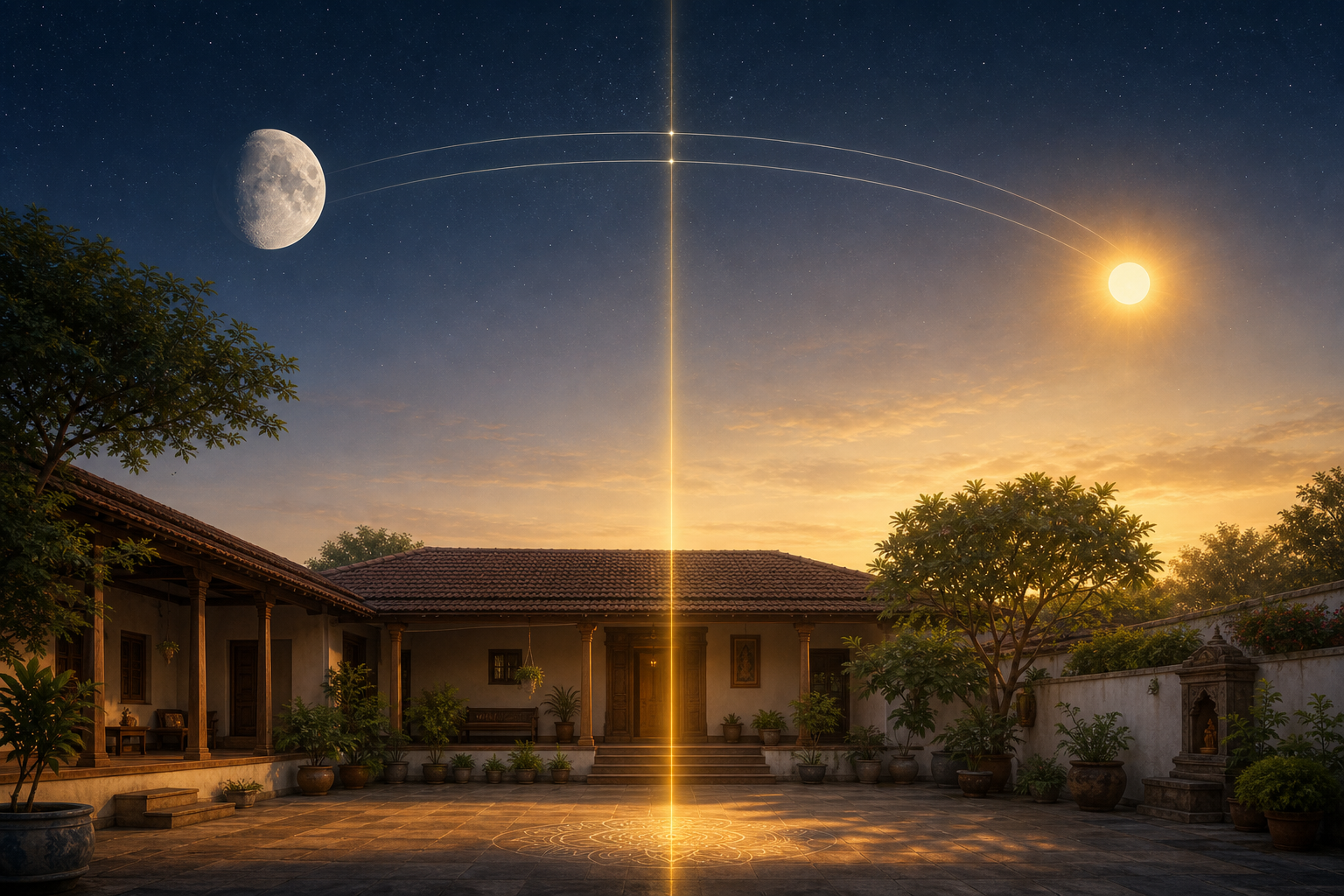
A tithi is an astronomical interval, not an ordinary calendar date. It is determined by the angular separation between the Moon and the Sun. Every additional 12 degrees of separation begins another tithi, giving 30 tithis in a complete lunar month.
The calculation can be written as: tithi number = floor[(Moon longitude – Sun longitude) / 12] + 1. On the waxing side of the month, Shukla Dashami occupies the tenth interval, from 108 degrees of separation up to 120 degrees. The change to Shukla Ekadashi occurs when the separation crosses 120 degrees. The listed 10:06 AM time is the clock expression of that crossing.
This explains why a tithi can change in the middle of breakfast, a journey or a puja. It does not wait for midnight, and its astronomical boundary does not wait for sunrise. Sunrise matters for a different reason: many observances use the tithi prevailing at sunrise to assign a vrata or festival to a Panchang day.
Before the boundary, Dashami is the operative tithi. Its waxing quality is commonly associated with steady progress, consolidation and follow-through. If you have routine administration, study, household duties or charitable work to complete, the Dashami morning offers a coherent place for them.
After the boundary, Ekadashi is astronomically current. You may mark the change with a brief sankalpa, japa, meditation, temple worship, reading from the Bhagavad Gita or Bhagavata Purana, sattvic restraint or seva. That is a meaningful use of the transition even when your sampradaya assigns the formal Ekadashi vrata to another sunrise-based calendar day.
Do not turn the tithi into a complete muhurta verdict. A favorable tithi does not automatically cancel an unfavorable karana, an avoidance period or the personal considerations used for a major samskara. For an ordinary task, the tithi may be enough context. For a wedding, griha pravesha, naming ceremony, initiation or consequential financial commitment, it is only one input.
Do not confuse Ekadashi’s entry with the vrata day
The most consequential mistake on March 28 is reading “Ekadashi begins at 10:06 AM” as “everyone must begin the formal Ekadashi fast at 10:06 AM.” Those statements are not equivalent.
Many Ekadashi observances are assigned according to the tithi present at local sunrise, with additional rules and exceptions preserved by different traditions. Because Dashami continues into the morning on the published March 28 schedule, the later entry of Ekadashi establishes the astronomical boundary but does not settle the vrata date on its own. You also need Ekadashi’s ending time and its relationship to the next local sunrise.
Use this five-point check before declaring the fasting day:
- Set the Panchang to the city where you will observe the vrata, not merely the city where your family normally lives.
- Confirm the tithi prevailing at local sunrise on March 28 and on the following relevant sunrise.
- Check the date explicitly marked for Ekadashi vrata by the Panchang you follow. Do not infer it only from the tithi start time.
- Read the Dwadashi and parana entries as well. Fast-breaking is ordinarily performed in the prescribed Dwadashi window while avoiding Hari Vasara.
- Where your household, temple or sampradaya follows a more specific rule, keep that rule consistently rather than switching between calendars to obtain a preferred date.
This distinction also lets you honor both portions of March 28 without pretending they are the same observance. Complete normal responsibilities during Dashami, then reduce distraction and deepen devotional practice after Ekadashi enters. If the formal vrata belongs to the next Panchang day under your tradition, the post-10:06 period can serve as preparation rather than as an improvised fast beginning.
Upavasa is practiced in varied forms. Full fasting, partial fasting, sattvic food, japa, study and seva all appear within living practice. Do not assume that complete food or water restriction is the only spiritually serious option. If such restriction is unsuitable for your health, choose an appropriate form of vrata with guidance from your family tradition and qualified medical advice where needed.
Build auspicious windows from your local sunrise

An honest March 28 timing guide cannot give one set of Abhijit, Choghadiya and Rahu Kalam clock times for Delhi, Toronto, London and Singapore. These periods are derived from local sunrise, sunset and day length. Even within one time zone, latitude and longitude can change the clock boundaries.
Do not simply read 10:06 AM as local time outside India. At minimum, an astronomical instant stated in IST would have to be converted to your time zone. For ritual use, open a location-specific Panchang as well, because the local sunrise, civil date and observance rule determine how that instant functions in your day.
Use Abhijit as a midday window, not clock noon
Abhijit Muhurta is a broadly favorable interval centered on local solar midday. A practical approximation places it about 24 minutes before and 24 minutes after that midpoint. Solar midday here means the halfway point between sunrise and sunset, not automatically 12:00 PM on your clock.
You can make a working calculation in three steps:
- Find the correct local sunrise and sunset for March 28.
- Subtract sunrise from sunset to obtain daylight length, then divide that duration by two.
- Add the half-day duration to sunrise. Use the resulting midpoint, with roughly 24 minutes on either side, as an approximation until your local Panchang supplies its exact Abhijit interval.
Abhijit is commonly used when a broadly supportive time is needed and a specialized muhurta is unavailable. It is most sensible for sattvic or neutral aims. It should not replace the fuller analysis expected for a major samskara.
Calculate Choghadiya from the actual day length
Day Choghadiya divides sunrise-to-sunset time into eight equal parts. Night Choghadiya divides sunset-to-next-sunrise time into another eight. Because the segments are equal portions of the actual day or night, their duration changes with season and location.
After calculating the segment boundaries, use the Saturday sequence supplied by the same regional Panchang. Amrit, Shubh and Labh are generally preferred for beginning work. Chal is often treated as neutral to mildly favorable. Kaal, Udveg and Rog are ordinarily avoided for auspicious starts. The label and the clock boundary both matter; copying only one from a generic table produces a false sense of precision.
Check avoidance periods after choosing a favorable span
Rahu Kalam, Yamaganda and Gulika Kala are also sunrise-derived. First identify a favorable candidate window, then see whether it overlaps one of these periods. They are generally avoided for starting travel, inaugurations and consequential new commitments.
These periods are not a command to suspend ordinary life. Use them for continuing work, maintenance, preparation or tasks already underway. The operative distinction is initiation: beginning the consequential act is what practitioners usually move outside the avoidance span.
If Abhijit, a favorable Choghadiya and an avoidance period appear to conflict, do not manufacture a hierarchy from a simplified calendar graphic. For an ordinary errand, choose the cleanest available local window. For a major rite or irreversible commitment, obtain a full muhurta that also considers nakshatra, karana, Tarabala and Chandra-bala.
Read the five limbs before calling a time shubh

Panchang literally refers to five limbs: tithi, vara, nakshatra, yoga and karana. The Dashami-to-Ekadashi line gives you only one of them. A useful daily reading checks what each limb contributes and identifies what is still unknown.
| Limb | What it measures | What you can establish for March 28 |
|---|---|---|
| Tithi | Successive 12-degree intervals of Sun-Moon elongation | Shukla Dashami until 10:06 AM, then Shukla Ekadashi, under the published India-based timing |
| Vara | The weekday, ordinarily reckoned from sunrise to sunrise | Saturday after local sunrise; before sunrise, check the preceding Panchang day rather than relying only on the civil date |
| Nakshatra | The Moon’s position among 27 divisions of 13 degrees 20 minutes each | Not established by the 10:06 AM tithi line; obtain its name and ending time from a location-specific calculation |
| Yoga | A combination derived from the sum of the Sun’s and Moon’s longitudes across 27 divisions | Not established by the tithi transition; look it up separately |
| Karana | Half of a tithi | Not established here; check whether Vishti, also called Bhadra, is present before initiating auspicious work |
Moon sign, or Chandra Rashi, is also commonly consulted, although it is not one of the five named limbs. Nakshatra and Chandra Rashi can matter for personal suitability, travel and the emotional tone traditionally associated with a period. Neither should be guessed from the fact that Ekadashi begins.
If two Panchangs disagree by several minutes, first check their settings. Modern Drik systems use observational or ephemeris-based positions, while Vakya systems preserve traditional tabular calculations. The chosen ayanamsha, including the commonly used Lahiri ayanamsha, can also shift boundaries. Regional Amanta and Purnimanta month naming may label the month differently without changing the actual passage of the day.
Before treating a discrepancy as an error, verify these items:
- Both calendars are set to the same city and time zone.
- Both use the same Drik or Vakya calculation approach.
- The displayed time means “ends at,” not “begins at.”
- The time is not being read in the wrong 12-hour or 24-hour format.
- The festival or vrata rule belongs to the same regional and sampradaya convention.
Once you select a reliable location-specific Panchang, use it consistently for the entire observance. Taking the tithi from one calendar, parana from another and avoidance periods from a third can combine individually plausible figures into a schedule that no single tradition or calculation actually supports.
A workable plan for March 28
You do not need to turn the day into a maze of competing clocks. Use a simple sequence that gives each timing the job it is meant to do.
- Before the day: set a trusted Panchang to your actual city. Record sunrise, sunset, the tithi end time, nakshatra end time, yoga, karana, Rahu Kalam, Yamaganda, Gulika Kala, Abhijit and the relevant Choghadiya.
- At local sunrise: note the tithi that is present. This is the fact that commonly governs the assignment of an Ekadashi vrata day.
- During Dashami: finish routine responsibilities and work already in motion. If you are planning a major new beginning, do not rely on Dashami alone; check the full local muhurta.
- At the Ekadashi transition: if 10:06 AM IST is the correct figure for your chosen calendar, mark the change with a short devotional act. Outside India, use the location-specific displayed time rather than treating 10:06 as your local clock reading.
- After Ekadashi enters: shift the emphasis toward restraint, japa, dhyana, scripture, worship and seva. Keep this distinct from the formal fasting-date decision.
- Before any consequential start: place the act inside a locally calculated favorable window and outside the relevant avoidance periods. Seek a specialized muhurta for a samskara or other commitment whose timing cannot easily be changed.
- Before fasting: verify the marked vrata day, Ekadashi end time, Dwadashi and parana window. Do not decide parana from the March 28 start time alone.
Save the complete city-specific Panchang entry, not just a screenshot of “Dashami until 10:06.” That one boundary becomes genuinely useful when it is placed beside sunrise, the next tithi ending, the five limbs and the observance rule you actually follow. Then March 28 can carry both sides of its rhythm: disciplined completion under Dashami and a deliberate inward turn as Ekadashi arrives.
References
- DharmaRenaissance Blog – March 28, 2026 Panchang: Shukla Dashami to 10:06 AM, then Ekadashi – Guide to Auspicious Timings, Nakshatra, Rashi
- HinduPad – Panchangam (Panjika) Explained: Guide to Vedic Hindu Calendar, Festivals, and Auspicious Timing