
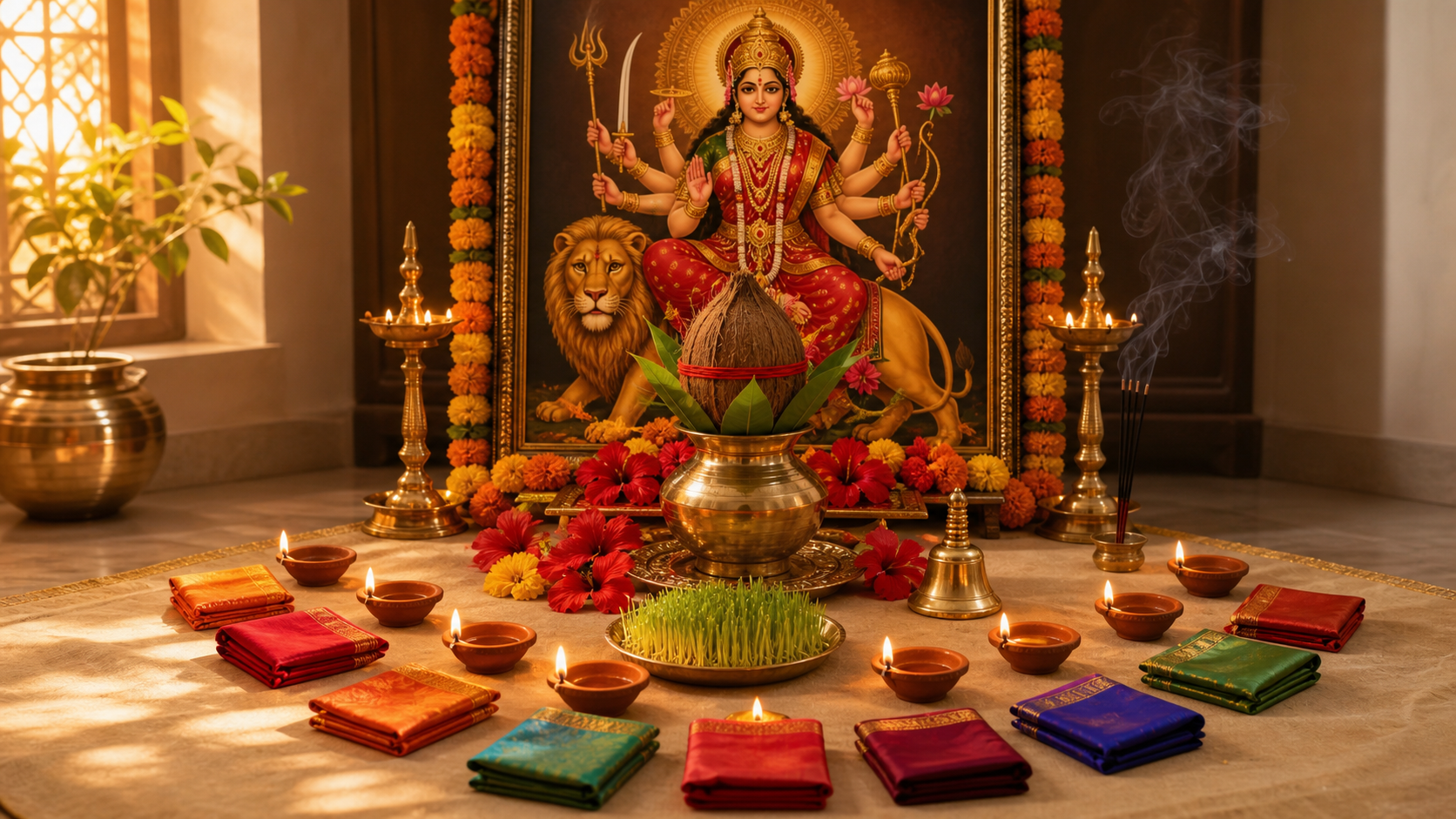
If you are arranging leave, buying puja samagri, choosing a fasting routine or planning nine days of clothes, use March 19 to March 27 as the working Chaitra Navratri 2026 schedule for India. Ghatasthapana begins the observance, Durga Ashtami falls on March 26, and Navami coincides with Sri Rama Navami on March 27.
There is one important complication: a tithi is not confined to a midnight-to-midnight civil date. Your location can change which tithi prevails at sunrise, and the popular Navratri colour rotation also changes with the weekday accepted as Day 1. Confirm that first; then keep one calendar throughout the festival instead of mixing dates, deities and colours from different schedules.
Lock your local Day 1 before making the nine-day plan
Chaitra Navratri begins on Chaitra Shukla Pratipada, not merely on a pre-printed Gregorian date. For the principal India schedule used here, Day 1 is Thursday, March 19, and Day 9 is Friday, March 27. This also places Chaitra Shukla Tritiya and Chandraghanta Puja on March 21.
If the panchang or temple calendar followed in your city places Pratipada at sunrise on Friday, March 20, use the March 20 to March 28 schedule instead. Shift every deity and concluding observance forward by one civil date: Ashtami becomes March 27 and Navami or Rama Navami becomes March 28. This is especially important outside India, where sunrise and tithi boundaries must be calculated for the place of worship rather than copied from Indian Standard Time.
Muhurat-sensitive rites need the same discipline. Ghatasthapana is normally performed after sunrise, during the first one-third of the day while Pratipada remains active. When the preferred morning period is unavailable, Abhijit Muhurat may serve as a secondary option. Vaidhriti or Vyatipata yoga and other local restrictions should be checked in the panchang used by your family or temple. A national festival date can help you plan the week, but it cannot supply an exact muhurta for every city.
The nine-day deity, date and colour plan
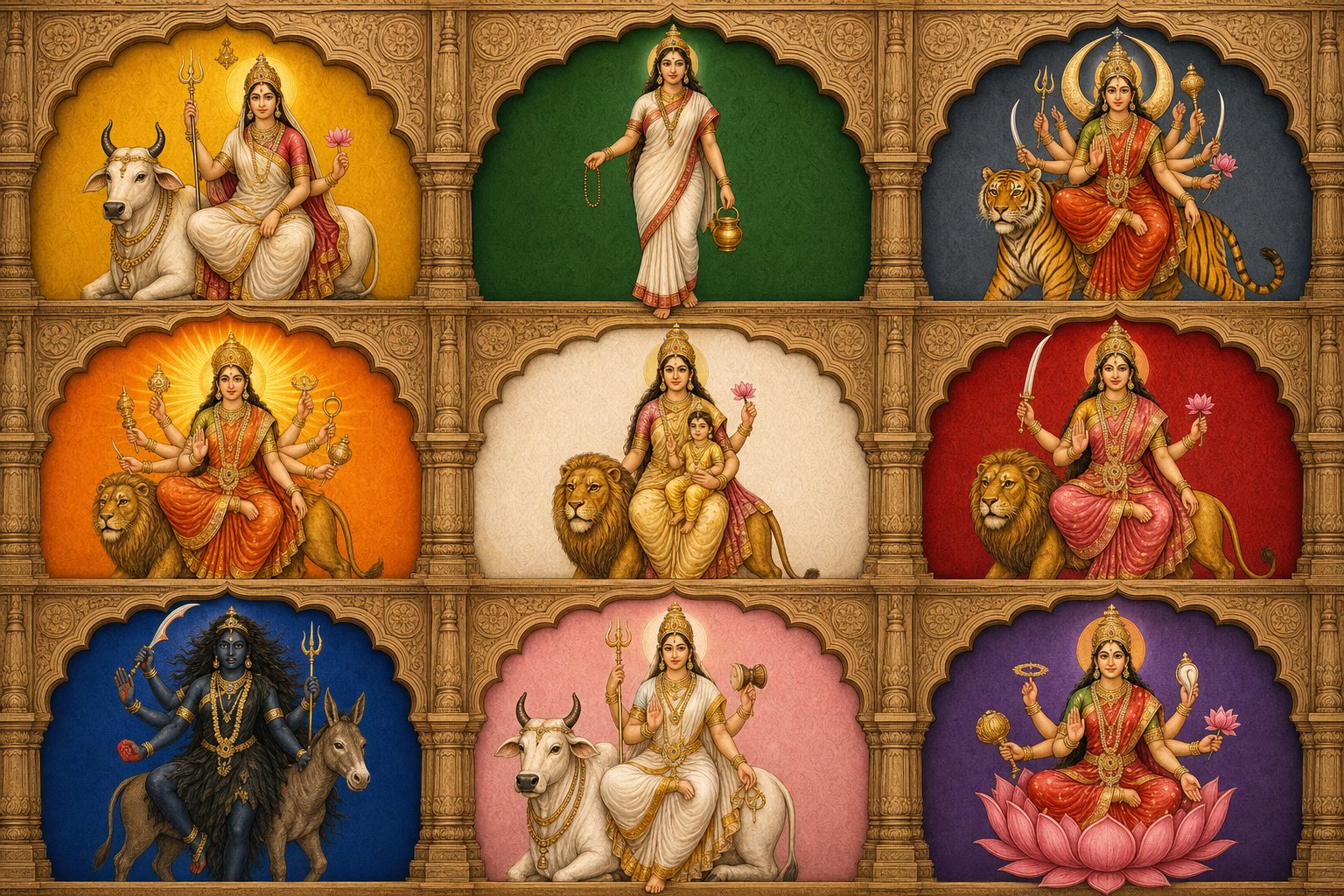
The Navadurga sequence remains Shailaputri through Siddhidatri regardless of local date variation. The colour custom works differently: the widely followed Maharashtra-Gujarat convention uses a fixed rotation beginning at the colour assigned to the weekday of Pratipada. Applying that convention to a Thursday, March 19 start produces the sequence in the table below. These colours are a cultural aid to collective bhakti, not a scriptural condition of valid worship.
| Day and date | Tithi and deity | Thursday-start colour | Practical devotional focus |
|---|---|---|---|
| Day 1: March 19 | Pratipada: Shailaputri | Yellow | Establish the kalasha, sow barley or wheat, and make a nine-day sankalpa centred on steadiness. |
| Day 2: March 20 | Dwitiya: Brahmacharini | Green | Give extra time to japa, quiet study and the disciplined simplicity represented by tapas. |
| Day 3: March 21 | Tritiya: Chandraghanta | Grey | Ring the puja bell, offer fruit or a milk-based preparation, and pray for courage joined to composure. |
| Day 4: March 22 | Chaturthi: Kushmanda | Orange | Offer seasonal fruits or grains and direct the day’s energy towards constructive, life-giving work. |
| Day 5: March 23 | Panchami: Skandamata | Peacock Green | Express nurturing devotion through patient care, annadana or another concrete act of seva. |
| Day 6: March 24 | Shashthi: Katyayani | Pink or Purple | Renew one neglected sankalpa and ask for strength that remains answerable to dharma. |
| Day 7: March 25 | Saptami: Kalaratri | White | Bring a fear, destructive habit or recurring obstacle into prayer instead of avoiding it. |
| Day 8: March 26 | Ashtami: Mahagauri | Red | Observe purification, dana and, where customary, Kumari or Kanya Puja. |
| Day 9: March 27 | Navami: Siddhidatri and Sri Rama Navami | Royal Blue | Complete Devi worship with Ramayana recitation, Rama nama, kirtan or family reflection on maryada. |
If your locally accepted Day 1 is Friday, March 20, move the dates forward one day and use this Friday-start colour order: Green, Grey, Orange, Peacock Green, Pink or Purple, White, Red, Royal Blue and Yellow. Do not keep the Thursday dates while borrowing the Friday colour sequence; the entire purpose of the rotating convention is to begin with the weekday colour.
You may also follow your sampradaya’s established colours or the iconographic colour associated with a particular form of Devi. Wearing white for Mahagauri, for example, is not made incorrect by a rotating list that assigns another shade. If your household has no colour custom, clean and modest clothing is sufficient. A dupatta, stole, scarf, bangle or pocket square is enough for anyone who wants to participate without buying nine new outfits.
Establish the kalasha once, then maintain a daily rhythm
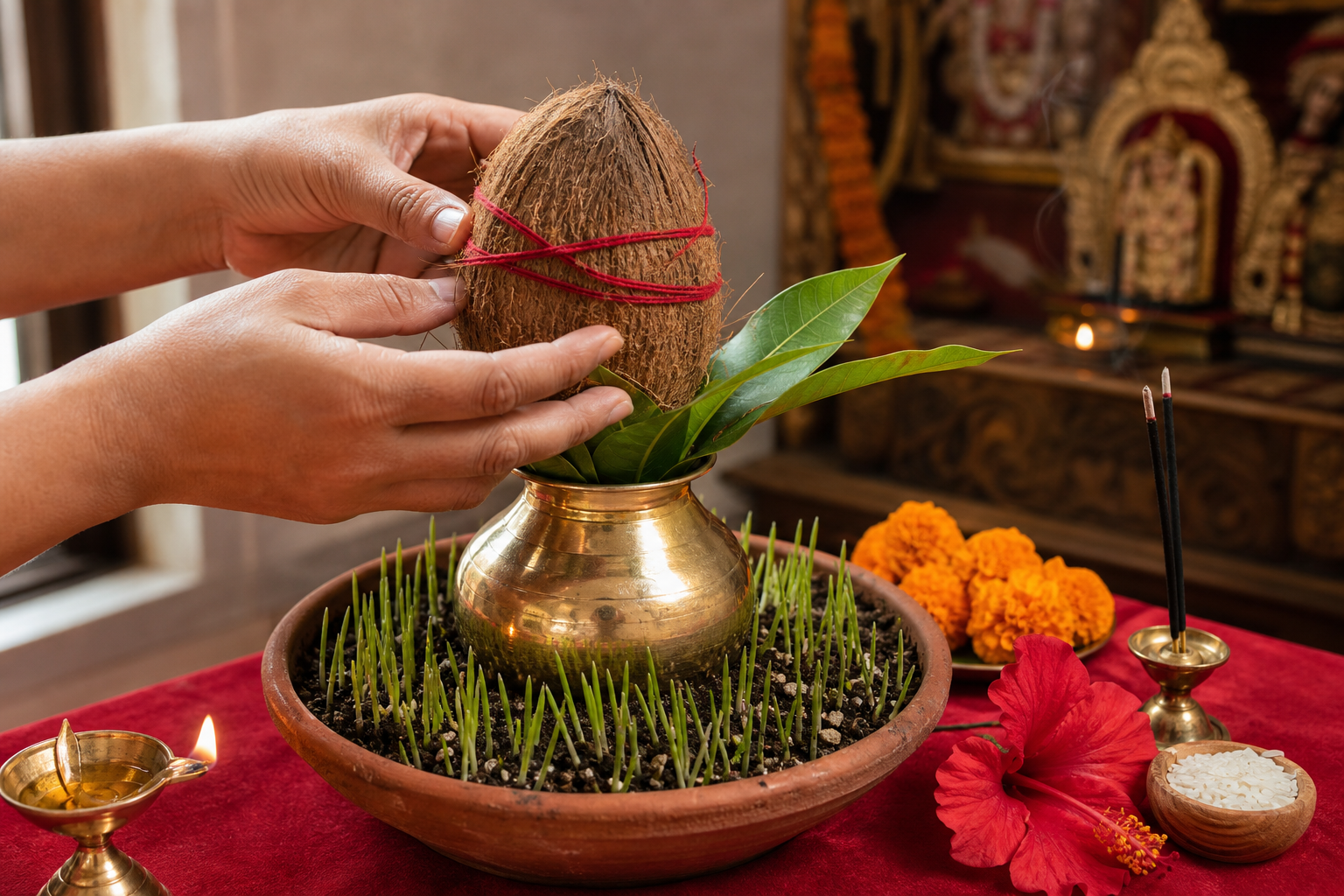
Ghatasthapana on Day 1
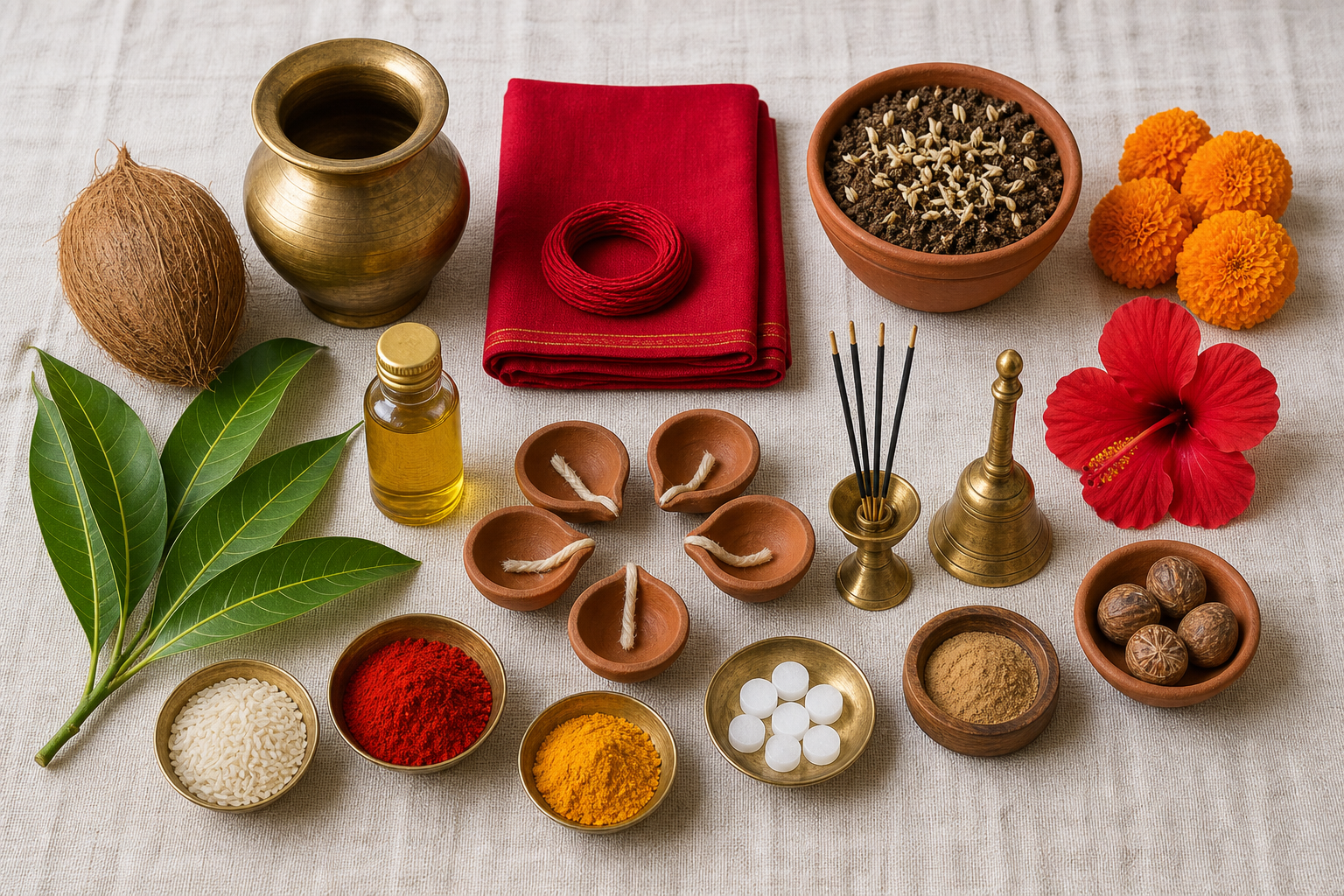
Gather the essential materials before the morning muhurta: a stable altar, an earthen or metal kalasha, clean water, akshata, a coin, red thread, five mango leaves, a whole coconut, red cloth, soil, barley or wheat seed, kumkum, flowers, incense, a safe lamp and simple naivedya. Betel nut, Ganga-jal, a conch, a yantra and elaborate decorations are optional additions, not reasons to delay a sincere household puja.
- Clean the altar and puja vessels, bathe, wear fresh clothes and settle the household before beginning.
- Place clean soil in a shallow tray and sow barley or wheat. The growing shoots become a visible reminder that daily attention, not a single dramatic act, sustains sadhana.
- Fill the kalasha with water. Add akshata and a coin, tie red thread around its neck, arrange five mango leaves at the mouth and place the coconut wrapped in red cloth on top.
- Set the kalasha securely on or beside the seeded tray. Place an image or yantra of Durga nearby and make a sankalpa naming your place, the observance and the discipline you intend to maintain.
- Invoke Ganesha, then offer gandha, pushpa, dhoop, deep and naivedya. This five-offering Panchopachara is a complete practical option when a sixteen-offering Shodashopachara would be rushed.
- Meditate on Shailaputri and chant ॐ देवी शैलपुत्र्यै नमः 11, 27, 54 or 108 times, according to the time and concentration you can sustain.
- Conclude with arati and prasada. Keep the kalasha in place, tend the shoots carefully and return to the altar every morning and evening through Navami.
The kalasha should rest on a stable surface, never on an unsteady bare edge. If you keep an Akhand Jyot, use a heavy lamp holder, clear away loose fabric and flowers, provide ventilation and ensure that a responsible adult can supervise it. When continuous supervision is impossible, light the lamp for morning and evening puja rather than leaving an unattended flame.
A daily puja that fits ordinary household life
Consistency matters more than adding a new elaborate ceremony every day. Begin with Ganesha smarana, light the lamp, offer water and flowers to the kalasha and Devi, meditate on that day’s Navadurga form, perform japa or a selected recitation, offer naivedya, complete arati and distribute prasada. The Durga Saptashati or Devi Mahatmya, Lalita Sahasranama and Devi Sukta are established choices. If a full parayana is unrealistic, select a portion you can read attentively and keep the commitment for all nine days.
The Navarna mantra, ॐ ऐं ह्रीं क्लीं चामुण्डायै विच्चे, can provide one stable japa practice across the festival. On Day 3, you may add ॐ देवी चन्द्रघण्टायै नमः and emphasize the bell during arati. Chandraghanta’s union of serenity and readiness makes the day useful for anyone who needs to act firmly without surrendering inner balance. Where Sindoor Tritiya or Saubhagya Tritiya is observed, sindoor may be respectfully offered to Devi and haldi-kumkum exchanged with prayers for household well-being and mutual respect.
Choose a sustainable vrata and prepare for Ashtami and Navami
Fasting should sharpen attention, not injure the body
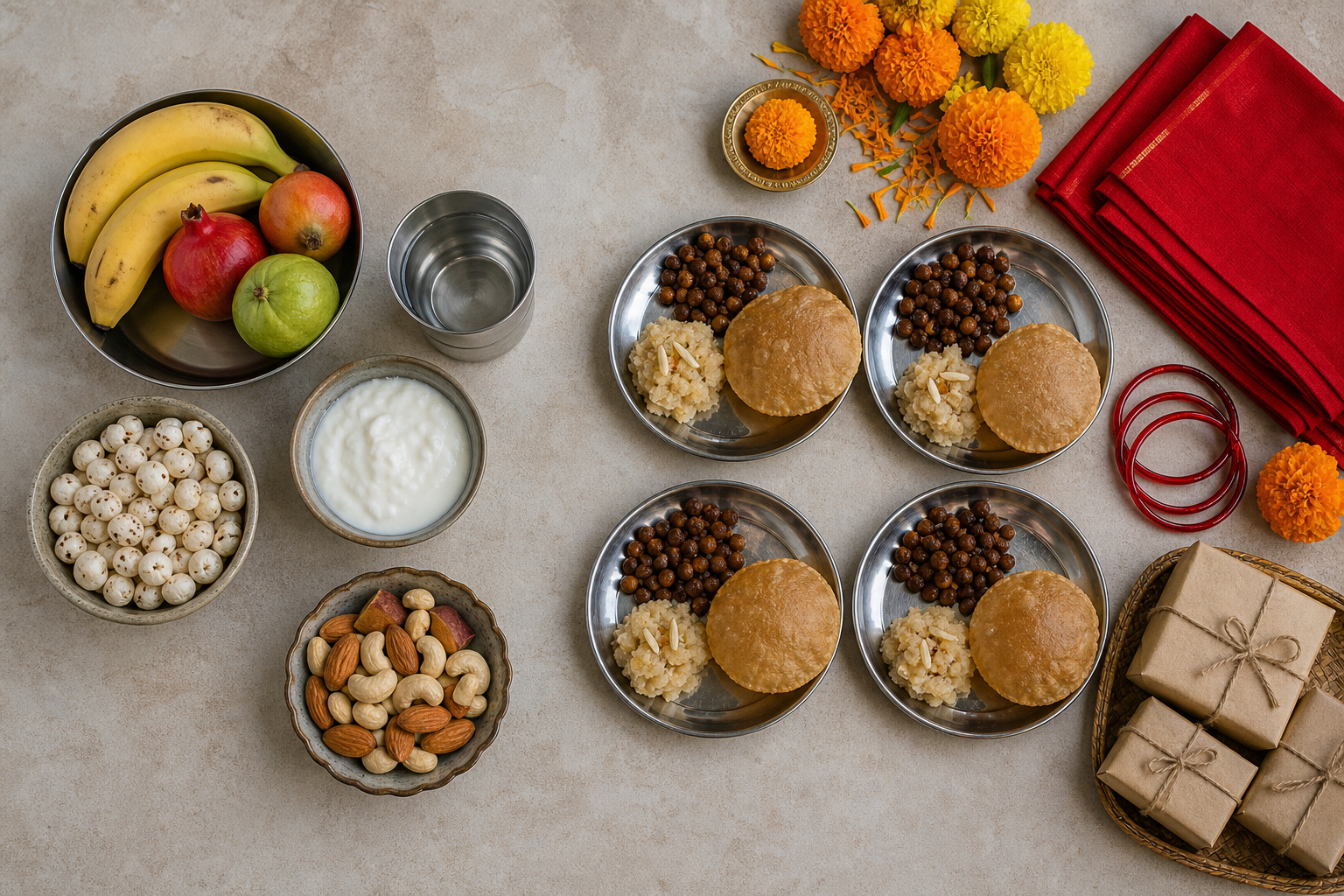
A Navratri vrata can take several legitimate forms. Some experienced and medically fit devotees undertake strict fasting; many use phalahara with fruit and milk; others take one light, grain-free sattvic meal and avoid onion, garlic, alcohol and excessively stimulating food. Choose the pattern before Day 1 so that daily convenience does not keep changing the vow.
Nirjala fasting is only for people who are fit, experienced and able to observe it safely. Children, elders, pregnant people and anyone with a health condition should use a gentler or symbolic restraint suited to their needs, with professional medical advice where necessary. Hydration and necessary medication should not be sacrificed to appearance. Ahimsa applies to your own body as well as to others.
Food restriction is only one part of vrata. Add one behavioural discipline that you can actually notice: no harsh speech, no deliberate waste, a daily act of dana, or a fixed period without distracting media. This turns fasting from a menu change into self-mastery. Simple seasonal food, reusable puja vessels, clay lamps, natural flowers and biodegradable offerings also keep reverence for Devi aligned with care for Bhumi.
Ashtami: honour Mahagauri with humility
On the March 19 schedule, Durga Ashtami is March 26. Families that practise Kumari or Kanya Puja may welcome children respectfully, offer food and gifts, and remember that the rite honours divinity rather than displaying ritual status. Obtain parental consent, provide suitable food and make hospitality more important than photography or spectacle.
Sandhi Puja belongs to the transition from Ashtami to Navami, so its timing cannot be inferred from civil midnight. Use a local panchang or temple announcement for that junction. If your household does not perform Sandhi Puja, focused Mahagauri worship, dana and evening arati remain a coherent Ashtami observance.
Navami: bring Shakti sadhana into Rama-bhakti
March 27 is both Siddhidatri Puja and Sri Rama Navami on the principal schedule. The convergence matters: Shakti supplies the capacity to act, while Sri Rama represents strength governed by maryada and dharma. You can mark the culmination with Siddhidatri archana followed by Ramayana recitation, Rama nama-japa, kirtan or a family discussion about one duty that now requires clearer action.
If your local cycle begins March 20, observe these concluding rites on March 27 and March 28 instead. Follow the same local authority for Navami and any fast completion timing; changing calendars at the end can separate the rite from the tithi it is meant to honour.
Key takeaways before you buy supplies
- Use March 19-27 as the working India schedule unless your local panchang or temple explicitly begins the observance on March 20.
- For a March 19 start, the weekday-based colours are Yellow, Green, Grey, Orange, Peacock Green, Pink or Purple, White, Red and Royal Blue.
- For a March 20 start, shift every observance one day later and use Green, Grey, Orange, Peacock Green, Pink or Purple, White, Red, Royal Blue and Yellow.
- Perform Ghatasthapana in the locally valid Pratipada morning window; do not copy a muhurta calculated for another city or time zone.
- Choose one sustainable fasting level and one daily spiritual discipline before Navratri begins.
- Treat colours as a joyful community custom. Your sampradaya’s practice, devotional attention and clean attire take precedence over perfect wardrobe matching.
Your most useful preparation now is simple: confirm the local sunrise-based calendar, write down your Day 1 and colour sequence, choose your vrata, and assemble the kalasha materials. Once those decisions are settled, the nine days can remain what they are meant to be: a steady movement from resolve to disciplined strength, purification and dharmic action.
References
- DharmaRenaissance Blog – Navratri 2026 Day 3 (March 21): Auspicious Sindoor Tritiya, Chandraghanta Puja, and Dashain Traditions
- Hindu Pad – Chaitra Navratri 2026: Definitive Dates, Puja Vidhi, Nava Durga Guide, and Rama Navami Insights
- Hindu Pad – Navratri 2026 Day 1 Unveiled: Ghatasthapana Guide for Chaitra (19 March) and Ashwin (11 October)
- Hindu Pad – Chaitra Navratri Colours 2026: Definitive Day-Wise Guide to Auspicious Saree and Dress Shades
- Hindu Pad – Chaitra Navratri Day 1, 19 March 2026: 10 Powerful Rituals, Muhurat and Fasting Guide