
If you are arranging Navratri 2026 Days 3 through 5 at home, the hardest part is not remembering three forms of Devi. It is keeping the worship steady while the tithi, deity, mantra, offering and regional observance change from one day to the next.
You do not need three elaborate ceremonies. Settle the calendar for your location, retain one dependable puja structure, and change the day’s devotional focus. That gives you a practice you can sustain with attention instead of a checklist you rush to complete.
Settle the local tithi before assigning the civil date
Navratri follows lunar tithis, not fixed 24-hour dates. A tithi can begin or end between two sunrises, so a calendar prepared for India cannot automatically be transferred to Toronto, London, Kathmandu or another location. For most household observances, the tithi prevailing at local sunrise is the practical starting point. Temples and particular lineages may instead use a prescribed madhyahna period or another muhurta.
| Cycle and date | Calendar position | Primary observance | What you should verify |
|---|---|---|---|
| Chaitra Navratri, 21 March 2026 | Day 3 | Chandraghanta Puja | The local Tritiya tithi and your household puja window |
| Chaitra Navratri, 22 March 2026 | Tritiya-Chaturthi transition in regional reckoning | Varad Vinayak Chaturthi and, in some traditions, Kushmanda Puja | Whether your panchang assigns Kushmanda worship to this date or the following local observance |
| Chaitra Navratri, 23 March 2026 | Panchami, approximately in IST and NPT reckoning | Skandamata Puja | The Panchami tithi at your sunrise |
| Shardiya Navratri, 14 October 2026 | Day 4, Ashwin Shukla Chaturthi | Kushmanda Puja | Your local Chaturthi window and temple schedule |
| Shardiya Navratri, 15 October 2026 | Day 5, Ashwin Shukla Panchami | Lalita Panchami in many traditions, with Skandamata worship in the Navadurga sequence | Whether your family follows Lalita Panchami, Skandamata Puja or an established observance incorporating both |
The 22 March entry deserves special care. In many spring almanacs, that civil date remains associated with the third-day rhythm while Shukla Chaturthi rites are also performed. Some regional traditions place Kushmanda Puja there; others place it according to the next sunrise-based count. This is normal lunisolar calendrical variation, not an error that you have to solve by choosing whichever date appears most often online.
Before writing your sankalpa, check a reputable panchang configured for the city where you will perform the puja. Then apply your family rule consistently. If your guru, family pandit or temple has issued a schedule, follow that schedule rather than combining unrelated muhurta tables. If a tithi spans two civil dates, the local sunrise rule is a useful domestic default, but lineage practice remains decisive.
Use one repeatable puja structure for all three days
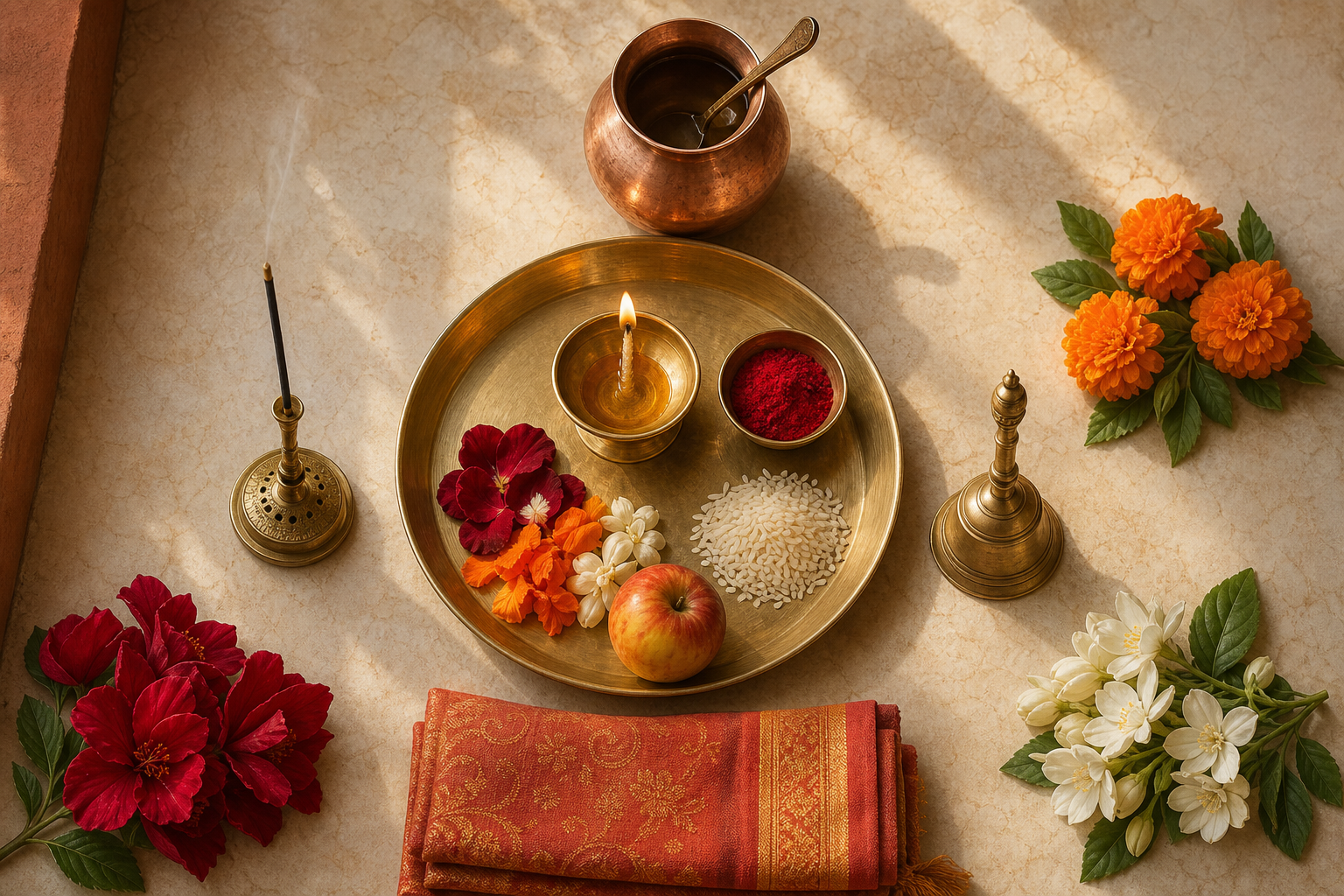
The stable part of these observances is more important than the decorative part. Keep the kalasha established at Ghatasthapana undisturbed, clean the altar each day, and arrange only what you can offer reverently: a safe lamp, incense if suitable for your home, clean water, flowers, fruit and the day’s naivedya.
- Prepare yourself and the altar. Bathe or wash, wear clean clothes, clear yesterday’s wilted offerings, and place fresh water and flowers. Do not move an established Navratri kalasha merely to redesign the shrine.
- Make the sankalpa. State your location, the locally applicable tithi and your intention. Keep the intention concrete: steadiness in dharma, welfare of the household, clarity in speech, courage in duty or the well-being of the wider community.
- Light deepa and dhoop. Place the flame on a stable, heat-safe surface and keep it away from cloth, flowers and children. If smoke is unsuitable, the lamp and mental offering are sufficient for a simple home practice.
- Invoke the day’s form of Devi. Offer gandha, akshata and pushpa according to your custom. Panchopachara is enough when a longer shodashopachara sequence is impractical.
- Offer the day’s mantra, reading and silence. A smaller number of attentive repetitions is preferable to racing through a large count. Where 108 repetitions are customary and manageable, keep an even pace.
- Present naivedya and water. Offer food before tasting it, then distribute it respectfully as prasada. Keep quantities modest enough to prevent waste.
- Perform arati and kshama prarthana. Conclude by asking forgiveness for mistakes in pronunciation or procedure. This preserves humility without turning minor ritual imperfections into anxiety.
If work, caregiving or health limits your time, retain four elements: sankalpa, the day’s nama-mantra, a simple naivedya and arati. Elaborate materials do not compensate for distraction, and a shorter observance does not become spiritually empty merely because it fits the household’s real capacity.
Day 3: Let Chandraghanta turn alarm into disciplined courage
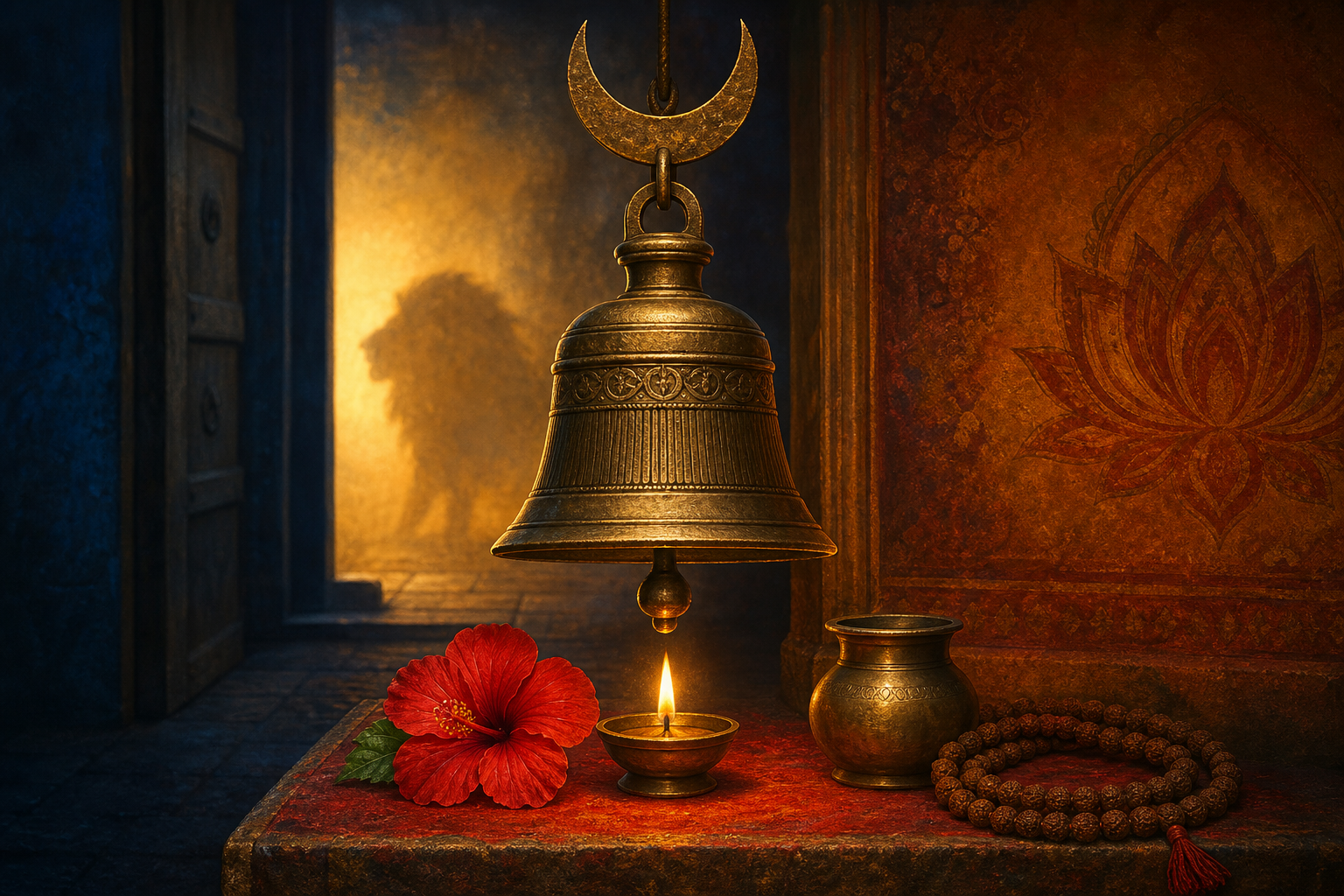
Chandraghanta bears the crescent moon in the form of a bell and is commonly portrayed with ten hands and a lion or tiger as her vahana. The imagery unites readiness with composure: weapons signify the power to confront adharma, while the lunar and bell symbolism recalls an awareness that is clear rather than frantic. The practical aim of the day is therefore not aggression. It is the ability to act without being ruled by fear.
A focused Chandraghanta home observance
- Offer red or white flowers according to availability and family custom.
- Offer milk, curd, kheer, a milk-based sweet or seasonal fruit as naivedya.
- Ring a clean bell in a measured way at the opening of the puja. Treat its sound as a boundary between scattered activity and worship, not as a display of noise.
- Repeat Om Devi Chandraghantayai Namah. A traditional practice is 108 repetitions with steady attention.
- Read or listen to a manageable passage from the Durga Saptashati, also known as the Devi Mahatmyam, and leave a short period of silence afterward.
- Take 9 to 12 slow, comfortable breaths while seated. If you use the common Manipura contemplation, rest attention gently near the navel without straining the breath or treating the practice as a test of endurance.
Color charts for Day 3 are not uniform. Grey appears in some observances, while white or golden tones are used elsewhere to express calm and luminosity. Wear the color your regional tradition follows; if your family has no rule, choose clean clothing suited to worship and move on. The vrata is weakened far more by argument and vanity than by an alternate color.
Give the day’s courage a visible form. Complete one necessary duty you have postponed through apprehension, but do it without harsh speech. You can also offer dana, support annadan, assist girls’ education or undertake another act of service. Chandraghanta worship becomes ethically meaningful when the strength invoked at the altar protects someone beyond the self.
For fasting, use the discipline your household can sustain safely. Common phalahar foods include fruit, milk, yogurt, nuts, potatoes, sabudana, kuttu, singhara and sama rice, with sendha namak where permitted. Onion, garlic and ordinary grains are avoided in many vrata traditions. If fasting conflicts with a medical need, choose a light satvik meal rather than turning physical distress into a measure of devotion.
Day 4: Worship Kushmanda as warmth, vitality and right beginning
Kushmanda represents the creative warmth through which the cosmic egg is brought into ordered existence. She is often shown with eight arms, a lion as her vahana, and implements including a kamandalu, bow, arrow, chakra, gada, rosary, lotus and vessel of amrita. The many implements do not fragment her meaning. They show creative energy directed with intelligence.
Day 4 is a useful correction when a vrata has become heavy or mechanical. Its discipline is radiant steadiness: nourish energy, remove needless obstacles and let warmth enter your dealings with others. Many traditions associate this practice with the Anahata or heart center, so the test is not whether you feel an unusual sensation. Notice whether your breath, tone and conduct become less constricted.
How to handle the Varad Vinayak Chaturthi overlap
If your local panchang and family custom place Varad Vinayak Chaturthi within the spring observance, begin with Ganesha as the auspicious remover of obstacles. A household may offer durva and modak or laddoo, recite its customary Ganesha mantra, and then proceed to Kushmanda Puja. The traditional Chaturthi offering may include 21 blades of durva, but you need not import that count if it is not part of your practice.
Do not duplicate the entire ceremony simply because two observances share a civil date. Make one opening purification and sankalpa, complete the Ganesha worship in the sequence your family uses, and then give Kushmanda her distinct invocation, mantra and naivedya. On 14 October in the Shardiya cycle, the emphasis is more straightforwardly Ashwin Shukla Chaturthi and Kushmanda worship.
A focused Kushmanda home observance
- Invoke Devi with Om Devi Kushmandayai Namah, keeping the breath natural and the japa rhythm even.
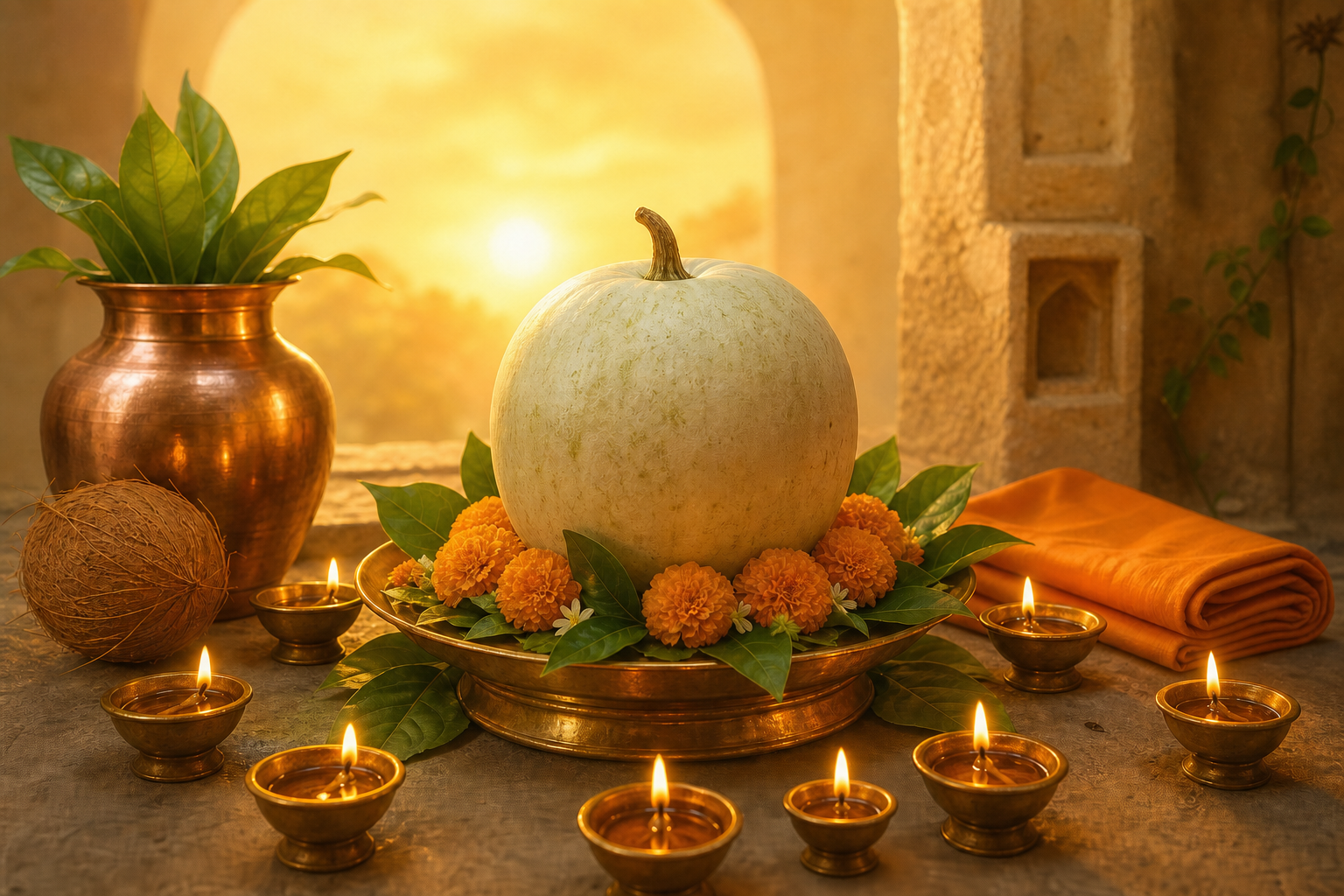
- Offer ash gourd when it is part of your regional practice. Malpua, seasonal fruit and milk-based preparations are also used as naivedya.
- Use a ghee lamp to represent ordered luminosity, but place it where the flame cannot reach a cloth backdrop or garland.
- Rest attention gently at the heart center during a brief silence. Let the contemplation end in a practical resolve to make your speech warmer and your conduct more generous.
- Continue the same balanced phalahar pattern rather than compensating for fasting with an excessively heavy evening meal.
Kushmanda’s creative force is not mere busyness. Choose one neglected task that restores order to the household, community or your own sadhana, and finish it calmly. That might mean preparing the next day’s offerings, repairing a strained relationship through honest speech, or contributing food to someone who needs it.
Day 5: Choose the correct Panchami stream without creating a conflict
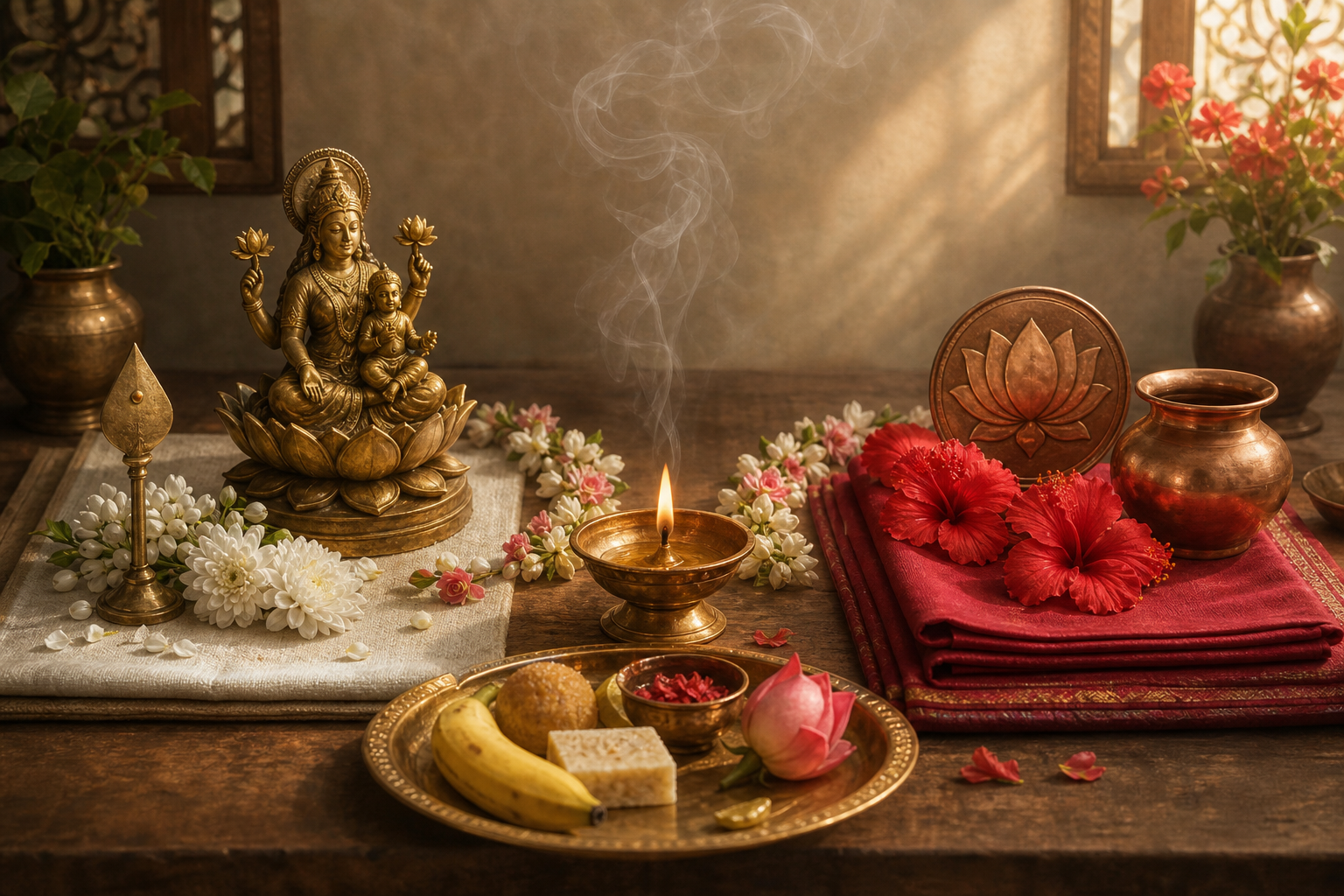
Day 5 requires a distinction between the two Navratri cycles. Chaitra Panchami on 23 March centers on Skandamata. During Shardiya Navratri on 15 October, many Shakta communities observe Lalita Panchami or Upang Lalita Vrata, while numerous households continue the Navadurga sequence with Skandamata. Neither emphasis makes the other invalid. Your family or lineage determines which practice leads.
Skandamata: protection that enables another to grow
Skandamata is the mother of Skanda, also known as Kartikeya, Subrahmanya and Murugan. Her image, seated on a lion with the child Skanda on her lap and lotuses in her hands, joins maternal compassion to dharmic valor. She does not protect by keeping the child permanently powerless; she nourishes the strength through which righteous duty can be fulfilled.
- Repeat Om Devi Skandamatayai Namah with an unhurried cadence.
- Offer lotus flowers if locally and responsibly available. Other fresh flowers are entirely suitable when lotus is unavailable.
- Offer seasonal fruit, banana, a modest jaggery preparation or another homemade satvik naivedya.
- Recite a Navadurga stuti, an appropriate portion of the Durga Saptashati, or the refrain Ya Devi Sarvabhuteshu Shakti Rupena Samsthita, Namastasyai Namastasyai Namastasyai Namo Namah.
- Contemplate the common Vishuddha association by observing your speech for the day. Tell the truth without using truth as permission to humiliate someone.
The mother-and-child icon also gives you a useful test for seva. Help someone become more capable rather than making them more dependent on you. Teach, encourage, share food, make space for another person’s voice, or remove an obstacle that prevents worthy effort.
Lalita Panchami: recitation, sacred form and inward stillness
Where Lalita Panchami is the inherited observance, worship centers on Lalita Tripurasundari and the Sri Vidya synthesis of mantra, sacred geometry and bhava. Offer kumkum and fragrant flowers to the Lalita image or Sri Chakra used by your household, then recite the Lalita Sahasranama at a pace that preserves attention. You may recite an established portion if the full text is not practical. Close in silence instead of moving immediately back to conversation or a phone.
Lalita Trishati should be approached only where your tradition permits it. Do not treat every practice associated with Sri Vidya as an interchangeable public ritual. If your household has no established Sri Chakra worship, a respectful image, lamp, flowers, kumkum and Lalita Sahasranama provide a coherent observance without improvising a specialized procedure.
If your family remembers Skandamata while observing Lalita Panchami, do not force the two into competing camps. Let Skandamata express maternal protection within the Navadurga sequence and Lalita express sovereign beauty, wisdom and sacred order within the Panchami vrata. Preserve the ritual sequence you have received rather than constructing a new one from disconnected instructions.
In Nepal, Panchami continues the daily Durga upasana of Dashain. Maintain the household kalash, cleanliness, lamp, offerings and recitation as one stage of the longer movement toward Maha Ashtami, Maha Navami and Vijayadashami. Continuity matters more on this day than adding spectacle.
Key takeaways
- Use a panchang configured for the place of worship; do not copy another city’s clock time into your sankalpa.
- Keep one daily puja framework and change the Devi form, mantra, naivedya and contemplation.
- On Day 3, direct Chandraghanta’s courage toward a necessary action performed without anger.
- On a Chaturthi overlap, worship Ganesha first if that is your household custom, then proceed to Kushmanda without needlessly repeating every opening rite.
- On Shardiya Panchami, let your lineage determine whether Lalita Panchami or Skandamata is the principal observance.
- Adapt fasting to health, keep lamps safe, avoid single-use plastic, compost suitable flowers and prepare only as much prasada as the household can consume or share.
Before Navratri begins, write down your city, the locally applicable tithis, your family’s Day 5 stream and the three naivedya choices. Once those decisions are settled, Days 3 through 5 can do their real work: moving you from composed courage, through creative warmth, into protection guided by truthful and compassionate speech.
References
- DharmaRenaissance Blog – Navratri Day 3, 21 March 2026: Powerful Chandraghanta Puja Vidhi, Mantras, Fasting, 10 Key Actions
- DharmaRenaissance Blog – Navratri 2026 Day 4 Guide: Kushmanda Pujan, Varad Vinayak Chaturthi, and Dashain Insights
- DharmaRenaissance Blog – Navratri 2026 Day 5: Skandamata Puja, Lalita Panchami, and Dashain Timings, Vidhi, Meaning