
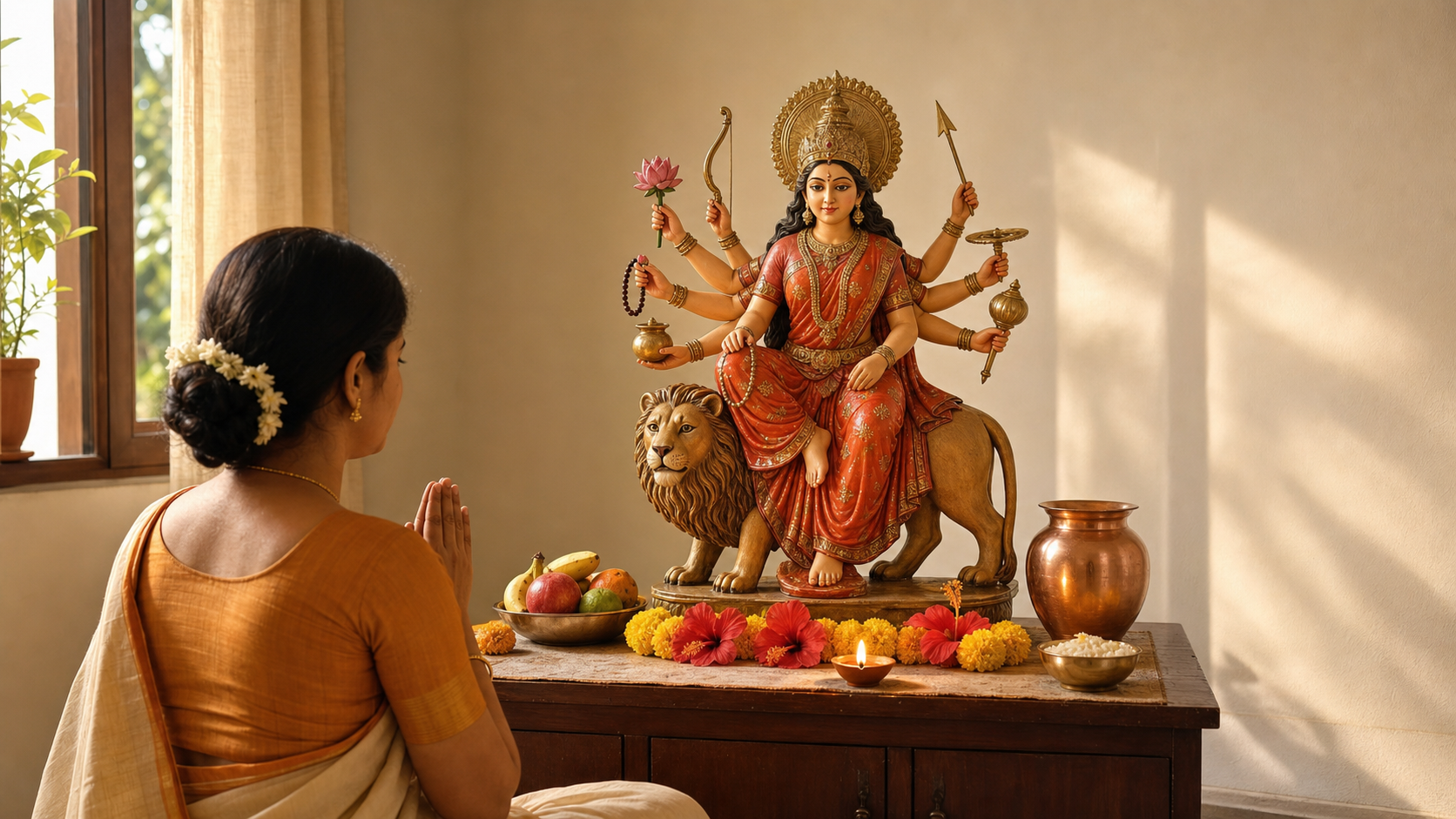
You want to worship Goddess Kushmanda on Chaitra Navratri’s fourth day, but the practical question is usually not whether you have enough devotion. It is what must be done, what may be omitted, and how to fit the puja around work, family, fasting, and your local calendar.
You do not need a temple-scale ceremony. A clean place, a clear sankalpa, five attentive offerings, mantra japa, naivedya, and a proper closing form a coherent household puja. Add a kalasha, extended recitation, or homa only when these belong to your parampara and you can perform them safely.
Confirm the local Day 4 before choosing a puja time
Navratri Day 4 generally corresponds to Chaitra Shukla Chaturthi. For 2026, Kushmanda Puja falls on 22 March, subject to the regional panchang. That qualification matters: a tithi does not necessarily begin and end at civil midnight, and local sunrise and transition times can change how a temple or household observes the day.
Check a panchang calculated for your location, not one published for a distant city. You need three pieces of information:
- When Chaitra Shukla Chaturthi begins and ends locally.
- Whether your family or temple identifies the observance by the tithi present at sunrise or follows another established regional convention.
- The local morning window, Abhijit Muhurat, and Rahu Kalam if your parampara uses these timing considerations.
Morning worship after sunrise is the usual first choice. Abhijit Muhurat offers a practical midday alternative when work or caregiving makes the morning impossible, while avoiding Rahu Kalam is customary in many households. If a local temple announces a date or time that differs from a generic calendar, a tithi transition or regional convention may explain the difference. Follow the panchang and parampara that actually govern your observance.
Reserve 20 to 40 uninterrupted minutes for a concise family puja. It is better to protect a realistic window than to plan an elaborate rite and rush through the mantra, naivedya, and closing.
Build an altar that expresses Kushmanda’s form
A traditional devotional explanation reads the name Kushmanda through ku, subtle or little; ushma, warmth; and anda, the cosmic egg. The form points to the primordial warmth through which creation becomes manifest. Her radiance is therefore not merely decorative imagery. It invites you to examine what your own energy is creating, nourishing, and protecting.
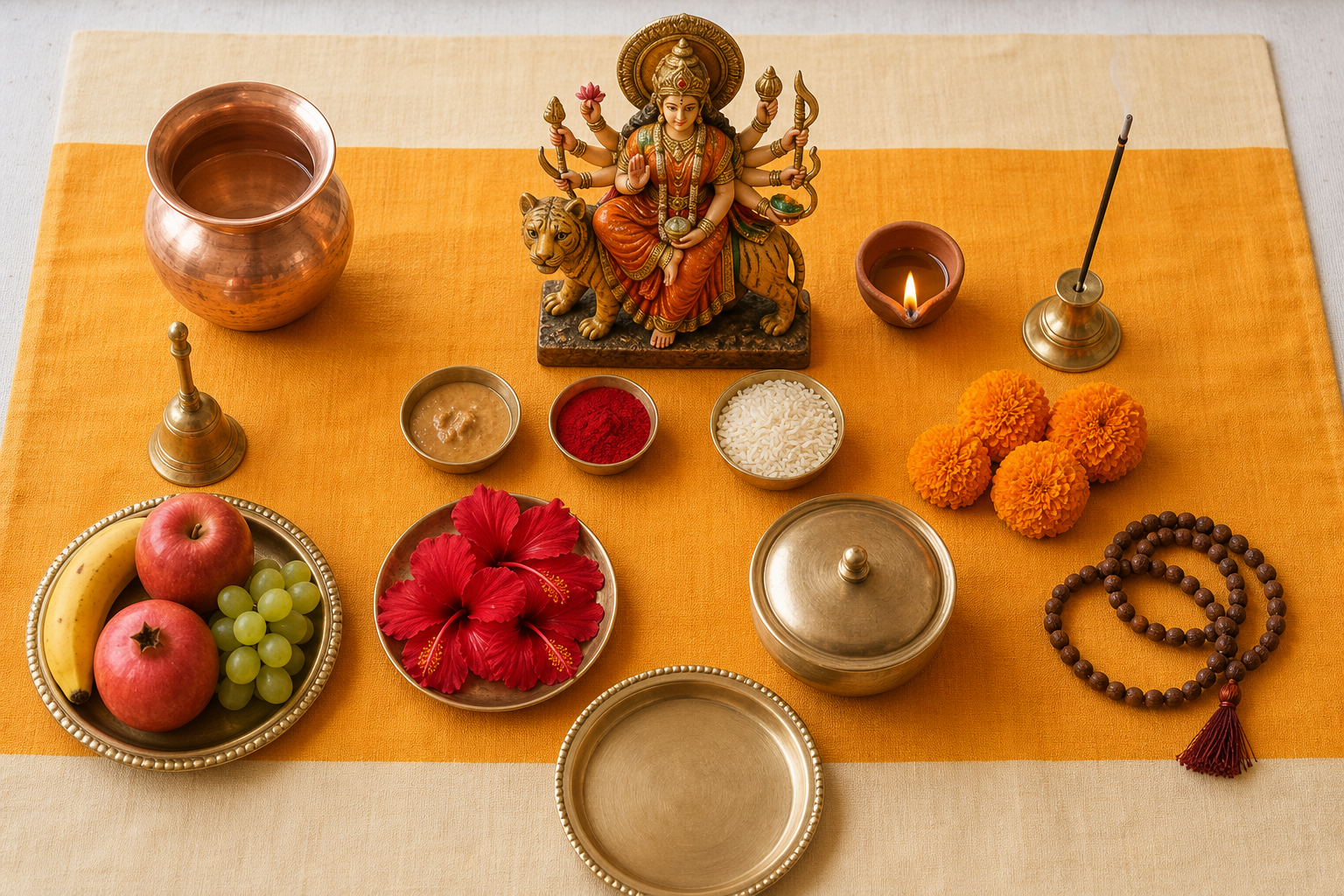
Goddess Kushmanda is commonly portrayed as Ashtabhuja, the eight-armed Devi, seated on a lion. Her hands may hold a kamandalu, bow, arrow, lotus, amrita kalasha, chakra, gada, and mala. The image joins protection with nourishment, disciplined power with spiritual practice. You do not need to acquire every symbolic object separately; a suitable murti or image is enough to hold the form before you.
Use a clean, ventilated worship area. An east- or north-facing arrangement may be used when the room and household custom allow it. Place the murti or image centrally, the lamp safely to the right, and clean water to the left. Keep each offering within reach so you do not have to interrupt the puja to search for an item.
For a focused household Panchopachara, prepare one item for each of the five offerings:
- Gandha: sandal paste, kumkum, haldi, or the fragrance used in your tradition.
- Pushpa: fresh flowers offered without excessive packaging or waste.
- Dhupa: incense, used lightly in a ventilated room.
- Deepa: a stable ghee or sesame-oil lamp.
- Naivedya: one sattvic preparation or fruit, with water for the concluding offering.
You may also keep akshata, a panchapatra and spoon, a japa mala, and a kalasha with water, mango leaves, and coconut if those belong to your practice. White, green, or yellow cloth and clothing can support the day’s sattvic, heart-centered mood, but color customs vary. Do not let a color chart displace your family’s living tradition.
Decide your sankalpa before lighting the lamp. A traditional form is: asmin shubhe tithau Chaitra Shukla Chaturthyam Navaratri Chaturtha-dine Shri Kushmanda Devi prityartham mama kutumbe sukha-arogya-sampad-siddhyartham pujam karishye. In plain language, you are resolving to worship Shri Kushmanda Devi on the fourth day of Navratri for her grace and for well-being, health, and auspicious prosperity in the family. If Sanskrit pronunciation distracts you from the meaning, state the intention reverently in the language you understand.
Perform the household Kushmanda Puja in eight steps
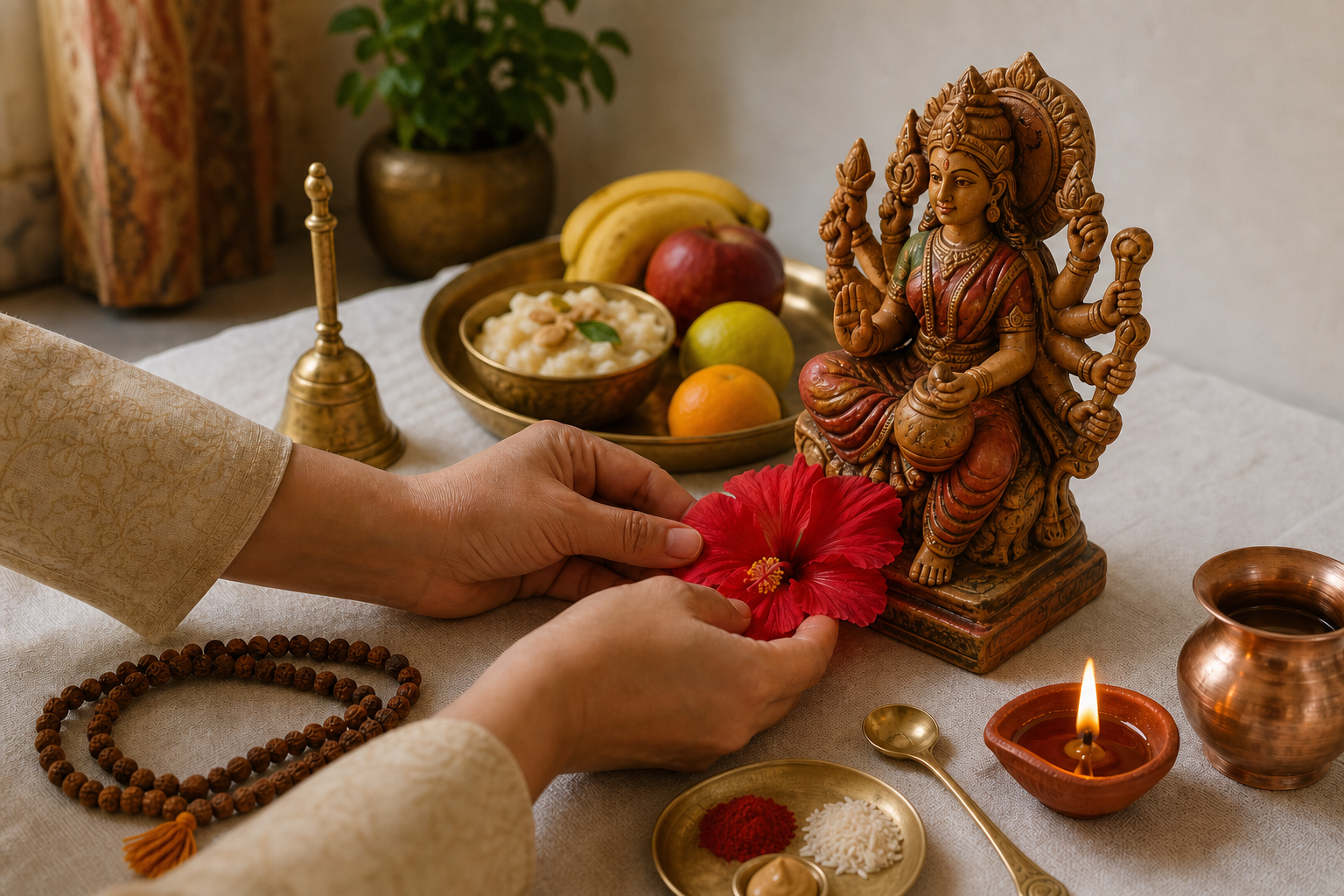
This sequence preserves the ritual arc: prepare, invoke, offer, recite, contemplate, and close. Keep the order steady even when the puja is brief.
- Settle the body and space. Wash your hands, complete achamana according to your custom, and sit with a relaxed, upright spine. Take a few calm breaths. The pause is functional: it separates worship from the activity that came before it.
- Make the sankalpa. Name the tithi, the Devi, and the purpose of the worship. Keep the purpose dharmic and concrete: clarity, right use of vitality, family well-being, gratitude, or strength for service.
- Invoke the Devi. Offer avahana before the image or murti. If your household uses a kalasha for this worship, install or honor it according to your established procedure. Treat the invocation as the point at which casual arranging ends and attentive worship begins.
- Offer Panchopachara or Shodashopachara. Present gandha, flowers, incense, lamp, and food one by one for a concise puja. Use the sixteen-offering sequence only if you know it through family or lineage practice. More items do not compensate for distracted handling.
- Chant the central mantra. Use ॐ देवी कूष्माण्डायै नमः, transliterated as Om Devi Kushmandayai Namah. A round of 108 repetitions on a rudraksha or sphatika mala is common. Chant at a pace that keeps each repetition intelligible; if you cannot complete 108 attentively, choose a manageable count rather than racing through a nominal total.
- Add the Navarna mantra only where appropriate. The mantra ॐ ऐं ह्रीं क्लीं चामुण्डायै विच्चे, Om Aim Hrim Klim Chamundayai Vicche, is revered in Shakta sadhana. Follow the guidance of your lineage where mantra instruction governs its use.
- Contemplate at the heart center. Many traditions associate the fourth day with anahata. Let the breath become even, allow the exhalation to lengthen gently without strain, and bring attention to the center of the chest. Visualize a soft green or golden radiance while cultivating gratitude, maitri, and daya. This is contemplation, not a demand for a dramatic inner experience.
- Offer naivedya and close. Present the food and then water, perform aarti, bow, and conclude with gratitude. Distribute the food as prasad rather than leaving it as altar decoration. Make sure every flame is secure before anyone leaves the room.
If scripture recitation is part of your Navratri discipline, add it after japa and before naivedya. Households divide the Devi Mahatmyam or Durga Saptashati across the nine days in different ways. Some recite selections from the Madhyama Charita on the fourth day; others use a complete section, kavacha, or another allocation received through their parampara. Follow the division you have inherited instead of forcing an unfamiliar schedule merely to increase the volume of recitation.
Adapt bhog, vrata, family participation, and seva wisely
Ash gourd, also called kushmanda, has an obvious symbolic connection with this form of the Devi. It may be offered as a simple sattvic preparation or as petha. Regional households also use malpua, kheer, milk, curd, honey, mishri, or seasonal fruit. Choose one principal naivedya and perhaps one fruit. A modest portion prepared cleanly is more sustainable than several dishes made only to satisfy a checklist.
A light sattvic vrata may include avoiding onion and garlic, but fasting must be adjusted for age and health. If restricting food conflicts with medical needs, medication instructions, or professional advice, modify or omit the fast. The sankalpa can be kept through sattvic food, moderation, japa, and seva. A prayer for arogyam is not a substitute for needed care.
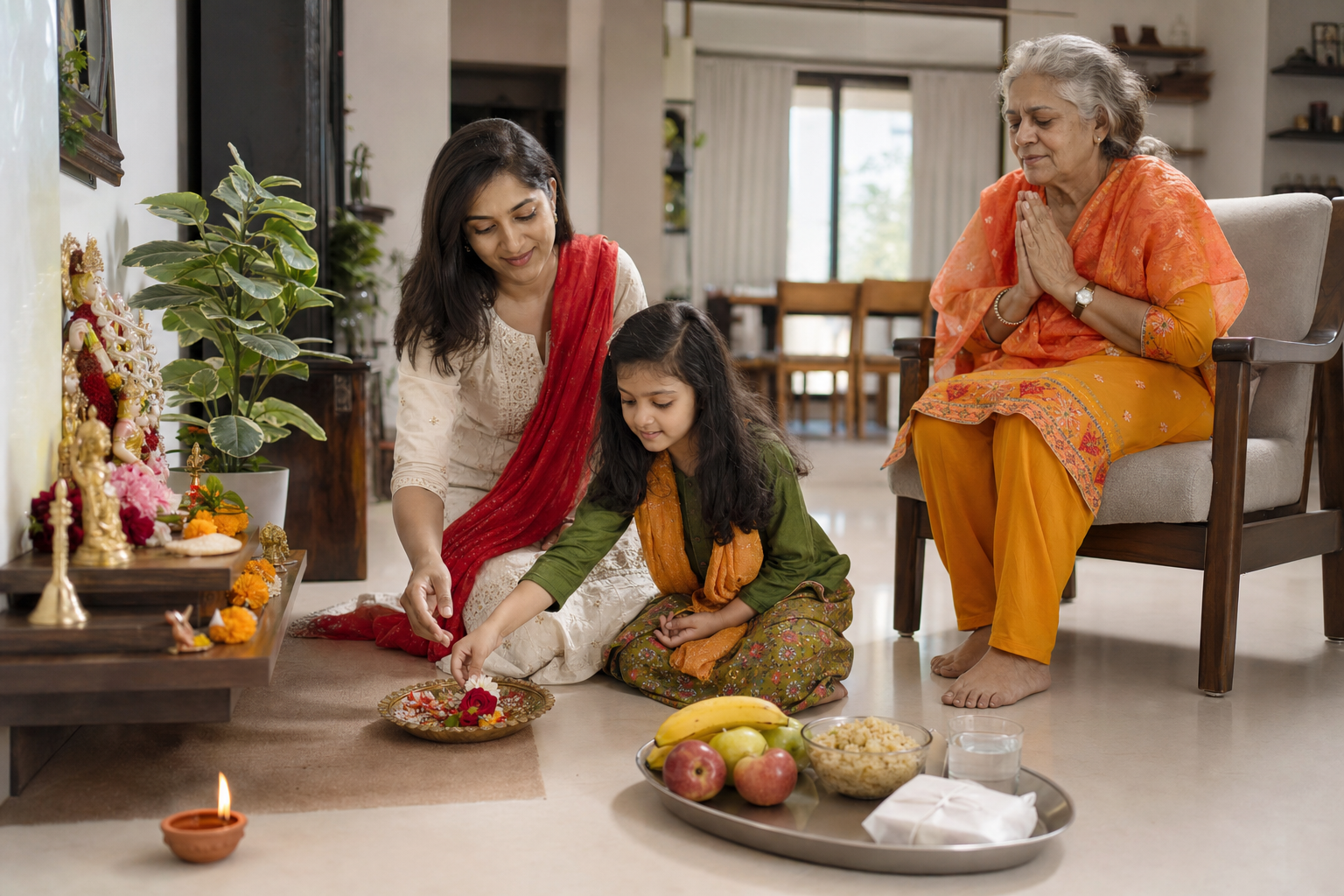
For children and mixed-age families, divide the 20-to-40-minute puja into visible tasks. A child can place a flower, carry the unlit offering plate, count a few mantras, or help distribute prasad. An adult should supervise any lamp, incense, or hot vessel. Participation transmits the practice more effectively than asking a child to remain passive through a long ceremony.
In a family that includes more than one Dharmic tradition, retain the specifically Hindu character of Devi worship while making its ethical purpose understandable to everyone. The heart-centered observance can be discussed through ahimsa and aparigraha, Buddhist maitri and karuna, and Sikh seva and sarbat da bhala. These traditions are not interchangeable, but gratitude, non-harm, compassion, and service provide honest points of meeting.
Turn the inner emphasis into one outward act on the same day. Offer annadana, give fruit or vegetables to a household in need, support a community kitchen, plant a sapling, or contribute an ash gourd to a food program. Choose one action you can actually complete. Seva prevents the language of compassionate energy from remaining only a private feeling.
A household homa is optional. Perform one only if you already know the procedure and have a stable havan kund, dry samidha, ghee, suitable tools, adequate ventilation, and a safe way to extinguish the fire completely. Keep smoke minimal and flames away from cloth, children, and walkways. If any part of the setup is doubtful, omit the homa and continue with lamp, mantra, and offering. Never leave a lamp, incense stick, or sacred fire unattended.
Use natural flowers and biodegradable offerings in moderate quantities. Reverence is not measured by the amount discarded afterward. Clean fuel, careful placement, and ethical sourcing make environmental responsibility part of the worship rather than an unrelated concern.
Key takeaways for Chaitra Navratri Day 4
- Confirm Chaitra Shukla Chaturthi with a panchang calculated for your location; in 2026, the observance is generally on 22 March, subject to regional timing.
- Prefer a calm morning puja after sunrise; use local Abhijit Muhurat when midday is more practical, and observe your customary approach to Rahu Kalam.
- A complete concise rite can consist of sankalpa, avahana, Panchopachara, Kushmanda mantra japa, brief heart contemplation, naivedya, aarti, and pranam.
- The central mantra is ॐ देवी कूष्माण्डायै नमः. Chanting 108 times is common, but attention and intelligibility matter more than a rushed count.
- Offer one suitable bhog, such as an ash-gourd preparation, petha, kheer, milk, mishri, or seasonal fruit, according to household custom.
- Adjust fasting to age and health, involve children safely, omit homa when the setup is unsuitable, and complete the observance with one practical act of seva.
Before Day 4, check the local tithi, set aside the five basic offerings, write your sankalpa, and choose one achievable act of service. When you sit for the puja, protect the quality of your attention. Kushmanda’s warmth becomes meaningful when the energy awakened in worship is carried into the way you nourish, protect, and serve life around you.