
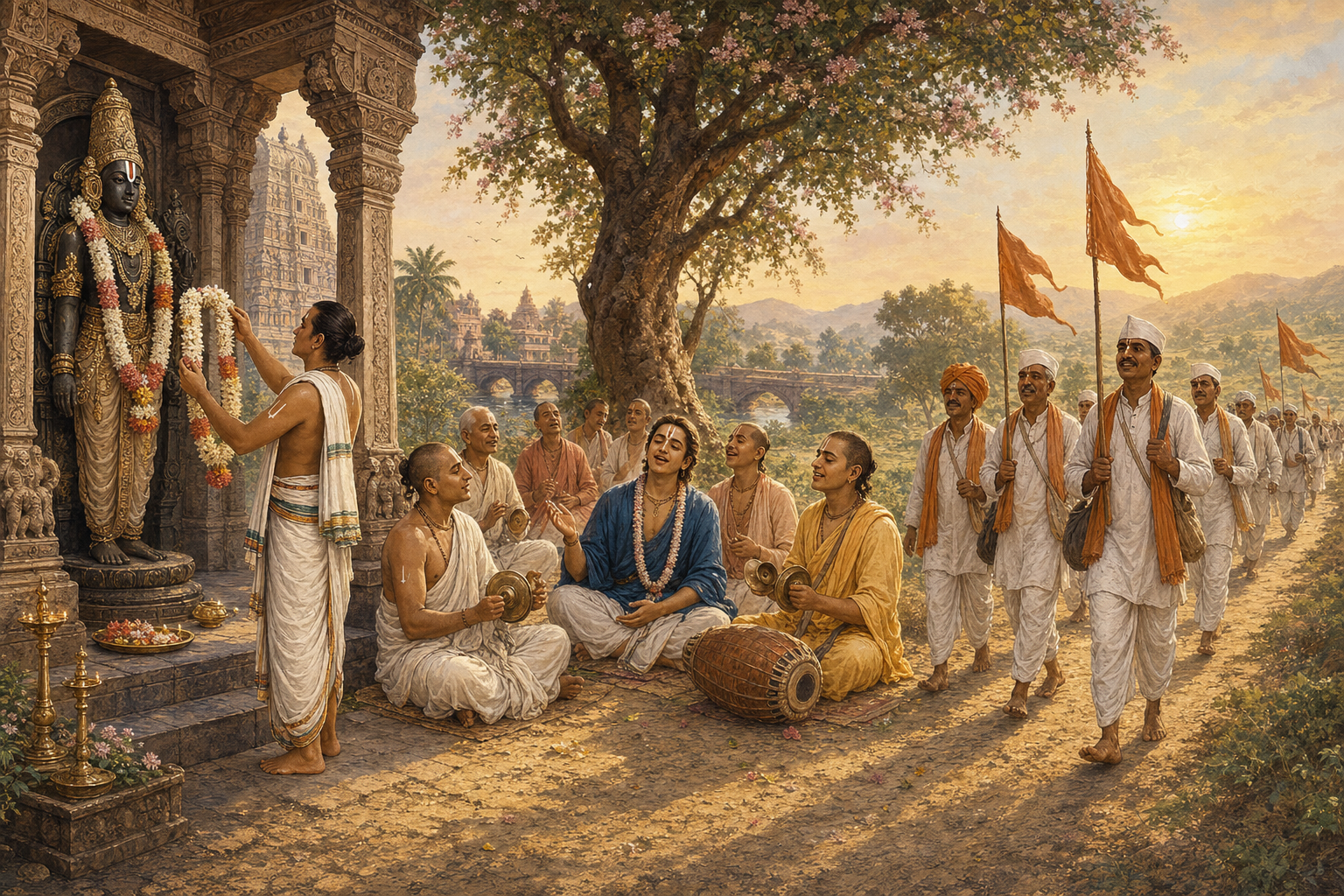
You may feel drawn to bhakti yet hesitate at the word surrender. Does it mean giving up judgment, neglecting practical duties, or waiting for Bhagavan to solve what you should address yourself? In the Vaishnava traditions, authentic surrender asks for none of these things.
The real task is to act wholeheartedly without pretending that you control every outcome. Sri Vaishnava, Gaudiya Vaishnava, and Warkari traditions express that relationship in distinct ways, but each turns devotion into disciplined remembrance, ethical conduct, service, and receptivity to grace. Understanding those differences will help you choose a practice instead of merely admiring the idea of bhakti.
Key takeaways for approaching Vaishnava surrender
- Surrender is a relationship with Bhagavan, not the collapse of your intelligence, dignity, or responsibility.
- Vaishnava traditions share devotion to a personal Supreme but differ in theology, liturgy, sacred language, lineage, and the devotional relationship they cultivate.
- The six limbs of sharanagati give you a practical test for decisions: accept what supports devotion, reject what obstructs it, trust divine protection, depend upon divine maintenance, offer yourself, and remain humble.
- Divine protection does not promise a life without adversity. It means that hardship need not destroy your remembrance, integrity, or capacity to serve.
- A workable practice joins the Divine Name and scriptural hearing to one concrete act of service and one deliberate correction of conduct.
One devotional family, several ways of taking shelter
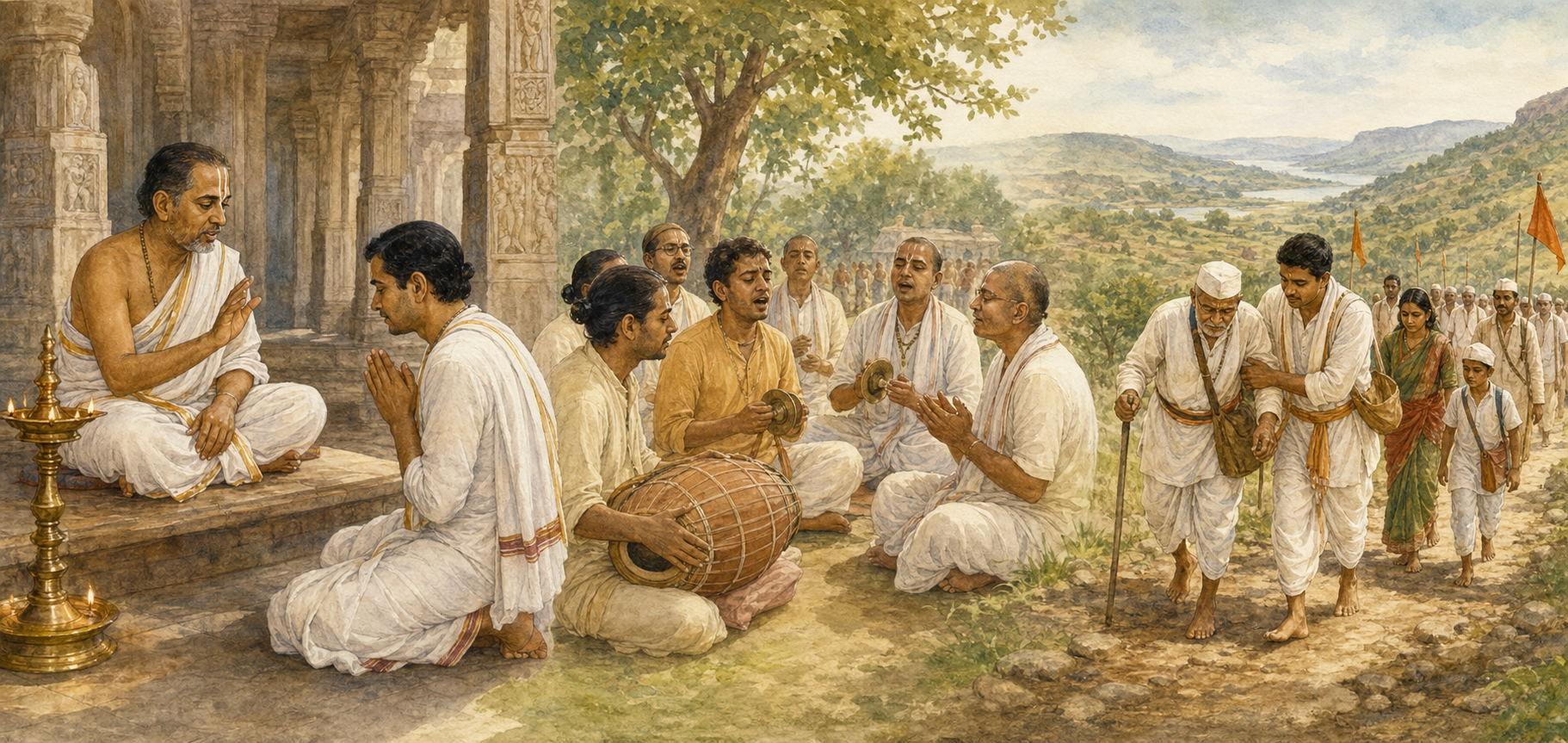
Four prominent Vaishnava sampradayas are traditionally identified as the Sri, Brahma, Rudra, and Kumara lineages. Regional movements such as the Warkari Sampradaya also carry a deeply Vaishnava devotional life centered on a particular form of Bhagavan, a community of saints, sacred songs, pilgrimage, and service.
These identities are not decorative labels for the same interchangeable practice. Before adopting teachings from a temple, teacher, or online community, ask four questions: Which form of Bhagavan stands at the center? Through which acharya-parampara is the teaching received? Which texts and hymns shape its devotional language? What does that community expect surrender to look like in ordinary conduct? Clear answers protect you from assembling fragments that use the same words but rest on different theological foundations.
Sri Vaishnavism: belonging to Narayana
Sri Vaishnavism understands surrender through the Vishishtadvaita Vedanta system associated especially with Sri Ramanujacharya, who lived from 1017 to 1137 CE. Sri Narayana is the one supreme reality, infinitely auspicious and personal. Conscious selves and the material world are real rather than illusions; they exist inseparably in relation to Brahman, often explained through the relation of body and indwelling self. This unity that preserves real distinction gives devotion a firm metaphysical basis: you belong to Narayana, yet you remain a real self capable of loving and serving Him.
This matters in practice. If the world and other beings are related to Bhagavan, surrender cannot be an excuse for indifference toward them. Temple service, care for devotees, disciplined conduct, and respect for embodied life become expressions of that belonging. Liberation is not disappearance into an impersonal abstraction but entrance into the personal presence of the Lord in Paramapada, or Vaikuntha, where loving service reaches fulfillment.
Sri Vaishnavism integrates karma-yoga, jnana-yoga, and bhakti-yoga while giving a decisive place to prapatti, total taking of refuge sustained by divine grace. The acharya therefore does more than transmit information. The acharya teaches the devotee how to understand scripture, receive grace, and live within a community of service without treating private emotion as the final authority.
The tradition’s Ubhaya Vedanta honors both Sanskrit revelation and the Tamil Divya Prabandham of the Alvars, including Nammalvar and Andal. If you are drawn to this path, do not separate its philosophy from its devotional poetry. Study of the Bhagavad-Gita or Ramanuja’s teachings can be joined to attentive listening to the Divya Prabandham, recitation of Om Namo Narayanaya, temple worship, and kainkarya. Each practice trains the same recognition: your life is received from Bhagavan and may be offered back through service.
Gaudiya Vaishnavism: surrender expressed as active service
Gaudiya Vaishnavism, situated in the Brahma-Madhva-Gaudiya lineage, places Krishna, remembrance of His names, and loving devotional service at the center. Practices such as nama-sankirtana, japa, hearing, remembrance, and seva repeatedly return wandering attention to Krishna. Surrender becomes observable in what you give your time, speech, and energy to; it is not confined to a powerful feeling during kirtan.
A. C. Bhaktivedanta Swami Prabhupada’s 1965 voyage on the Jaladuta and the founding of ISKCON in 1966 offer a useful illustration. His reliance on Krishna did not replace preparation. It accompanied the preservation of manuscripts, cultivation of community, establishment of spiritual disciplines, and sustained organizational work. The lesson is not to imitate physical danger or dramatic renunciation. It is to unite careful effort with freedom from proprietorship over the result.
If this is your path, pair chanting with a defined responsibility. Hear from the Bhagavad-Gita or Bhagavata tradition, complete the japa or kirtan practice given by your lineage, and perform a service that another person can actually receive. That combination prevents devotional emotion from becoming self-enclosed.
Warkari bhakti: remembrance at every threshold
The Warkari Sampradaya centers devotion on Vitthal, or Vithoba, of Pandharpur. Communal abhang singing, remembrance of the Divine Name, pilgrimage, simplicity, mutual care, and the lives of saints such as Namdev, Dnyaneshwar, and Tukaram make surrender something practiced by householders while walking, singing, serving, and keeping faith with one another.
Namdev Chi Payari, the first step approached on the way toward Vitthal’s darshan, makes that discipline visible. Pilgrims bow at a physical threshold and collect the mind before moving farther into the temple. Sacred narratives connect the step with Namdev’s devotion and Vitthal’s answering grace, although details vary across devotional memory and are not presented as an archival reconstruction. The enduring instruction is more important than treating every narrative variation as a historical report: humility prepares the devotee to see.
You can carry this Warkari insight into ordinary life without pretending that your doorway is a temple shrine. Before entering a meeting, beginning a meal, answering a difficult message, or starting a household duty, pause at the threshold. Remember the Divine Name, examine your intention, and then proceed. The pause interrupts reflex; remembrance gives the next action a devotional direction.
Use the six limbs of sharanagati as a decision test
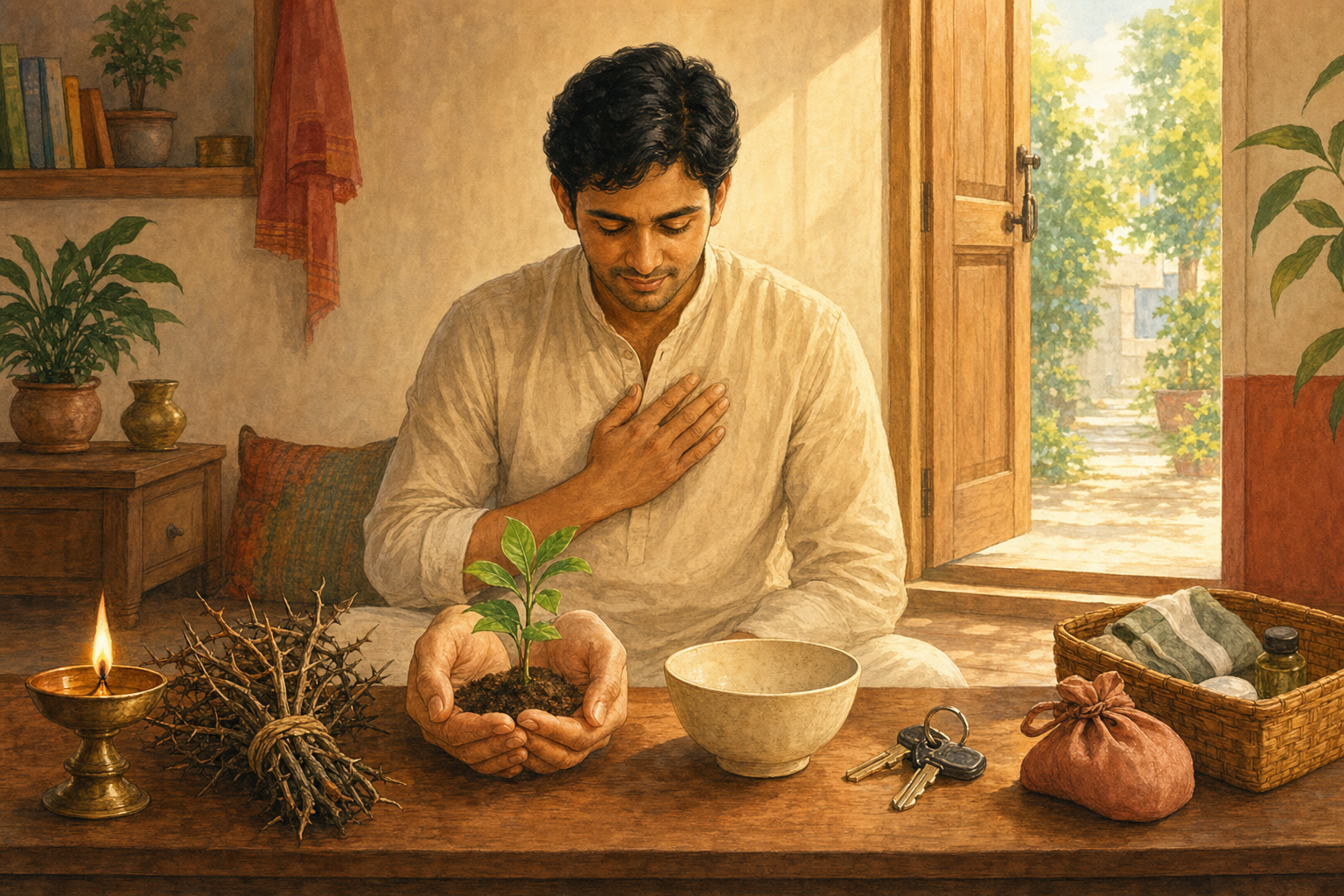
Vaishnava teaching describes six mutually supporting limbs of surrender. They are best used together. Trust without discernment can become recklessness; rejection without a positive devotional commitment can become mere austerity; humility without self-offering can become self-absorption.
- Anukulyasya sankalpah – accept what favors devotion. Identify the relationships, habits, teachings, and duties that make remembrance and service more truthful. Then choose them deliberately. Favorable does not mean pleasant; correction, an inconvenient duty, or disciplined study may support bhakti more than an emotionally gratifying activity.
- Pratikulyasya varjanam – reject what obstructs devotion. Name the obstruction precisely. It may be cynicism, avoidable distraction, resentment, an offense toward another devotee, or a habit that repeatedly displaces your practice. Remove one identifiable cause instead of making a vague promise to become more spiritual.
- Rakshishyatiti vishvasah – trust in the Lord’s protection. Proceed in dharma without demanding certainty about every outcome. The trust is that Bhagavan can preserve and deepen your bhakti through changing circumstances, not that every circumstance will conform to your preference.
- Goptritve varanam – accept the Lord as maintainer. Receive ability, opportunity, sustenance, and the fruits of work as dependent upon a reality greater than your isolated will. You must still earn, plan, repair, ask for help, and fulfill obligations. Dependence upon Bhagavan corrects the fantasy of absolute self-sufficiency; it does not abolish responsible means.
- Atma-nikshepa – offer the self. Move beyond offering only spare time, ritual objects, or convenient tasks. Place your intention, labor, reputation, and desired result before Bhagavan. Then perform the duty fully rather than using detachment to justify careless work.
- Karpanya – cultivate humility. Admit dependence, limitation, and the need for correction. Humility does not require declaring yourself worthless. A devotee can acknowledge a mistake, make amends, and accept guidance without denying the dignity of the self that belongs to Bhagavan.
Before a consequential decision, write one sentence under each limb. Ask what supports devotion, what obstructs it, what protection you are actually trusting, how maintenance will be responsibly addressed, what part of yourself you are offering, and where you may be mistaken. If you cannot answer the first two questions concretely, calling the decision surrender is premature.
Divine protection is not a contract against adversity
The Bhagavad-Gita’s call in 18.66 to take refuge in Krishna, its assurance in 9.22 concerning the devotee’s yoga-kshema, and the declaration in 9.31 that the devotee does not perish are central to Vaishnava confidence. Yet they should not be converted into a guarantee that a surrendered person will avoid every loss, conflict, illness, failure, or period of uncertainty.
Within Gaudiya Vaishnava teaching, protection is the preservation and deepening of bhakti amid adversity. That changes the question you ask in difficulty. Instead of asking only why Bhagavan did not prevent an unwanted event, ask what must be protected within you now: truthfulness, remembrance, courage, compassion, or the ability to complete the next rightful duty.
The sacred narratives of Draupadi, Prahlada, and Gajendra portray wholehearted reliance under conditions that exceed ordinary control. They teach refuge, but they are not a formula for manufacturing a dramatic rescue on demand. Srimad-Bhagavatam 10.14.8 describes the devotee as recognizing divine compassion even while undergoing the consequences of difficulty and continuing in faithful service. The inner pivot occurs before external circumstances are fully resolved.
Three checks help distinguish trust from fatalism:
- Duty: Have you completed the action that dharma, competence, and ordinary prudence require from you?
- Discernment: Have you sought correction from scripture, acharya-parampara, and trustworthy practitioners rather than treating your strongest impulse as divine instruction?
- Steadiness: Can you continue a basic devotional and ethical practice even if the preferred result does not arrive?
If surrender makes you less willing to plan, tell the truth, keep commitments, or repair avoidable harm, its direction has become distorted. Prabhupada’s example points the other way: reliance on Krishna intensified purposeful action.
Turn surrender into a daily discipline

You do not need to manufacture an extraordinary emotional state. Begin with a repeatable sequence that connects remembrance to conduct. If you already belong to a lineage, use the mantra, texts, liturgy, and guidance of that lineage rather than replacing them with a generic mixture.
- Begin with a received name or prayer. A Sri Vaishnava may recite Om Namo Narayanaya; a Gaudiya practitioner may follow the prescribed japa or nama-sankirtana discipline; a Warkari devotee may remember Hari or Vitthal through nama-smaran and abhang. Initiatory practices should be learned through the appropriate community rather than reconstructed from fragments.
- Hear before you improvise. Read or listen to a manageable portion of the texts and hymns honored by your tradition. Sri Vaishnavism joins Sanskrit Vedanta to the Tamil Divya Prabandham; Gaudiya practice places strong emphasis on hearing about Krishna alongside chanting; Warkari devotion transmits insight through abhang and saintly memory. Hearing gives your private interpretation something by which it can be corrected.
- Remove one recurring obstacle. Apply pratikulyasya varjanam to a concrete behavior. Put away the distraction that consumes the period reserved for japa, apologize for an offense that has poisoned association, or stop volunteering for devotional work that you repeatedly neglect. Renunciation becomes credible when another person could observe the change.
- Perform one complete act of service. Temple assistance, prasada-seva, annadana, care for a family member, responsible community work, or attentive help to someone in need can become kainkarya when done honestly for Bhagavan rather than for display. Define what completion means before beginning.
- Close with an evening audit. Ask where you acted as servant and where you acted as proprietor. Offer gratitude for what was received, acknowledge one failure without dramatizing it, and decide the next corrective action. This makes humility operational.
Formal temple worship deserves particular care. Sri Vaishnava temple culture draws on Agamic traditions including the Pancharatra and Vaikhanasa corpora, with established liturgical sequences, offerings, festivals, and roles. Lay participation is vital, but participation is not permission to improvise the temple’s ritual order. Learn the local protocol, observe how service is assigned, and let precision itself become devotion.
Household responsibilities do not stand outside this practice. Warkari remembrance dignifies the devotional life of householders, while the organized labor of Vaishnava acharyas shows that surrender can inhabit planning, teaching, travel, institution-building, and care for community. The practical standard is not how religious an activity appears. Ask whether it is truthful, responsible, offered to Bhagavan, and beneficial to those entrusted to you.
Recognize false surrender before it hardens
The language of surrender is powerful, which means it can also be misused. You should become more discerning as devotion deepens, not less. Watch for these substitutions:
- Passivity presented as faith: a necessary duty is left undone while the person waits for divine intervention.
- Recklessness presented as fearlessness: avoidable danger is embraced to force Bhagavan to provide a particular kind of rescue.
- Obedience to personality presented as devotion: loyalty to a human figure is used to override scripture, conscience, truthfulness, or accountability.
- Self-contempt presented as humility: the devotee confuses admitting limitation with denying personal dignity and moral agency.
- Emotion presented as transformation: intense chanting, pilgrimage, or darshan leaves recurring dishonesty, cruelty, and neglected obligations untouched.
- Flattening presented as unity: Sri Vaishnava, Gaudiya, Warkari, and other teachings are stripped of their distinctive theology so that every devotional term appears to mean the same thing.
A healthy devotional community can explain its lineage, the limits of a teacher’s role, its standards of conduct, and how correction is handled. If the word surrender is being used to demand secrecy about harm, unquestioning personal loyalty, or abandonment of clear responsibilities, seek counsel from trustworthy senior practitioners outside the immediate pressure. Sharanagati is directed toward Bhagavan; no human intermediary becomes Bhagavan by demanding compliance.
Vaishnava surrender also belongs within a wider Dharmic ethical horizon. Compassion resonates with Buddhist discipline; ahimsa and aparigraha have clear importance in Jain practice; seva and remembrance of the Divine Name have strong parallels in Sikh life. These affinities invite mutual respect, but they do not erase doctrinal differences. Unity is strongest when traditions meet truthfully rather than being blended into a vague spirituality.
Choose one limb of sharanagati before your next recurring duty. Name what would favor devotion, identify the obstruction you will reject, offer the act to Bhagavan, and then perform it completely. That beginning is modest enough to repeat and demanding enough to reveal whether surrender is becoming real.
References
- Dandavats – Ramanujacharya’s Appearance Day: Vishishtadvaita Essentials and the Sri Sampradaya’s Timeless Legacy
- Dandavats – From Fearlessness to Surrender: Prabhupada’s Doctrine of Divine Protection at ISKCON Mombasa
- DharmaRenaissance Blog – The Blessed Step of Pandharpur: Namdev Chi Payari and the Transformative Power of Bhakti