
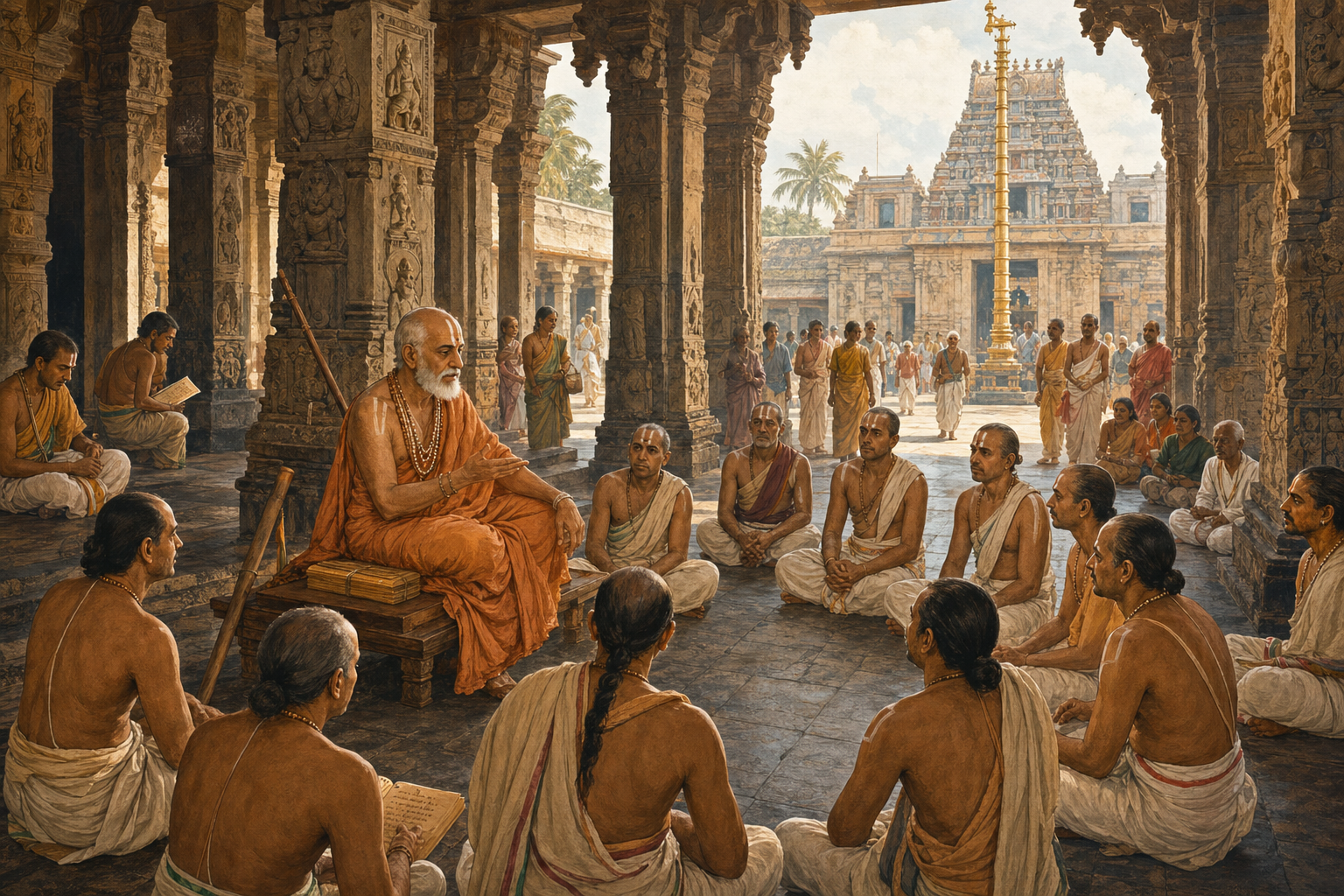
If you have met Manavala Mamuni only as a name in the acharya-parampara, the phrase Sri Vaishnava revival can sound frustratingly vague. What, exactly, did he revive: Vishishtadvaita philosophy, Tamil hymnody, temple worship, or a community recovering from disruption?
The answer is all four, but the important point is how he joined them. Manavala Mamuni made doctrine teachable, devotion congregational, ritual repeatable, and institutions capable of carrying the tradition beyond one generation. That gives you a practical way to understand his achievement: look for the connections he restored, not merely the works or reforms attached to his name.
Revival meant restoring transmission, not inventing a new creed
Traditional biographical registers place Manavala Mamuni’s birth in 1370 at Tirukkuruhur, now widely known as Azhwar Tirunagari, and his attainment of paramapada at Srirangam in 1443. His lifetime belonged to a period when South Indian temple communities were rebuilding after invasions and social disruption. Physical restoration mattered, but reopening a shrine could not by itself restore an intellectual and devotional civilization.
A living tradition facing that kind of rupture has at least four problems to solve:
- Authoritative teachings and their interpretations must remain intelligible.
- Teachers, reciters, priests, and household practitioners must be trained.
- Daily worship and annual festivals must return to a stable rhythm.
- Temples and monastic lineages must preserve responsibility after an individual leader is gone.
Manavala Mamuni worked across all four levels. He did not present himself as the founder of a replacement theology. His honorific Yatindra-pravanar identifies him as one wholly devoted to Yatindra, Ramanuja. Fidelity to Ramanuja was therefore not ceremonial nostalgia. It supplied the doctrinal center around which teaching, worship, and community life could be reorganized.
This distinction matters whenever you encounter the word revival. A revival is shallow if it depends entirely on one charismatic speaker or one large celebration. Ask what will still transmit the tradition when that moment passes. In Manavala Mamuni’s case, the enduring answer includes commentarial teaching, congregational recitation, festival observance, trained lineages, liturgical guidance, and the daily remembrance of the acharya.
It is also worth separating devotional memory from historical judgment without forcing them apart. Sri Vaishnava biographies include miraculous motifs, as sacred biographies commonly do. You need not treat every such scene as a modern chronicle to recognize the sturdier historical pattern. Temple records, inscriptions, prabandhams, guru-parampara narratives, and institutions that continued his work converge on his role as a textual teacher, organizer, and guardian of communal practice.
Ubhaya Vedanta kept Tamil devotion and Sanskrit reasoning together
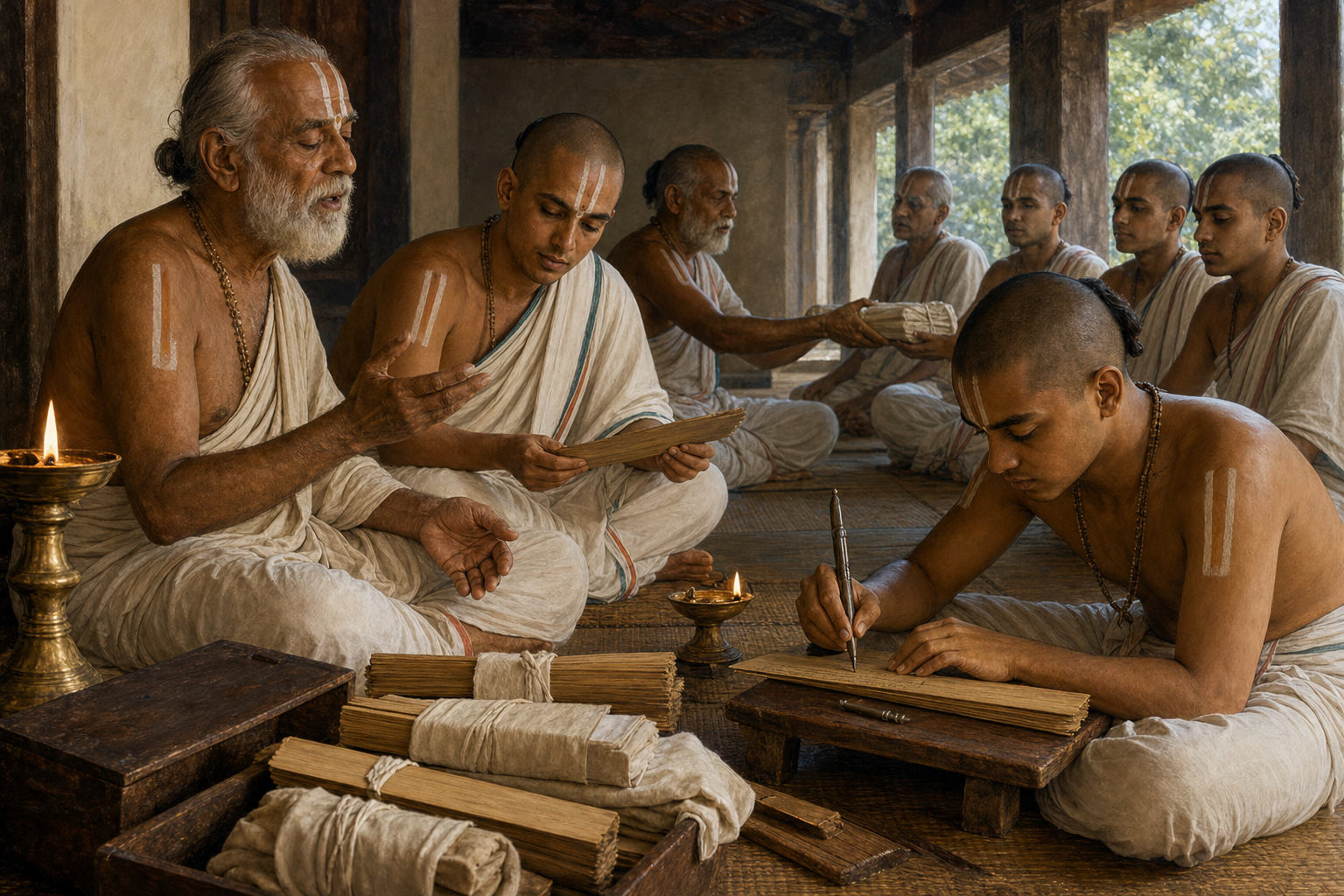
Manavala Mamuni’s formation explains the shape of his revival. At Tirukkuruhur he received pancha-samskara and systematic instruction under Tiruvaymoli Pillai, also remembered as Azhagiya Manavala Perumal Nayanar. The celebrated thaniyan for Manavala Mamuni calls him the recipient of Sri Sailesa’s compassion, using another name for this acharya. His identity was thus anchored in two loyalties: gratitude to his immediate teacher and devotion to Ramanuja’s larger theological inheritance.
That education cultivated Ubhaya Vedanta, the twofold Vedantic inheritance of Sanskrit and Tamil. The phrase does not mean two competing philosophies. It names a unified method in which Sanskrit Vedanta and the Tamil Divya Prabandham illuminate the same reality. Manavala Mamuni treated Nammalvar’s Tiruvaymoli not as an emotional ornament added after the serious philosophy was finished, but as a theological authority whose central intent accords with the Vedic vision.
This corrects two common reading errors. The first reduces the Azhwars to poets of private religious feeling and overlooks the precision of their theology. The second treats Sanskrit categories as the real doctrine while assigning Tamil hymns only a popular or decorative role. Ubhaya Vedanta refuses both reductions. Reasoned exposition and sung devotion are different modes of access to one teaching.
Upadesa Rathina Malai makes this commitment visible through the acharya lineage, the Azhwars, their sacred chronology, and the transmission of commentaries. Its succession of names can look like a list to memorize, but that is only the surface. The work trains you to notice that knowledge reaches a community through relationships: someone preserves a teaching, someone explains it, someone learns to recite it, and someone passes it forward without severing it from its devotional setting.
When you study Upadesa Rathina Malai, keep two columns on a page. In the first, note each person or text named. In the second, record what is being transmitted: a hymn, an interpretation, a ritual responsibility, gratitude to an acharya, or a way of serving. That small exercise prevents the parampara from becoming a decorative genealogy. It reveals transmission itself as part of the sacred content.
Prapatti places human action inside dependence on grace
Manavala Mamuni stands within the Vishishtadvaita understanding of Ishvara, sentient beings, and insentient reality. These are not collapsed into an undifferentiated sameness, nor are souls and the world independent of the Supreme. Their relationship is one of inseparable dependence. For the individual, the practical consequence is sheshatva: belonging to the Divine and finding one’s proper freedom in willing service.
Bhakti-yoga remains a luminous path within this framework, but Manavala Mamuni’s teaching gave particular pastoral force to prapatti, or sharanagati. Prapatti makes surrender to the Lord available without requiring the long ritual qualifications associated with more demanding disciplines. Its accessibility does not make it a casual shortcut. It changes the basis of confidence: liberation depends finally on the Lord’s saving grace, not on a practitioner’s ability to construct a flawless spiritual record.
Five supportive dispositions, or angas, commonly clarify what this surrender looks like:
- Anukulya-sankalpa: resolve to do what is pleasing and favorable to the Divine.
- Pratikulya-varjana: relinquish conduct that opposes the Divine will.
- Maha-vishvasa: place deep trust in the Lord’s power to save.
- Goptritva-varana: seek and accept the Lord as protector.
- Karpanya: recognize one’s inability to secure liberation through self-sufficiency.
Lists and formulations can vary, so the five items should not be mistaken for a mechanical transaction. The decisive center is atma-nikshepa, the offering of oneself. Maha-vishvasa is more than optimism, and karpanya is not self-contempt. Together they dismantle the claim that the ego can become its own savior.
Does this dependence make conduct unimportant? The first two dispositions answer plainly: no. Surrender redirects action rather than abolishing it. The practitioner turns away from what is contrary, chooses what serves the Divine, keeps company with devotees, and expresses belonging through bhagavata-seva. Grace is not permission for passivity; it is the ground on which disciplined service becomes possible without spiritual pride.
Manavala Mamuni is especially honored in the Tenkalai articulation of Sri Vaishnavism, where dependence on grace is often illustrated through marjara-nyaya, the image of a kitten carried by its mother. Use the analogy for the point it actually makes: the soul’s security rests on the Lord rather than on independent spiritual strength. Do not turn it into a caricature in which Tenkalai teaching rejects devotion, discipline, or service. Distinct Sri Vaishnava pedagogical accents remain situated within a shared commitment to Vishishtadvaita.
Srirangam turned teaching into a repeatable public culture
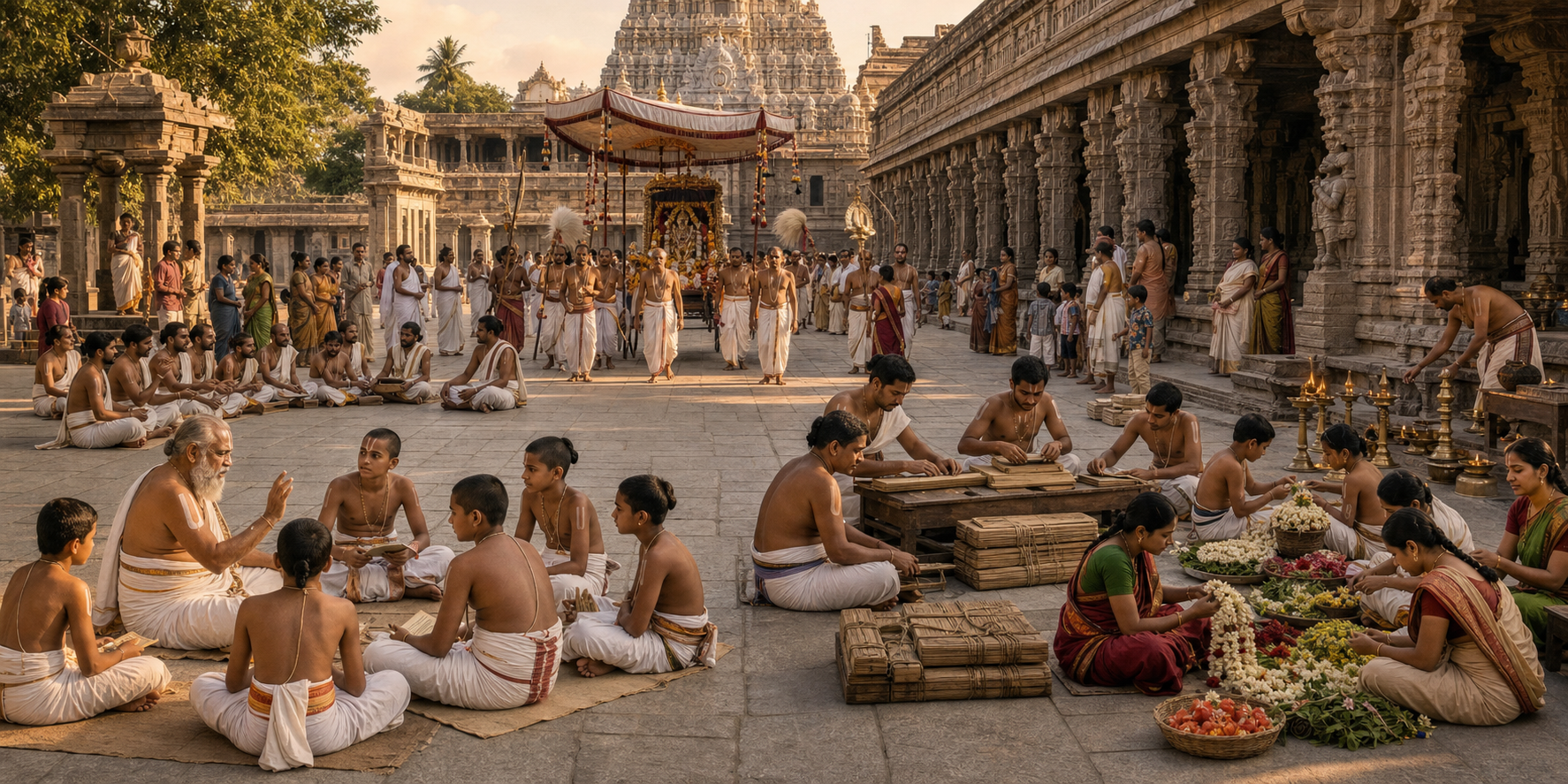
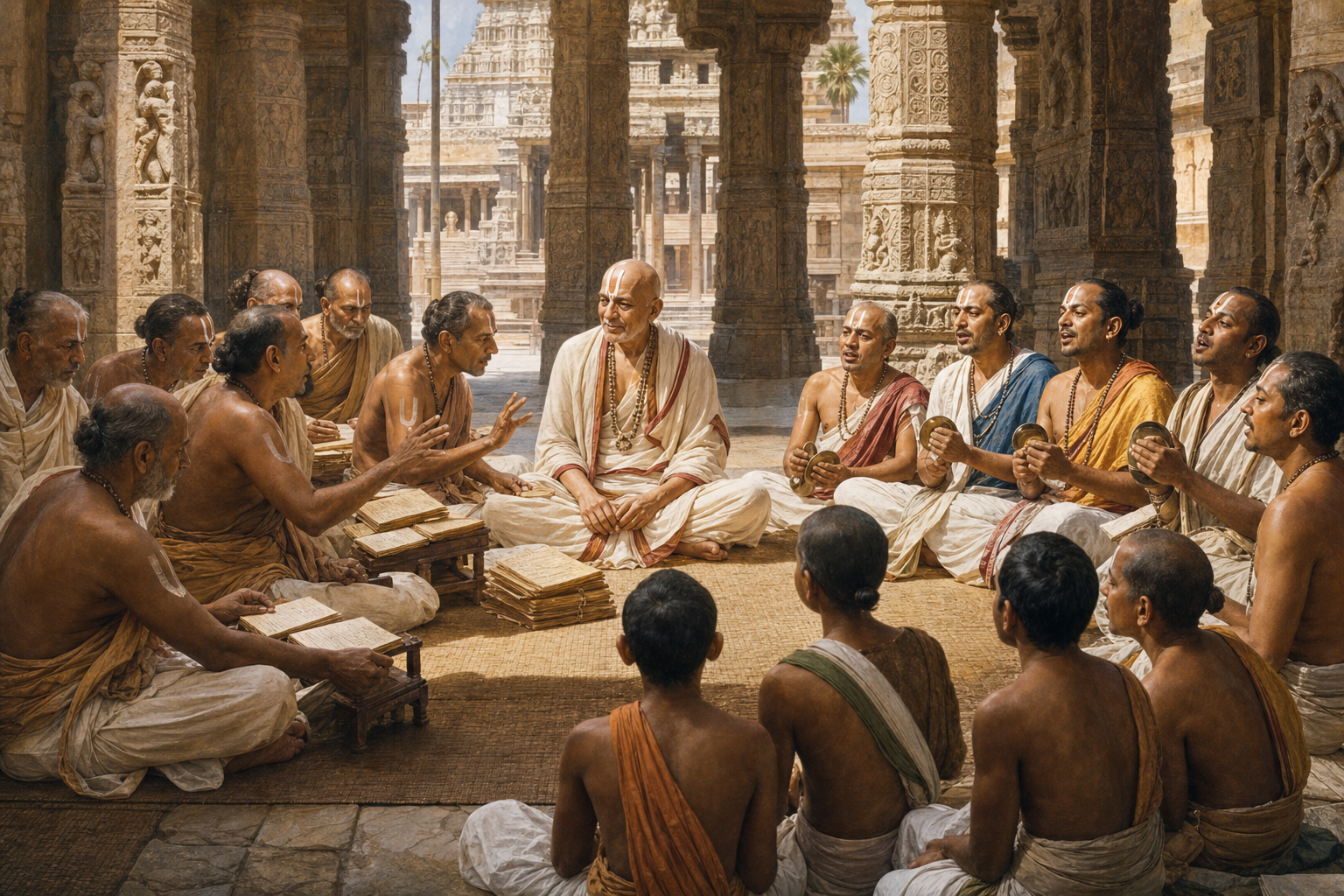
Manavala Mamuni’s public exposition of Nampillai’s Eedu 36000 padi commentary on the Tiruvaymoli became a defining event at Srirangam. Temple tradition remembers Lord Ranganatha as granting the thaniyan that praises Manavala Mamuni’s devotion to Sri Sailesa, his treasury of virtues, and his unwavering orientation toward Ramanuja. Its continued daily recitation keeps those relationships audible: disciple to teacher, interpreter to Ramanuja, and community to its lineage.
The setting matters as much as the lecture. A major commentary was not left inside a small scholarly circle. It entered the public life of a temple where exposition, darshan, recitation, and communal memory reinforced one another. Theology could therefore be heard repeatedly, attached to a sacred calendar, and carried by a congregation rather than surviving only on manuscript leaves.
Different works answered different needs
- Upadesa Rathina Malai preserved the map of teachers, Azhwars, commentaries, and transmission.
- Arthi Prabandham gave language to longing, separation, and the seeker’s desire for the Divine, preventing theology from becoming emotionally sterile.
- Tiruvaradana Kramam gave practical order to worship, connecting conviction with sustainable domestic and temple observance.
- Exposition of the rahasya-granthas clarified surrender, acharya-bhakti, and grace. The received tradition particularly associates Manavala Mamuni with lucid commentary on Pillai Lokacharya’s Srivachana Bhushanam and Mumukshuppadi, while the precise history of authorship and transmitted discourse should be handled with appropriate care.
At the institutional level, he revitalized the Adhyayana Utsavam and the organized goshti recitation of the Divya Prabandham. Training for priests and reciters, clearer festival routines, and accountable temple stewardship placed textual fidelity inside an operational structure. Traditional accounts also remember journeys to Kanchipuram, Tirupati, and other sacred centers. The Vanamamalai or Totadri Mutt locates its foundations within his spiritual orbit, showing how discipleship could grow into lasting institutional continuity.
You can see the design through four elements: text, voice, calendar, and office. A text retains the teaching. A trained voice makes it audible and memorable. A calendar returns the community to it at dependable intervals. An office, whether a temple responsibility or a jeeyar lineage, assigns stewardship. Remove any one of these for long enough and transmission becomes fragile. That four-part test remains useful when you assess any modern effort to preserve dharma.
A practical way to study Manavala Mamuni without flattening him
You do not need to master every rahasya text before his achievement becomes visible. You do need to approach the material in an order that preserves the connections he worked to strengthen.
- Locate him in the parampara. Begin with the broad movement from Nathamuni and Yamunacharya through Ramanuja, followed by the great interpretive inheritance associated with figures such as Nampillai and Pillai Lokacharya. Then place Tiruvaymoli Pillai immediately behind Manavala Mamuni. This keeps his originality from being confused with doctrinal rupture.
- Read Upadesa Rathina Malai as a map. Mark every acharya, Azhwar, text, and act of transmission. Ask why gratitude and lineage appear inside a work of instruction rather than outside it as ceremonial preliminaries.
- Hear the Tiruvaymoli through commentary. A guided recitation or explanation will show more than an isolated poetic translation can. Notice how devotional speech carries claims about the soul, the Lord, dependence, and liberation.
- Learn the vocabulary of surrender precisely. Write brief definitions for prapatti, atma-nikshepa, maha-vishvasa, karpanya, sheshatva, and bhagavata-seva. If an explanation reduces all of them to generic faith, return to their distinct functions.
- Join study to practice. Let Arthi Prabandham introduce the inward register of longing, and observe how goshti recitation, darshan, festival worship, and service make theology communal. Approach Tiruvaradana Kramam with guidance from a living Sri Vaishnava teacher or established temple tradition rather than building a ritual practice from detached instructions alone.
Key takeaways
- Manavala Mamuni’s revival was a restoration of transmission: doctrine, liturgy, trained people, and institutions were made to support one another.
- Ubhaya Vedanta does not subordinate Tamil devotion to Sanskrit philosophy. It reads the Divya Prabandham and the Vedic inheritance as mutually illuminating authorities.
- Prapatti rests on Divine grace, but its supporting dispositions require moral direction, trust, humility, and service rather than passivity.
- His Tenkalai reception is important, but the label should clarify an emphasis on grace, not be used to erase the wider Sri Vaishnava commitment to Ramanuja and Vishishtadvaita.
- A responsible historical account can acknowledge sacred memory while grounding his lasting importance in works, teaching lineages, temple practices, and institutions that endured.
Your next step can be modest and concrete. Begin with Upadesa Rathina Malai, make a one-page map of the people and teachings it preserves, and then study one Tiruvaymoli passage in its commentarial setting. You will start seeing Manavala Mamuni not as an isolated saint between two dates, but as an acharya who taught a civilization how to remember, worship, and transmit together.